Laura Erickson's For the Birds

Monday, March 10, 2014

Eileen Bentzen's Pileated Woodpecker!


Last week, I opened my email to discover one of the most fascinating photos I’ve ever seen, from a friend in Port Wing, Wisconsin. Eileen Bentzen writes,

On the morning of March 2, 2014, in this longest and harshest of cold winters on record, I glanced out my window and saw a black “lump” on the side of one of the trees in my yard, which piqued my curiosity. Even with binoculars it was too far away to see anything but the fact it was black, shaped like a bird with a flare of red at the top. There was a vicious wind, and I could see what looked like feathers fluttering.

I had to see what it was – maybe a bird in distress, freezing, injured – so I slipped on my boots and coat, grabbed my camera and went for it. The snow was up to my waist, and immediately my boots were full of snow and my legs aching, but I got to the tree and took one photo, afraid it would scare the bird, but he didn’t move. He was gripping the tree with his feet, and soft downy, feathers, gray with tips of white, moved in the wind, his gloriously red crowned head tucked. He was directly in the sun, about a foot above the snow line, and as out of the wind as he could be. I put the camera in my pocket and reached out my mittened hands to touch the bird on both sides. As my hands touched him, his wings FLEW apart, his head jerked up and he instantly flew away. It was a huge male pileated woodpecker. When I startled him, which I am very sorry for, his wing span was awesome – and his movements so quick it was difficult to register. At least he wasn’t hurt, and he was able to get himself back into the woods safely.

I’ve never seen anything like Eileen’s photo. The bird was perched on the trunk, wings down in the normal position, obscuring all but the tips of the tail, and the soft down feathers of the back and sides were entirely erect, protruding through what we call the contour feathers of the back, providing maximum insulation. The sun was shining directly on the bird, and out of the wind where he was, he may have been warmer in the sun than he would have been within a cavity of a frozen tree. It’s very easy for woodpeckers to rest in a vertical posture—their claws cling effortlessly to the trunk, their body also braced by their tail feathers. When I was a licensed wildlife rehabber, I once took care of a fledgling Pileated Woodpecker for a few weeks, and he slept on a nice thick chunk of wood in this same posture, except it was summer, so my young bird didn’t erect his down in the same fluffy way.


Seeing a sleeping Pileated Woodpecker in captivity is no big deal, if you happen to have one handy. But discovering one in the wild is something else! I was thrilled that Eileen sent me the story and her amazing photo.

Thursday, February 27, 2014

Baiting Owls

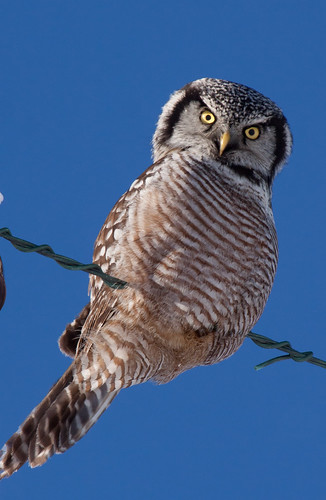
Northern Hawk Owl

When Russ and I were living in Madison, Wisconsin in the late 70s, there was an invasion of northern owls into the Duluth area, and a lot of my friends drove up one weekend to see their lifer Boreal, Great Gray, and Northern Hawk Owls. I was sick with the flu and missed the trip, but from then on always associated northeastern Minnesota with incredible owls. After Russ earned his Ph.D. and had a few job offers, I lobbied for the one up here because of all those owls. 

I’m not the only one who equates Duluth winters with wondrous owls—year after year, people from every state and several foreign countries come up, hiring guides or combing the Sax-Zim Bog on their own, all in search of owls. In 1998, three men competed in a record-setting Big Year memorialized in the movie The Big Year—all three of them came to Duluth to get their owls. As digital photography and social media have grown in popularity, the fame of our owls has mushroomed.

When people travel hundreds or even thousands of miles to see and/or photograph an owl, and then spend a frigid winter day in a remote bog, they want a payoff. But more and more, this wanting has evolved into a sense of entitlement. Now many people arrive here armed with bait, so when they do spot an owl, they can easily lure it in for close-ups and thrilling flight shots. Some professional birding guides (not the local ones that I know of) use bait so their participants will get incredible instead of ordinary views, and a great many photographers do this. 

They use two kinds of bait—live rodents and dead or fake ones at the end of a fishing line. When they spot an owl, they toss a hapless mouse or gerbil out onto the snow, or cast out a fake one and reel it in. Our winter owls are astonishingly alert—they almost always fly in instantly when they spy a rodent, instant gratification for the photographer that reinforces the practice. 

Some birders and photographers don’t see a problem at all. Some have enough misgivings about the ethics that they are secretive about doing it. And some twist arguments to act as if baiting is perfectly fine, or if not, is no worse than setting out bird feeders for songbirds.
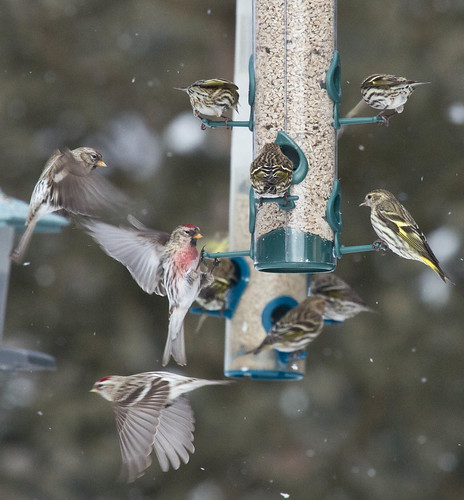
Common Redpolls and Pine Siskins

Baiting owls is not at all comparable to traditional bird feeding. Americans have been offering breadcrumbs and seed to birds since before the time of Thoreau and Emily Dickinson. Little by little, we’ve learned that some practices are harmful—for example, we know that wet seed in spring can provide a medium for botulism and other pathogens, that wet corn and peanuts can become contaminated with aflatoxins, and that bread doesn’t provide enough nutrition for most birds and can encourage House Sparrows, starlings, and rodents. The Cornell Lab of Ornithology, which encourages backyard bird feeding, has conducted decades of research into best practices, and disseminates a huge body of accessible information far and wide to ensure that backyard bird feeding is as healthy for the birds as it is enjoyable for people. 

No one has thoroughly researched any best practices with regard to owl baiting. All we have are anecdotes. Most photographers and birders who lure owls claim never to have seen any bad effects, but many impartial observers have witnessed owls hurt or killed directly or indirectly due to baiting, and so the preponderance of data is clearly against the practice. The Raptor Center in St. Paul, the OwlFoundation, the Raptor Education Group, and Project SNOWstorm, world-class organizations with a thorough understanding of owls, are all on record opposing baiting, except by licensed bird banders or to trap individual owls to remove them from a dangerous situation or bring them to a rehab facility. 

Baiting owls with fake mice is a horrible practice, immediately harmful to the owls. Owls cast pellets consisting of felted fur and all the bones and other indigestible matter in their prey. These pellets are formed in their lower stomach—the muscular gizzard—and must pass through the glandular stomach and esophagus to be spit out. These organs are emptied of fluids before the owl regurgitates the pellet. Before swallowing the next meal, the owl "primes the pump" by siphoning off body fluids back into these organs, which is accomplished as the owl spies and closes in on prey. Doing this and then coming up empty, as always happens when the owl chases a decoy, is very harmful, especially for owls that are hungry and growing dehydrated. When this is repeated over and over, as many photographers do for more photos, it's extremely frustrating for the poor owl as well as potentially destructive.

There are also many reasons why luring owls with live rodents is bad for the owls. First, owls that are baited quickly learn to associate people with food, sometimes leading to extremely dangerous situations for both people and birds. And most baiting is done from roadsides, luring owls in to immediate danger. Last year, one photographer actually tried luring a Boreal Owl across busy Highway 61 so he’d have better light for photography, despite the fact that Boreal Owls seldom fly above the height of logging trucks. Considering that a primary cause of mortality for owls in winter is collisions with cars and trucks, this was unconscionable.

In 1997, when a Boreal Owl turned up at the Springbrook Nature Center in Minnesota, the staff, concerned about the bird and thrilled about so many birders coming to see it, started providing daily handouts. The vast majority of the bird's pellets that winter consisted of white mice raised at the facility--it was feeding on very little natural food all season, but fortunately, the mice were raised at the nature center. When spring arrived, the owl didn't migrate north according to a post by Michael Hendrickson on MOU-net in 2009.  I'd defended the feeding in 1997 because it was an exceptional situation--it was Mike Hendrickson's information and apparent inside knowledge about the fate of the bird that led me to think even that exceptional circumstance might not have warranted artificial feeding. Regardless, though, that was indeed an exceptional situation.

Northern owls seem far less fearful of people than most birds, often not fleeing until people have come within a few feet. There is no evidence that most of these species are the least bit tame, or associating people with food--they are simply trusting to their cryptic coloration and saving energy. Many spend their lives in remote areas where large mammals aren't particularly interested in them, so are less fearful than most birds. Northern Hawk Owls often actually approach people, whether or not the birds have been baited. They seem to share with Gray Jays the inclination to follow large predators in case they can capitalize on a feeding opportunity—there are records of them grabbing snipe shot by hunters before the hunters could retrieve them. I've taken many closeup photos of hawk owls, including the one at the top of this post, without ever baiting. I've also photographed them catching voles and other prey, no baiting involved.

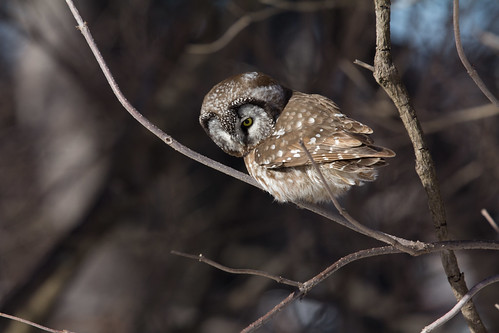
When Boreal Owls descend on the North Shore of Lake Superior in winter, they are sometimes so hungry that they abandon their normal nocturnal habits and hunt by day. Photographing them is quite possible without baiting.
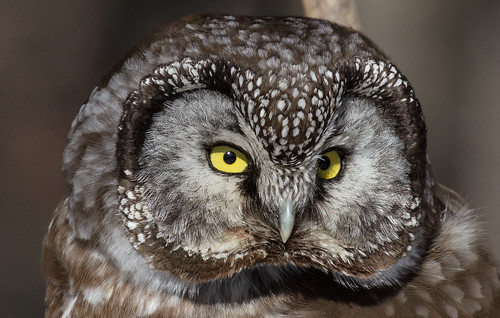
Boreal Owl

Boreal Owl

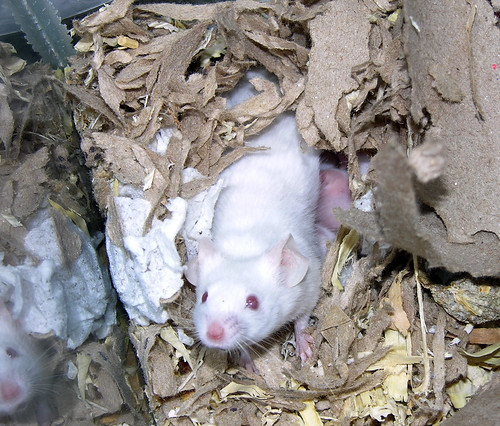
Pet store rodents are notorious for carrying salmonella. The Minnesota Department of Health and the Centers for Disease Control have published accounts of children contracting salmonella, including multidrug-resistant strains, from pet store mice, rats, and hamsters. The affected children had merely played with and sometimes kissed their little pets—as predators that consume the entire bodies of their prey, owls are even more vulnerable to swallowing pathogens. Of course, as natural predators feeding on raw meat, owls are more resistant to salmonella than we humans, but two species that are baited extremely aggressively by photographers, Great Gray and Boreal Owls, are typically most conspicuous when they are physiologically stressed, with their immune system already compromised—this is when they would be most vulnerable to disease organisms.
Mother and babies

My focus has always been on birds, but I’m also partial to rodents. It’s ironic that I’d consider the feelings of the little mice tossed onto the snow, considering that I myself thaw out a mouse every night for my education screech-owl Archimedes. But the frozen mice I purchase were raised and then killed humanely and in clean circumstances so are guaranteed not to harbor diseases, and I still feel sad about them. The ones tossed out on the snow are kept warm and cozy right up to the moment someone grabs them out of a cage and throws them onto the frozen landscape. Then, in the best-case scenario, they get grabbed and devoured before they have time to think. In the worst-case scenario, they escape, but are lost, bewildered, and cold. If they manage to survive, that introduces another exotic species and its attendant parasites and germs into the natural landscape.

Some photographers justify baiting owls by claiming that their photos are valuable for conservation and environmental education, when in reality many of these photos actually promote misinformation. One photo showing a Great Gray Owl closing in on a mouse won awards and was conspicuously displayed on the National Geographic and Nature Conservancy websites, even though it was a house mouse on the surface of the snow—something that would simply never happen in a wild situation. Over 90 percent of a Great Gray Owl’s normal diet consists of meadow voles, which never walk on the surface of deep snow—they construct tunnels at ground level under grass, so even when there is no snow cover at all, voles stay out of sight. Unfortunately, by posting the photo, these organizations were misinforming people about the way Great Gray Owls normally hunt, and also providing misinformation about rodents. Suggesting in a photo that a hamster or white mouse or brown house mouse is part of a wild owl’s normal diet hardly promotes education. Unfortunately, magazine editors don’t always recognize these unnatural situations themselves. Photographers claiming to be photographing the natural world should not be using such unnatural set ups.

In some cases, baiting owls interferes with research that is providing important information about owls. Scientists from the Northeast and Great Lakes areas participating in the brand new Project SNOWstorm are affixing GPS-GSM transmitters to Snowy Owls and then tracking them via the Internet. Each transmitter costs $3,000. In this, the inauguration year of Project SNOW Storm, we’ve already amassed a huge body of information about Snowy Owl movements, activities, and what habitats they’re drawn to. But one bird bearing one of these expensive transmitters in Ramsey County, Minnesota, is being persistently baited by photographers, who have been giving it so much food that it’s simply staying put. Scott Weidensaul of Project SnowStorm wrote a comment on the project blog:

We're aware of the situation in Ramsey, and very concerned about it. Jim [Williams] of the Minneapolis Star-Tribune has been writing about it, among others. The photographers feeding pet store mice to the owls are creating a situation in which the birds are becoming increasingly habituated to humans, which in a congested, suburban environment is especially risky. There's also the fact that Project SNOWstorm has invested thousands of dollars and a lot of collaborator effort in tagging Ramsey in order to learn how a wild snowy owl lives -- not to track a bird that's being fed by photographers too lazy to wait for natural behavior. It was our understanding that most of the feeding is targeted at the other, untagged snowy owl and not Ramsey, but that appears to be changing -- and it's not justified in either case. While it's not illegal, it is wrong, and we urge the photographers who are tossing mice to these owls to please stop.
The project website started out displaying real-time movements of the birds, but because photographers were using the information to rush in and bait them, Project SNOWstorm had to start putting a 3-day delay on the tracking maps. Photographers, birders, and bird guides baiting these or any owls are compromising important conservation or education work, not providing anything of value except to their own egos and pocketbooks.

As a former licensed rehabber who handled lots of owls, as someone who has lived with my licensed education screech-owl for 14 years, and as someone who studied bird digestion (specifically nighthawks and owls) during my ill-fated Ph.D. project, this area is something I do have some small bit of expertise in. By next winter, the Minnesota DNR will have new regulations in place prohibiting owl baiting. And in my considered opinion, that’s the way it should be.

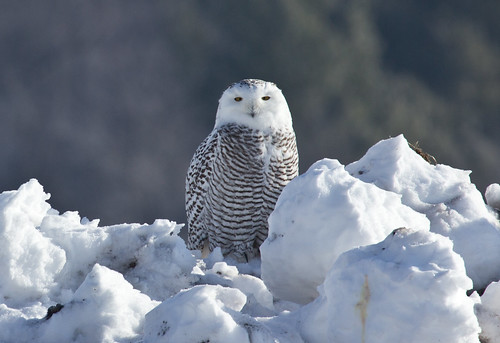
Snowy Owl

Banding Owls

Laura and Long-eared Owl at Hawk Ridge: Photo by Lisa Johnson

When I was a fairly new birder, right after Russ and I moved to Duluth, I went on a winter field trip to look at Snowy Owls and watched a couple get trapped and banded. The bander, David Evans, used a fake mouse tied to the end of a fishing line, which he cast out on the snow. In both cases, the movement as he reeled it in instantly caught the owl's attention—within seconds, it took off straight for the bait, only to get trapped in a net. David quickly and gently put the band on the bird’s leg, applied a colored dye to its forehead so he’d recognize the owl and not have to put it through this procedure again all winter, recorded the necessary data, and released it. I don’t think either bird was held longer than 3 minutes total.

I've also watched owl banding at research stations in Duluth, Whitefish Point in Michigan, Braddock Bay in New York, and other places, where the main species being trapped from day to day were Northern Saw-whet and Long-eared Owls. When Frank Nicoletti has public programs about owl banding at Hawk Ridge Bird Observatory, he is extremely cautious about allowing flash photography, prohibiting observers from using flash on most of the birds he displays momentarily before release, and is very careful to give the owls plenty of time to adjust before releasing them in the cases where he does allow people to take photos using flash. I've watched my education Eastern Screech-Owl when people photograph him using flash. He never twitches or shows any discomfort even in low light conditions, and his pupils return to the proper size for the ambient light within less than a second after a flash. As a reasonable precaution, Frank and other banders give the owls time to adjust, and based on my observations of wild and captive birds, that is sufficient. The owl in the photo below was held with a spotlight at Whitefish Point back in 1976. (When I also saw my lifer!) No one was allowed to use flash, but it wasn't necessary with the light, which he extinguished a full minute before releasing the bird.

Long-eared Owl

The body of research Duluth's first owl bander, David Evans, produced in the four decades he’s been banding up here has been seminal to our overall understanding of Snowy Owls. His was some of the very first research to establish that some individual Snowy Owls not only migrate south every year, but return to the same winter territory year after year as well. He found that many of the Snowy Owls that migrate south aren’t emaciated but rather in excellent condition—something that obviously makes sense because how could they fly a thousand miles or more from the tundra if they were emaciated from the start? Even though that is common sense, it ran against the ornithological consensus of the time. Snowy Owls that were picked up dead or dying were often emaciated,but necropsies usually showed that these birds had been poisoned or suffered some kind of physical trauma, often from collisions with structures, wires, or automobiles, rendering them incapable of hunting, but these problems didn't arise until they'd started moving south. Banding data reveals that the majority of Snowy Owls reaching the Lower 48 states embarked on their migration as healthy, robust birds.

This year, an exciting new program called Project SNOW Storm, is taking banding to the next level. Participants in the program are capturing Snowy Owls in the Northeastern and Great Lakes states and not only banding them but affixing a GPS-GSM transmitter to each bird, which allows them to track each bird. Duluth's own Frank Nicoletti is one of the researchers participating in the program. We're already getting valuable data that helps scientists understand Snowy Owl movements—information that will contribute to conservation of the species as well. The researchers are committed to attaching these transmitters only to individuals in robust health.

Anyone who has watched banders handling birds can see that the process is stressful to virtually all the individual birds. But if you’ve observed more than a few bandings, you also can’t help but notice that many of these individual birds benefit from the banding process. One of my owl-banding friends who occasionally trapped deer mice in his house froze them while they were fresh, and stashed a few, thawed, in his pocket when he was banding cavity-roosting owls. He didn’t lure these birds into nets—just reached into their roost holes in the daytime to capture them—but when he noticed that one was underweight, he’d give it one of those mice. 

Some owls are caught with pre-existing injuries. I’ve known banders to remove excessive parasites, treat injuries, take emaciated or injured birds to rehabbers, and in other ways help individual birds they’re dealing with. And the lives of hundreds of Snowy Owls have been saved thanks to banders, who can capture birds at airports and relocate them so both people and those owls won’t be killed in airplane collisions.

Rarely, the banding process itself causes injuries or can even kill individual birds, but in all the years I’ve been watching banders, I’ve never seen a single case of this, so know how very exceptional it is. No one can get a master license to band birds until they've apprenticed under a master bander long enough to have thoroughly learned the best practices, and banding is strictly regulated by both the US Fish and Wildlife Service and state departments of natural resources. Although the banding process helps few individual birds overall, from what I’ve personally seen, the harm it causes individual birds is far, far rarer, and banders that I've observed go to exceptional lengths to minimize the stress to each bird. And the incredible body of knowledge about most species—knowledge that has directly improved their conservation—is due more to banding than to any other research method. 

So I give a lot of latitude to bird banders for how they trap and handle birds. I hold birders, bird guides, and photographers to far stricter rules because their pursuit of birds is entirely for personal pleasure and financial gain, with no benefits for those individual birds. 

Monday, February 24, 2014

Birding by Amtrak

I have always loved the idea of train travel. My Grandpa worked for the Milwaukee Road. One time I got to go along when my dad dropped him off at Union Station in Chicago, and my grandpa showed me a sleeper car and the dining car—it all seemed so sophisticated and adventuresome.

Grandpa and me

For a 6-year-old girl, the train provided a lot of food for thought, too. Beautifully lettered “No Spitting” signs hung in every car. I couldn’t imagine anyone—much less the sophisticated adults I pictured traveling by trains—not realizing you should never spit on a train. It was only recently, over half a century later, that I found out that the signs had been set out in crowded establishments such as trains as a public health response to the raging plague of tuberculosis. The mystique of those “No Spitting” signs stayed with me—when Russ and I brought our kids to a railroad gift shop a couple decades ago, I bought myself a metal "No Spitting" sign as well as a "Milwaukee Road" sign.

"No Spitting" sign

Except for the Chicago el, I never rode a train myself until my first two years of college. Russ and I attended different schools then, and he and I often took the Grand Trunk Railroad between Chicago and East Lansing, Michigan, and the Illinois Central between Chicago and Champaign to spend weekends at home or visit each other. Between urban centers, trains pass through a lot of beautiful and fairly wild areas, and even before I became a birder, I loved looking out the window and noticing birds, even if I didn’t know what they were. But once we got married and bought our first car, Russ and I stopped traveling by train. 

So in all the 39 years I’ve been a birder, I never once rode a train until just last week. I badly wanted to hear Joel Greenberg, author of A Feathered River across the Sky: The Passenger Pigeon’s Flight to Extinction, who was speaking in North Chicago on February 20. I dreaded the thought of driving all the way—I think I’ve encountered one too many blizzards in Wisconsin in the past several years—and it suddenly occurred to me that I could take the train. I looked up the Amtrak schedule, and it was actually affordable, even more so because I’m 62—exactly the right age to qualify for the senior discount. I did have to drive to the station in St. Paul, where I left my car in the free parking lot. After that, I left the driving to Amtrak.

My train was scheduled to leave the Twin Cities around 7 am, so I had to leave Duluth at 3:30 in the morning—not all that much of a problem for a birder accustomed to early rising. But the Empire Builder line—the one that runs from Seattle to Chicago, has been suffering an extremely high number of delays in recent years, exacerbated by all the oil tanker trains originating in North Dakota, so my train was 5 hours late arriving in St. Paul. If I’d  anticipated this, I’d have slept in and left Duluth later, but as it was, I got to spend the time working on a writing project and visiting with one of my friends who lives near the station. The station itself was very pleasant—quiet, well lighted, and staffed by friendly, helpful people. There was no Wi-Fi, but my son Joey talked me through setting up my cell phone as a hotspot, something I used on the train, too.

Once I boarded, I was in heaven. The eastbound Empire Builder passes through some of the loveliest places along the Mississippi, and I spent a lot of time gazing out the window at lots and lots of Bald Eagles along with Red-tailed and Rough-legged Hawks, an exciting variety of ducks, and a smattering of Snow Buntings, Lapland Longspurs, and Horned Larks. Sadly, the delay meant I had five fewer hours of daylight for birding from the train, but that gave me more time to work on some writing projects after the sun went down.
My return train left in mid-afternoon, when the February sun was starting to get low in the sky, but in the stretch between Chicago and Milwaukee, I got a lovely look at a Snowy Owl along with plenty of waterfowl. I didn’t see a single "No Spitting" sign on either trip, but I guess we can’t have everything. It also didn't occur to me to take pictures.

We’d had a lot of snow while I was gone, but the parking lot at the St. Paul station had been plowed extremely well, including removing almost all the snow from behind the cars, so I only had to clear the snow off my car and shovel the relatively loose stuff right behind my wheels to get out of the space. I’m impressed that I could park in such a well-maintained lot for three days for free.


Russ and I have always longed to take a long trip in a sleeper car, and now I’m even hungrier for that. Different Amtrak lines take different routes, and I’d love to try them all. My Amtrak birding list right now includes about 20 species, and suddenly I’m yearning to see just how high I can bring it. Riding the train may be a little more unpredictable than driving thanks to the high number of delays because freight trains have priority on the limited tracks, but it uses less energy than flying or driving. I wish we had better rail infrastructure to avoid the delays, but that was a minor inconvenience in exchange for such pleasant, no-hassle, productive trips that provided such exciting birding to boot.

Snowy Owl

Wednesday, February 12, 2014

This Frigid Winter

Black-capped Chickadee

I keep hearing report after report about this winter being the worst in 30 years. The winter 30 years ago really was a doozy. I remember it vividly because my daughter was born in December 1983, while Russ and I were still adapting to life in the frozen north, and we had a lot of difficulties bringing our tiny new baby, along with a bundled up toddler, to pediatrician appointments when there was so much snow and so many days well below zero. But I also remember Duluthians telling me that winter about much worse ones, and really, the two previous winters, when I was first living in Duluth, hadn’t been much milder. It seemed like double digits below zero happened at least several times every winter up here.

Statistically, that winter 30 years ago was colder than average, but not that far off the norm. People keep saying the ice cover on the Great Lakes is the most in this century, but the century is only 14 years old, after all. For our relatively large brain size, we humans have surprisingly short memories. We used to be able to count on frigid weather and enough snow to run the John Beargrease Sled Dog Race—in the past decade, the race has been marred by postponements and even cancellations.  The safe date for planting tomatoes has crept earlier in May. Temperatures on average are definitely creeping upward. This winter may be extremely cold, and a serious outlier compared to recent winters, but it’s really not so far from the norm of winters in previous decades, at least not in Duluth.

We humans aren’t the only ones with memories too short to easily reconcile this year with winters past. Some non-migratory species and short-distance migrants have been wintering here in increasing numbers in recent decades, including cardinals and Mourning Doves. If the propensity to linger has a genetic component, several mild winters in a row can increase the number of birds remaining in the north whose bodies aren’t as cold hardy as would have survived previous winters, and this year’s could be having a devastating effect on some of those individuals. 

Mourning Dove detail

I haven’t been getting many reports of dead and dying birds, but lots of questions about where are the doves and where are the finches. The doves have mostly moved south, but some are remaining near feeding stations in the Northland. Both Mourning Doves and Rock Pigeons are susceptible to frostbite, unlike songbirds and many other groups. Birds in the dove family have a crop—a pouch within the esophagus in which they can store a lot of food, so when they pig out at a feeder, after they fill their stomach they can keep downing quite a bit of seed. When the crop is full, they fly off to roost on a sunny, protected perch while they digest, their belly resting on their feet to keep their toes warm. Those doves that have remained in the frigid north can be fine as long as they can count on enough food that they don’t have to waste valuable time seeking out new sources.

The absence of finches was predicted way back in the fall. Redpolls, siskins, and crossbills apparently are pigging out on an abundance of food further north, and haven’t had to move south for sustenance. These are irruptive species, not moving far each year. We can look forward to seeing many more of them next winter.


The extreme cold, after so many unseasonably warm years, will take a toll. Providing nutritious food for the smaller numbers of birds at Northland feeders this year will at least help some of them for the duration.

Mourning Dove

Thursday, February 6, 2014

Old Cootdom

American Coot

When I was recently in the visitor center at Merritt Island National Wildlife Refuge, I noticed a sign encouraging people over 62 to purchase a Senior Pass, which gives the owner free admission to national parks and other federally owned wild lands for life for only $10. I had just turned 62 in November, and this seemed a great value, so I impulsively bought one. And the moment the purchase had been made and it was too late, it hit me—this pass was proof that I’d become, officially, a senior. Not that I hadn’t been one before I bought it, but somehow now my advancing age seemed more concrete. I had to face it—I’m a senior citizen.

In America’s youth culture, there are a lot of negative terms for older people but few for young ones except whippersnapper. Merriam-Webster defines codger as “an often mildly eccentric and usually elderly fellow,” and geezer as “A queer, odd, or eccentric person—used especially of older men.” Both of those words give the impression of someone who might be amusing and eccentric in a cranky sort of way. I wouldn’t mind being called either, I suppose. On the other hand, I am mortally offended when anyone calls me a crone, which Merriam-Webster defines as “a cruel or ugly old woman” and “a withered old woman.” Crone is etymologically related to carrion and carcass, coming from Anglo-French for dead flesh, and the usage, focused on appearance rather than character, seems sexist to boot. No thank you.

Turkey and Black Vultures enjoying lunch

Bald Eagle
Nope--I'm not ready to be reduced to carrion.
If I have to accept being called anything in reference to my advancing years, I’d like to go with old coot. Coots are cool birds—excellent at swimming, diving, walking (or waddling), and flying, at least once they get up into the air. They’re mostly sociable and friendly with one another, fairly approachable for birders, and are one of the rare birds that live their lives primarily as vegans.  

American Coots

The oldest known coot wearing a US Fish and Wildlife Service leg band was at least 22 years 4 months when taken by a hunter, which isn’t a bad lifespan for a wild game bird, though if we wanted a symbol of longevity, the Laysan Albatross would be a better choice. The female albatross nicknamed “Wisdom,” who made the news a couple of years ago for being at least 61 years old and still raising a chick, is raising yet another one this year. She was banded as a nesting adult in 1955, when she was at least 5 years old, and remains the only known bird who is older than me—at the very least, she’s 63 now. She’d make a perfect symbol for senior citizens—almost old enough for social security but still leading a productive and fulfilling life.

Wisdom and her newest chick on Midway Atoll NWR. Photo credit: Ann Bell/USFWS

But thanks to Samuel Taylor Coleridge, albatrosses already symbolize innocent victims or burdens of shame, so I’m not expecting people to call me an old albatross anytime soon.

Black-capped Chickadee

No one ever calls anyone an “old chickadee”—chickadees have lived in the wild for over 12 years, but somehow even the oldest chickadees just don’t conjure up the image of senior citizens. Some people have reminded me that old coot is typically used to refer to men, not women, but there is no data to support the idea that real coots have anything other than a 1:1 ratio of males to females at any age, so there’s no reason to restrict old cootdom to men only.


Whatever we call it, I'll negotiate old cootdom the way I've gone through my life all along, taking each day as it comes and not worrying about things before they happen. You know, the way real coots do it.

American Coot

Tuesday, February 4, 2014

The Last Duck My Uncle Dick Ever Shot

untitled-57.jpg

My Uncle Dick, who was also my godfather, was an outdoorsman who enjoyed hunting and fishing. We shared our love of both nature and the Chicago Cubs, so we gravitated together during family events. And every time we were together, after he’d had a couple of beers, he told me the story of The Last Duck He Ever Shot. He always told the story the exact same way. He was hunting with his buddy, took a shot, and his buddy’s dog brought him back a hen Mallard. The bird didn’t struggle in the dog’s mouth, but when my uncle took her, he realized she was still alive.  He held her still-warm body in his hands, and as he said every time he told me the story, “I watched the light go out in her eyes.” When he said that, each time, my uncle’s eyes filled with tears. The moment that duck died, my uncle handed his shotgun to his buddy and never ever picked up a gun again. He always closed the story of The Last Duck He Ever Shot by saying he still went fishing, though he always felt it necessary to explain that fish were lesser beings. “Laura, they eat their young.”

Uncle Dick

I usually tell that story when I’m explaining about Irish wakes and weddings, fueled on beer and tears. But really, in essence, that story is about the transformative moment when we recognize an essential spark of life and individuality and value in someone other than a human. For most of us, be we photographers, hunters, or birdwatchers, a bird is a target. Whether we’re using a camera, gun, or binoculars, we see birds as quarry to be captured and possessed, for looking at, holding in our hands and eating, or augmenting a bird list. We may smile or even cry at that Bud commercial without actually believing a Clydesdale can form a meaningful bond with a man or a puppy.

Mallard


Even if we believe our pets and some other animals have an essential spark of individuality and intelligence and heart and even soul, the tragic reality of life on earth is that all animal life takes its energy and physical being directly from the lives of other living or once-living things, plant or animal. The moral complexities and paradoxes of reckoning with the value of other beings are too much for many of us to deal with, so we close our eyes to them, intentionally or without even considering the possibilities. My uncle never noticed the spark of life and soul in any duck until he watched it ebb and die in one individual, and at that moment, he made what was the only moral choice he saw—to stop shooting ducks for sport. He didn’t stop eating meat, nor did he see any moral paradox in that. All animal life springs from death, and even if every animal has value, so do we, and even the vegetarians among us take the lives of something in order to sustain their own. But in that transformative moment, my uncle broke from the comfortable view that animals were set here on earth for us, with no inherent value beyond what entertainment, sport, nourishment, or ecological well being they provide for us humans. When I consider what the difference is between humans and animals, I see our intelligence and emotional capacities as differences in degree, not in fundamentals. Maybe the essential difference is that we are capable of puzzling through the vast moral complexities, ambiguities, and paradoxes of our lives. Whatever it is, reckoning the individual worth of our fellow creatures causes a sea change in our own perspective; that very reckoning enlarges us as human, and humane, beings.

Mallard

Many hunters I know are indeed able to see the moral complexities. My discussion of that is in A Question of Hunting. 

Tuesday, July 9, 2013

Every cog and wheel

Diamondback Rattlesnake
Charles Schulz’s Peanuts was at the epitome of popularity when I was in high school and college, and I was a major fan. One of the posters I hung on my dorm room wall showed Linus calling out, “I love mankind. It’s people I can’t stand!” Most of us are at least a little that way about wildlife. I love it all in principle, and do a pretty good job in my everyday life of protecting habitat and defending the right of all species to exist as sustainable populations. I also defend the rights of individual animals to exist as fellow travelers on this little planet. Since early childhood, I’ve carried spiders and most insects outside rather than killing them. Spider
This wasn’t some sudden transformation I underwent as an adult. When I was a little girl, I went through a phase that lasted several years during which I’d absolutely never walk in the grass—I’d stay on roads, sidewalks, or trails no matter what when outside. I wouldn’t even cross our back lawn to reach the swingset until my big brother made me a path of rocks. I wasn’t the least bit scared of any animals that might be lurking down there, but I was absolutely terrified of the thought of squishing tiny creatures, being responsible for their deaths without even knowing they existed. Even today I avoid walking off trail as much as is humanly possible. Vesper Sparrow nest
But, inconsistently, I’ve always made exceptions, even regarding my most deeply-held convictions. In the case of mosquitoes and ticks, I learned as a very little child that they carry diseases from one animal or human to another, which especially scared me when I had chicken pox—what if mosquitoes carried the germs from me to a bird or mouse or other innocent creature? My daughter has a rare but extreme allergy to mosquitoes that made me even less patient with them. Non-targeted insecticides applied environmentally haven’t made any difference in reducing mosquitoes, but I don’t mind in the least smacking them. Garter Snake
I grew up in a blue-collar suburb of Chicago, and my house harbored a garter snake hibernaculum under our front porch. One day every spring until my dad plugged up the porch, the snakes would suddenly emerge, and our yard would seem to come alive, writhing with them. My big brother would try to frighten me by holding snakes in my face. He told me their double-pointed tongues were needle sharp, but I picked one up and put my finger near the tongue, and it was soft and delicate. My big brother couldn’t scare me! Garter Snake
When I was on a birding walk in my early 20s, I heard children yelling, “Look! Its blood is red!” and came upon two boys beating a small garter snake with sticks. The poor thing had coiled its body up tightly to protect its head, but was already dead. I lit into them with a fury I’d never suspected I had, yelling that of course its blood was red—it was a vertebrate animal just like them and had not been hurting them in any way, shape, or form. And I gave them a lecture about bullies and cruelty. At the time, I was a little surprised that they stuck around listening to me and seemed repentant, but in retrospect I realized that this was during the period after the movie Star Wars came out. I was skinny and in the habit of wearing my long, very dark brown hair in Princess Leia bagels. The poor kids probably thought Obi-Wan Kenobi wasn’t far behind with his light saber.

I may not have been the least bit afraid of snakes, and was clearly willing to defend their right to exist, but something about them seemed cold and forbidding even before I learned that bird eggs and chicks are a major staple in their diets. I’ve taken some good photos of snakes, from ribbon snakes to diamondback rattlers, but I must admit that I don’t particularly like them. Despite that, I’d still intervene today if I came upon people clubbing one to death.

Whether or not a particular species strikes us as adorable or creepy, beautiful or ugly, or even beneficial or harmful, we’re each an essential part of this world’s ecosystem. Hard as it is to face when it comes to snakes, armyworms, and even mosquitoes and ticks, every species has a role in keeping the earth’s biosystems functioning properly. Aldo Leopold was right: “To keep every cog and wheel is the first precaution of intelligent tinkering.” Even when some of those cogs and wheels are snakes.
Diamondback Rattlesnake

Thursday, June 6, 2013

Declining Numbers of Birds

Late spring in Port Wing, Wisconsin--taken on June 3!

 This spring has been exceptionally cold in my neck of the woods. As of June 3, a great many trees and shrubs hadn’t even started to bud out in Port Wing, Wisconsin, and there are far fewer Neotropical migrants on territory than I can ever remember. We lost a lot of birds during migration this year due to exceptional cold, both up here and down in Texas and the central states during migration, and I’m concerned about how successful the survivors will be at nesting. Studies have shown that for many species, nesting success is much lower when they arrive on their nesting grounds later than average.   

Whooping Crane carrying blue crab to edge of water

 There have always been bird losses on migration and bad years for songbird breeding, but these harsh cycles are growing increasingly dire, because for many birds, I suspect that there simply is no longer a “surplus population” that can take up the slack. What troubles me is that we have no tools for getting exact population numbers for bird species. The one exception used to be Whooping Cranes. Tom Stehn, a biologist with the US Fish and Wildlife Service, conducted aerial surveys over the Aransas National Wildlife Refuge and surrounding areas a few times each winter to get an exact count of wintering Whooping Cranes, but since his retirement last year, the Fish and Wildlife Service decided to stop conducting those precise censuses and use a simpler but far less accurate survey method.

  Breeding Bird Survey

 Most species aren’t as big and conspicuous as Whooping Cranes, and for most songbirds, the only consistent method for assessing numbers is the Breeding Bird Survey. This is an exceptionally invaluable tool, in use since 1966, so providing almost half a century of data now. But the Breeding Bird Survey has two serious limitations. First, it’s a roadside survey, and as traffic increases, a great many surveys have been re-routed away from dangerous traffic areas. This makes sense because it’s harder to hear bird songs as cars pass by, and traffic puts the people conducting the surveys in jeopardy, but little by little, what were originally randomly-situated routes are being moved away from developing areas, skewing results to make it seem as if birds requiring wilder habitat are more abundant than they are. I conducted one of these Surveys for 20 years, and my own survey route was re-routed twice during that time due to development.

  Indigo Bunting

The second limitation for the Breeding Bird Survey is that it counts only males successfully defending a territory, so doesn’t include any “floaters”—that is, birds quietly waiting in the wings for a suitable territory to open up. We have no idea how many of these are out there for any species, but there is strong reason to believe that there used to be far more than there are today.

In a 1945 experiment, a scientist studied what seemed to be an isolated pair of Indigo Buntings. To learn if the female could finish incubating and raise chicks on her own, the scientist shot the male. When he returned the next day, she had a new mate, which he also shot. Day after day, the scientist shot a new male until he’d killed nine male Indigo Buntings on that territory, finally leaving the tenth in peace to help raise the young. The Breeding Bird Survey would have shown exactly one Indigo Bunting on that territory throughout, until every male was gone.

We don’t have any way of counting these “extra” birds, but there’s powerful evidence that their overall numbers have dwindled. Sydney Gauthreaux, the first scientist to look at bird migration via NEXRAD radar data, found that movements of migrating birds over the Gulf of Mexico had dropped by almost 50 percent between the 1960s and 1980s, and by another 50 percent in the following two decades. Many conservationists disputed his findings because their Breeding Bird Survey data didn’t show a corresponding decline, but the simple truth is that you need to lose an awful lot of individuals of a healthy population of birds before you can detect any loss at all on a Breeding Bird Survey, if the health of the habitat remains the same. Those of us who have been birding many decades have seen fall-outs before, and watched species recover after setbacks. But we’ve also seen a definite decline in birds, during migration and on territory, over these decades.

  Canada Goose

 Unless someone knows and values individual species of birds, it’s hard to wrap our heads around bird population losses. Here in the North Woods, there are more Canada Geese, Wild Turkeys, and American Robins than ever, and naturally people with little knowledge about birds conclude from how conspicuous these birds are that birds in general are doing fine. But a great many species are not, and unless we’re willing to face the problem head-on, we’re not going to be able to find solutions in time.

Sunday, June 2, 2013

The "Resurrection Project"

Boat-tailed Grackle--male fledgling begging from mother

 Every year starting about now, I get emails and phone calls from well-meaning people who took in a baby bird—often without even knowing what species it is—who fed it for a few weeks and now want to release it. It ever surprises me how many people seem to ascribe to the outdated, long-ago-disproven idea that baby birds are instinctive robots needing nothing but food and protection for the first month or two of their lives, and that as soon as they can fly, they will perfectly capable of leading rich and full lives on their own even if raised in an artificial environment without any of the vital training their parents would have given them. In the real world, parent birds of most species provide an in-depth education to their young, teaching them a variety of subjects that may include their species’ vocalizations and when to use each call and song, how to get along with their own and other species, how to recognize all kinds of different dangers and deal with each, which habitats are appropriate and how to find food in each one, what are the best places for roosting and hiding out in the event that a predator appears, and all kinds of other topics, depending on species. Whenever possible, modern professional rehabbers do their best to place nestlings in a nest of their own species with young at the same stage of development. When I was a licensed rehabber who had to raise baby birds on my own, I gave them “gentle releases” in my own yard or, where the species warranted it, at my mother-in-law’s place in Port Wing, Wisconsin. The bird could return to me for food whenever it wanted as it learned, slowly on its own, how to deal with life. This was obviously not a perfect system, but at least gave the birds their best chance, though it involved a lot more time and effort on my part than normal people without training are willing to invest.


 Today there was a story in the news about some scientists, experts in the specialized discipline of DNA cloning, who are trying to bring extinct animals back to life via what they call the Resurrection Project. Like people who think baby birds need nothing but attention to their bodily needs, these DNA experts are well-meaning, but obviously know little about living, breathing, creatures except what can be inferred from their genetic code. News reports suggest they are trying to bring back to life the Passenger Pigeon using DNA from specimens killed in the 1800s. I’m sure they are developing the techniques necessary to one day bring to life some bodies of extinct animals, but like those who raise baby birds without understanding what they need to survive in the real world, these scientists restrict their focus to bodies alone. Passenger Pigeons are tinier and more innocuous than Frankenstein’s monster, but animals resurrected from extinction via DNA will be mere shells of what were before their species’ vital chain of existence was severed by extinction. The behaviors and mental processes unique to each individual of each species can’t be restored simply by replicating a genetic code.


  Whooping Crane family

 Scientists, like anyone else, do learn from their mistakes. Back in the 1970s, well-meaning scientists tried to save Whooping Cranes by putting whooper eggs in the nests of Sandhill Cranes. The Sandhill Cranes raised the chicks to be healthy, but without the basic education and socialization Whooping Crane parents would have given them, the chicks had no clue how to select a proper mate. Of the scores of Whooping Cranes raised by Sandhill Cranes in this project, only one ever found a mate at all, and that one mated with a Sandhill Crane. The pair raised one hybrid chick before the entire family was lost in a storm.

  Operation Migration!

 The current project of raising Whooping Cranes in captivity and training them to learn their migration route by following an Ultralight airplane their first autumn is still very much an experiment. This is the 13th year of the project, which is being conducted by a wide array of specialists, including scientists recording behaviors and vocalizations of wild Whooping Cranes on their breeding grounds in Canada, veterinarians, people who have bred cranes in captivity, habitat management experts, and DNA specialists to ensure that there is as much genetic mixing as possible.

Many of the cranes raised in the program have reached breeding age. Of the 20 nests offspring of this program started in Wisconsin this spring of 2013, 17 failed within a three-day period in May, due to black flies. Scientists have studied Whooping Cranes in the wild for over a century, but we have yet to comprehend all the things successful cranes do in the wild to rear their chicks. Operation Migration scientists rearing them use crane puppets and have the technology to play an assortment of vocalizations in what we believe are the right contexts to give these chicks some of the education wild parents would give them, and the young birds spend time socializing with captive adults.

Clearly we are doing everything possible, based on what we understand today, to help these young birds grow as naturally wild as possible as we try to bring this population to sustainable numbers, but after 13 years, we haven’t had enough pairs successfully reproducing to know whether we’re still missing key information to raise these chicks anywhere nearly as well as wild parents would. I don’t know how we could possibly presume to know what Passenger Pigeon parents did in raising their young, when none have been observed in the wild in over a century, when we have no recordings of their calls or observations of parents interacting with their chicks, or any other information essential for giving a chick anything close to a natural upbringing.

 It’s only human that people yearn to bring back what was lost, and it’s only human to be arrogant enough to think some understanding of DNA is all we need to accomplish it. Scientists are going to experiment, and if they succeed in bringing back anything genetically resembling a Passenger Pigeon, the poor bird will most certainly be stuck in captivity. But I sure hope people don’t start thinking the Resurrection Project has anything to do with conservation, anymore than Dr. Frankenstein’s experiments had anything to do with medicine.

Saving animals here and now, from Whooping Cranes to California Condors, we’re little by little starting to understand just how complex each species is. The time to protect species is before they disappear. Regardless of DNA, extinction of living, breathing, wild creatures really is forever.