Laura Erickson's For the Birds

Thursday, June 25, 2015

Window Collisions This Spring

Canada Warbler
Canada Warbler (this one is being held by a bird bander just before release)
This spring, during the peak of warbler migration, two windows on my house killed three birds. I found one poor Blackburnian Warbler under the big bay window that had already been covered with special bird-protecting tape—we’re not 100 percent certain it was killed at that window or one upstairs, but based on the bird's position on the ground, I suspect the bay window. And a Canada Warbler was killed at the tiniest window in the house, our kitchen window. A Merlin must have been chasing it or something, because that one made a direct hit, head on at top speed. The tips of both the upper and lower bills were broken. The lower bill was also broken at the base where it met the face on the right side, and the upper bill was broken where it met the face on the left side—blood was dripping from that nostril.

Dead Canada and Blackburnian Warblers
These two birds died on May 18 and 19. 
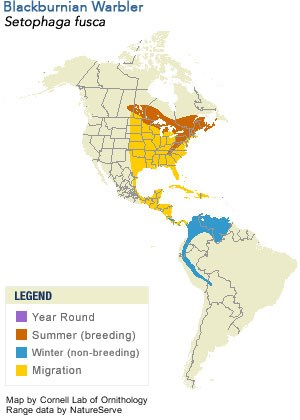
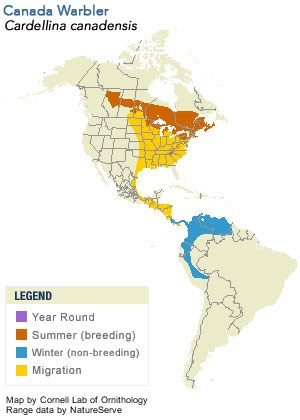
Both these deaths were horrifying to me. Warblers are such gorgeous birds, and so very tiny. Both these species average little more than a third of an ounce. Blackburnian Warblers winter in Central and northern South America, and Canada Warblers virtually all winter in northern South America.

Range of Blackburnian Warbler, from Cornell Lab of Ornithology's All About Birds (www.allaboutbirds.org)

Range of Canada Warbler, from Cornell Lab of Ornithology's All About Birds (www.allaboutbirds.org)
The straight-line distance from the Panama Canal to Duluth is 2707 miles—the bare minimum each of those birds flew, entirely on his own power—wingbeat after wingbeat for days or weeks, stopping for food here and there, after surviving an entire fall migration down there in the first place, and a full winter competing with hundreds of tropical birds and staying clear of snakes and lizards and an abundance of other predators. They survived all this for nothing more than to smash into a sheet of glass when they were so very close to their final destination, where they could finally fulfill the hormonal imperative that sent them on the long journey in the first place, to raise young.

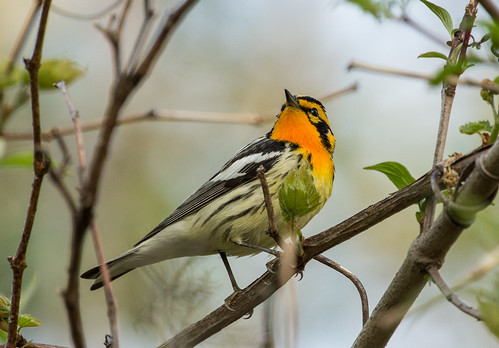
Blackburnian Warbler
How a Blackburnian Warbler SHOULD look
Any bird death at a window is an obscene waste, but losing tropical migrants seems somehow even more tragic, though when I found a dead Pine Siskin under the same tiny kitchen window I felt just as sad. That window will be first to get some bird-safe collision protection this summer, but we’re also adding something to every window on our house, including the many windows that so far don’t seem to have ever killed a bird during all the 34 years we’ve lived here. Even a single death is too many.

Those were the fatalities, but our windows knocked a few other birds out, too. One Swainson’s Thrush hit the window above our garage door. We hadn’t had a collision with that window in years, but apparently it needs some bird-safe protection against collisions, too. The thrush was stunned for several minutes.

Swainson's Thrush
Swainson's Thrush, still stunned, in a shoebox lined with paper towels. Wadding some of it provides some support before the bird can balance on its own.

My normal technique when a songbird hits a window is to place it in a shoebox, with paper towels on the bottom to give it something textured to grip, and place it in a cool place out of sunlight, checking on it every five minutes or so, but only outdoors, during daylight. The darkness keeps the bird quiet so if it does come out of its stunned condition it won’t panic and reinjure itself. I of course only open the box outdoors in case it has come out of its daze. I feel better about the release if the bird has some time to notice its surroundings and get its bearings before it flies off, so when the bird seems to have good balance and be a little alert, I hold it in my hand to make sure it's gripping evenly on both feet, and then move it to a branch or twig that I hold in my hand.

The thrush stayed in the box for 10 or 15 minutes. When it started looking around somewhat alertly when I opened the box, I carried it in my hand to the center of the yard, away from the house. I took some photos—first, some close-ups in my hand and then on a branch. It took several minutes to look around and get its bearings, and then suddenly took off. Sadly, even when they do take off, they only have a 50 percent chance of survival. Subdural hematomas and other invisible injuries take a significant toll.
Swainson's Thrush
At this point it's perched on a wide twig, getting its bearings.

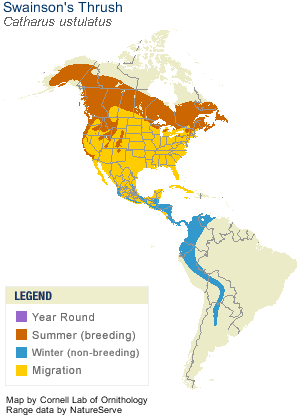
Some Swainson's Thrushes winter from Mexico through Central America, but most spend the season in South America. Again, this bird flew a long, long way just to hit a window so close to its destination, but at least this one has a good chance of surviving.

Range of Swainson's Thrush, from Cornell Lab of Ornithology's All About Birds (www.allaboutbirds.org)
Even though we can’t prevent all of them, next time I’ll talk about what we can do to reduce the chance of collisions at our windows.
Swainson's Thrush


Sunday, June 21, 2015

My Father's Day Story

(This is not at all about birding [well, except maybe to explain why I take so much solace from birds], and I don't usually reveal much about my childhood. But in light of the news, it's time I did.)
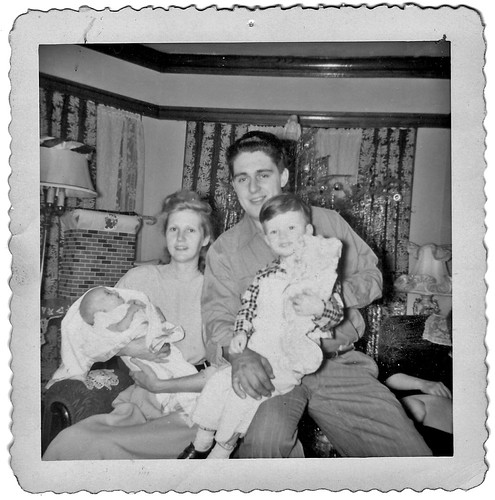
Christmas 1951
My dad, mom, older brother, and me 

I loved my father. That’s important to stipulate from the very start. I have fond memories of him singing “Popeye the Sailor Man” to us, barbecuing chicken for summer picnics, and cooking corned beef and cabbage every year at my grandpa’s birthday party. We were the only kids I knew whose dad was a Chicago firefighter and, for a time, a volunteer firefighter in our blue-collar suburb, Northlake. That was our family’s claim to fame, and we were very proud of it.
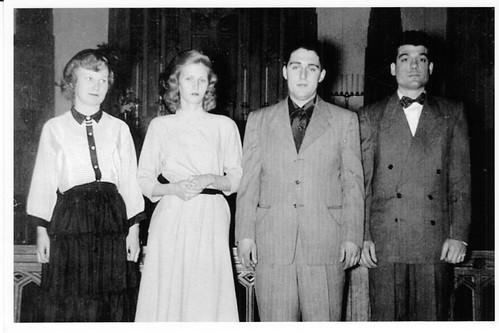
My parents (center) have their marriage blessed at St. Ferdinand's church
My dad and mother, flanked by my aunt and uncle, when my parents got married in 1949.
My mother was 17, my dad 19.

My first memory of my dad is a sad one that maybe gives some insight into why I loved and even felt protective of him, and made excuses for him in my heart. I must have been very little, and my dad very young, because we still lived in our two-flat apartment in Chicago—we moved away when I was four and he was 26. He came home from work one morning (the fire department’s 24-hour shifts started and ended at 8 am). This was the only time I can ever remember him coming home covered with soot and smelling smoky—he’d usually take a shower at the fire hall before he left. I was in the kitchen with my mother, who was standing at the sink with her back to the rest of the room, and he walked in as if in a daze, picked me up ever so gently, sat down with me on his lap, and started rocking and crying, his body heaving with sobs. The tears ran down his sooty face in glistening streaks.

He started talking about the fire, and how a woman in the street was screaming “My babies! My babies!” over and over, and how he and his partner searched everywhere, and finally found the two little children huddled, dead, in a closet. He did artificial respiration, but “We couldn’t make them come alive again.” He buried his face in my hair. By then, I was crying, too. My mother turned from the sink to face him and said coldly, “If you’re going to do a man’s job, you damned well better grow up and be a man, you motherless bastard.” He kissed me tenderly on the top of my head, softly put me down, and walked out.

So for understandable reasons, my dad wasn’t around much after that. Even during the periods when he and my mother were married and sort of getting along, his 24-hour shifts as a Chicago firefighter kept him away one out of every three nights, and he was often gone on other nights as well—he’d explain that he’d had to work someone else’s shift. He got my mother pregnant six times in eight years, but the fact that none of us had fall birthdays bore testament to the fact that he missed a lot of Christmases. Back then the firemen each were assigned a number from one to three, and the big fire department calendar on our kitchen wall showed which were work days for his number, but when he was supposed to have Christmas off, he’d tell us about some poor fireman whose children needed their daddy on Christmas, so he’d traded days with him. I’d try to feel compassion for those poor children, never, at the time, thinking that maybe five little Farleys needed their own daddy on Christmas, or that maybe he was not really working on those days. I also tried not to think about how he was leaving us pretty much defenseless with my mother. When that did occur to me, I justified it, because what could he do?

Truth to tell, things were a bit more peaceful when he wasn’t around. We had developed strategies for appeasing my mother's rage or at least diverting her attention, but when he showed up, all bets were off. Our strategies weren’t 100 percent effective—I wore tights and long sleeves to school even on hot days to cover the welts and bruises. Like most children in this situation, I was ashamed, knowing if anyone saw them they’d know what a bad little girl I must be.

My mother’s constant bitterness and unpredictable rages pervaded our every waking moment and seeped into our dreams, so I usually felt more sympathy for my dad than for her. And I could muster that sympathy for him, on and off, as long as he lived. But I remember the exact moment, and the exact place, when I learned that my father was a bad human being. I still loved him—what was my alternative? But just as had happened with my mother years before, I suddenly could see my father through clearer, more objective eyes, and things were never the same again.

I may remember the moment, but I don’t remember exactly what year this happened. It was one of the only times my dad was around when my mother wasn’t, and it happened after we moved to Northlake, so I’m pretty sure it was while she was in the hospital after her miscarriage in 1956 or 57, when I was four or five. My dad had to do some grocery shopping at Dominick’s, and either left the other kids alone—my parents often left all five of us on our own—or my grandpa or uncle was there helping and didn’t think he could manage all five of us by himself. I was too old to ride in the shopping cart, and my dad didn’t want me to slow him down, so he brought me to the cereal aisle and told me to stay put and not move a muscle until he came back.

The store wasn’t busy, so there wasn’t much to look at besides cereal boxes, but they were colorful and cheery. Kix. Cheerios. Sugar Smacks. Rice Krispies. Corn Flakes. Eventually a shopping cart turned into the aisle. The first thing I saw was the little toddler inside—she was laughing and clapping, but what arrested my attention was her hair. It was dark brown like mine, and tied up in what looked like hundreds of little pigtails (looking back, I’d say at least a dozen) each lovingly tied in a pretty pink bow. Her daddy was pushing the shopping cart, and he pulled it up right by me, next to the Cheerios. That’s when I saw her face—she had the biggest, happiest smile I’d ever seen on anybody except on TV. She was having more fun than I’d ever dreamed a little girl could have with her daddy, at least in real life.

He reached down and pulled her out of the cart, holding her up to the cereal boxes that seemed almost as big as her, and told her to help him pick one. She opened her pudgy arms wide and pulled out a box of Cheerios. He wheeled her around so she could drop it into the basket as they both laughed. As he tenderly placed her back in the little seat in the cart, he noticed me watching them, looked right into my eyes, and gave me a warm, friendly smile, his eyes crinkling. For one beautiful moment, perhaps the most perfect moment of my entire childhood, I felt drawn in and included—a part of that happy little family.

The next moment everything shifted horribly. He started pushing the shopping cart away, straight toward where my father was turning into the aisle, facing them directly.

In the Little Golden Book, Sleeping Beauty, when the evil Maleficent shows up at the christening, “the room darkened suddenly. A chill wind swept through it. And a shudder passed over the crowd.” My grandpa gave me that book a couple of years later, and when I read those words, the memory of that moment flooded my mind. The instant he saw that man and his little daughter, my father's eyes filled with fury and naked hatred, and every bit of joy and cheer drained from the man’s face. Instantly, it was filled with fear and a kind of impotent anger that bewildered and frightened me. I was horrified to realize my father wielded a profoundly unfair power over this stranger. He wheeled the cart around in retreat as my father charged forward, sputtering too, too audibly, “It’s bad enough the niggers took over the city. Now they’re invading the suburbs.”

Like a lightning bolt, I was struck with a shocking realization. Those horror stories my father came home from work telling us about, using that ugly word over and over, weren’t about faceless, monstrous bogymen—he’d been talking about this warm, friendly man, and this tiny child, and people just like them!

I couldn’t see the little girl in the shopping cart or the man’s face now—just his rapidly retreating figure from behind. As he turned the cart around the corner at the end of the aisle, I saw the child crying. I wanted so badly to catch their eyes—to somehow convey to them that I wasn’t like that—I was nice—please take me home with you, far, far away from ugly cruelty and mean-spiritedness. Please.

Five years old is too young for children to face the harsh truth that their father can be horrifyingly, cruelly, absolutely wrong about something so important. I suppose it was easier for me to accept, having learned that same lesson about my mother at an even younger age.

My whole life, I’ve been haunted by memories of this brief encounter. I often wonder what became of that man and his little girl. She was so little—only about two or three. Could she have forgotten all about it? Did she carry away a vague, inchoate sense of dark menace lurking all about that could pop up anywhere? Could a box of Cheerios trigger bad memories? Did she grow up scared of every white man? Did her daddy teach her to not be prejudiced—to understand that not every white person was like that? How would she know which was which? She’d be in her late fifties now—sixty-one at the oldest. How has she negotiated this world in which we pretend as much as we can that racism is dead, that the bad white people, even the ones in positions of power, are mere outliers? Does she have children? Grandchildren? Can she sleep at night before they’re all accounted for?

And what about her daddy? Did he encounter other people like my father—people who hated him for simply being? My father’s temper and lack of filters may have made him something of an outlier, but I knew plenty of grownups who shared his attitudes. Did the man in the grocery store develop some kind of radar to anticipate ugly encounters before they happened? Even if he somehow developed thick enough skin to deal with bizarre and random attacks on himself with equanimity, how infuriating it must have been to not be able to protect his tiny daughter from such ugliness. How did he deal with that anger?

And what about me? I have always been haunted by a vague but pressing feeling that I owe these two people a heavy debt impossible to pay. I feel complicit, by virtue of blood, by virtue of my inability to change my own father’s mind and heart, and by virtue of living in a system that protected me from that kind of horrible encounter thanks to nothing more than my skin color. Never once have I entered a grocery store, or any other place, and been viciously assaulted with ugly words just for being there.  

Are the sins of the father visited upon the children, and upon the children's children, unto the third and to the fourth generation?

Every time I read yet another news story about a hot-headed white man murdering yet another black child, I can’t help but think of my dad. On this Father’s Day weekend, so soon after a 21-year-old terrorist gunned down nine people in their church, my response to the news is filtered through memories of him.

We—family and friends, society at large—every one of us is personally responsible for reining in that kind of hatred long before innocent people are killed; long before it can even erupt in ugly words shot like bullets at innocents in a grocery store. Some people, virtually all white, feel a magical distance between themselves and racial tension. Of course they’re not racists! This wasn’t their fault! When they listen to Rush Limbaugh spewing hatred or NRA spokesmen disingenuously saying the victims should have been armed; when they defend the tradition of the Confederate flag, that treasured symbol embraced by the Ku Klux Klan, I can’t help but think of the Prince saying "See what a scourge is laid upon your hate," as he gazed upon the young bodies of Romeo, Juliet, and Tybalt. He had tolerated the strife between the two families, not intervening to stop the hateful exchanges, and now was wracked with guilt for his complicity. “And I, for winking at your discords, too, Have lost a brace of kinsmen. All are punished.”

I think of the words of Thomas Jefferson:
Deep rooted prejudices entertained by the whites; ten thousand recollections, by the blacks, of the injuries they have sustained; new provocations; the real distinctions which nature has made; and many other circumstances, will divide us into parties, and produce convulsions which will probably never end but in the extermination of the one or the other race.
Is Jefferson’s bleak forecast the only way this can end, or simply the only way he could imagine two centuries ago? He could not envision the many messages of peace from Martin Luther King in the ‘60s, or the gentle forgiveness bestowed on the murderous Dylann Roof by so many grieving members of the families of his victims on this sorrowful Father's Day weekend. But as long as we white people live in complacency, even as our society is diminished by the losses of so many innocent compatriots, I fear for worse to come, those memories of my father’s hatred so vividly flashing through my mind.

He had a hair-trigger temper. Several times we kids were along in the car on the Illinois Tollway when, incited by some perceived transgression by the driver ahead of him, he’d speed up to “tap” the guy’s rear bumper, over and over. My mother and siblings would laugh—either thinking that playing bumper cars at 80 mph was funny or as an involuntary response to fear—as he lowered his head at the wheel, a raging bull muttering obscenities and roaring the engine. After he’d forced the car over to the shoulder, he’d yell a victorious whoop as he sped past, giving the hapless driver the finger, and it would take an hour or more before he cooled down. He made the newspaper in 1965 when he punched a judge during the hearings for his divorce from his second wife. And when he became an ambulance driver for the fire department, he often came home boasting of leaving someone “bleeding on the street” after they “mouthed off” to him or his partner—“those people” had to “show some respect.”

The NRA today targets their message at people exactly like him. They fan the flames of paranoia and hatred to ensure that more and more gun purchases enrich the corporate manufacturers they represent. They weren’t like this in the 50s and 60s—back then they were a true membership organization focused primarily on sportsmen. My father, like most city people who weren't hunters of that time, never owned a gun. So I can console myself with this: at least my father never outright murdered anyone. If he were a young man today, he’d be armed to the hilt.

I argued a lot with him, about racism and other topics, as I got older, but little by little I gave up, resigned to hopelessness. When I started my first teaching job in Madison, Wisconsin, my father asked if I had any niggers in my class. I was so stunned by the audacious obscenity of the question that all I could blurt out was an indignant “No.” When he later saw photos of my beloved students displayed in our apartment, he said, “I thought you said you didn’t have any niggers in your class.” I looked him dead in the eye and said, “I don’t.” He looked uncomfortable—I hope I made him feel ashamed, but I’ll never know. That was the last time I saw him alive.

He died when he was fifty from a massive heart attack. I cried and cried, mourning for all he couldn’t be rather than for all he was, and filled with grief about the debt I would never be able to repay to people I would never be able to find, and to the many people just like them who were victimized by an ugliness that is an undeniable part of my family heritage, a dark stain that will not wash clean.

My own first child was born a year after my father's death. If we are to honor all the happy traditions of our families with joy and share them with our children, each one who started out as a baby and toddler just like that sweet little one in the grocery store, mustn't we first acknowledge and sweep out the dark corners of that family heritage? Or will our children's children, unto the third and to the fourth generation, be born into a world still infected by this evil hatred? What are we, as individuals and as a people, prepared to do?

So on this Father’s Day, as I read so many loving messages from friends about their fathers and the valuable lessons they learned from them, I’m finally writing about my own father.  I loved him, and I learned valuable lessons from him. May God have mercy on his soul, and on mine.

Thursday, June 18, 2015

2015 Mourning Dove Survey

Mourning Dove
Mourning Dove at one of my survey stops this year
Back in 1987, I started doing an annual volunteer survey for the US Fish and Wildlife Service counting Mourning Doves along a 20-mile route. Each year I started at a precise spot along a country highway in the Adolph area and ended up out in Saginaw. Year after year I did the survey on one of the most northernmost routes in the country.

In the 80s, my area had very little development, and because it was almost all forested, most years I had at most one Mourning Dove. But little by little, some stretches have been developed for houses and motor homes, and some of the forests have been lost. So the bird life has changed, year after year, but after so many years covering the same area, I felt a real connection to the land and birds along my survey route.

Then, in 2013, the US Fish and Wildlife Service and US Geological Survey stopped conducting the Dove Survey. I’m sure this was due to cutbacks—most people don’t even realize that the cuts brought on by the federal government’s sequestration have never been restored.

The Mourning Dove is America’s most heavily hunted game bird, so I thought cutting back on such an amazingly cost-effective program, in which unpaid volunteers do much of the work, was a terrible idea. There’s absolutely no evidence that dove populations are at all in trouble—they seem to thrive on exactly the kinds of land management practices that are dominating the landscape right now—but the way to prevent problems all along is with solid information, and the dove surveys have been a perfect way of assuring the continued success of dove populations.

Minnesota only opened a dove season at all in 2004, and up here hunters have been slow to join in. That doesn’t surprise me—the hunting culture of many Minnesota hunters is steeped in tradition and conservation, and throughout the lifetimes of every living Minnesota hunter Mourning Doves were considered more of a backyard songbird than a legitimate game species. We’re at the far northern reaches of their range east of the prairie regions—that’s why my particular survey route has normally had so few doves compared to most routes. And that is also why it’s so important to maintain surveys to keep track of dove numbers here in the forested parts of Minnesota, where their population is so much smaller than elsewhere in the state or in other states. It’s especially urgent now, as interest in dove hunting in the state is growing, so we can keep track of its effects in the specific region of the state where their numbers really may be too small to sustain a hunt.

So I was thrilled this spring when I was contacted by the coordinator of the old hunt, asking me if I’d run my route again this year, using a new protocol. They’re piloting a new survey that will only involve one-tenth of the routes formerly run, using range finders and GPS to locate the precise locations of each dove to create a more precise statistical picture of dove numbers.

I’d never used a Garmin GPS or any kind of rangefinder before, but it wasn’t hard to learn the new technology. (See? You CAN teach an old dog new tricks!) This new protocol will be tested for 3 years, so I’ll be doing the Survey in 2016 and 2017 as well.

This past weekend I headed out, as I’ve done in so many springs, to cover the exact same stops as I’ve done in the past. There’s been more development since last I was there, and I ended up with 5 doves—close to my route’s all-time record number. I heard cuckoos and snipe, warblers and vireos, Alder Flycatchers and Rose-breasted Grosbeaks. I brought my dog Pip along, too. She stayed in the car for most of the stops, but poked her head out to listen to the birds and frogs singing.

Democracy and wildlife management both work only when we’re armed with accurate information. It’s so satisfying to be able to volunteer my time for an important survey that both collects valuable data and is such a pleasurable part of my annual traditions.

Mourning Dove

Friday, June 12, 2015

Chickadee Update: Fledging!!

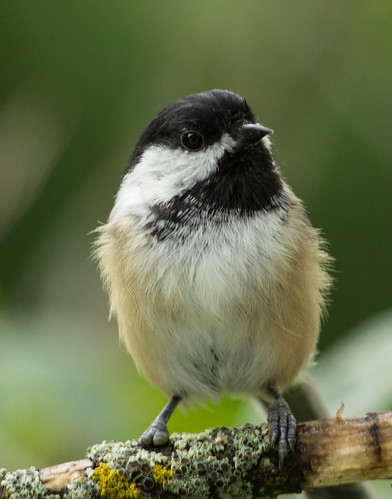
Black-capped Chickadee--fledging day!

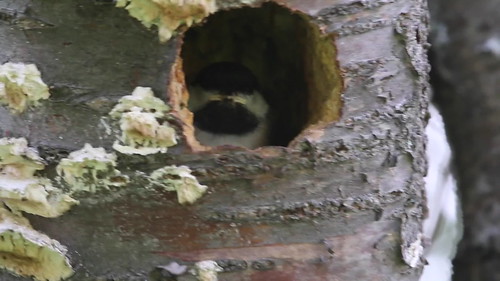
On Wednesday this week, my neighbor Jeanne Tonkin told me that she had found the chickadee nest of the male chickadee we’ve been tracking. I went straight over and got hundreds of photos. We got some good looks at one or two nestlings that had worked their way up to peek out the entrance hole, and they appeared well feathered out—I thought they had to be close to fledging.

Sure enough, when I headed over there around 10 am on Thursday, at least two and quite likely more of the babies had already left the nest. The parents were rushing about keeping track of and finding food for the new fledglings as well as the nestlings. The male and female both came to the nest during the first few minutes after I arrived and fed the ones still in the nest, but they also came in a few times without food, perhaps just encouraging the nestlings to make the jump.

Black-capped Chickadee--fledging day!

The parents weren’t coming very often, and the nestlings were apparently hungry. Two of them worked their way up near the entrance—it was so endearing to see them side-by-side in the nest.

Black-capped Chickadee--fledging day!

Twenty-five minutes after I arrived, one of them suddenly flew out of the nest hole into a nearby branch of the cherry tree. It was as thrilling as it was adorable seeing a chickadee’s very first flight.

Black-capped Chickadee--fledging day!

I’ve watched chickadees fledge before this, but these seemed a few days older—their tails were already about half grown in rather than tiny stubs, and they seemed more coordinated from the very start. Only one still had any evidence of "fuzz"—wispy bits of baby down feathers still sticking out of the juvenile plumage. This is a good thing—the longer birds stay in the nest, the higher their chances of long-term survival tend to be. This fledgling went directly to a nearby branch and landed as easy as pie. I tracked it for five minutes. It stayed in the cherry tree for a minute or so, looking all about, carefully watching an ant that walked along the branch it was on, and then it flitted above the lawn to another tree, and another. The mother came in briefly, without food, as if trying to show it where to go, but it wasn’t ready for a long flight across the yard to where the family was, so I got a few more photos.

Black-capped Chickadee--fledging day!

Black-capped Chickadee--fledging day!

I got back to the nest in time to watch a second chick about to fledge—I got a bunch of photos, and then watched it take off.

Black-capped Chickadee--fledging day!

This one went further on its maiden voyage—past the nearby cherry branches and into some shrubbery a good 10 feet further away. Again, it just sat there for a few minutes, getting its bearings, and then started working its way branch to branch. That one was a little less coordinated than the first, but for the first moments out of the nest didn’t seem all that awkward.

Black-capped Chickadee--fledging day!

When it did flit off, I went back to the nest in time to see the last little chickadee take off—I got a 5-second video of that.

Chickadee Fledging

That one didn’t stick around in the open as long as the others did before it moved into the denser vegetation.

Back at the nest, no little chickadees were up at the entrance, so I presume I got to see the last three fledge. I’d seen the parents trying to deal with at least two fledglings when I arrived. Chickadee nests usually produce 5-9 chicks, and it’s exceedingly difficult for the parents, much less people, to keep track of them when they fledge to count them, so I’ll never know exactly how many chicks were in there.

It was so fun watching the little ones looking around and figuring out the big world. While they were in the nest cavity, they could see out in only one direction, which didn’t include the thick area of trees and shrubs where the parent wanted them. Everything was new.

Black-capped Chickadee--fledging day!

It’s SO hard for parent birds to feed and keep track of all their fledglings. When people run across fledglings during that first day or two, when the chicks are clumsy and not quite following the parents’ directions yet, they tend to assume the chicks were abandoned. Worse, they tend to assume that it’s better to “rescue” the chick—to snatch it out of its home territory and bring it indoors, where it will be “safe.”

Parent birds give their young a perfect diet and so much more—exactly the kinds of contact, by touch and vocally, that their chicks need, and exactly the education that will give the young birds a chance of surviving in the wild. What most people give baby birds is nothing more than food. It reminds me of that experiment when baby chimpanzees were given nothing but a bottle and a wire doll, and grew up to be very stunted mentally and emotionally. Baby birds don’t have a chance of a real life after that kind of experience.

When you see a fledgling, consider yourself lucky, but don’t make the bird unlucky by removing it from its home and family. If it really does seem to be in danger, on the ground, you can pick it up to put it in some nearby shrubbery, but don’t do more than that without describing the situation to a wildlife rehabber and getting careful instructions for where to bring it. The only reason we have birds at all is because parent birds really do know how to raise them themselves.

Black-capped Chickadee--fledging day!


Thursday, June 11, 2015

Chickadee Update: The Nest!

Black-capped Chickadee
MY chickadee—the one with the deformed bill and foot—at his nest!

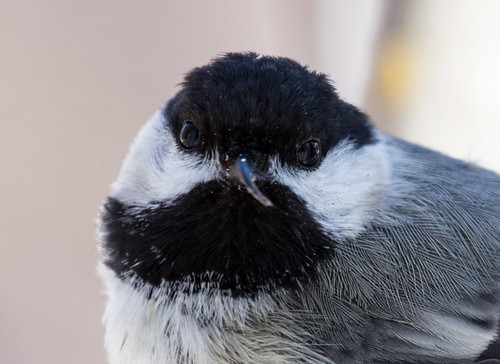
At the end of my conservation big year in 2013, I started noticing a chickadee in my yard whose bill had become overgrown—the kind of deformity that has been woefully common in Alaska, so the USGS’s Alaska Science Center has been keeping track of all chickadees with deformed bills. Their data comes mostly from Alaska, but a handful of records are from elsewhere.

Black-capped Chickadee with deformed bill
This same chickadee in April 2014

Black-capped Chickadee with deformed bill
Same guy in April 2014
I took lots and lots of photos of my little guy, which was relatively easy because he takes mealworms out of my hand. Because the tips of his bill didn’t meet properly and the upper bill extended so far beyond the lower, he had a lot of trouble picking up and eating food. But he could easily grab mealworms out of my cupped hand, and I was spending so much time at my computer, next to the window, as I finished up writing my nesting book, that whenever he wanted food, I’d notice right away.

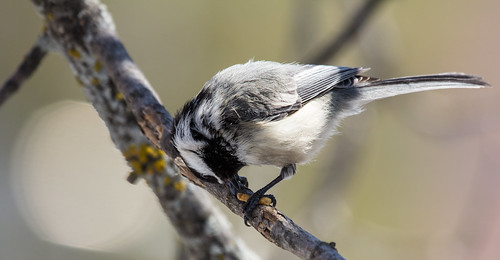
Of course, even in the middle of a book project I can’t stay at my office desk every moment of daylight hours, so when I wasn’t going to be there, I’d put some mealworms into a little window feeder. At first, the mealworms had to be piled up more than 2 or 3 millimeters thick for him to easily grasp them—his lower bill had to be able to reach them in order to take one—but little by little, I noticed that he was learning to turn his head upside down and slide the upper bill under a mealworm until the lower bill could close on it. He must have had at least a little trouble preening with the deformity, but didn’t look very scruffy except one side of his face.

Black-capped Chickadee with deformed bill
He had to turn his head upside down to eat the mealworms, too.
My guy made it through the winter and exceptionally cold, long spring, and I was thrilled—and then suddenly I stopped seeing him. Well, not quite—I stopped seeing a chickadee with a very long upper bill. But he was still there—it took me a couple of days to figure out that the bill tip had broken off, and his bill looked almost normal. The upper tip wasn’t smoothly worn to perfectly match the lower bill, but was working almost perfectly.

Meanwhile, I suddenly was noticing that one chickadee who came regularly to my hand had a badly deformed foot, missing the front three toes. When I put two and two together, I realized that this was the very chickadee whose bill had been deformed. Sure enough, when I went back and studied those photos I’d taken, in every one showing the right foot of the bird with the overly long upper bill, I could see that pitifully deformed foot. Now that I knew about the foot, that chickadee felt way different in my hand—I must have been so keyed in on studying the bill that I simply hadn’t noticed.

Black-capped Chickadee
This shows his deformed foot well.
He clearly faced difficulties in getting food that the other chickadees didn’t, but he had two advantages over them. He trained a human to find food for him, and give it to him whenever he flew to her window and gave her a long, hard stare. And he was trusting enough to remain in my hand long enough to grab two, and then three, mealworms with every trip.

As it turns out, he didn’t train just one human—by this past winter, he started getting mealworms from my neighbor Jeanne Tonkin, too. All along, I noticed that when he flew off with his bounty, he headed over toward the trees behind her house. When she told me she was feeding mealworms, I told her about my guy, and sure enough—he had turned two different people into his personal servants.

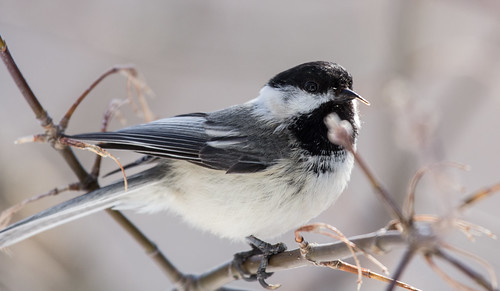
He didn’t attract a mate in 2014, and I couldn’t be certain he was a he or a she. This past winter, the upper bill grew just slightly longer—the bill is still slightly unusual, but I have to study it to notice. And this year he did attract a mate. Jeanne noticed before I did that he was feeding a begging chickadee the mealworms he was carrying off.  I soon saw him doing that, and also singing. These two behaviors verified that he was a male, and the bird he was feeding had accepted him as a mate. They had to be  nesting somewhere, but where?

Jeanne discovered the nest in her backyard a few weeks ago.

Black-capped Chickadee
The nest cavity
It’s in a dead portion of a large cherry tree. The hole is slightly larger than it needs to be—I think it must have been constructed originally by a Downy Woodpecker. Jeanne called me yesterday to tell me about the nest, so I ran right over with my camera, and got lots of photos of both the female and my little guy bringing food in and carrying off fecal sacs. They’ve been feeding mealworms to the nestlings, but also a rich assortment of natural insects and spiders.

Black-capped Chickadee
Here's Dad after a feeding bout

Black-capped Chickadee
Mom with a juicy caterpillar

Black-capped Chickadee
Mom carrying out a fecal sac

Black-capped Chickadee
Mom with a spider and other delicacies
I loved realizing that even though I’d helped keep this particular little bird alive during his worst year, and he is still adept at getting handouts from us, his survival was due not just to our subsidizes but to his own plucky nature. Life is harsh for chickadees, but they’re survivors. Smart ones who know how to capitalize on every little feature of their home range are the ones who make it. What does it matter if one of those features happens to be two trainable women with a supply of mealworms?

Black-capped Chickadee
A nestling!
I got some photos of one of his nestlings near the entrance of the cavity—proof of the tenacity of life and just what a survivor my chickadee has been. The chick was quite well feathered out, so it’ll be fledging any day now. I’m so thrilled that I got to see at least one of my dear little guy’s own dear little guys.

Black-capped Chickadee


Thursday, June 4, 2015

Protecting Plovers

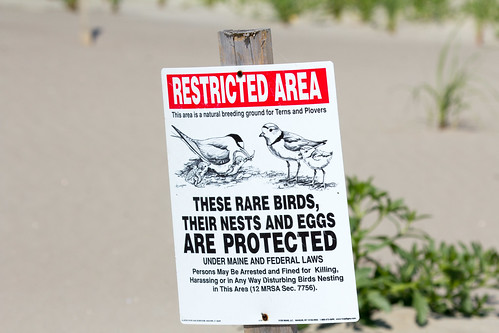
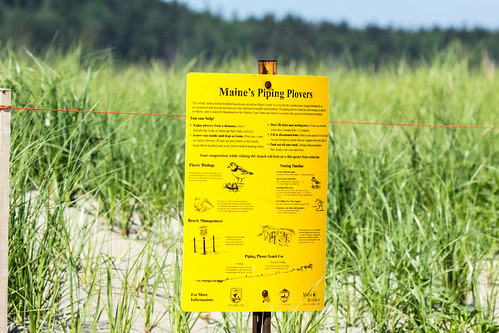
Sign at Popham Beach State Park
Sign at Popham Beach State Park in Maine
When I was a starting out as a birder, Russ and I were poor college students with little opportunity to travel. He had to present a paper at a scientific meeting in Savannah, Georgia, in June 1976—that was the first time I ever birded outside Michigan, Illinois, and Wisconsin, and I added 26 lifers. But that was it for travel until Christmas Eve in 1978. Russ had an early January meeting in Corpus Christi, Texas, and so we took advantage of Christmas break to mosey down, birding along the way, following directions in two wonderful books, A Birder’s Guide to the Texas Coast and A Birder's Guide to the Rio Grande Valley, both by Jim Lane. I added 46 lifers in all, 39 before Russ’s meeting even started. For the few days of the meeting, we camped at Goose Island State Park, just outside Corpus Christi. Russ needed the car to get back and forth to the meeting, but I was perfectly content to walk about the park those days. During winter the park wasn’t very heavily used—I ran into hardly any people at all—and it was on the sandy beaches there that I added some of my favorite birds of the entire trip: the Snowy, Piping, and Wilson’s Plovers.
Snowy Plover
Snowy Plover photographed at Quivira National Wildlife Refuge in Kansas in 2015
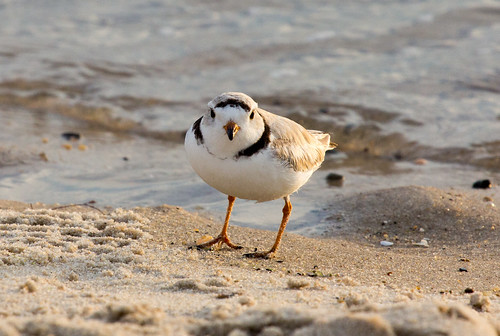
Piping Plover
Piping Plover photographed at Cape Henlopen State Park in Delaware in 2013
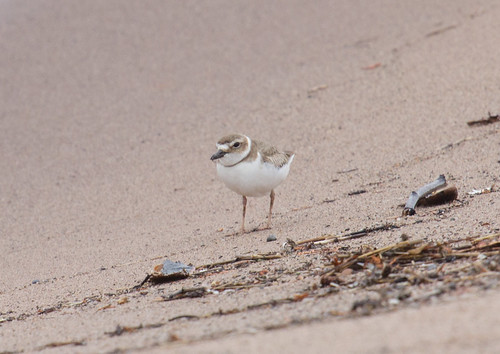
Wilson's Plover
Wilson's Plover photographed at Park Point in Duluth in 2013
Plovers are plump, big-eyed, endearing shorebirds, many with somewhat shorter, slightly thicker bills than most sandpipers. They hunt by sight rather than smell or feel, and their large eyes give them a sweet, innocent appearance, though the invertebrates they feed on don’t appreciate that big-eyed look as much as we humans do.

Killdeer
Killdeer photographed in 2015 in Port Wing, Wisconsin
The most abundant plover breeding in our neck of the woods, the Killdeer, nests on disturbed ground in open habitat—our land use patterns are fairly beneficial to it. Other plovers nesting within the Lower-48 are reliant on coastal areas, making them far more vulnerable.
Wilson’s Plover nests on sparsely vegetated coastal beaches above high tide, dune areas, and edges of coastal lagoons. Snowy Plovers nest on sparsely vegetated coastal beaches and shores of inland alkaline lakes. Piping Plovers nest on open beaches, alkali flats, and sand flats. So both Snowy and Piping Plovers can nest both along the Atlantic and Pacific coasts and inland.

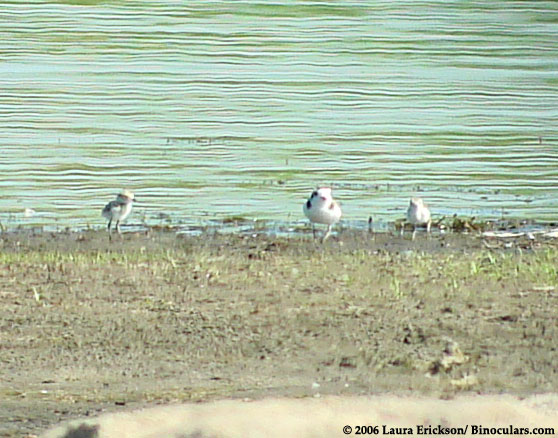
Our first record of Snowy Plovers nesting in Minnesota, at Big Stone National Wildlife Refuge in Lac Qui Parle County, was in July 2006—it’s hard to say whether the species nested there or elsewhere without detection before that.

Snowy Plover adult and 2 chicks, photographed at Big Stone National Wildlife Refuge, Minnesota, in 2006
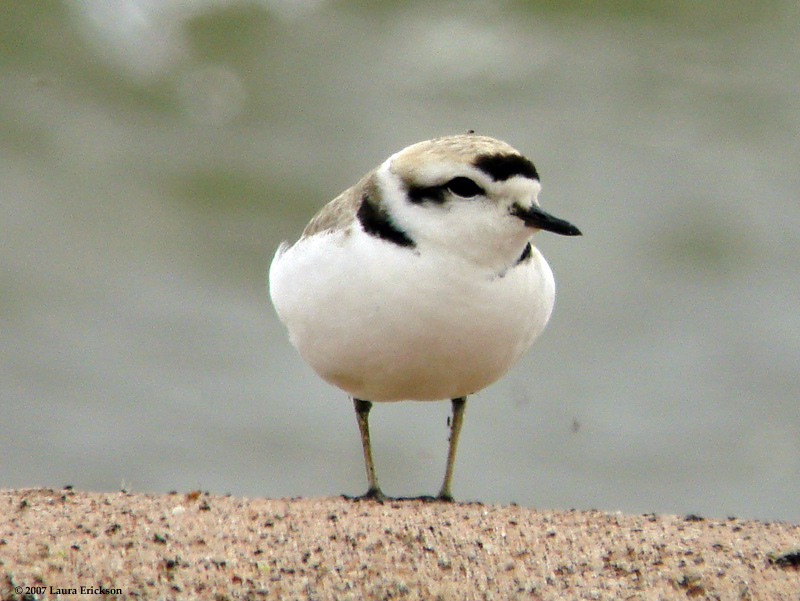
Snowy Plovers also occasionally appear along Lake Superior during migration.

Snowy Plover photographed at Park Point in Duluth in 2007
Piping Plovers historically nested here on sand beaches along Lake Superior and on Lake of the Woods. Both Snowy and Piping Plovers are pale—their backs the color of dry sand—and they blend in beautifully. They don’t construct a nest but merely make a scrape in the sand, where they deposit their four cryptically colored eggs.

Plovers have broken-wing displays to lead potential predators away from their eggs or young, but no defenses at all against people and dogs running and playing on the beach. Most people don’t mean any harm, but the birds’ cryptic colors work against them when people are playing beach volleyball, running their dogs, cruising in an off-road vehicle or car, or picnicking.

Coyotes and wolves virtually never walk along beaches in broad daylight. When dogs do, the poor plovers panic, and may abandon their nests or chicks even if the dogs don’t crush them or pick them up.

It takes well over 3 weeks and sometimes more than 4 weeks for the eggs to hatch after incubation begins, and the vulnerable chicks, looking rather like marshmallows on sticks at first, can’t fly until close to four weeks old. Even after they can fly, the chicks depend on their parents, often remaining with them until fall migration.

If I was thrilled to see my lifers in Texas, I was just as excited to see a Piping Plover on May 22, 1982, in the Port Terminal in Duluth, where several pairs once nested. By the time I first saw them here, the Duluth population was already dwindling to virtually nothing, and Minnesota’s Lake Superior population was considered extirpated by the mid-80s. Since then, spotting one during migration makes all the birding hotlines,.

Between our large gull population—Ring-billed Gulls eat eggs—and the burgeoning numbers of both residents and tourists crowding the beach for dog walking, picnicking, beach-combing, and birding, nesting in Duluth now seems out of the question.  

Snowy Plover photographed at Coal Oil Point Reserve at UCSB in August 2005
In 2005, I went to an American Ornithologists’ Union meeting in Santa Barbara, for which the biggest highlight for me was a field trip to see nesting Snowy Plovers. The beach where they nest is at Coal Oil Point Reserve, part of the University of California-Santa Barbara Natural Reserve System, and it was thrilling to see how the university and some non-profits were working together to create a safe haven for the lovely birds.

Their docent program was at the heart of the project—they trained volunteers from the university, Santa Barbara Audubon Society, the US Fish and Wildlife Service, and the city to guard over the beach throughout daylight hours. Sections of the upper beach where plovers are nesting are roped off. The docents not only enforce dog leash regulations—they serve as ambassadors for the plovers, with spotting scopes trained on the birds to draw people in to how adorable and vulnerable they are.

People love walking on beaches, and our species is selfish enough that a great many individuals can’t look at any issue beyond their own personal gratification. In this case, what was weighed against personal fun was the continued existence of a threatened species.

Most people cooperated really well with the docents, some so thrilled to get such good looks at adorable birds that they became docents themselves. Not everyone was good-natured about it—one was quoted saying she’d walked her dogs along the beach without leashes for 30 years and was not about to stop—but regulations, enforcement, and a lot of good-will generated by the docents have made this an extraordinarily successful program that has produced hundreds of new Snowy Plovers.

Beaches are uniquely vulnerable habitats, and this year’s Santa Barbara oil spill from a pipeline rupture, right during the start of plover breeding season, is jeopardizing both nesting success and the adult birds. Interestingly, in a year when Minnesota is considering expanding Enbridge’s pipelines through vulnerable habitat, we’re not hearing a lot about that in the news. (Read news about the oil spill from Audubon here, and from the UCSB campus newsletter here.)

With regard to beachgoers, the Coal Oil Point Reserve program has been a model of success, but protection of the plovers in other places along the California coastline hasn’t been as successful. Many beaches are open to automobile and off-road traffic, and new restrictions—even very localized, limited ones—to protect plovers have been met with some anger and belligerence, just as protections to protect Piping Plovers along the Atlantic coast have been in some areas.

One Atlantic coast place where people have been cooperative in protecting Piping Plovers has been Delaware’s Cape Henlopen State Park. The plovers use limited parts of the beach, and other beaches there are completely open.

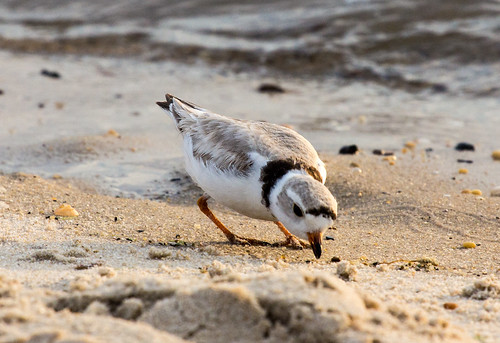
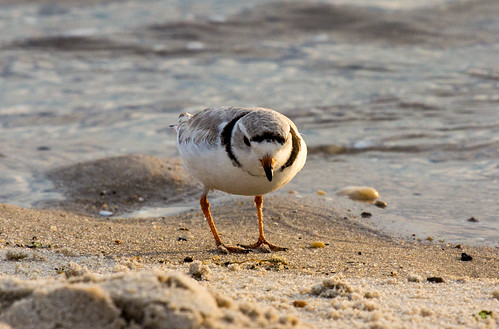
Piping Plover
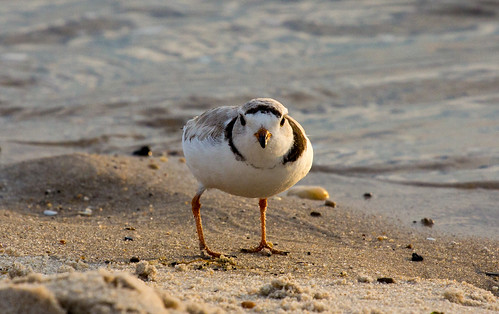
Piping Plover feeding at Cape Henlopen State Park in May 2013.
I visited a plover nesting area there during my Conservation Big Year. We were allowed on a tiny part of the beach at the point, and because people have been honoring the restrictions, it was easy to see and photograph the plovers simply by staying out of the roped off areas. The closest plover looked at me occasionally, but never ran or flew away, and continued to feed during the entire time I was there.

Piping Plover
Piping Plover at Cape Henlopen State Park in May 2013

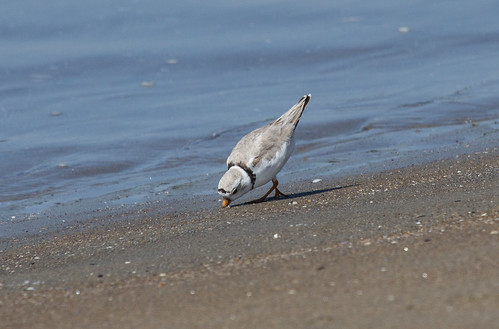
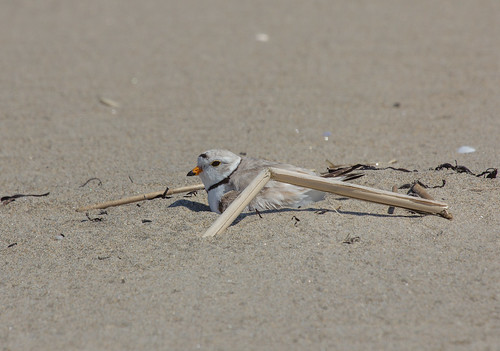
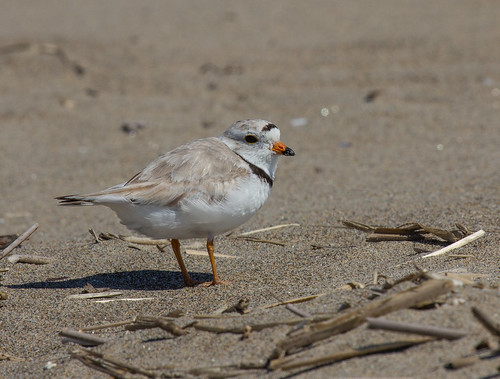
That also happened in Maine at the very popular Popham Beach State Park. I went there twice during my Big Year—it was amazing to me how easy it was to observe Piping Plovers and Least Terns when I faced one way, and over a hundred beachgoers when I faced the other way, right from the public bath and changing rooms.

Popham Beach State Park

Thanks to clever crowd management, people were sort of automatically led to the public part of the beach, and I saw absolutely no foot prints on the protected side of the roped off area.

Sign at Popham Beach State Park
Sign explaining roped off area at Popham Beach State Park
People were allowed to walk along the beach, even below the nesting area as long as they stayed below the high tide mark, but no one was there while I observed, and the plovers and terns seemed completely relaxed, as if they’ve learned the patterns of human activity there. I had a wonderful time taking photos of them eating, preening, and loafing.

Piping Plover


Piping Plover

Piping Plover

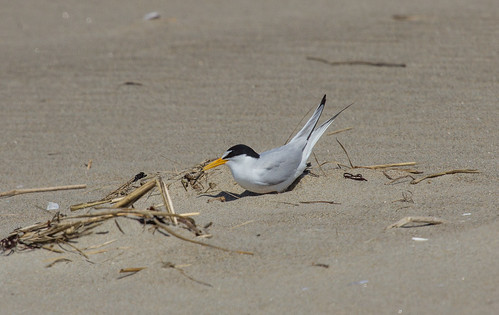
Least Tern
Least Tern digging a scrape for nesting at Popham Beach State Park. Protecting beaches helps both plovers and terns.
So people and plovers can share beaches. The most essential requirement is for people to know that plovers exist, and to recognize their value as fellow travelers on this increasingly crowded planet. Outdoor and environmental education programs are squeezed out of most school curricula nowadays. So it’s up to those of us who are aware of these lovely birds to draw other people into that awareness.

 This year, two Piping Plovers were spotted on the Park Point beach near the airport in May. A wonderful campaign by the St. Louis River Alliance sent the alert out, and volunteers worked with dog walkers to minimize traffic along the beach, but as it turns out, the birds were probably both males, and they disappeared.

I happen to belong to three of the groups that most threaten nesting plovers—I have a dog, I'm a birder, and I'm a bird photographer. I went to the beach twice during the time areas were roped off in case the plovers decided to nest. All the dog walkers I saw were keeping their dogs out of the roped-off area while I visited. Dogs are required to be on 6-foot or shorter leashes on all public property in Duluth—a rule consistently violated by many dog walkers on Park Point—but at least during the time we were trying to protect plovers, I didn't see any loose OR leashed dogs in the protected area.

Erik Bruhnke and I were birding with my dog Pip at Park Point when the signs were up. Pip was on a short leash on the boardwalk, and when we reached the beach, she went into my shoulder bag. She got plenty of exercise in many of the places we went to that day. Why risk scaring off even the most common shorebirds, which were feeding and resting during their long, long journey. 
Embarrassingly, the people I did see walking along the beach in the roped off section were birders with scopes and cameras.

This year plovers won't be breeding in Duluth. There may still be some hope on the Wisconsin Point side. Sand beaches are rare on Lake Superior, and so it’s understandable why people gravitate to them. But we have choices in where we play, while the tiny, vulnerable plovers have no choice at all in what habitat they need for raising their young. I sure hope we can discipline ourselves to set aside a little bit of beach for them where no one—not dog walkers and especially not birders who should know better—can bother these precious birds.

Piping Plover
It takes a village to protect a plover.
This news story from 2011 provides a great overview of the Santa Barbara and other California plover programs, including their successes and challenges.