Laura Erickson's For the Birds

Wednesday, April 27, 2016

Branded

Black-capped Chickadee--fledging day!
You don't own me!
What’s in a name? That which we call a rose by any other name would smell as sweet—at least until someone trademarked the word and outsourced production to maximize return on investment.

I’ve been thinking a lot about branding and trademarks since March 1, when the National Park Service changed the names of several historic designations within Yosemite National Park to avoid a trademark infringement claim. Delaware North, the corporation that had been the park’s concessionaire since 1993, now claims to own intellectual property rights to the names of the Ahwahnee Hotel, Curry Village, Wawona Hotel, Yosemite Lodge at the Falls, Badger Pass Ski Area, and several other beloved and iconic features of the park, all of which were named long before Delaware North was even in the picture.
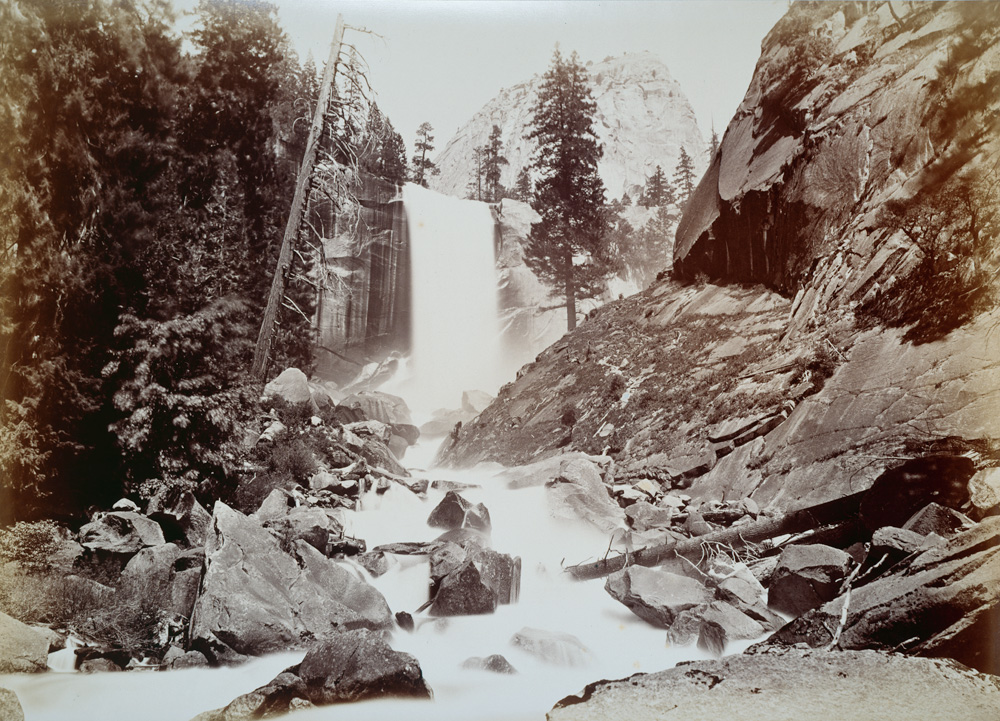


I visited Yosemite for the first time in 2013, and like anyone who hikes in our treasured national parks, I felt a pride of ownership in this magnificent place that belongs to you and me—to everyone and so, essentially, to no one. I found the news about Yosemite’s trademark woes depressing evidence of the continuing corporatization of modern life.

That corporatization isn’t restricted to America, either. Last week, as we approached the 400th anniversary of William Shakespeare’s death, I knew there would be lots of media coverage about him. But I didn't expect that the very first story I'd hear, on American Public Media’s Marketplace, would be a report about how much money the Shakespeare “brand” is worth today, specifically to people in Stratford-upon-Avon, in England.


There’s absolutely no evidence that Shakespeare disapproved of capitalism, and I suspect he’d be proud of how his legacy endures. But something deep in my soul resists referring to either Shakespeare the man or his body of work as a “brand.” His plays and sonnets make him the best-selling author of all time, at least in English—over 2 billion copies of his works have been sold worldwide. He took many of his plots from existing stories, but added nuance and depth to his characters and imbued the dialog with a richness of language that made his versions of those stories the ones that endure.

People have been profiting off Shakespeare's work since two of his friends published the First Folio after his death. I myself have two Shakespeare posters, a bronze statue, lots of souvenirs from the Folger Shakespeare Library in Washington, D.C., two volumes of his complete works, most of the paperback copies of his plays that I read in college, several biographies and books of criticism, and a Shakespeare action figure. But when it comes right down to it, the play’s the thing—neither Shakespeare nor his creations that made his name so revered are manufactured products. Shakespeare is not a brand.

The word brand originally referred to the process of literally searing proof of ownership into a living animal’s flesh. Now we establish and defend property rights over our animals with the higher tech but equally invasive process of embedding a microchip into their flesh or a tag into their ear. 
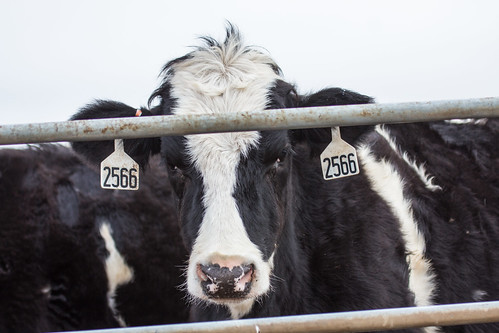
My favorite cow
Modern cattle branding includes microchips and ear tags.

My dog Pip and I may think of ourselves as family, but legally she is property, and I have the microchip registration that proves my ownership. 

Shorn little Pip
My dog Pip?
I have a license to keep an education owl, Archimedes, but he is not property, and I am not allowed to refer to him as a pet. My license to possess him is limited, and the U.S. Fish and Wildlife Service has the legal authority to confiscate him at any time for any reason.
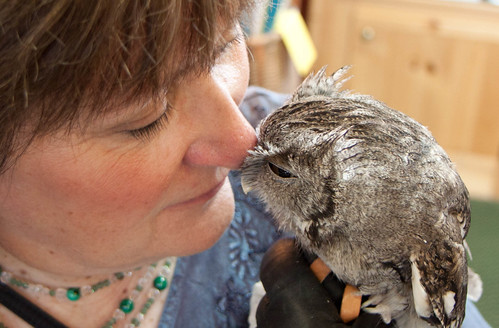
An owl and his human
Me and Archimedes, a licensed education bird, not property or a pet. 

It’s not that the federal government holds with any belief that wild birds have an intrinsic quality that transcends possession, ownership, trademarks, or branding. It’s just that the federal government itself claims ownership of America’s wildlife. Governmental agencies can grant permits to individuals to permanently mark wildlife, including embedding microchips in their flesh, for research purposes, but again, the bird banders and other wildlife researchers doing this don’t “own” those animals—the same federal government that does not own the trademark on Yosemite National Park’s named features does own every animal within the park and beyond.

Specific images of wild animals can be trademarked: Coca Cola uses both accurate and stylized depictions of their trademark polar bears in their ads, and the Minnesota State Lottery uses images and sounds of real wild loons on their commercials and official logo, but neither they nor anyone else can trademark or claim ownership over an actual species. People often say chickadees are my “trademark” bird or my “brand.”  They mean well, but I find myself growing increasingly impatient with the whole concept of trademarks and brands, except on manufactured products belonging to corporations. Just because I love chickadees and many people associate them with me, or just because I refer to the chickadees living in my neighborhood as mine, doesn’t mean they belong to me or anybody else. No one can possibly own loons or chickadees, Yosemite National Park, or William Shakespeare. The best things in life are free, in both senses of the word. 
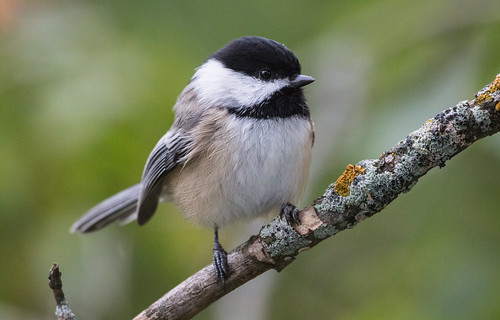
Black-capped Chickadee


Monday, April 18, 2016

A few lovely poems from J. Drew Lanham's wonderful Sparrow Envy


I love poetry, I love birds, and I love the magical spaces where birds and poetry intersect. One of my treasured friends, J. Drew Lanham, Alumni Distinguished Professor of Wildlife Ecology in the Forestry and Environmental Conservation Department at Clemson University, lives in what he describes as the shadows of the Blue Ridge Escarpment of South Carolina. He’s a great birder and a wonderful writer whose evocative poetry stirs my imagination and draws me into the warmth and magic of life in South Carolina the way Robert Frost’s poems draw me into rural New England. 

Drew just put together a gorgeous book titled Sparrow Envy, published this month by Holocene Press. I’d have been delighted enough had he given me permission to read a few of his poems. Imagine my elation when he agreed to read them himself, in his rich voice! (I didn't transcribe his poems to prevent unauthorized copying. If you can't easily read them from the images, click on them to hear the poems read by J. Drew Lanham himself.)

I’ve been overwhelmed with writing assignments lately, drawing me to his “Wild Wishes beyond Widgets.”


I’m directionally impaired, but always thinking about where I want to be, both geographically and metaphorically, so I find “Compassing” especially evocative.


Anyone whose eyes are drawn skyward as migrating birds pass over can be drawn into “A Dream of Swans.”


As night passes into morning and reality intrudes on our R.E.M., or “rapid eye movement” dreaming sleep, we may find a deeper purpose to our day if we open our hearts and minds to what J. Drew Lanham calls “Wren R.E.M.”


If you want to get an autographed copy of this splendid book of poetry, send $16 to:

J. Drew Lanham
112 Kirk Drive
Seneca, SC 29678

J. Drew Lanham

Sunday, April 17, 2016

The Cruelty of a South Wind

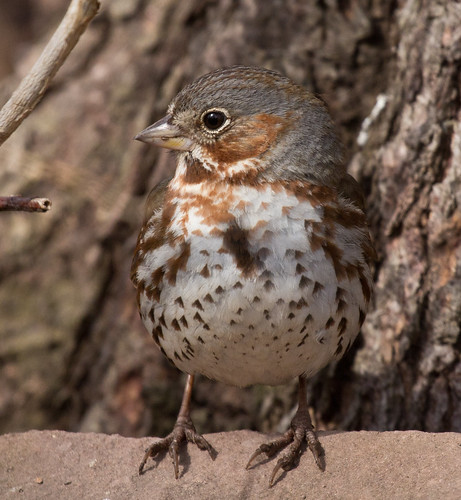
Fox Sparrow
Fox Sparrow

One of my friends recently moved to Duluth from Bemidji. He seemed utterly distraught on April 14, when the high here was 43 degrees but 78 in Bemidji. I don’t know if T.S. Eliot was thinking specifically about Duluth when he wrote that April is the cruelest month. Other places may have it as bad, but I don’t know how anyone can have it worse than those of us on the north shore of the largest, coldest lake in the U.S., at least as far as frigid temperatures so close to where people are getting ready to plant tomatoes.

The problem is our location on the north shore. We relish Lake Superior’s influence in summer when we’re enjoying temps in the 60s or 70s while it’s pushing three digits in Bemidji, or in winter when the lake modifies the sub-zero temps of whatever large system is driving record lows away from the lake. Balmy weather conditions in spring ride in on south winds—and everywhere west of Duluth, those south winds carry the warmth from warmer places further south. But Lake Superior chills those south winds significantly.

This year April was colder than average in a much wider swath of the country than just Duluth, so sudden balmy conditions sent a huge migration our way. Even as redpoll and Bohemian Waxwing numbers were at the peak, a whole bunch of new migrants from the south were carried up on that south wind. On Friday the 15th, Ryan Brady experienced an enormous migration event in Herbster, Wisconsin, when he counted 8,979 birds of 64 species in just 5 hours. He posted his results on the Wisconsin Birding Facebook page. His top ten species numbers were: 
  • 4,925 American Robins 
  • 1,232 Northern Flickers  \
  • 794 Rusty Blackbirds 
  • 769 Common Redpolls 
  • 212 Yellow-rumped Warblers 
  • 140 Common Grackles 
  • 72 Purple Finches 
  • 59 European Starlings (which Ryan noted were actually migrating) 
  • 58 Pine Siskins 
  • 44 Yellow-bellied Sapsuckers.

Ryan also listed a bunch of other cool birds that were actively migrating: Belted Kingfishers, Wilson's Snipe, Brown-headed Cowbirds, Fox Sparrows, Bohemian Waxwings, Evening Grosbeaks, White-breasted Nuthatches, Lapland Longspurs, and a Trumpeter Swan. He counted 91 Long-tailed Ducks on the lake and a dark-morph Red-tail among a decent raptor flight inland, too. 

Russ took this photo of me in my Bruce Pomeroy Photo Blind a few years ago.

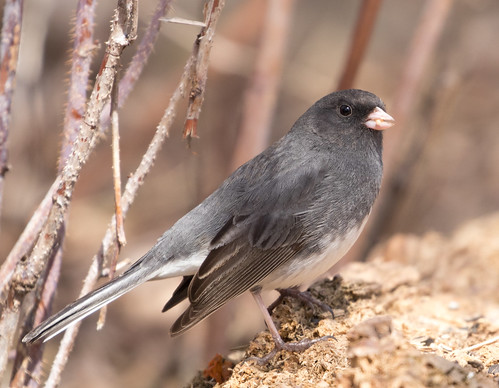
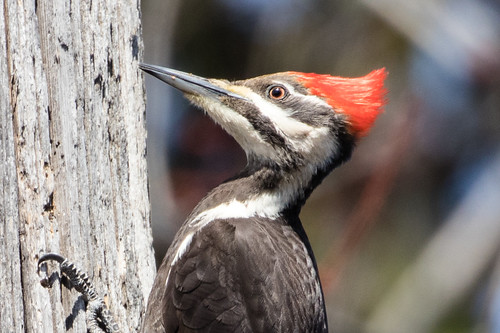
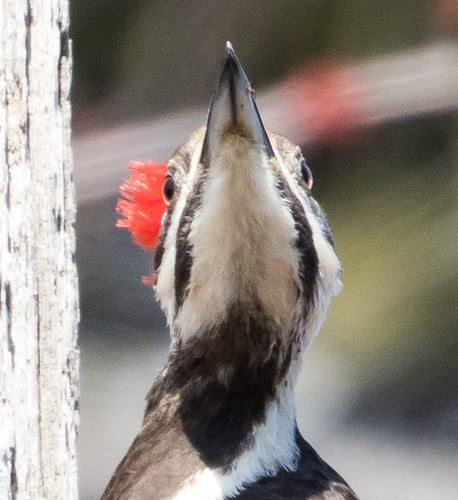
For a couple of hours that day, I sat out in what I call my Bruce Pomeroy Photo Blind: a cool camouflage tent given to me by a friend, testing out my new camera on juncos and a briefly cooperative Pileated Woodpecker. 

Dark-eyed Junco
Dark-eyed Junco

Pileated Woodpecker
Pileated Woodpecker

Pileated Woodpecker
Pileated Woodpecker

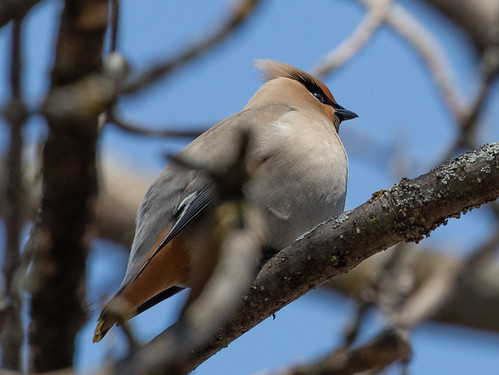
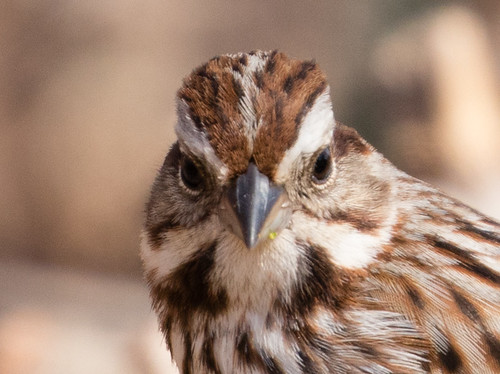
Migration through Duluth was more pronounced closer to the tip of the lake, at Park Point, and our hawk count at West Skyline has been producing hundreds of raptors—mostly Bald Eagles and Red-tailed Hawks—but once birds clear the lake, migration trends north, not east, so I don’t see actual migration events from my own backyard in spring very often. All weekend I kept seeing good birds—redpolls and Bohemian Waxwings lingering as robins and Song Sparrows sang their hearts out. Kinglets, Brown Creepers, and Fox Sparrows were among the typical April migrants. And the neighborhood’s squawking Merlins were a noisy reminder that birders aren’t the only ones enjoying the abundance of new birds.  
Bohemian Waxwing
Bohemian Waxwing


Song Sparrow
Song Sparrow

April may be the cruelest month weather-wise, and that cruelty can extend to birds that get slammed by nasty weather after arriving on a false promise of spring or get gobbled up by a hawk or falcon. But April is also a rich month, full of promise and filled with birds. And week by week, April gets better and better, but unlike May, when April is over, the very best of spring migration is yet to come.

Wednesday, April 13, 2016

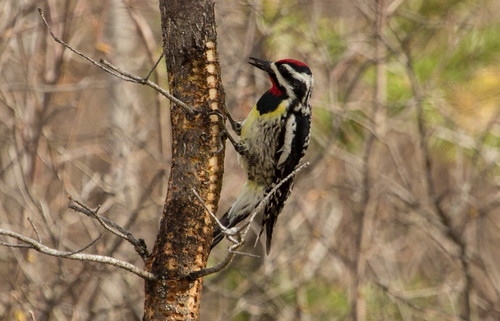
Yellow-bellied Sapsucker

Yellow-bellied Sapsucker
Male Yellow-bellied Sapsucker
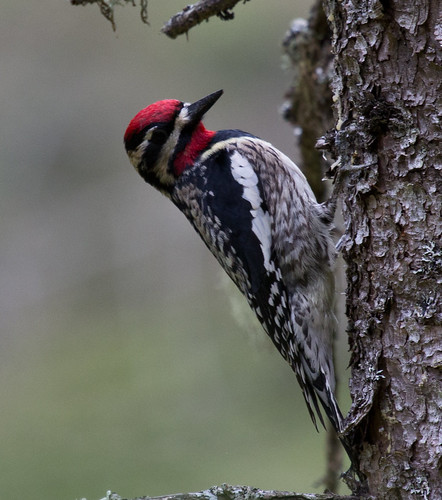
One of my friends on facebook, who lives outside Chicago, was thrilled a few days ago when a Yellow-bellied Sapsucker spent a day in a conifer right outside her window. Jodie Cregier Nettelhorst reacted pretty much the way I do when I get a sapsucker in my yard. She said, “I feel so lucky. It sat on the tree for hours… [and] I sat for hours watching it. I thought for sure it would fly off before I got my camera out and ready so I waited for a long time. Then when the neighbors came and went and it still didn't fly off I decided to quit watching to get my camera. It was still there after my boys came home from school." Jodie wondered what brought to her yard a bird that neither winters nor breeds near her.

Jodie Cregier Nettelhorst's male Yellow-bellied Sapsucker as seen through her window.
Birds don't have access to Star Trek's transporters—they can't just get beamed up from their winter to summer range—and April is the month when they pass through the vast in-between area. When their body is in shape and weather conditions are right, they migrate by night, depleting their fat stores to fuel the long journey. Wherever they find themselves in the morning, they settle in to rest and feed. When their fat stores are replenished, they head out once again.

From All About Birds. Yellow-bellied Sapsuckers 
breed in the dark red, winter in the blue, and 
simply pass through in the yellow.


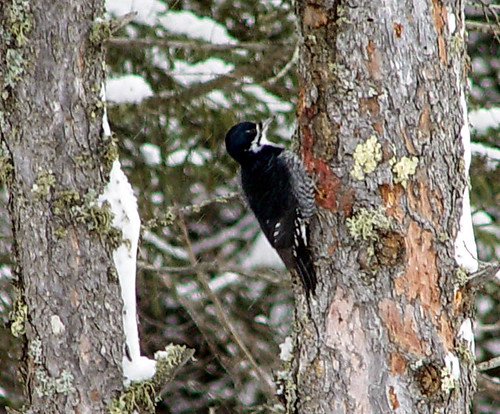
Many woodpeckers move at least a bit from place to place between seasons, and a few species, such as Black-backed and Three-toed Woodpeckers, travel long distances in search of tree stands harboring the insects that attack diseased or burned trees.

Black-backed Woodpecker
Black-backed Woodpeckers like this one flake bark off diseased trees to get to the insects beneath.

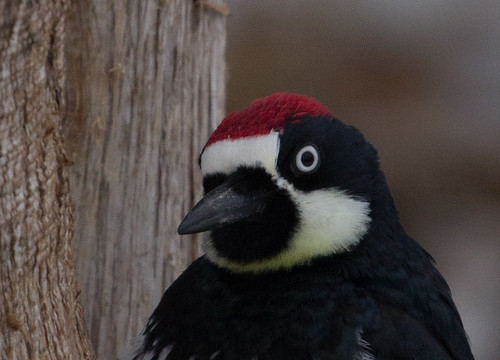
But very few woodpeckers undergo what we traditionally think of as standard bird migration, with annual movements between a northern breeding range and a non-overlapping southern winter range. Why so few? It takes time and work to dig out wood-boring beetle larvae and other prey insects deep in trees. By staying within the same area year-round, each woodpecker can keep track of the health of and insect-populations within lots of individual trees. Some woodpeckers, including Red-headed and Red-bellied, use acorns as an important food resource, storing a great many for future use. Acorn Woodpeckers are especially adapted for this. Sticking around in the same place allows them to protect and utilize those food stores.

Acorn Woodpecker
Acorn Woodpecker
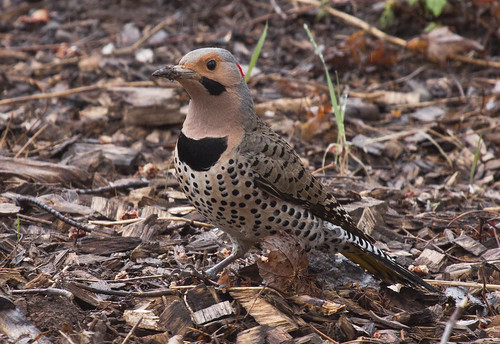
Most woodpeckers roost in cavities that take many hours each to excavate and must be defended against invaders like flying squirrels and starlings. Investing all that time and energy in hard-won resources makes this group, as a whole, non-migratory. Yet two woodpeckers, the Northern Flicker and Yellow-bellied Sapsucker, are regular migrants. Flickers are specially adapted for feeding on ants, which aren’t accessible when the ground freezes or is snow-covered, so they retreat south for the winter.

Common Flicker
Flickers feed on ants and other insects in the soil.
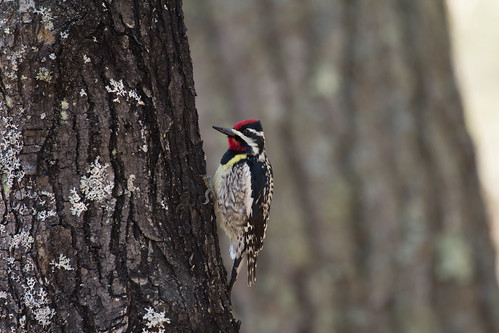
Yellow-bellied Sapsucker
Sapsuckers are functionally illiterate, and this one hasn't read that it's supposed to stay in trees. 
Our good old Yellow-bellied Sapsuckers return north as sap starts running in trees. They dig tiny ports around the trunk or a large limb, often in a perfect circle, and stick around most of the time, lapping up the sap that oozes out with their specialized, brushy-tipped tongue.

The sapsucker makes two kinds of holes for harvesting sap. Round holes extend deep in the tree and are not enlarged. Rectangular holes are shallower, and must be maintained continually for the sap to flow. New holes of either type are often made in line with old holes to encircle the trunk, and then the woodpecker starts a new row of holes above the old.The sapsucker licks the sap from these holes, and also eats the cambium of the tree and insects drawn to the sap.

Yellow-bellied Sapsucker
If you look carefully, you can see tiny holes on this large limb. 
Yellow-bellied Sapsucker
These shallow, rectangular holes must be maintained or the sap will stop running to them.
The work involved in creating and defending these holes gives each sapsucker a vested interest in staying near them until it continues migration (the holes eventually seal up). Meanwhile, the quieter each one is, the less likely other birds will notice those drill holes and chase it off. Sapsuckers are pretty meek: I've seen birds as tiny as Cape May Warblers drive them away. This is why people seldom notice them during spring migration unless specifically looking for them.

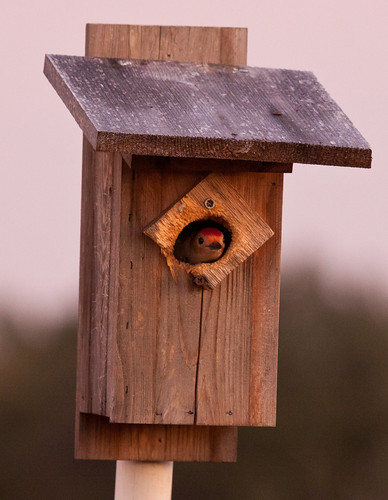
 Woodpecker species that show sexual dimorphism, meaning the males look different from females, virtually always show those plumage differences on their heads, which allows them to recognize each other's sex when one is inside a cavity with just the head sticking out.

20110202-IMG_1290.jpg
This Red-bellied Woodpecker can be recognized as a male by its
red forehead, easy to see even when it's within a cavity.
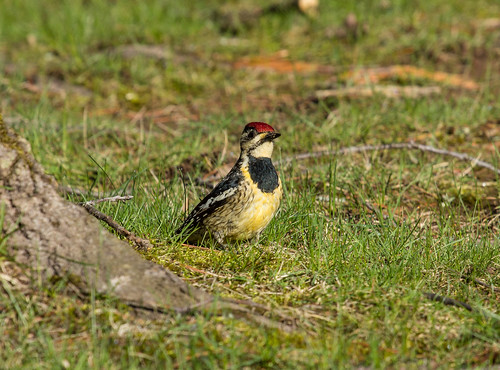
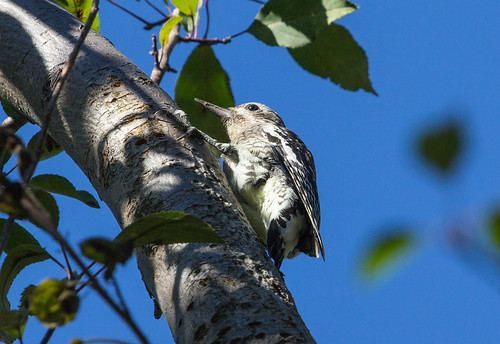
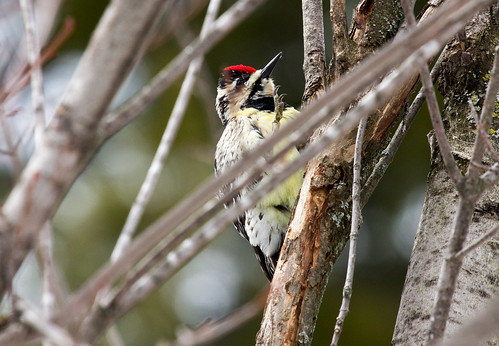
Both male and female adult sapsuckers have red crowns, but males also have a red throat. (Young birds, which we'll see starting in June, lack red.) Some adults lack yellow bellies; those that do have yellow on the underside usually keep it hidden against tree trunks.

Yellow-bellied Sapsucker
If facing the right way on a narrow branch, you might get a peek at the yellow belly, like on this female.
Although usually quiet on migration, lucky people may hear a sapsucker occasionally making its whiny mewing call, which is pretty easy to recognize. Those of us in the north woods where sapsuckers breed hear this sound a lot. Their territorial drumming sounds, only very rarely heard on migration, are exceptionally easy to recognize—they don’t have a steady rat-a-tat drum roll like other woodpeckers but a slower, much more arrhythmic one. Listen to the calls and sounds at All About Birds here.

 Any day now, I’m going to find my first backyard sapsucker feeding quietly in my aspen tree, where I’ve seen my first every year since 1981. During cold snaps, I might spot a Ruby-crowned Kinglet or Yellow-rumped Warbler at the drill holes. Crows carrying sticks; robins, grackles, and Killdeer are my first reliable signs that spring is really coming. But my first backyard Yellow-bellied Sapsucker is my official sign that spring has actually arrived, and all is right in my world.

Yellow-bellied Sapsucker


Wednesday, April 6, 2016

A Birder's Guide to Gracious Deportment

Pip the Birding Dog
A few minor changes and this birder would be properly attired for virtually any social occasion.  

Back in 2004, a group of whimsical Duluthians organized what they called a Geek Prom at the Great Lakes Aquarium. Being an everyday, stereotypical, geeky birdwatcher, I was asked to serve as a judge. Many birders bristle at the very thought of being considered a geek, which is defined in the American Heritage Dictionary as “A person who is single-minded or accomplished in scientific or technical pursuits but is felt to be socially inept.” In my case, as a person who grew up considering Miss Jane Hathaway a perfect role model, I can’t think of a more apt description, so I jumped at the opportunity.

At the time, a few people seemed to think I should be offended, though I thought the whole idea of a geek prom was pretty cool. I decided to make it clear that I wasn’t deficient in the social graces by appointing myself the “Miss Manners of Birding,” and wrote a few basic rules of etiquette for birders. Over a decade later, those rules need to be updated a little.

When dining with friends or family, at home or a restaurant, and an interesting bird is seen or heard, it is inconceivable that anyone would not jump up, grab the nearest binoculars, and gaze intently out the window. In this situation, the only issue of good manners revolves around nearby diners. Miss Manners chides anyone for rudely staring at a person for any reason. If someone does stare or comment negatively, it is he or she who is behaving in a socially inept way, and besides that, is missing a good bird.

In 2004 I wrote:
When watching a movie at a theater, a birder may quietly announce, right at the movie’s dramatic climax, that a Savannah Sparrow is singing in the background.  And how could that birder possibly keep from pointing out that the habitat is all wrong for that species?  Occasionally the theater-goer sitting behind may kick our seat hard and go “shhhh!” but he’s probably repositioning himself for comfort, and gasping with surprise or excitement at the movie or the sparrow.  If our own date or spouse elbows us for identifying a bird during a movie, the graceful way to deal with it is to suggest taking an anger management class.
In 2016, I realize that this advice also holds when we are watching a movie or television show at home. One of the most fundamental underpinnings of etiquette is the need for generosity among community members, and what could be more generous than sharing valuable ornithological information that will better inform the entire viewing audience about the birds depicted at that moment? The movie's sound director made a specific decision to insert a bird vocalization, be it a Kookaburra or Red-tailed Hawk, into that scene for a reason, and it would be dismissive and rude to ignore this important contribution.

When traveling on a non-birding excursion with friends or family and riding in the passenger seat, one should never insist that the driver stop and back up a little so you can identify a bird on a power line more than once every six miles, though if two intriguing birds appear within less than six miles, it's perfectly allowable to ask again as long as the total number of stops to accommodate your birding hasn't exceeded an average of once every six miles. Miss Manners regrets that on some interstate highways and where traffic is heavy and the shoulder narrow, factors other than etiquette may enter into the driver’s decision whether to comply, but it's no breach of proper deportment to ask. 

At any major social event, the well-appointed birder's attire will be accessorized with a tasteful pair of fine optics. At most funerals, the binoculars should be black or a dark neutral color.

When weddings or funerals are held in the out-of-doors, pishing during the ceremony is a serious faux pas unless the bird could be a lifer.

Tilley hats are considered gauche in most formal settings: to avoid a serious fashion breach, most birders cover the hat with bird-themed buttons and pins. If the bride or widow is a birder, it’s perfectly acceptable for her or her seamstress to arrange a veil over the hat. At formal gatherings and most weddings and funerals, another clever solution is to place a large Chicago Cubs “This Year for Sure!” button on the hat, which both draws attention from the Tilley hat and serves as a perfect conversational ice-breaker. Smoothing social discourse in subtle ways such as this strengthens the social fabric of our lives.

The bride is expected to make eye contact with at least 74 percent of the people in the receiving line even on a peak hawk migration day, though all but the most self-absorbed guest would excuse her for cutting out if a Mississippi Kite flies over.  If the bride or groom gets a text message about a rare bird showing up a hundred miles away that day, she or he is only allowed to skip out on the reception and first night of the honeymoon if the bird is a lifer, or at least new for a state, county, or year list. If the bride or groom has started a Wedding Day list, chasing a good bird under any circumstance would of course be allowed.

Adhering to these simple rules of etiquette should allow every birder to blissfully yet responsibly build up our bird lists even as we impress everyone we encounter with our unimpeachable social graces. 

Tuesday, April 5, 2016

First Red-winged Blackbird of Spring

Red-winged Blackbird - detail

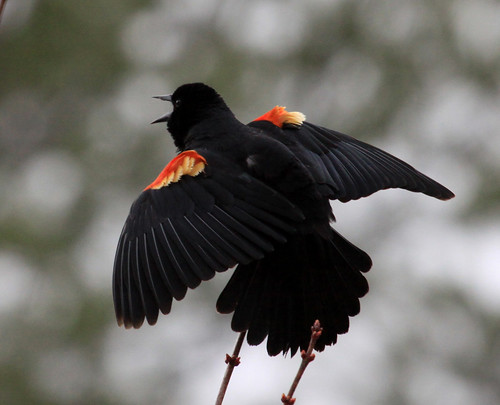
On March 18, 1975, Russ’s and my third wedding anniversary, we headed out for a romantic walk at the Little Red Schoolhouse Nature Center in the Cook County Forest Preserve District, where we came upon the first Red-winged Blackbird I’d ever seen. This was a lifer, not a sign of spring, for me.

On March 6 the following year, I saw my first Red-winged Blackbird of the year at Point Pelee in Ontario. That was new for my Canada list, but I think the thrill came more from it being back in a marsh—I was still a new birder, but within that first year I could already feel deep within me the difference between a winter marsh and a spring marsh, and the Red-winged Blackbird was at the very heart of that.

In every one of the 40 springs since then, the first Red-winged Blackbird of the year has given me a surge of joy. This may be one of the most common songbirds in North America, considered a serious agricultural pest, but what does that matter after a long winter when I’m hungry for warmth and evidence that spring really is coming?

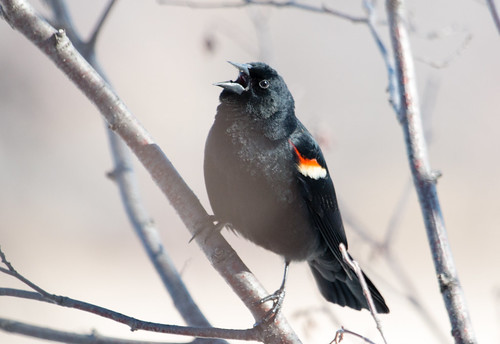
So this year on March 12 when I led a field trip along the Western Waterfront Trail in Duluth, I turned my hearing aids up a notch so I could be sure to pick out the thrilling O-ka-lee call. A couple of participants picked up the sound before I did, but we all heard some half-hearted songs as well as a few whistles and other notes. 

Red-winged Blackbird

The marsh was still mostly frozen, and only three birds had so far returned. One was on the far side of the river, and the two on our side were far apart. Being so far apart gave each the feeling that he controlled an improbably large territory. No nearby birds flaunted their epaulets in his face or sang out, so none of the three had to work at all to defend his vast real estate holdings. Those happy notions would within days be dispelled as more and more male Red-wings arrived to contest their titles to the land, but for now the three felt rich and powerful.

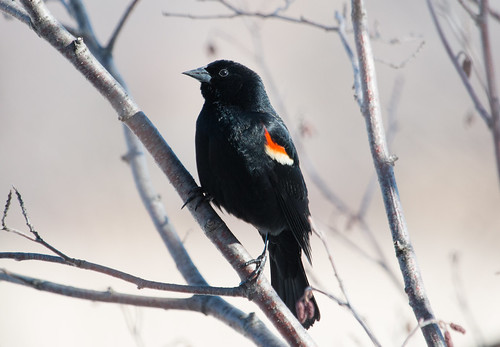
It doesn’t matter that I see Red-wings every year, and that in most years I see them at least once in every month. And it doesn’t matter that I’d already seen thousands of Red-wings in California this year. The first Red-wing of spring is a special kind of magic. We perceive the magic partly through our senses—on our field trip, we could feel the warmth of the sun on our faces as we walked about with our jackets unzipped; our eyes could savor the brilliant red epaulets against glossy black plumage; our ears could drink in the sound of voices carried on a soft spring breeze; our noses could sniff out at least a hint of the deliciously wormy fragrance of spring mud and new grass; and our beating heart’s innate sense of rhythm could be reassured as this new encounter fit into the natural rhythmic pattern of so many previous first Red-wings of spring.

We know with absolute certainty that we’ll see Red-wings each year, and we know with reasonable certainty that we’ll see our first in March on a day just like March 12 was. From the parking lot before we even started out, most of the participants were already speculating on the high probability that we’d see them on the hike. But that certainty is akin to a child’s certainty that he or she will get a birthday or Christmas present—the certain expectation hardly diminishes the thrilling joy the moment the anticipated present appears in reality. And in the end, that’s what the first Red-wing of spring is: a living, breathing, tangible gift, beautiful in its own right as well as solid proof that the natural world is just as it should be. We can count on it.

Red-winged Blackbird

Sunday, April 3, 2016

Clean Water

Sanderling
Sanderlings need clean water, too. 

I live in one of the older neighborhoods of Duluth, and my house was the first built on our block, sometime between 1900 and 1910, long before Peabody Street was paved, so it’s set closer to the road than any other house on the block. The water and sewage lines in my neighborhood are quite old, and little by little have been needing to be patched up and even replaced. A few years after we moved in, Russ noticed that our water lines were lead—it cost us thousands of dollars to replace them at a time when we were just starting out, but it would have been even more had our house been set further back like the other houses. In Duluth, lead can be found in the joints of the old cast-iron water mains that still serve much of the city, and Duluth has just shy of 2,000 lead pipes connecting mains to curbside valves — about 7 percent of its total connections. On top of that, the city has a large number of older homes like ours with lead service lines or lead-laden plumbing. Fortunately, Duluth draws water out of Lake Superior, not the Flint River, so the water isn’t leaching all that much lead out of people’s pipes into their drinking water. 

A few weeks ago, a valve down the block suddenly quit, and the city had to turn our water off for several hours as they put in a new one. While they were working on it, they discovered that the valve right across the street from us was also reaching the end of its life, and so a week or so later, they had to turn off our water again to fix it. They gave us plenty of warning both times so we could time showers for before or after and fill water bottles and the bathtub beforehand, and both times the water was turned back on ahead of schedule. We suffered the bare minimum of inconvenience and our taps were running again with Lake Superior’s wondrously clean water.

Well, it’s pretty darned clean. The entire Duluth water system’s infrastructure is slowly crumbling, and not just the pipes that carry the water to our homes. We had heavy rains in March—2.7 inches fell on March 15 and 16, the largest March rainfall on record here, and 5.7 million gallons of wastewater, including untreated sewage, flowed into the lake. The 12.5 million gallons of backup storage tanks that are usually empty were filled to capacity with runoff from storm sewers, overflowing at four centers including one at WLSSD.  Duluth had just added capacity after our last overflow incident in the July 2012 flood, which normally would have been plenty, but the rains fell on already saturated soil. David Montgomery, Duluth's chief administrative officer, was quoted in the Duluth News-Tribune warning that with changing weather patterns due to climate change, these 150-year events could be happening much more frequently. I got horribly sick in the 1990s when I was rehabbing and ended up with four sanderlings that had become sick after one of these sewage events.
We Americans expect to be able to walk to any sink or tub, turn a faucet, and have clean running water. The city water in Duluth is remarkably clean despite people’s lead pipes and the occasional sewage overflows, especially compared to water in other cities, but we can’t count on it lasting forever unless we are proactive.

Ever since the 1980s, Americans have been acting like a family that purchases a house way beyond their means and is both falling behind on the payments and not bothering with proper maintenance. I’m bewildered how we as a nation could have lowered taxes, especially on households earning more than $200,000 a year, at the same time that we’re falling further and further behind on basic infrastructure.


People in Flint have been drinking toxic water since April 2014—many children there have suffered irreparable damage to their brains.  The water lines in the most damaged neighborhoods were built between 1901 and 1920, exactly when my neighborhood was built. Once the lead-infused water of Flint is flushed or washed down the drain, that water ends up flowing into the sewage system, which can clean up a lot of basic filth from household wastewater but can’t do much at all about lead, which eventually pollutes natural water. Yet somehow politicians still endure when their entire platform is to “shrink government and drown it in the bathtub.” Even that bathtub requires a functioning public water system. Every one of us humans and all the birds and other wildlife that drink from our lakes and rivers depend on clean water for our health and wellbeing. Any politician who doesn’t grasp that elemental fact should not be in office.