Laura Erickson's For the Birds

Thursday, July 14, 2016

Kirtland's Warbler: Endangered Species Act Success Story!

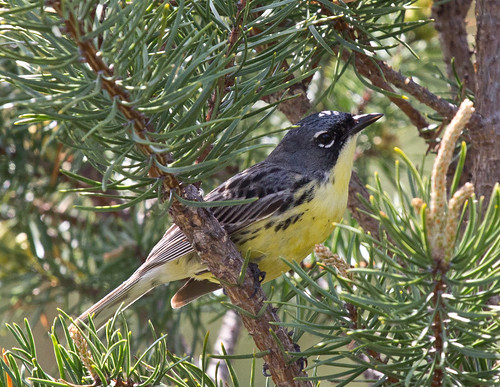
Kirtland's Warbler

In the movie When Harry Met Sally, Sally Albright orders a piece of pie in a restaurant saying, “I'd like the pie heated and I don't want the ice cream on top, I want it on the side, and I'd like strawberry instead of vanilla if you have it, if not then no ice cream just whipped cream but only if it's real; if it's out of the can then nothing.” The waitress asks, “Not even the pie?” and Sally responds, “No, I want the pie, but then not heated.”

In the movie, that particular brand of fussiness is part of what endears Sally to us. We humans are a varied lot, from people who just grab a chunk of pie into their hand and gobble it down to people who are very particular about every little element of their food.

Kirtland’s Warbler is rather the Sally Albright of the bird world. It nests in areas of pine, but not just any pine—Kirtland’s Warbler must have jack pines, and want them in stands over 80 acres in size. The jack pines must be growing on well-drained soil, and not just any well-drained soil—the birds want what’s called Grayling sand, which has very low humus content so water percolates right through and the nests don’t get flooded. And Kirtland’s Warblers won’t accept just any old jack pines—the trees must be no younger than about 5 years old, and no older than about 20 years old. The warblers nest on the ground beneath the pines, and need for the trees to be large enough for their bottom branches to provide protection, and stop using the trees altogether when they’ve lost their lower branches. Ideal habitat for them was historically found within a large swath of the northern part of Michigan’s Lower Peninsula.
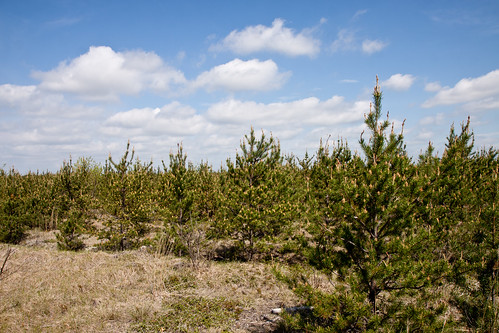
Kirtland's Warbler habitat

Kirtland’s Warbler was first described for ornithology in 1851, when a migrant was collected outside Cleveland, Ohio. One wintering in the Bahamas was shot in 1879. But ornithologists didn’t discover the actual breeding grounds in Michigan until 1903, in Osceola County. The big, beautiful warbler with the loud voice attracted a lot of research, but not a single nest was found farther than 60 miles from that first nest until 1996.
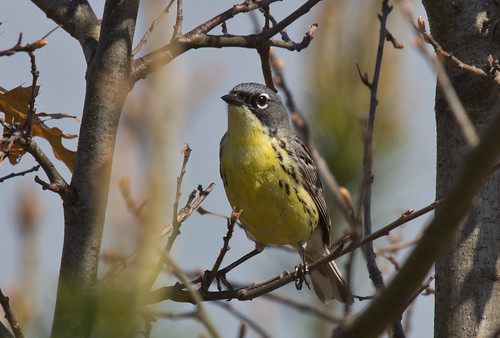
Kirtland's Warbler

That precise habitat is rather forbidding for us humans—the low nutrient content of Grayling sand makes it inappropriate for agriculture and for manicured lawns both. There had always been plenty of jack pines the right age in that area of Michigan, where forest fires occurred rather frequently due to the dry conditions. Jack pine cones don’t open to release their seeds until they’re exposed to the extreme heat of fires, so they’re among the very first plants to pop up after a forest fire. Unfortunately, decades of forest management that included fire suppression severely limited new growth of jack pines, and by 1975, there were slightly fewer than 200 singing males. Michigan designated the Kirtland’s Warbler the “Bicentennial Bird.” Researchers covering the species entire range managed to find just about exactly 200 singing males that year. Only 167 singing males were found in the census at the low point in 1987. Kirtland’s Warbler was our rarest endangered songbird except for Bachman’s Warbler, which is now extinct.
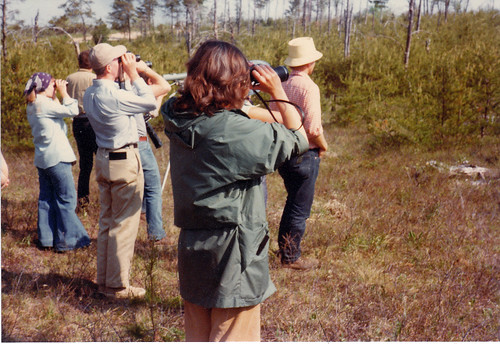
Me looking at my lifer Kirtland's Warbler
Me looking at my lifer Kirtland's Warbler on June 6, 1976. That year there were barely 200 pairs. 

Thanks to the Endangered Species Act, foresters started managing Michigan’s jack pine forests for Kirtland’s Warblers, using fire as the primary tool to ensure that there were plenty of jack pines the right age. Unfortunately and tragically, a fire in 1980 went out of control, destroying 40 homes and killing a young Forest Service worker. The burn obviously had to change some of our approaches to management in the area, but by the late 80s, that burned over area provided so much appropriate habitat that, combined with Brown-headed Cowbird removal, the Kirtland’s Warbler population started growing. In 1993, the census found 485 birds, more than double the low of six years earlier, and now the population includes over 2,000 pairs—so many that some had to spill out beyond the species’ original narrow range to claim any territory at all. Now we have a few nesting pairs in the Upper Peninsula of Michigan, Ontario, and Wisconsin.

Kirtland’s Warbler was doing just fine despite its fussy ways until we humans started suppressing fires and destroyed the tight relationship between Brown-headed Cowbirds and bison. Fortunately, this lovely bird with its cheerful song is as endearing as Meg Ryan’s Sally, giving us humans plenty of incentive to act as the species’ own Harry. As long as we can ensure the continuation of appropriate habitat for Kirtland’s Warblers and make sure cowbirds don’t wipe out their reproduction, the Sally Albright of the bird world should continue to thrive, thanks to the Endangered Species Act.
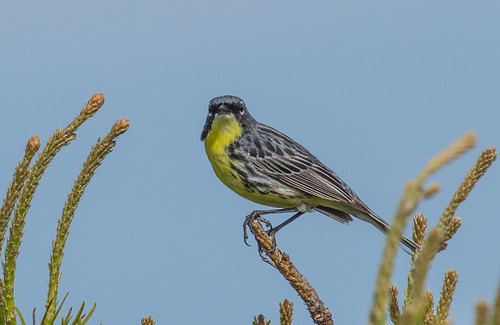
 Kirtland's Warbler


Wednesday, July 13, 2016

Endangered Species Act: A Big Success!

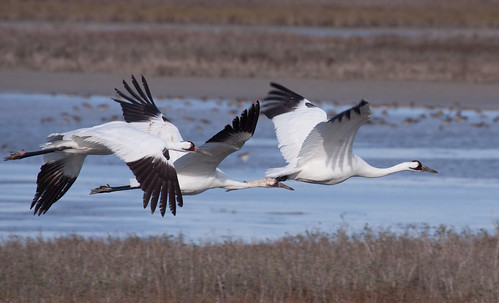
Whooping Crane

One of the most frustrating elements for me of the toxic political climate today is how little facts seem to matter anymore in public discourse. It’s become a common belief that the Endangered Species Act hasn’t worked because, since its passage in 1973, only a handful of species have recovered enough to be de-listed. Just between 2011 and2015, over 50 bills have been introduced trying to dismantle the Endangered SpeciesAct, usually on the grounds that it has been a huge failure. 

How can anyone argue this when Bald Eagles and Peregrine Falcons are so obviously doing well? They say the Endangered Species Act had nothing to do with these species’ recoveries—it was simply the banning of DDT. It takes a certain level of chutzpah for the same people who still decry banning DDT in the United States to seize upon that ban as the entire reason for the recovery of these species, but as entertainment and politics become increasingly intertwined, chutzpah seems the order of the day.

In reality, the Endangered Species Act sets forth provisions for researching the specific needs of each listed species and the causes for its decline, and requires the development of a specific plan of action created by researchers, state departments of natural resources, landowners, and other stakeholders that focuses on the specific needs of that species. Each recovery plan includes benchmarks of success that set a minimum population level at which a species can safely be de-listed, along with an expected timeline for this to happen. The Senate unanimously voted in favor of the Act, Congress voted 390–12 in favor, and Richard Nixon signed it. The U.S. Supreme Court found that “the plain intent of Congress in enacting” the ESA "was to halt and reverse the trend toward species extinction, whatever the cost.”

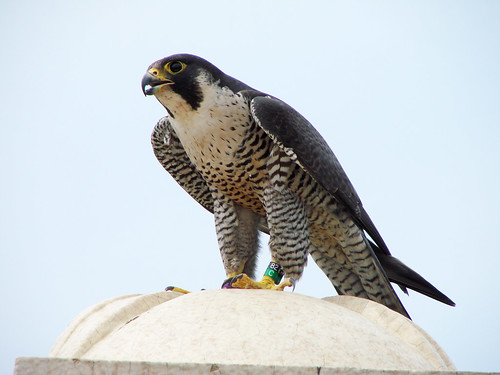
Peregrine Falcon

In the case of Bald Eagles and Peregrine Falcons, the banning of DDT was certainly a primary cause of the endangerment in the first place. But both species had declined over most of their former range to critical levels—nesting Peregrine Falcons had been completely wiped out over the eastern United States. For either to recover, research into nesting requirements and sturdy protections of habitat and nesting areas were crucial; in the case of Peregrine Falcons, painstaking reintroduction projects after developing techniques for captive breeding, all funded by the Endangered Species Act, were also essential.

We humans are an impatient and shortsighted species. Back in 1973, everyone knew what a long, hard battle was needed to bring each species back from the brink, especially because virtually all endangered and threatened species are imperiled not by one easily fixable thing but by an assortment of causes, some very hard to address. But that law was passed 43 years ago—before most people living in the United States today were even born. Nowadays, it’s easy to pull a fast one on people, claiming the Endangered Species Act doesn’t work simply because it does take a long time to bring some species back.

Fortunately, a new report by the Center for Biological Diversity was released this week, documenting just how successful the Act has been with regard to birds, the group of animals most easy to accurately census. Fully 85 percent of the 120 bird species protected under the Endangered Species Act in the Continental United States increased or stabilized their population size since being protected, and the average population increase was 624 percent. For the most part, birds are recovering at the rate and magnitude intended by the Endangered Species Act’s congressional creators and administrative overseers. And birds listed as endangered fared much better than unlisted birds, which on average have declined 24 percent since 1974.


It’s impossible for a significant majority of Americans today to remember the ‘70s, when condors, eagles, osprey, and falcons were virtually gone; when the state bird of Louisiana, the Brown Pelican, had been entirely wiped out in Louisiana; when the extinctions of Black-capped Vireos, California Gnatcatchers, and Kirtland’s Warblers loomed in the foreseeable future. Today, those of us who were adults at the time and do clearly remember are ourselves disappearing. So in coming days I’ll focus on some of the dramatic successes of the Endangered Species Act.

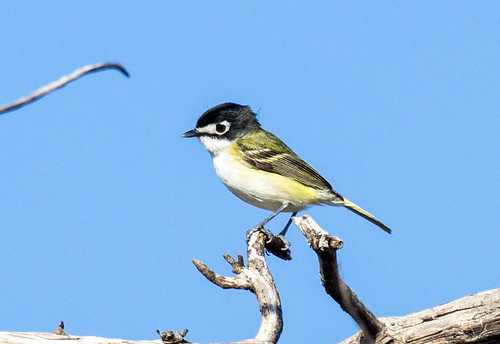
Black-capped Vireo

Tuesday, July 5, 2016

Red-bellied Woodpecker nest update

Red-bellied Woodpecker male with a tasty morsel.

I’ve been checking on my Red-bellied Woodpeckers every day, and every day the chicks, still entirely hidden in the cavity, get noisier and more insistent. When I returned from Maine on June 15, probably only a day or two after they’d started hatching, I couldn’t hear any sounds during feeding time; it took a few days before I could pick up tiny whispery sounds, and I needed my hearing aids to pick up that. When the parents came in with food, they usually brought a few small items, and they spent a minimum of two or three minutes inside the cavity feeding the young, and probably brooding them to help them maintain a healthy body temperature. Baby woodpeckers hatch out in a very undeveloped state, and need a lot of gentle attention to survive, much less to thrive.

As the days passed, the little guys first grew louder during feedings, and then could be heard for seconds, and then minutes, after the parent left the nest. Now I’ve been back for almost three weeks, and the ever-growing babies are keeping up their insistent begging even longer. They’re staying below the cavity entrance so I still can’t see them, but over the weekend the parents started holding food at the entrance now and then, reaching in several times as if to entice them to the entrance hole. Through Sunday the parents still had to go all the way in to reach the chicks, but on the Fourth of July, the babies could climb high enough that both parents could deliver the food while remaining at the entrance hole. Any day now I’ll see the first baby face.

Red-bellied Woodpecker

The nestlings take the food as fast as the parents can deliver it, so feedings are short and sweet—sometimes literally so, because now the parents sometimes bring berries as well as insects. Insistent calling draws the parents back much more frequently now, often with just a single big grub, and feedings last only one or two seconds.

Red-bellied Woodpecker

On Saturday morning, July 2, in one 15-minute period the parents came in 10 times; in the next 21 minutes, they returned only 3 times. On the videos I made, you can hear Hairy and Downy Woodpeckers, flickers, crows, robins, cardinals, Chipping Sparrows, and a Red-eyed Vireo. The Red-bellied parents pretty much ignored them unless one was in the actual nest tree—then a parent would dive-bomb it, sometimes hitting it hard rather than simply giving a warning.

On Tuesday, June 28, a baby squirrel fell asleep on the broken limb on one side of the cavity opening while an older squirrel groomed itself on the limb rising above the opening. The male Red-bellied Woodpecker was inside the cavity, looking back and forth between the two, for about a minute after I arrived. It’s not that he was afraid to tangle with squirrels, but he seemed to be weighing how probable it was that one would enter the cavity while he was attacking the other. He bided his time until the female flew in and aggressively dive-bombed the baby squirrel. Branches obscured my view of much of the action, but she appeared to actually knock the little guy off the branch. I disapprove of squirrels raiding nests, but this little guy was napping, and I’m partial to baby squirrels, too, so I was glad when the little rodent caught the trunk and scurried safely away. Meanwhile, the male Red-bellied came out and the pair drove off the larger squirrel together. Squirrels and chipmunks eat a disconcerting number of baby birds, so diligence is essential even as it distracts from the essential search for food for growing babies.


I start hearing the parents about five minutes before sunrise every morning, and they keep at it, hour after hour, until about sunset. Once the babies fledge in a week or two, the parents will have to maintain their vigilance over a much larger area as the fledglings learn to negotiate the world. Last year I was seeing young Red-bellieds with their parents into September, so raising babies is an all-consuming commitment through the entire season that many of us humans take our vacations, and they can never leave those young at a daycare center for an hour’s respite. Raising baby woodpeckers is not for the faint-hearted, and woodpeckers play such a central role in forest ecology that raising young ones is a job that makes every one of our lives better. They deserve our gratitude.

Red-bellied Woodpecker

Friday, July 1, 2016

Hog Island Audubon Camp

Hog Island

Last month, I spent two weeks on Hog Island in Maine, where I was one of the instructors for two week long programs, one about Breaking into Birding, the other about the Joy of Birding. Hog Island is a small island too close to the mainland to have many of the seabirds people associate with the popular Maine Audubon camp—a boat trip each session brings participants much further from the mainland to Eastern Egg Rock, where Atlantic Puffins have been successfully reintroduced and Common, Arctic, and Roseate Terns nest. The only oceanic birds we saw every day from Hog Island itself were Common Eiders... 

Common Eider

Common Eider

and Black Guillemots. 

Black Guillemot

I saw only one or two Ring-billed Gulls while I was there—instead, the gulls around Hog Island were mostly Great Black-backed, Herring, and Laughing. 

Great Black-backed, Herring, and Laughing Gulls

The landscape looks surprisingly like northern Minnesota until you remember that the water lapping on the shore near your cabin is salt water. Walking about the island from day to day, seeing the changes as the tide came in and out, was disconcerting for someone who has always lived in landlocked states. And when you look into Lake Superior, somehow you never see jellyfish.

Lion's Mane Jellyfish

Moon Jellyfish

The land birds on the island were pretty much what you’d expect to see in north woods forests, such as Northern Parulas, Black-throated Green, Magnolia, and Blackburnian Warblers, Song Sparrows, Eastern Phoebes. The warblers are of course tricky to see well, though when I first arrived while apple trees were in blossom, the Parulas spent a lot of time at eye level eating tiny insects in the blossoms. 

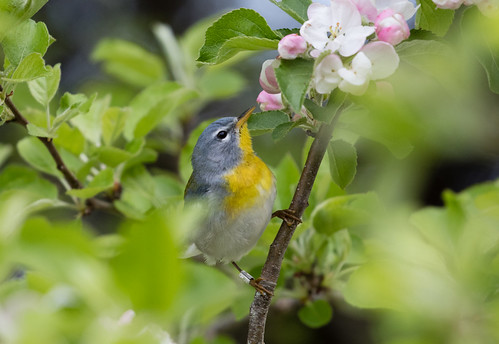
Northern Parula

Northern Parula

And a lovely water feature with a recirculating pump gave me great looks at a variety of warblers, especially during the dry spell we had the first week.

Blackburnian Warbler

Northern Parula

Yellow-rumped Warbler

A pair of Osprey nests right near the main buildings—these are the famous Steve and Rachel, the subjects of a popular nest cam. I was there when the first two of three eggs hatched. So far the chicks are doing well, but the possibility of Bald Eagles snatching the chicks is a clear and present danger—both of last year’s chicks were taken from the nest when they were about a month old.

Osprey

Near the main buildings, there was also an interesting little population of meadow voles that seemed as interested in us as I was in them. 

Meadow Vole

People arrive on the island on Sunday afternoon, and after settling into their rustic cabins, we start meeting for sessions in the afternoon. Days were mostly spent on field trips with some workshops ending with an evening program.

My favorite day of all was when we spent the morning on a boat trip to Eastern Egg Rock to see puffins. We don’t get up close and personal the way I’ve done on trips to Machias Seal Island, where the Canadian Coast Guard maintains a station and allows a limited number of visitors each day to spend an hour or so in an observation blind seeing puffins and Razorbills at very close range. Only a small staff of researchers are allowed on Eastern Egg Rock, but we got to see plenty of puffins in the water...

Atlantic Puffin

along with lots of terns flying over. 

Terns over Eastern Egg Rock

On the island, we saw some Razorbill decoys but no real ones. 

Razorbill decoys near observation blind

After cruising around Egg Rock, we boated to Harbor Island for a picnic lunch and an invigorating hike.

We spent another day hiking on the mainland, a tradition of the camp since Roger Tory Peterson started it back in the 1930s. On my hike there the first week, we came upon a Hairy Woodpecker nest, the chicks sticking their heads out of the cavity entrance for feedings. 

Hairy Woodpecker nestling

By the following week, they had fledged, but instead, we found a Pileated Woodpecker nest with babies poking out.

Pileated Woodpecker chicks

Pileated Woodpecker chicks

The instructor staff was great fun to work with, including top birders like Tom Auer from Cornell who is part of the eBird team; Charles Duncan, internationally acclaimed shorebird conservationist; Pete Dunne, popular author; Steve Kress, whose seminal graduate research on Atlantic Puffins paved the way for Project Puffin; Wayne Peterson, a top birder and conservationist who is writing the American Birding Association’s field guide to birds of Massachusetts; and John Pumilio, Director of Sustainability at Colgate College.


On the windless Saturday morning between program sessions, when I had the island pretty much to myself, I set my microphone and recorder out near my cabin and let it pick up the bird songs and soft ocean waves. Oddly enough, that happened to be the only morning during the entire two weeks when a late migrant, an Eastern Wood-Pewee, showed up on the island, singing away. He apparently moved on that night, but the recording proves he was there.  That’s the background sound I used for today’s radio program; you can listen to or download the full 37-minute recording here. It’ll keep Hog Island fresh in my mind until I return next year, to Hog Island and also to speak at the LL Bean and the Acadia Birding Festivals.

Hog Island