Laura Erickson's For the Birds

Monday, September 19, 2016

Peru! Traveling to Fight Climate Change

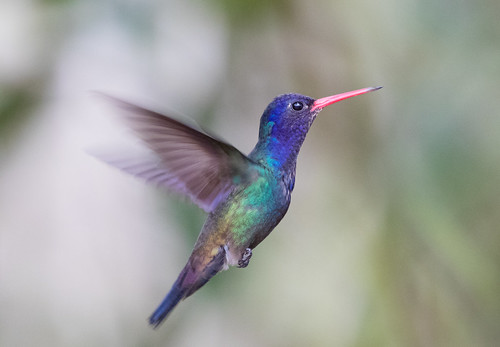
White-chinned Sapphire

Every year, two million people from around the world head to Peru specifically to visit Machu Picchu. Some of them want to see South American wildlife and enjoy a wonderful experience at one of the genuine wonders of the world, but their visits don’t require protection of anything outside of this area. Indeed, the sheer magnitude of them has caused a lot of development of the area.
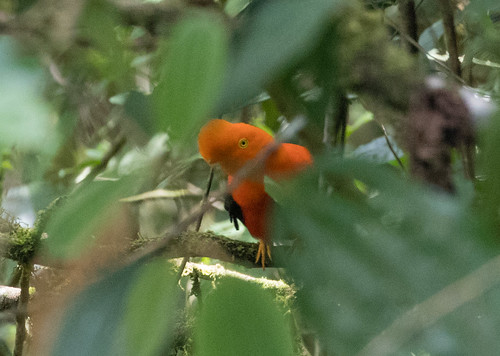
Andean Cock-of-the-rock

Meanwhile, every year barely three thousand people from around the world head to Peru specifically to see its amazing wildlife. This surprises me because Peru, a little smaller than Alaska and not quite twice the size of Texas, is home to such astonishingly magnificent biodiversity. At current count, 1,824 bird species are found in Peru, almost double the number seen in all of North America north of the Mexican border! And some of those birds of Peru are wondrously amazing, including the national bird—the Andean Cock-of-the-rock—and the mind-boggling array of 123 different species of hummingbirds, including the Fiery Topaz and the Marvelous Spatuletail. I was shocked to learn that the number of people visiting Peru to see an archeological site is three orders of magnitude larger than the number who visit Peru to see its amazing biological wealth.
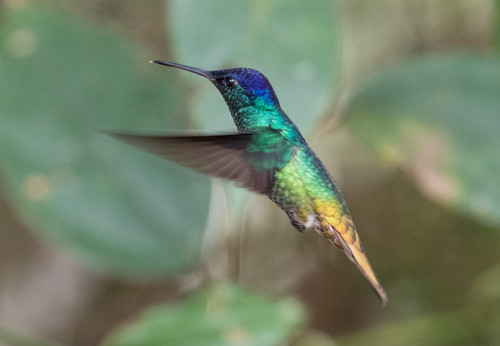
Golden-tailed Sapphire

Many people concerned about climate change of course see the relatively small number of birders visiting Peru as a good thing: airplane travel accounts for about 4–9 percent of the total climate change impact of human activity. For them, the fewer people flying to Peru, or any other place, the better.

It’s absolutely true that climate change is the hugest issue facing humans right now, and the birds that we treasure as well. The trick is that as serious as airplane travel is in the overall picture, tropical deforestation is at least equally critical, contributing at least 10 percent of the total climate change impact. And agricultural byproducts, especially from beef production, contribute over 12 percent, exacerbating the effects of deforestation wherever forests are replaced with cattle farms.
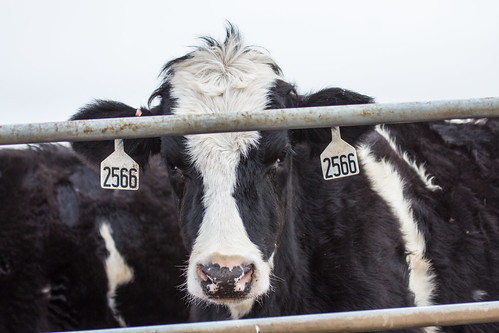
My favorite cow

We talk about how horrible deforestation and large-scale cattle production are in the abstract without coming up with specific alternatives. People struggling to get by and just feed their families in impoverished counties often have no alternative but to lease or sell their land for logging and then for large-scale cattle or sun-grown coffee production until the soil is depleted. And the soils of tropical rainforests and cloud forests are singularly devoid of nutrients, which are locked up in the vegetation. When the forest is cut, the loss of vegetative-driven humidity in combination with the low-nutrient soils make regeneration slow—it can take centuries to replace a cut cloud forest, and many scores of years for even sparse ground cover to take over.

Meanwhile, local climate change effects due to the loss of the carbon-sucking, humidity-enhancing forest are exacerbated by patches of bare ground. Loss of relatively small amounts of rain or cloud forest leads to bigger losses in rainfall and cloud cover over a more widespread area, leading to more plant and wildlife deaths in a horrifying spiral. Many people don’t realize that the overall rainfall and cloud cover patterns in tropical forests are not mostly due to typical weather systems but are a self-generating set of local conditions because of the forest vegetation itself. When a tropical forest is cut down, climate change is exacerbated by more than the loss of carbon-sucking vegetation.

Katie on suspension bridge
The Monteverde Cloud Forest of Costa Rica, which I visited with my daughter Katie in 2001, grows increasingly less cloudy as more and more landowners cut down their own forests. It's the trees themselves that create this cloud cover.
Right now, poor people in the Peruvian countryside make what little money they can by logging and agriculture. Some wise, forward-thinking Peruvians have worked tirelessly to try to persuade them to feed their families with money earned from hummingbird feeding stations and other ecotourism ventures that protect rather than cut down the forests.

Some environmentalists think it’s mere selfishness for birders to want to conserve species for their own sakes in the face of the massive destruction climate change promises, but protecting cloud and rain forests is an essential component in the fight against climate change. And the only way to do that is to give the landowners alternative ways of making a living without logging. Some kinds of ecotourism really do that.
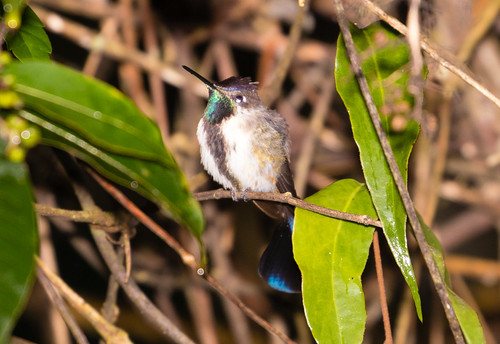
Marvelous Spatuletail

Several landowners in northern Peru have started promoting conservation just in the past couple of years, since they discovered that they can get more money, now and into the future, by letting birders see rare hummingbirds on their property than they can earn by logging their land. Now they take pride in getting more and more hummingbirds at their feeding stations,. Their hummingbird numbers are directly related to the quality of diversity in nearby forested land as well as their own property. So they are not only protecting their own land but also encouraging their neighbors to preserve their land, too—a win for birds and biodiversity, a win for birders, a win in the fight against climate change, and a win for the planet.
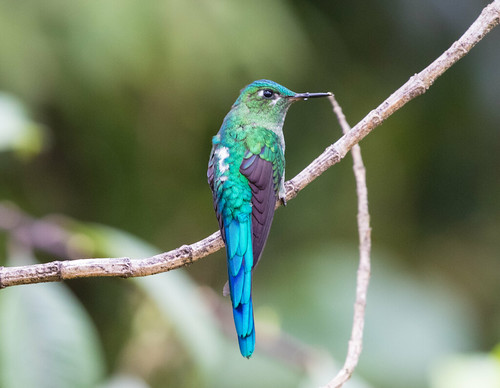
Long-tailed Sylph

The government-sponsored fam tour I was on this month was led by the co-founder of a fantastic small Peruvian company called GreenTours—their mission is embodied in their true commitment to their social and environmental responsibilities. They compensate for their own CO2 footprint via a conservation project of the Tambopata National Reserve, and are certified by the Green Initiative to be a carbon neutral company. The lodges and hotels where we stayed on our trip had much softer impacts on the environment than the huge 5-star resorts near Machu Picchu. Genuine eco-tourism is an entirely different thing than tourism in general.
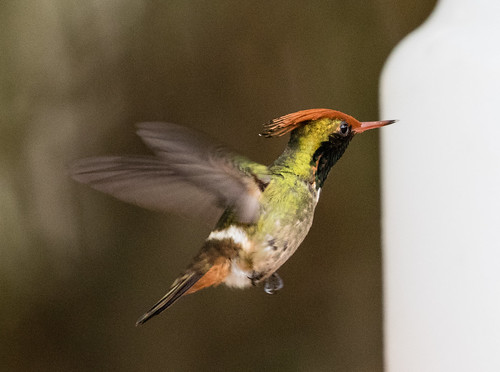
Rufous-crested Coquette


Ecotourism specifically by birders supports the people who are directly preserving quality cloud and rainforest habitat, which has an even greater impact in the climate change equation than air travel does. So visiting Peru to see its birds, even for purely selfish reasons, may be much more important for fighting climate change than sitting home.

Of course, those of us who understand some of the complexities know that even with respect to deforestation, travel is still a huge driver of climate change. To compensate for my own trip to Peru, I made a contribution to the Rainforest Trust, to ensure that the fuel burned by the airplanes and other vehicles transporting me around would be offset by reforestation to absorb that much carbon. The World Land Trust is another good organization to support for carbon offsets. But I feel good that the individuals who are protecting their land so that I and other birders can see those Marvelous Spatuletails and Emerald-bellied Pufflegs, Sparkling Violetears and Sword-billed Hummingbirds, have prospects of earning an income long into the future not by cutting down their forests, but by protecting them.
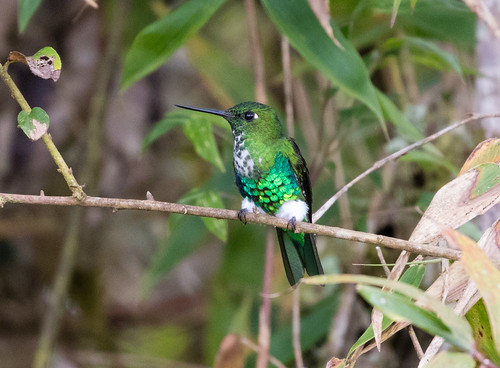
Emerald-bellied Puffleg

Friday, September 16, 2016

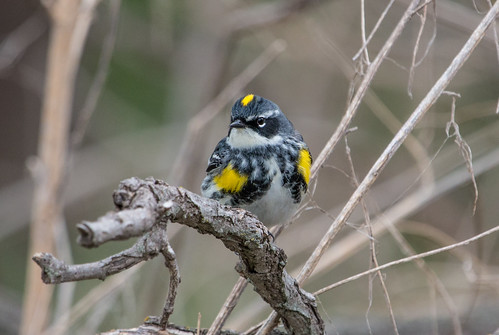
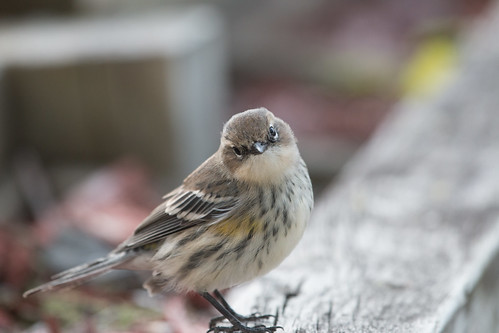
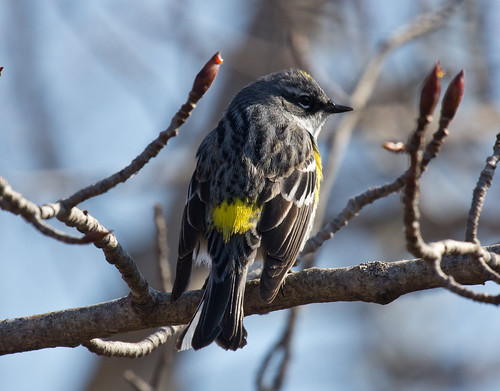
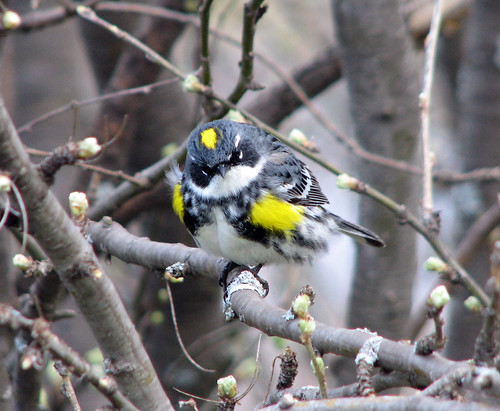
Splitting the Yellow-rumped Warbler

Yellow-rumped Warbler

In May 1975, the year I started birding, I saw 5 species of warblers. In the summer, when I took my first ornithology class, I added 4 more. And then in the week leading up to Labor Day, Russ and I headed to Port Wing for a little break before fall classes began. And even with my novice skills, I managed to find three new warblers, including one that in retrospect I’m surprised I didn’t figure out in the spring, because it’s the most abundant warbler of all, the Yellow-rumped Warbler.

Yellow-rumped Warbler

Yellow-rumps have a soft, fairly unobtrusive song that they seldom sing until they reach their breeding grounds, so I’m not surprised I didn’t learn the song that first year. But they have a very distinctive chip note that sounds rather like the tsking of an annoyed math teacher, and they are so very abundant, and arrive noticeably earlier than the other warblers, so it does seem odd that I never picked one out in the spring. If I had, I’d have listed it in my lifelist the way it was listed in my trusty Golden Guide and my Peterson Guide—as the Myrtle Warbler. But by September 2, when I saw my first one, I’d already taken ornithology, where I learned that the Myrtle and Audubon's had been lumped into a single species, the Yellow-rumped Warbler. So that’s the way it appeared on my lifelist from the start.

Yellow-rumped Warbler

1975 seems so very long ago, but the one constant is that the Yellow-rumped Warbler stayed a constant single species. Research published in 1973 led scientists to believe that Myrtle and Audubon’s Warblers belonged to the same species, because the two hybridize fairly often in the narrow area where their respective ranges overlap.

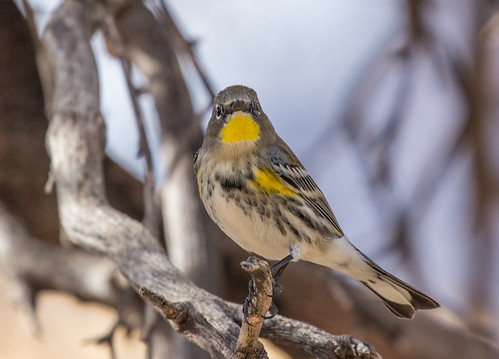
Yellow-rumped Warbler (Audubon's)

Now, 43 years later, a new paper has been published in The Auk reporting that those hybrids, like mules, aren’t genetically fit enough to reproduce, so hybrids have never spread and melded the two forms genetically. The researchers conclude that the two forms are, indeed, fully separate species as people originally believed.

One of the researchers, David Toews, did the genetic work as a post-doc at Cornell, so I got it on very good authority in 2009 when I worked there that the species was going to be split in the near future, but solid peer-reviewed research takes time. And the results turn out to be even more interesting than I thought.  Based on significant DNA as well as several behavioral differences, there are actually three unique species bundled into that yellow-rumped group. North America’s Myrtle and Audubon’s Warblers are what people originally thought—two distinct species—but another separate population, found only in and very near to Guatemala, also deserves full species status as “Goldman’s Warbler.” A fourth distinct population, fairly closely related to Audubon’s Warbler genetically, is restricted to the mountains of Northern Mexico. When taxonomists examine the data, they will probably make that one, the Black-fronted Warbler, a subspecies of Audubon’s Warbler rather than its own species.

The paper was published on August 24 in The Auk, the premier, peer-reviewed journal of North American ornithology. But that doesn’t mean that those of us who have seen both Myrtles and Audubons get to add a new species to our life lists just yet—that will have to wait until the next time the North American Classification Committee meets to create the next AOU Checklist supplement, something that happens just once a year. But next year, one morning I’ll wake up, check the news, and discover that without having gone anywhere, I’ve added a brand new lifer—one of the unexpected joys of birding.

Yellow-rumped Warbler

Wednesday, September 14, 2016

Fall Migration Update, and Hawk Ridge Weekend!

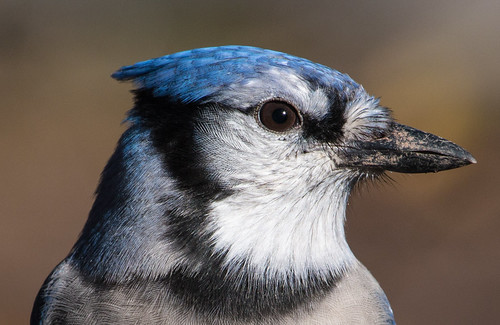
Blue Jay

I was in Peru for a week, and between preparing for the trip and getting ahead on work deadlines, I’ve not been able to keep up with fall migration here. Even 4,000 miles away, in the jungles and cloud forest of darkest Peru, I was getting emails about huge numbers of Blue Jays coursing over Duluth, and could only imagine what else was happening. 

Karl Bardon, the Count Director at Hawk Ridge, wrote on the Hawk Ridge blog that, as of September 12, the counters had tallied over 10,000 raptors and over 100,000 non-raptors since August 15, with peak numbers yet to come! Sure enough, the very next day, yesterday the 13th, they almost doubled the total raptor count.

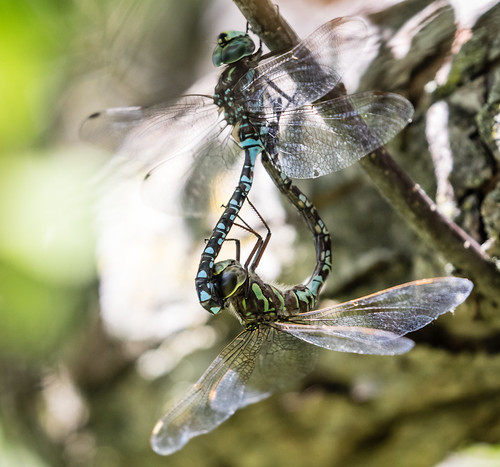
On August 25, they counted 2603 Cliff Swallows; on September 9, they counted 6651 Cedar Waxwings. These migrating birds are capitalizing on the wealth of food available to fuel their flight, such as the 100,000 dragonflies documented winging along the Ridge on August 30. That was the very day I photographed mating dragonflies in my own backyard. 

Where baby dragonflies come from

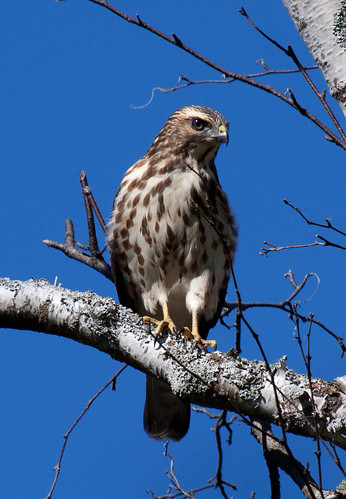
People often seem most excited about the huge numbers of Broad-winged Hawks that pass over the Ridge in mid-September. Our biggest day so far this year was yesterday, September 13, when the counters tallied 8,163 Broad-wings, but this is not yet the peak. On our biggest day ever, September 15, 2003, an unbelievable 101,716 Broad-wings were counted at the main overlook. 

Broad-winged Hawk

Hawk Ridge Bird Observatory times their biggest annual event to coincide with the peak of the Broad-wing flight.  This coming weekend, September 16-18, is this year’s Hawk Ridge Weekend. Of course, the timing is necessary but not sufficient to ensure a big flight—weather holds the final key—but no matter what happens, there will be lots of birds here in Duluth this weekend.

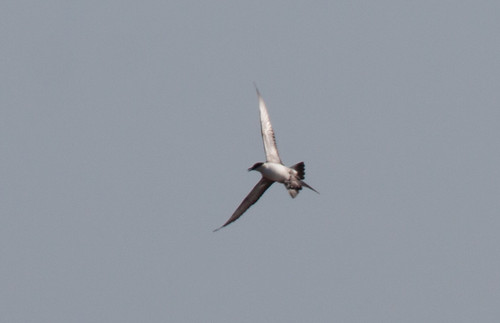
If the wind has any kind of westerly component and it’s not raining, hawks will definitely be flying over the Ridge. Duluth may be the best spot in the Midwest to view many migration events, but if it’s raining with winds from the east—the worst case scenario for Hawk Ridge—birders have our best chances of spotting jaegers down on Wisconsin Point.

Long-tailed Jaeger

Warblers, thrushes, and sparrows are passing through in large numbers, which are most easily tallied at observation points such as Hawk Ridge, but these birds are not just flying by—they visit bird baths and fruiting trees and shrubs in backyards, too, so even if we’re stuck at home, we can enjoy them.

Swainson's Thrush at my bird bath

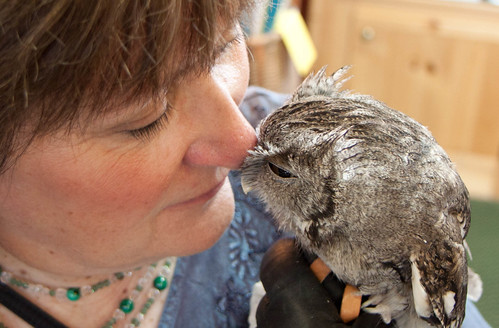
Many events are planned for the weekend. On Friday afternoon, I’ll be one of the leaders of a fun and popular train ride along the St. Louis River—last year we saw quite a few cool birds on this trip, which kicked off the weekend. Friday evening’s after-dinner program will feature Chris Wood of the Cornell Lab of Ornithology talking about “Bird Migration, Birding and Conservation.” Before dinner, I’ll be there with Archimedes, the Eastern Screech-Owl—a rare chance for people to get to meet my now elderly but still healthy little education bird. 

An owl and his human

Both Saturday and Sunday there will be more field trips as well as lots of events for both adults and children at the Main Overlook. Saturday night’s keynote will be by U.S. Fish and Wildlife Service Biologist Nathan Rathbun, talking about “Masses of Migrants: Visualizing the Movement in the Sky.”

For details about any of these events or more information about this year’s flight, check out the Hawk Ridge website at www.hawkridge.org.

Tuesday, September 13, 2016

Peru! Andean Cock-of-the-rock!!!

Andean Cock-of-the-rock

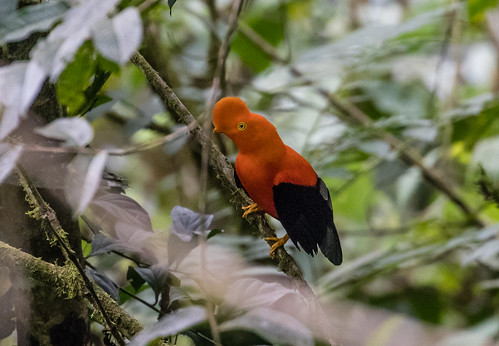
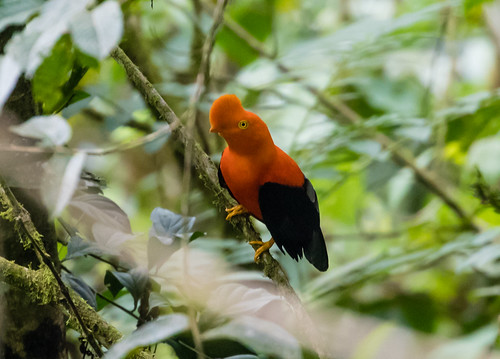
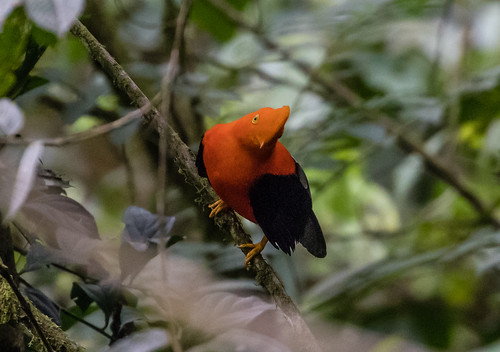
When I was a teacher in the late 70s, one of my students was fixated on the Andean Cock-of-the-rock, the national bird of Peru. The funky males are an improbably glowing orange or red on their head, back, and underside, with shiny black wings and tail, and rectangular, soft- gray scapular feathers running down the edge of their wings in the center of their back. The forward-sloping rounded crest, on both sexes, virtually covers the small bill and gives the head an oddly bulging shape. The glittering white iris forms a perfect circle around the black pupil, all surrounded by that lovely tropical orange.

Andean Cock-of the-rock

I’d been birding for a few years back when I was a teacher, but I’d certainly never seen a cock-of-the-rock, and had no more concept of Peru than that Michael Bond’s sweet Paddington Bear came from deepest, darkest Peru. As I got more into birding and started learning about birds from beyond North America, I started wishing I could see a cock-of-the-rock myself, but it seemed improbable at best that I’d ever make it to Peru.

But in late July, I was asked to go to Peru for a week on a “fam tour”—I’d be shown several of the top birding spots in northern Peru with the assignment of writing about them. My very first thought was—was it possible I’d see an Andean Cock-of-the-rock there? I received an itinerary a few weeks ago, and instantly saw that it wasn’t listed as a target species. When I went through the eBird checklists for the places we’d be going to, it was listed on two of the checklists, but I realized that meant my chances were poor at best—the sightings from there might have been in the wrong season or the bird just too rare or too shy for an easy sighting with a group.

The cock-of-the-rock is an extremely secretive bird of a highly endangered habitat—tropical cloud forest. One of the most important dangers facing cloud forests in South and Central America is that the clouds are dwindling. Between the heat and droughts associated with climate change and the massive destruction of the forests, the land is warming, the clouds above it dissipating.

Other species associated with cloud forest, such as the Resplendent Quetzal and many trogons, toucans, and hummingbirds, are also dwindling. I tried not to get my hopes up about seeing a cock-of-the-rock, but that is of course easier said than done.

But last Tuesday, September 6, on our drive between two birding lodges, our guide Wilson Diaz (from Green Tours) told the bus driver to stop in a spot that looked pretty much like every other stretch of that mountain road, and we piled out. 


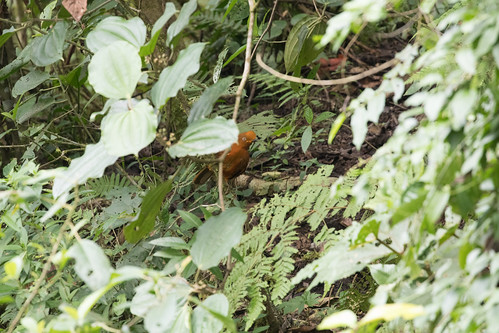
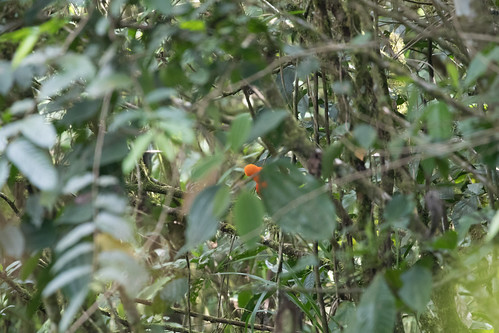
He started down the road a short ways, me scanning the forest floor on the downslope, when what to my wondering eyes should appear but a brilliant orange blob of color hurling through a tiny opening in the trees. It was the briefest of sightings, and I didn’t even see the shape of a bird—for all I knew for sure, it could have been someone tossing away a rather large bowl of orange sherbet. But there is nothing else that color that occurs naturally there, so we stopped and scrutinized. 

After just a few minutes, someone spotted a female Andean Cock-of-the-Rock, and soon we noticed a second one, lurking in the shadows far below us. 

Andean Cock-of-the-rock

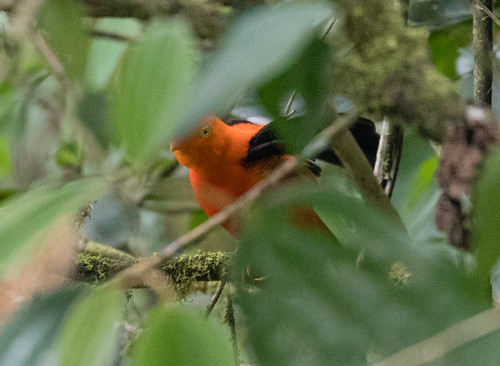
And then, what to our wondering eyes should appear but a glorious male. He was mostly hidden by foliage—even with a spotting scope, it took minutes before anyone could see his glittering eye and funky crest. 

Andean Cock-of-the-rock

Conditions were horrible for photography—the forest was dark, and the bird so far away that he was hard to locate in the camera viewfinder, much less to actually focus on. But I got took hundreds of photos, refocusing over and over hoping that a few would turn out. And suddenly he fluttered over a couple of branches, and for a few glorious minutes we had him in full view. Photography was still tricky with the low light and distance. About sixty percent of my photos didn’t turn out at all, but of the ones that did, thanks to the miracle of Adobe Lightroom, a few look pretty darned good, at least as memories of a magical moment.

Andean Cock-of the-rock


After my heart attack last year, I’ve pretty much scaled back my hopes and dreams for what I can do and see and hear in my remaining years. Just being in Peru, walking on ground that I knew cocks-of-the-rock had also walked upon, breathing air molecules that had been breathed by cocks-of-the-rock was wonderful enough. Spotting an orange blob hurtling through the air was wonderful enough. Seeing females in the shadows was wonderful enough. Seeing pieces of the male behind the foliage was wonderful enough. Actually feasting my eyes on this beautiful bird in full view for many minutes was a greater gift than I could have dreamed of—one that will stay with me every day I’m given on this beautiful earth.

Andean Cock-of the-rock

Wednesday, August 10, 2016

Fall is here! A walk on the Western Waterfront Trail

Sumac

A lot of people seem to think it’s still summer—yesterday’s sweltering 88 degrees contributes to that misapprehension. 

Birds know better. Days are noticeably getting shorter, most baby birds of the year are on their own now, and adults are recovering from the rigors of raising those young birds—many have finished molting into new feathers and are ready to head south. NEXRAD has been showing some migratory events already, and even though birds are quiet, we can’t help but notice that a lot of them are starting to pass through. 

Red-eyed Vireo showing off eye

I went out to the Western Waterfront Trail yesterday for a short walk. I’d hardly stepped onto the path from the parking lot before I was seeing lots of birds. A Red-eyed Vireo family. Five Ovenbirds that I assumed were a family unit. A couple of Veeries hanging out together. Two adult Cedar Waxwings with a growing fledgling. Lots of goldfinches flying this way and that. A noisy Blue Jay family. A few Nashville Warblers and two immature Magnolia Warblers—those two species don’t nest anywhere near the Western Waterfront Trail, so I’m assuming they were migrants. Berries abound, and tasty insects were everywhere, as my many mosquito bites attest. One female Ruby-throated Hummingbird snatched insects from a spider web.

Ruby-throated Hummingbird snatching insects from spider web

It’s interesting to consider how some of the mosquitoes that bit me would in turn be eaten by birds, so my blood is providing at least a few of the calories fueling migration. We really all are in this together. It takes a village.

One American Redstart, two Song Sparrows, and a Swamp Sparrow were still belting out a song now and then, but most of the birds I saw were pigging out in small family units or mixed flocks moving with the local chickadees.  

I have a new field recorder that I’m trying to get the hang of before heading out on three major work-related trips this fall, and I was also trying to photograph some birds. I missed pictures of the Ovenbirds because it took too long to put away my microphone to switch over to my camera—Ovenbirds don’t approve of paparazzi in the first place, and are certainly not going to sit around waiting while a photographer gets organized. I got dozens of photos of Red-eyed Vireos, but the lighting was awful. Most of the birds I saw were high up and not interested in posing. I got a couple of photos of an immature Magnolia Warbler—the photos are poor quality and most of the bird was obscured by leaves, but you can still see the one field mark that distinguishes it from any other warbler—the large white area at the base of the tail with the thick black tail tip.

Immature Magnolia Warbler

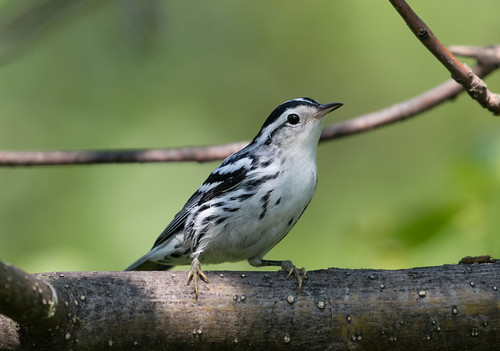
Fortunately, one female Black-and-white Warbler took pity on me and spent an inordinate amount of time posing this way and that on a nearby branch in perfect light.

Black-and-white Warbler

Black-and-white Warbler

Black-and-white Warbler


If only a few birds are singing, the rest are not exactly silent. They gravitate to chickadees, which make several little calls even when not chickadee-dee-deeing, and the warblers occasionally let out a call note themselves. I miss most of that if I’m not wearing my hearing aids, but I’ve been quite good at remembering to pop them in. It was windy, but the best thing about good digital hearing aids is that they selectively boost the sounds you want to hear, making them clearer against background noise. It wasn’t a big day for auditory or visual pleasures, but that made the birds I did find all the more precious.

Jewelweed

Wednesday, August 3, 2016

Birding at the Bog with Pip and Lisa

Pip!

This weekend I headed to the Sax-Zim Bog with my little dog Pip and my good friend Lisa. We’re in the silent part of summer now, when parent birds are busy chasing their little ones around more than singing, but we got to hear a surprising number of birds on Nichols Lake Road when we first arrived at 6:30. It was extra fun because Lisa had never been to the bog before, and is pretty new to birding.

Most thrilling for me were the two Winter Wrens who sang several of their long, silver-threaded songs. I simply cannot hear them without smiling. A few Alder Flycatchers sang pretty persistently, as did a few Red-eyed Vireos. The only warblers singing were Common Yellowthroats. To provide visual beauty to enhance the soundtrack, dew-clad spider webs dotted the landscape. My photos were taken too far away to capture the beaded pearl effect of dew along each strand when viewed from close range, though the best of my photos show at least a hint of that. The birds quieted down and the spider webs dried off as the sun moved higher in the sky.

Spider web

And that was about it for the day as far as bird song. Not that the birds disappeared. While we were still on Nichols Lake Road, a large loose flock of robins gathered along the gravel road looking for exposed bugs and worms, and a few flickers flew up from the roadside, too—this time of year, they are seen more often than not on the ground pigging out on ants to fuel their migration.

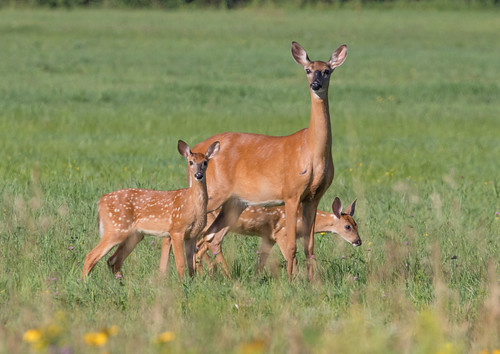
Next, Lisa and I moseyed along to Arkola Road, where we quickly came upon a deer and her twin fawns grazing in a lush meadow. Unfortunately, we saw them just as they saw us, and the mother was not interested in photo ops—I managed to get one shot before they took off.

White-tailed Deer with twin fawns

Along the roadside, we spotted several tent caterpillar webs, but I didn’t see any cuckoos on them, even though tent caterpillars are their preferred food. One cuckoo did fly across the road, giving me a split-second look, but Lisa and Pip didn’t get to see the exquisitely lithe, long-tailed beauty before it retreated deep into the trees. We all did get to see an active Eastern Kingbird family—they didn’t cooperate for photos, but I got to lecture Lisa and Pip about how this species has the coolest scientific name of all, Tyrannus tyrannus.

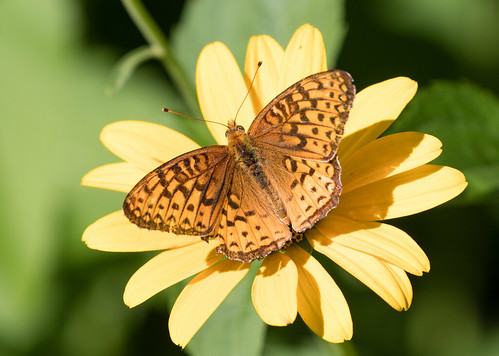
Atlantis Fritillary


Next we traveled down Owl Avenue, where we didn’t spot any owls, and turned off at the Sax-Zim Bog Visitor Center, where we didn’t spot any visitors—at least not human ones. An Atlantis Fritillary, several little skippers, and a host of bees sipped nectar at the flowers, a Chestnut-sided Warbler ate a few caterpillars, a Great Crested Flycatcher lurked in the foliage, and a hummingbird zipped by. It was one of those lovely end-of-summer days when you can savor every little thing without other little things interrupting. 

Butterfly


We continued down Owl Avenue to Correction Line Road, and took what I call the “Tree Loop” off Highway 133, spending a few minutes on Blue Spruce Road watching a pair of adult Broad-winged Hawks flying with a young bird. 

On the drive home we stopped briefly by the old Twig Bakery off Highway 53 to check on the two baby Osprey. They looked at us a bit but mostly squawked for their parents—they’re getting close to fledging. All these baby birds testing their wings gave us hope, and on that note, we headed home laden with memories and lots of photos of our lovely morning in the bog.

Twig's nesting Osprey