Laura Erickson's For the Birds

Friday, October 26, 2018

Choosing a life path: wolf or chickadee?

(This is the text and photos from my recent TEDxBemidji talk. I took all of the photos except the title poster (Russ took that photo of me), the photo of me giving the talk (Photo credit: John LaTourelle Photography, TEDxBemidji), the wolf photos (Photo Credit: Melissa Groo, Lisa Johnson, and Lynne Casperson Schoenborn), and the baby ptarmigan photo (Photo credit: Melissa Groo.) I put the photographer's name on those, in the right bottom corner. Thank you so much to Melissa Groo, Lisa Johnson, and Lynne Casperson Schoenborn for helping with this!!)


TEDxBemidji 2018
John LaTourelle Photography, TEDxBemidji
A long time ago in a galaxy far, far away—Chicago, to be precise—a little girl fell in love with wolves. A friend gave me the book White Fang when I was eight, and I read it over and over.
Copyright 2018 by Lisa Johnson
I didn’t discover chickadees until I was 23, but I quickly fell in love with them, too. When I have a problem, I often think, “How would a chickadee handle this?” It never occurs to me to wonder what a wolf would do.

People who say it’s a dog-eat-dog world so go for the jugular because cutthroat competitiveness is the way to make a killing and win forget how The Wolf of Wall Street ended—bad for him, and worse for a whole lot of other people.
Copyright 2018 by Lynne Casperson Schoenborn
There are many reasons why wolves are vanishing even as chickadees thrive. Maybe the little guys know something we don’t.

While putting this talk together, I asked a few friends which they would rather be—a wolf or a chickadee. Just about everyone went with wolves. Why? “No one messes with them.” “Wolves can take care of themselves.” And especially, “Wolves live longer.” But that one’s not true. Few wolves or chickadees survive their first year, but once they do, both species have a life expectancy of 4-8 years, and in both cases, some live much longer—wild wolves to 13 and chickadees to 12. 

A 150-pound wolf would balance roughly 6,000 chickadees. But for their size, chickadees are every bit as fierce when ferocity is called for.
Wolf photo copyright 2018 by Lisa Johnson
Ask any bird bander. If you grab a chickadee against its will, you are going to get walloped…

... and chickadees know right where to peck and bite to inflict the most pain. A chickadee battling a bird bander is like Ahab stabbing Moby Dick himself. 

A wolf would have to face a predator the size of the largest sperm whale on earth to measure up to a chickadee facing a bander.

But in a chickadee’s everyday life, curiosity and open-mindedness are much more valuable than ferocity. Hunters often tell me about hand-feeding chickadees up in their deer stands. Some chickadees even alight on their eyeglasses, hats, or beards to pick at dried blood on their faces. Hunters get a kick out of it, and chickadees get protein. Win-win.

We romanticize ferocity in a way I didn’t understand when I first read White Fang. When the little wolf cub left his mother’s den for the first time, he chanced upon a nestful of ptarmigan chicks and gobbled them up, and when their mother flew in, he killed and ate her, too.

He obviously had to hunt to survive, but Jack London’s salivating prose seemed excessive: “The lust to kill was on him... He was thrilling and exulting in ways new to him and greater to him than any he had known before.”  
Copyright 2018 by Melissa Groo
Imagine writing so intensely about a goldfinch thrilling as it rips apart and devours thistle flowers,

or a grosbeak exultantly chomping the life out of a box elder seed. No wonder Teddy Roosevelt panned Jack London’s books.

The magnificence of wolves and their importance in the web of life cannot be denied, but we glamorize “nature red in tooth and claw” as if nature’s vegetarians and insectivores aren’t equally vital and evolutionarily fit.
Copyright 2018 by Melissa Groo
Wolves do live in a kill-or-be-killed world where the main natural cause of mortality for adults is other wolves. Aggressive competitiveness keeps their numbers down so they won’t run out of prey; that’s why omnivores so outnumber them.
Copyright 2018 by Lynne Casperson Schoenborn
Even where wolves are most plentiful in the United States, in Minnesota and Alaska, chickadees are orders of magnitude more abundant. In both states, the Black-capped Chickadee population is about 2 million compared to Minnesota’s 2,800 wolves and Alaska’s 11,000.
Wolf photo copyright 2018 by Lisa Johnson
If we were carnivores, our numbers would have to be much smaller, too, but we’re not. Most of us eat meat, but based on our teeth, digestive system, and body structure, we’re omnivores just like chickadees.

And like them, we’re territorial but have to tolerate our neighbors. Chickadees sometimes squabble, but I’ve never witnessed a physical fight. They solve disputes with vocalizations and having the brains and humility to admit when they lose a debate. Coming to blows would be uncivilized.

Wolves avoid some fights by intimidation, faking dominance with aggressive posturing.
Copyright 2018 by Lisa Johnson
Juvenile chickadees try that too, at first, approaching others with feathers fluffed and wings open to appear as big and fierce as possible. But the adults ignore them, and soon the young birds realize they’re not fooling anyone.

Like wolves and baby chickadees, we humans bluff, bluster, and posture. Standing on this stage right now is Exhibit A. I was coached on how to appear more credible than I maybe really am. Should you believe anything I say when I’m putting on airs like a baby chickadee? Judge my words and facts, so you can do what any mature chickadee does—distinguish truth from a con.

A high rank assures a wolf of more food than its pack mates right up until it gets killed or wounded by one of those pack mates. It’s a zero-sum game—for one wolf to win, another must lose.
Copyright 2018 by Lynne Casperson Schoenborn
A chickadee’s rank doesn’t determine its survival or how much food it gets. Chickadee hierarchies simply set the order in which they take shared resources, ensuring domestic tranquility.

Wolves form packs because it takes coordinated effort to kill large prey, but once the moose is down, wolves fight fiercely over who gets what.
Copyright 2018 by Lisa Johnson
Chickadees are more self-reliant, each finding and caching away its own meals. The harder a chickadee works, the more food it gathers against hard times ahead, embodying the best of capitalism.

But those same tiny capitalists also embody the best of socialism. If lightning blasts the birch where a chickadee squirreled away most of its food stores, it’s welcome to raid other chickadees’ caches. In their world, it’s all for one, and one for all.

Chickadees don’t kill their enemies. They mob little owls, trying to drive them off, but when they spot most predators, they simply fly away. And the more eyes looking for danger, the easier to elude it.

That’s why chickadees welcome all kinds of birds into their flocks regardless of race, color, sex, or even species, as long as they’re not predators. Homeless, tempest-tossed warblers passing through Minnesota in spring and fall know which bird lifts its lamp to welcome them.

Chickadees don’t just believe in inclusiveness—they thrive because of it. 

I reread White Fang a few weeks ago. I still love that little wolf cub and the magnificent animal he became, but it isn’t just the over-romanticizing of killing, and the ugly racism I had no way of seeing as an 8-year-old white girl from Chicago, that now make me cringe.

Jack London wrote of a silent, desolate world of "laughter more terrible than any sadness... it was…eternity laughing at the futility of life ... It was … the savage, frozen-hearted Northland Wild."

Oh, come on! I remember February 2, 1996, when we hit that record 60 below zero. That morning was hardly silent or desolate. Someone slept in a snow fort up in Tower, emerging triumphantly at first light to cameras, microphones, and cheers, while no one even noticed all the chickadees calling and singing in the background.

They had each slept in their own little cavity or crevice, naked as jaybirds, no hand-warmers or camp stoves for them, and come morning, those tiny survivors went about their business like 60 below was no big deal. 

Aldo Leopold loved wolves, but he didn’t hear the terrible, mirthless laughter of Jack London’s wild imaginings.
Copyright 2018 by Lisa Johnson
Leopold heard something more joyful—he heard chickadees. He wrote in A Sand County Almanac:
That whimsical fellow called evolution, having enlarged the dinosaur until he tripped over his own toes, tried shrinking the chickadee until he was just too big to be snapped up by flycatchers as an insect, and just too little to be pursued by hawks and owls as meat. Then he regarded his handiwork and laughed. Everyone laughs at so small a bundle of large enthusiasms.

Right now, our country needs joyful, shared laughter. And we need something more. I wish that we, the only species on earth whose numbers include actual rocket scientists, could harness our intelligence to figure out how to live up to the Preamble to our own Constitution the way chickadees do.

They establish justice, insure domestic tranquility, provide for the common defense, promote the general welfare, and secure the blessings of liberty to themselves and their posterity.

We’re the ones who had the brains and heart to articulate that vision 230 years ago, yet we seem further from achieving it now than ever before. Let’s look to chickadees to lighten our hearts and light our way.

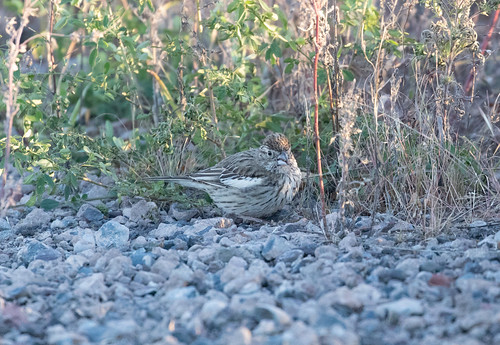
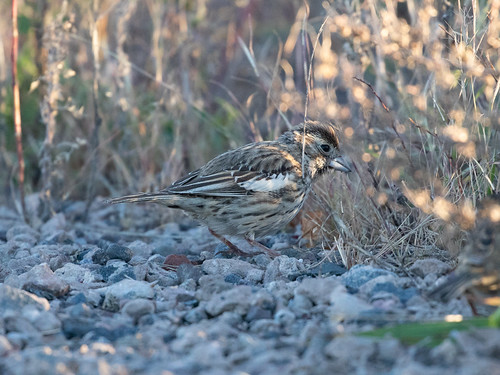
Lark Bunting in Duluth!

Lark Bunting in Duluth!

On Monday this week, my friend Dudley Edmondson discovered a Lark Bunting on Park Point by Sky Harbor Airport. He said the lost little bird was hanging out with Harris’s and White-throated Sparrows.

Late Tuesday afternoon, I got over there while it was still hanging out exactly where Dudley had originally found it, and where various people had reported it Tuesday morning, in the weeds and roadside just beyond the last hangar. Considering how easy it is for birds to fly, and how this particular vagrant was a good thousand miles from where it would normally be right now, it surprised me how it was sticking around in one tiny area for so long, but then I thought how much inappropriate habitat it must have flown over to reach Park Point from the High Plains of its breeding grounds, or the shortgrass prairies of Texas and Arizona and the High Plateau of Mexico where it should be headed for winter. Maybe when it finally discovered a good spot, it wanted to sit tight for a while before striking out into unfamiliar territory once again. It stuck around in that exact same area into at least Wednesday.

Lark Bunting in Duluth!

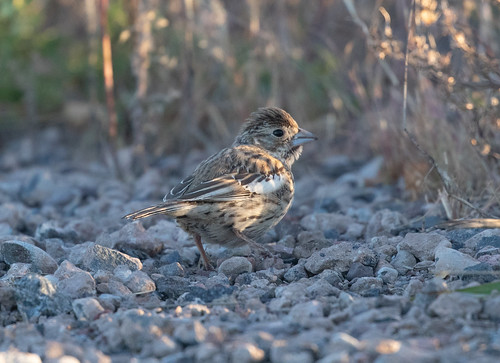
Because I didn’t get there until late in the day, my photos are low contrast and grainy, but these are the first Lark Bunting photos I’ve ever taken, so I can’t complain. During my Conservation Big Year, I visited Colorado in April before Lark Buntings arrived, and didn’t see them anywhere that year until November in Texas, where they didn’t let me get close. So I’m delighted to have any photos. But I badly want to photograph them in Colorado. I saw my lifer in Texas in the winter of 1978, but in 1979 I got to see males in full breeding plumage in Colorado and Wyoming in June and South Dakota in early August. 

Red Rose Tea and Coffee Company bird trading cards

Unlike virtually all sparrows, adult male Lark Buntings have a striking black-and-white breeding plumage that makes it easy to understand why this was selected as Colorado’s state bird. But the dramatic male breeding plumage is entirely different from the basic, more sparrow-like plumage males wear in winter, which resembles that of the females. This time of year, Lark Buntings are all rather drab, with only the white wing patch to set them apart from a generic sparrow. Males usually show at least some blackish around the bill, which this bird does not have, but I can’t seem to confirm whether these blackish feathers are found in first year males or just adults, so I’m guessing the Duluth bird is a female but am not 100 percent certain. So unless someone very familiar with Lark Bunting tells me otherwise, I’ll have to call this a female of unknown age or a first-year male.

Lark Bunting in Duluth!

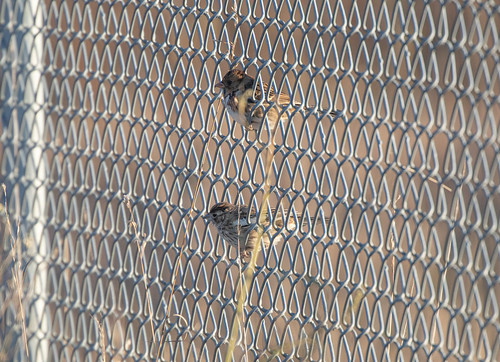
According to Sibley, vagrant Lark Buntings are "usually solitary," but this one is either functionally illiterate or uses another field guide, because it was hanging out with a Harris’s Sparrow when I saw it, and all the reports I’ve read noted that it was hanging out with one or more sparrows. That seems more in keeping with my National Geographic field guide, which says that Lark Buntings are "gregarious year-round." Most of the gregarious flocking species I am familiar with, such as waxwings and Pine Grosbeaks, join flocks of other species when they can’t find their own kind, so I wasn’t surprised that this little one was staying so close to the Harris’s Sparrow the whole time I watched.

Lark Bunting and Harris's Sparrow

Lark Buntings once bred at least sporadically in southwestern Minnesota. But like most prairie species, they’re declining now, and have disappeared from the edges of their breeding range; nesting hasn't been confirmed in Minnesota since 1964. I saw my first Lark Bunting in this state in the prairie area of Rock County back in August 1990. This little guy in Duluth is only the second I’ve seen in Minnesota, and was a lifer or a new state bird for a lot of active birders. Even beyond the fun of adding a new bird, it filled a lot of birders with joy. I pointed it out to a couple of dog-walkers, and they seemed suitably impressed, too. I wish the enthusiasm we feel toward these tiny wanderers translated to protecting their breeding and wintering habitat, but with so many other pressing issues diverting attention from conservation and basic environmental protections, I'm afraid Lark Buntings aren't a top priority for anyone. The state bird of Colorado deserves better.


Tuesday, October 23, 2018

Yellow-rumps: Gone with the Wind

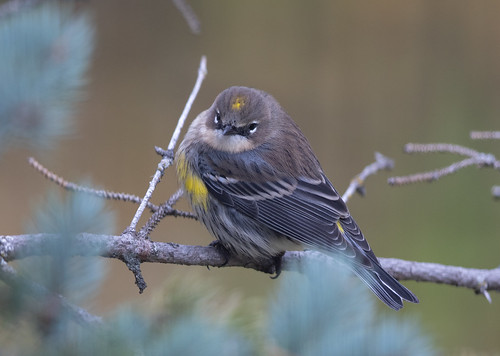
Yellow-rumped Warbler

Last week I gave a TEDx talk in Bemidji, Minnesota. When Russ and I left on Wednesday morning, October 17, I still had at least 40 Yellow-rumped Warblers in my yard. When we got back at mid-afternoon on Friday, there were still 15 or 20. The wind was strong from the northwest, blowing in some snow that night and blowing out the warblers. One lingered on Saturday morning, but he or she didn’t stick around. On Sunday, October 21, I didn’t see one for the first time all month. 

I’m not used to seeing as many yellow-rumps in my yard as I had this year—there were as many as 80 or even 100 in my yard much of the time during the first two weeks of October, and even as the numbers started to dwindle on October 15, my interest held strong because one of them was a lovely little leucistic bird.

Leucistic Yellow-rumped Warbler

There’s something about any conspicuously aberrant individual that instantly snares my attention and affection—probably because it’s so easily recognizable as an individual. The moment I noticed the Yellow-rumped Warbler with unusual white areas on its plumage, I found myself immediately keeping track of it. The little thing held its own in faceoffs with other Yellow-rumps as they crowded into my suet cakes—in other faceoffs between Yellow-rumps, it’s tricky to figure which “won” because they’re hard to tell apart. 

As thick as the Yellow-rumps were last week, this week they’re gone. Just like that. When I look at my calendar, these end-of-September migrants are way off. I’ve had large numbers of Yellow-rumped Warblers during the first few days of October before, but never into the third week of the month. 

Yellow-rumped Warblers don’t look at or even think about our calendars, but it suddenly occurred to me that one of the other things happening outdoors right as their numbers peak is leaf color. This year, leaves remained green on a lot of trees much later than normal, and way more trees are still clinging to leaves right now, on October 23, than I’ve ever seen this late in the month. 

Leaf color doesn’t seem directly, or at least simply, related to temperature—we’ve had some pretty cool summers where the leaves lasted relatively longer, and have had lots of trees changing colors early when the end of summer was warm and dry. But climate change involves rainfall patterns as well as temperature, and so may well be an important driver of changes in fall color. 

Those changing leaves fill us humans with wonder, but I wonder how changing and falling leaves affect the insects up in trees and on the ground among the growing piles of leaf litter. That will be interesting to research, because those insects must affect insectivores like Yellow-rumped Warblers. While I was in Bemidji, I spent several minutes watching an Eastern Phoebe still flycatching on a beautiful but cold day. When I entered my sighting of it into eBird, I had to add details because October 17 was later than phoebes are supposed to be seen up there. 

I’ll be looking for scientific papers about fall colors now, and how the timing of various trees losing their leaves relates to insect populations. As I hunker down, battening the hatches for winter and spending time sitting at a window watching my chickadees and winter bird arrivals, I’ll ponder this intriguing question. But meanwhile, I’m glad that my yellow-rumps have moved on. It’s getting cold out there!

Thursday, October 18, 2018

October Yellow-rumped Warblers

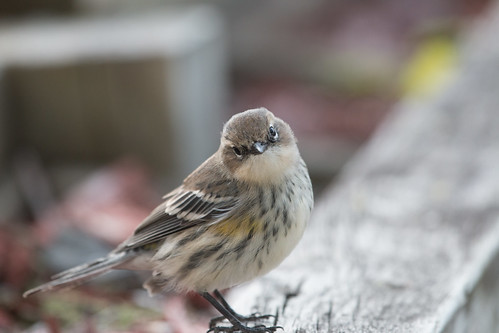
Yellow-rumped Warbler

Every autumn is unique, but there are definite patterns that birds follow. We always have a major warbler movement in late August and through September, along with Cedar Waxwings. White-throated Sparrows come in in big numbers in September, then White-crowned and Harris’s Sparrows, and then juncos and Fox Sparrows as Yellow-rumpeds bring up the end of the warbler movements in late September and early October. Some years we’ll see large numbers of some or many species, other years will be more lackadaisical, but overall, fall migration is fall migration.

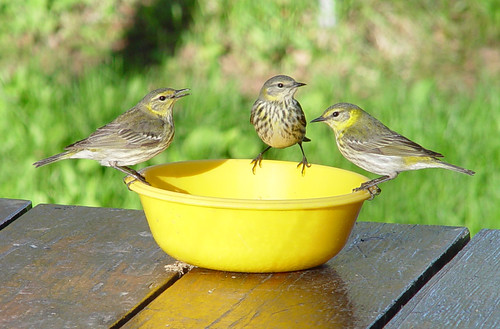
Sometimes when I think I’m seeing something I’ve never seen before, it turns out that I have—or at least something similar. Over the years, I’ve had lots of Cape May Warblers at jelly feeders.

Cape May Warbler

An occasional warbler of other species comes to my suet suet. Most notably, I’ve photographed one Pine Warbler coming regularly for a few days in 2003,

Pine Warbler at my suet feeder

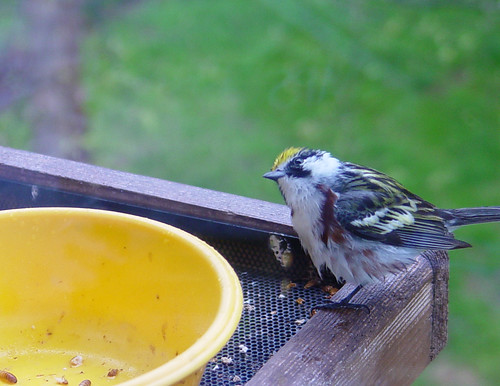
and what looked like a very confused, wet Chestnut-sided Warbler standing on my tray feeder in the rain in 2004.

Chestnut-sided Warbler

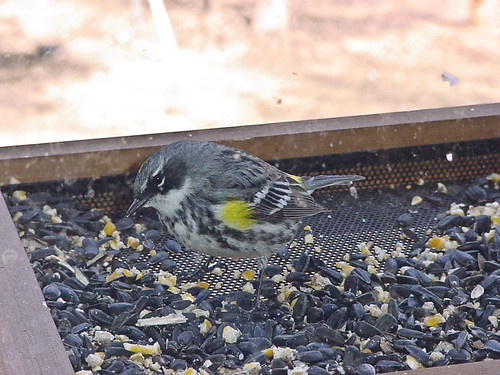
I saw my first Yellow-rumped Warbler at my feeder in 2001.

Yellow-rumped Warbler

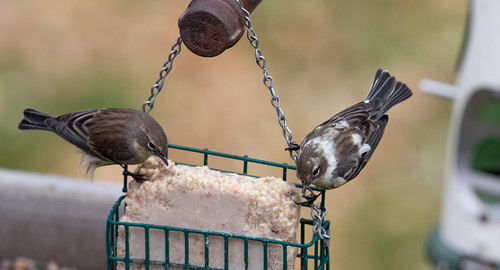
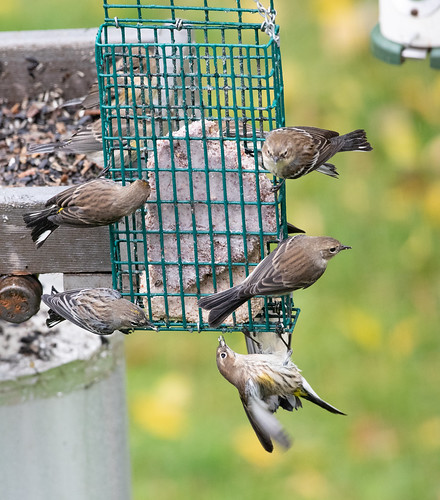
Since then, every now and then one would show up briefly in spring or fall. But in 2014, suddenly the little guys were everywhere. I took a photo at my feeder on October 7, 2014, captioning it in my blog “I've had as many as 12 Yellow-rumped Warblers in my suet and peanut butter feeders at the same time this week. This is not a typical visitor at bird feeders, but they're desperate.”

Yellow-rumped Warblers at my suet and peanut butter feeders.

Since then, I’ve had good numbers a couple times, but this spring didn’t see any at my feeders.

But this fall, suddenly, there they were. And I don’t mean just a dozen or so—I’ve had as many as 30 Yellow-rumped Warblers at my feeders at once, with 80 in my backyard at the same time.

Yellow-rumped Warbler

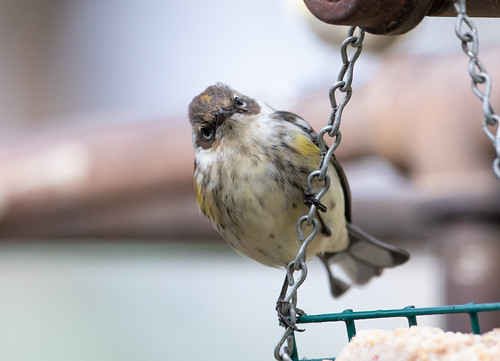
And this stretch of Yellow-rumps didn’t last for just several days or a week as it has in past weeks—it’s stretched through the first half of the month so far—I was still seeing at least 50 Yellow-rumps in the yard on the 17th. One of them is simply gorgeous—the first leucistic Yellow-rumped Warbler I’ve ever seen, with a pretty white collar, a few white patches, and a paler overall coloring except the yellow areas.

Leucistic Yellow-rumped Warbler

Leucistic Yellow-rumped Warbler

With so many warblers, I have three suet feeders filled with five suet cakes, and I’m needing to add one new suet cake every day, which may be more than I’ve ever used before, though when I was getting free raw suet from the grocery store in winters back in the 80s, I may have been using this much—I didn’t think to keep records. I’ve also been going through a lot of mealworms. I put them only in one little acrylic feeder stuck with suction cups to my home office window, for my chickadees, but of course the Yellow-rumps have discovered it, too. I’d not been handfeeding my chickadees all year—I mostly work from a desk treadmill now which makes it harder to notice when the chickadees are here, so I can’t jump to the window when they show up. But one chickadee still takes mealworms from my hand, and one or two warblers have tried that too, now—the only time in my life I’ve ever had a warbler alight willingly on my hand.

I’ve been using more than one 50 pound bag of black oil sunflower seeds each week, thanks to the huge number of Blue Jays I was getting as well as the high numbers of sparrows and juncos. That’s leveled off now that most of the Blue Jays have moved on, but even as the sparrow numbers seem to have peaked, I’m now getting lots of Purple Finches.

Every morning I’ve been surprised all over again to hear yellow-rumps chipping. One morning soon I’ll wake up and that sound will be gone. I’ll miss them, but my main feeling will be relief—it’s sort of scary to have them here so late when we’ve been having such cold weather now. And when they’re gone, people will finally stop asking me about drunk birds. At least I hope so. 

Yellow-rumped Warbler

Thursday, October 11, 2018

Drunken Birds: Final Recap

Yellow-rumped Warbler

Over 30 years ago, on January 20, 1988, in a program I did about waxwings, I said,
A couple of the calls I’ve had recently have been about waxwings that don’t seem quite sick, but act strange and allow people to pick them up–they seem, well, somehow they seem drunk. And that’s exactly what some of them are. If cold weather stops the flow of fresh sap to mountain ash berries and then there’s a thaw, the sugars in the berries may ferment. If a waxwing eats too many, it gets roaring drunk, staggering about on the ground or in the air, vulnerable to predators and accidents. If you find a drunk waxwing, it’s often a good idea to give it food and shelter until it dries out. Just remember that like all native American songbirds, waxwings are protected by law. As tempting as it is, they cannot legally be kept as pets.  
That may be the first time I ever talked about intoxicated birds on the air. I’ve mentioned the problem of fermenting berries and other fruits many times in the three decades since then, but apparently most people were still completely unaware of the problem until the police chief in Gilbert, Minnesota, wrote a press release last week stating that people throughout town are finding intoxicated birds everywhere, and in their drunken state, the birds are colliding with cars and windows.

That story went viral. The Duluth News-Tribune interviewed me about it, and soon I was fielding calls and doing interviews for CNN, KARE-11 TV in the Twin Cities, and even the New York Times. A local Fox News station in the Twin Cities called me. They needed a live interview, so I gave them Sharon Stiteler’s name—she’s the famous “Birdchick” and a park ranger down there, and she gave them a great interview. Some of the articles and TV spots used my photos of robins and Yellow-rumped Warblers, but some just did internet searches, which is probably why some were illustrated with European Robins, which aren’t even thrushes, and a Fieldfare, a Eurasian species which was found exactly once in Minnesota, in Grand Marais, back in 1991.

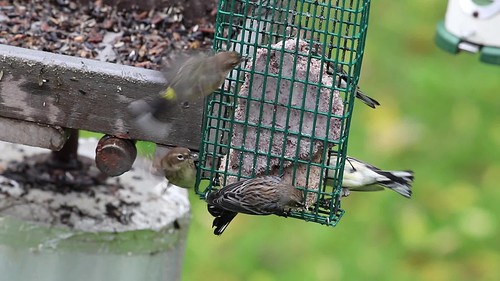
The problem is, there’s no evidence that berries fermented early this year, and it’s usually not until late winter and spring that the sugars in old fruits reach that stage of fermentation. We’re having a huge songbird migration right now—I’ve had at least 60 Yellow-rumped Warblers in my yard at a single time much of the past two weeks, sometimes counting over 25 in my feeders simultaneously.

Yellow-rumped Warbler

Except during these migration fall-outs, people seldom see these tiny little flutterers on the ground, and the way they hop and fly could appear weak and even drunken for those more accustomed to seeing the faster, more direct movements of heavier birds such as sparrows and juncos.

But even the writers who tried hardest to clear things up couldn’t resist putting a fun, drunken spin on the issue, except Matt Mendenhall, editor of BirdWatching magazine. On Tuesday he put up a summary of the story, “BirdWatching experts help explain ‘drunk birds’ phenomena to America.” The nationwide headlines were much heavier on humor than accuracy:

“Drunk birds are causing havoc in a Minnesota town. Police say they’ll sober up soon.” — Washington Post.
“Drunk Birds Are Currently Terrorizing a Town in Minnesota” — Vice.
“Drunk Birds Can’t Handle Their Alcohol, Are Flying Under the Influence Around Town” — Time.
“Birds are getting ‘drunk’ off of berries and flying into windows, police say” — USA Today.
“Drunk Birds? How a Small Minnesota City Stumbled Into the Spotlight” — New York Times

The Twin Cities Fox News story got picked up nationally. Soon Sharon Stiteler was being featured on Ellen DeGeneris and Jimmy Fallon's monologue—the one silver lining to the whole story.

People forget all about major news headlines now within days as everyone moves on to the next viral story. But meanwhile, I’m sad that people took the wrong lesson from this. I’m with Kenn Kaufman, who told The New York Times that he finds it “difficult to laugh at the plight of these potentially drunken creatures. He compared this widespread glee to the reaction to YouTube videos of loopy children after oral surgery.”

Right now, there is too much scary and even horrifying national news for people to wrap their heads around, so I’m not surprised that the country reveled in a story about drunken birds in such a lighthearted, if inaccurate, way. If a national story about migratory birds was going to lead to any kind of understanding of them and how to help them, I’d be thrilled. As it is, this all turned out to be yet another news item I’d like to forget.

Yellow-rumped Warbler

Tuesday, October 9, 2018

How Lisa Found Childlike Delight through Photography

Lisa Johnson — Wednesday Morning, 7 a.m.

Yesterday KUMD played a repeat For the Birds from 2014, in which I talked about how thrilling it was, as a new birder, to be seeing in real life birds I’d seen as a very little girl in my Little Golden Book: Bird Stamps. In it, I said: “I wish that everyone could experience at least one season filled with the joy of discovery that I had in 1975, when I saw so many of my first birds through eyes filled with a child’s elation and wonder.”

Something about that inspired Lisa Johnson to write this splendid essay (as a text message!!):
My eyesight has been crummy ever since third grade, when I got my first pair of glasses. First it was nearsightedness, then nearsightedness with astigmatism… now it’s both of those with old eyes. I’m lucky that (so far) it’s correctable, because I’m legally blind otherwise, but I’m accustomed to not seeing real specifics at a distance.  
So imagine my delight when, through the magic of a camera lens, I’m learning that the black specks and brown blobs I’ve been seeing all my life resolve themselves into birds with the most amazing and undreamed of colors!  

Great Blue Heron by Lisa Johnson
Photography, for me, is almost like Christmas morning when I was a kid: “What did I get? What did I get?” And frequently: “Oh, this is even better than I thought it would be!” Birds almost never disappoint: even a photo that’s not crystal clear or beautifully composed can show the bright black twinkle of a sparrow’s eye or the huge yellow eyes of an owl. Although the subject of the photo is long gone, I can pore over the image to my heart’s content, looking at cormorants’ funny feet or the slate blue in a sparrow’s wing. 
Who knew that bird was really green? Who knew that bird had a bright yellow head? Who knew that those “ducks” floating on the slough were wood ducks and blue-winged teal and scaup and redhead? Is that silhouette in a tree an eagle or a hawk? 
Photography has opened up a whole new world for me in a lot of ways, but it’s really made birds something special. If we’re not racing through our days being “busy,” we’re racing down the road at 70 miles an hour. I’m tired of busy. I still drive faster than I should, but now I’m scanning the roadsides and trees and fences and power lines for birds. My camera with the big zoom lens sits in the passenger seat so I can slam on the brakes and pull over at a moment’s notice to photograph a turkey vulture or a red tailed hawk or a bald eagle.
Yellow-headed Blackbird by Lisa Johnson 
I know every slough and body of water between Lake Brophy in Douglas County to Kenney Lake in Grant County, Minnesota, where I spend most of my vacation time. I know where the yellow-headed blackbirds will be in the spring, the little creek where I can almost always photograph a great blue heron or a great egret, where I’m likely to find coot or bufflehead and where I’ve gotten good photos of white pelicans and cormorants. And in the lake where my dad’s ashes are scattered, I got my best-yet photo of a loon this summer.  
Then after I’ve doodled my way home after as many stops as it took to get photos, I can make a cup of coffee and carry it over to the computer and sit down. I can take my time browsing through my pictures, finally able to see clearly the birds I photographed. I can take my time inspecting their colors and patterns, marveling over the personalities they show the camera, get a good close look at their wings and beaks and feet. I can mark with a star the good photos, but even the crummy ones can usually show me a detail I could never have seen with my unaided eyes. I have all the time in the world to enjoy examining the birds in the images, to look them up, learn their names, and plan for the photos I’ll get “next time.” 
So when Laura talks about that joy of discovery … I’m having that experience right now. That driver in front of you who just hit the brakes and veered over onto the shoulder? Who’s snapping away with a big lens at who-knows-what out the window? That’s just a 57 year old child, experiencing elation and wonder. She’s got her hazard flashers on, at least, so just give her a smile and drive on by.


Friday, October 5, 2018

Sober Up

St. James student with Cedar Waxwing

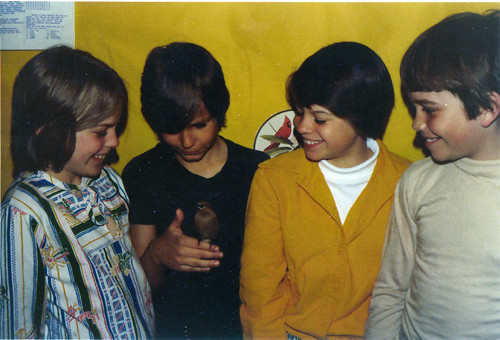
Back in the 1970s when I was an elementary and junior high science teacher, one of my students brought to our classroom a Cedar Waxwing that had become intoxicated on berries. During its drunken reverie, it must have flown into something, because it had a sprained wing. So for several days we kept it in my classroom, which we dubbed the Ms. Erickson Detox Center. My students helped me feed it mealworms and berries, and when it was ready to be released, we took a field trip to my favorite spot in Madison, Picnic Point, where we let it go.

I did a little research about intoxication in birds at that point, though I didn’t think I’d encounter another tipsy bird in my lifetime—it seemed too bizarre and random. But not too many years later, after we’d moved to Duluth, when I was a licensed rehabber, I was brought an intoxicated Bohemian Waxwing found by the Miller Hill Mall. 

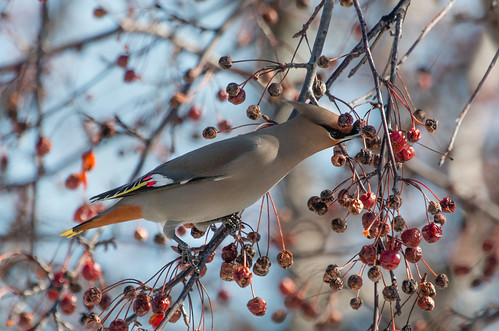
Bohemian Waxwing

This happens more often than you’d think, and we’ve been learning in recent years that some ornamental berry trees can be toxic, leading to “drunken” behavior, even without fermenting. But that is not what is happening in Duluth right now, and I suspect it’s not happening in very big numbers in Gilbert, either, despite the national news.

When birds collide with windows, they act very disoriented, usually because they have head injuries from the impact. We’ve long known in Duluth that birds hit windows in exceptional numbers during migration, because as a migration hotspot, so many birds are here in the first place. For decades I’ve been helping people find ways to make their own windows safer for birds—my book 101 Ways to Help Birds and now my webpages devoted to that include lots of strategies, and I’ve written and spoken extensively on the topic since the 80s. Glass is a killer—Daniel Klem of Muhlenberg College has spent his career studying the problem. He discovered that fully 50 percent of birds that hit glass and seem to come to eventually die from hematomas and other brain injuries. So it’s a problem that needs to be addressed.

Yellow-rumped Warbler

Migrating birds suffer another huge problem as they pass through northland towns and cities—they get hit by cars. Yellow-rumped and Palm Warblers spend a lot of time on the ground and in low shrubs during migration, especially when temperatures are low, because more insects are active lower down than at treetop level in the cold.

Palm Warbler
This year, these warblers and a host of sparrows have flooded through northern Minnesota in the past week, making it pretty much impossible for people to miss noticing them. I’ve seen lots of roadkill on Arrowhead Road and London Road. These birds came from much further north, and haven’t developed strategies for dealing with objects moving at high speed. It’s not too hard to avoid hitting them when driving 25, but as soon as we get over 30 miles per hour, we can’t avoid hitting these little birds.

Informing people about issues of fermenting berries is a good thing—knowledge is power. And a funny story about drunken birds may be more welcome right now than stories about sexual assaults by drunken college students. But the story of drunken birds in Gilbert has become completely overblown, leading to misinformation. Yesterday, one of my friends photographed five dead birds under a window at Essentia, a big medical establishment here in Duluth.


The birds were a variety of warblers—insectivores, not fruit-eaters. This happens every year—I bet this year huge numbers are dying at the Vikings Stadium. My friend took the photo because Essentia is planning a new building project, and she is trying to persuade them to use more visible glass in it. But while she was taking the picture, someone told her the birds had been drunk—she’d read about it in the paper. NO! The birds died because they were passing through and hit the glass. If the news about drunken birds leads people to take less seriously the serious issue of bird collisions with glass, that misinformation campaign will have done a grave disservice. It's time for us to sober up. 

Yellow-rumped Warbler


Thursday, October 4, 2018

Not so very drunk

Yellow-rumped Warbler

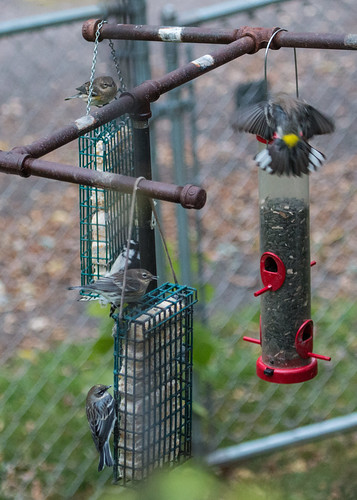
First thing Monday morning, I looked out at the birds in the back of my yard. With my very first peek, I had four sparrows in my binoculars—and they were four different species: White-throated, White-crowned, and Harris’s Sparrows, and junco. While I was still looking at them, another species flitted through—a Yellow-rumped Warbler. I was hearing lots of Blue Jays, and when I scanned, counted 23 jays in a single tray feeder just barely big enough to accommodate the crowd. There were plenty of other jays throughout the yard—more than 60 total—feeding in other feeders and on the ground, drinking from the birdbaths, and squawking from the trees. The total number of sparrows in the collection in the back of the yard was over 50. At least a dozen Yellow-rumps were about—some in my suet feeders but most on the ground and in the shrubs making their dry chips. Lovely calls drew my eyes skyward to a line of 9 Sandhill Cranes flying overhead. A Yellow-bellied Sapsucker worked my apple tree while robins and Swainson’s Thrushes fed in several berry shrubs in back. I could also hear my backyard Downy, Hairy, and Red-bellied Woodpeckers and a flicker, to say nothing of my chickadees.

Right now, at the peak of songbird migration, my backyard is a happenin’ place, but what we call a migration fallout is way more widespread than just on Peabody Street. People have been calling and messaging me for days about all the birds hitting windows and getting hit by cars.

On Tuesday, Police Chief Ty Techar of the Gilbert Minnesota police department issued a press release saying that the department had received calls about "birds that appear to be under the influence, flying into windows, cars and acting confused." I got a call from Peter Passi of the Duluth News Tribune asking about it. The Gilbert police were attributing the situation to intoxicated birds eating fermented berries, but they didn’t specify what species were involved in these problems. Robins, other thrushes, and waxwings are usually the birds found intoxicated. But that’s definitely not the issue with birds people have been calling me about, as I told Peter Passi. Yellow-rumped Warbler migration always peaks right at the end of September into early October, and this year they’re unusually abundant. I picked one up at a Subway restaurant in Duluth this weekend—it was stunned, and at first in no condition to walk or fly in a straight line, but it would have been perfectly capable of passing a breathalyzer test.

The Duluth News Tribune article took one quote from me but ignored everything else I said:
Laura Erickson, a Duluth birding expert, said waxwings, robins and thrushes often are some of the most prone to become tipsy, as they commonly feed on such berries. 
"Birds actually do get literally intoxicated when they eat berries that have started fermenting, and that does lead to drunken behavior," she said.
The article focused entirely on the drunken birds angle, starting with a funny color cartoon of a drunken bird with a sign, “Welcome to Gilbert,” and ending with Police Chief Techar joking that people didn’t need to report intoxicated birds to the police, but should call if they saw Heckle and Jeckle walking around being boisterous or playing practical jokes, Woodstock pushing Snoopy off the doghouse for no apparent reason, or a string of other funny situations.

I had a sinking feeling that drunken birds was going to be the only takeaway message even though I’ve yet to hear any actual evidence that fermented berries are even involved in this situation. Sure enough, I got a call from a Twin Cities TV news station reporter, and all he wanted to hear about was birds getting drunk. He wanted someone on the air to talk about it, and he asked her where he could get some footage of waxwings getting drunk. Then Minnesota Public Radio picked up the News Tribune’s story. On their Facebook article, they showed a dead hummingbird with a quote from me about birds eating fermented berries, implying that I was saying that’s what happened to the hummingbird. It absolutely is not!

I guess with all the talk on the news about high school and college drinking parties, it’s to be expected that birds acting a little out of the ordinary would be accused of being drunk. But even though the birds in Gilbert may indeed be intoxicated by fermented berries, I’m doubtful unless someone can confirm their species. And even then, when berry trees are close to windows or roads, birds feeding in them can be startled by a hawk and crash without even being intoxicated. But the first step in knowing for certain what’s going on isn’t to test their blood-alcohol levels, just check their ID.

Meanwhile, birds hit windows in unacceptable numbers every year during migration. But I’m afraid that important message is being lost in the fun people are having suddenly talking about drunken birds. It’s a diversion from national news, and people seem to have already forgotten one important news story. I expect there have been hundreds of birds killed at the Vikings Stadium this week. Even those of us who haven’t blacked out from too much beer since the stadium was in the news have forgotten what a hazard it is and will continue to be every single spring and fall. Migrating birds deserve safe passage through our state, but for a while now, the ones dying due to the hazards we put out there will be the butt of jokes.

You can help your backyard birds by making your windows safe. Here are some suggestions.

Vikings Poster