Laura Erickson's For the Birds

Monday, February 4, 2019

Superb Owl Sunday 2019

Barred Owl

On New Years Day this year, Russ and I made a date—come hell or high water, or even record-breaking low temperatures, we were going to get out birding together on Superb Owl Sunday. We set as our destination the Sax-Zim Bog. Last Thursday morning, Cotton, Minnesota, in the heart of the bog, had the coldest temperature in the Lower 48, and the fifth coldest temperature ever recorded in Minnesota, 56 below zero. But by Sunday, just three days later, the temperature was 24 degrees—yep, it was an amazing 80 degrees warmer than just a few days before.

As we drove to the bog, I told Russ I had three goals for the day: to see a shrike, to get some good photos of a Black-backed Woodpecker, and, of course, this being Superb Owl Sunday, to see at least one owl.

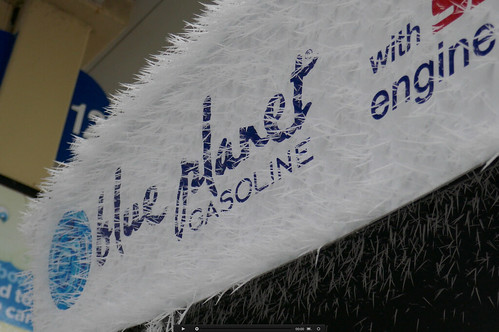
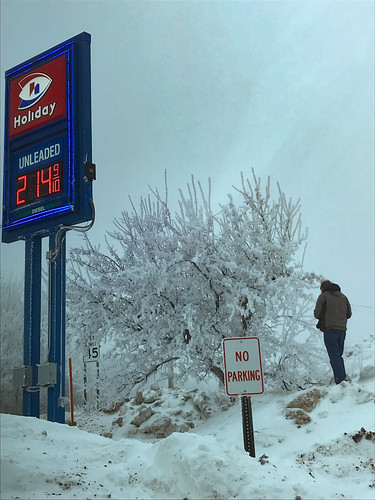
As we drove out of town, there was a beautiful light fog; hoar frost covered all the deciduous trees. We stopped for gas where frost covered everything—even the gas pumps and garbage cans.

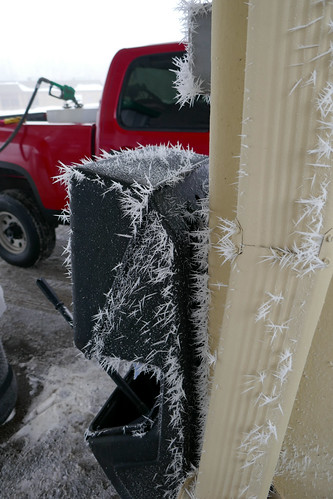
Hoar frost at gas station

Hoar frost at gas station

Hoar frost

Russ photographing hoar frost

Russ took photos—no matter what else happened that day, the stunningly beautiful, needle-like ice crystals gave the morning a special glow.
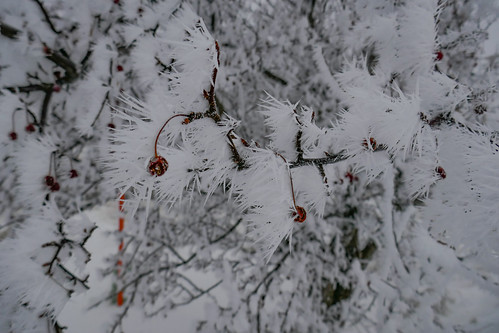
Hoar frost

Oddly enough, the fog never lifted all day, the sun never came out, and the temperature never rose higher than that 24 degrees, so for the first time I can remember, the hoar frost never disappeared. 

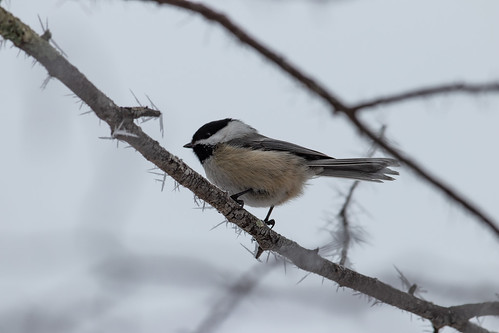
We made our first stop the boardwalk at the Warren Nelson bog—that’s where I hoped to see a Black-backed Woodpecker. No luck on seeing or hearing one, though all the fresh pieces of bark on the ground provided plenty of evidence that they spend a lot of time in this area. Distant crows making a ruckus suggested an owl somewhere, but we never saw where they were mobbing. I took some photos of the frost and of chickadees at the feeder.
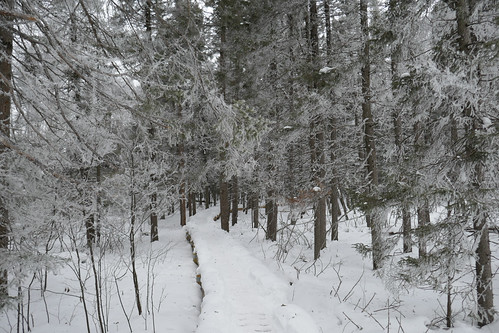
Hoar frost

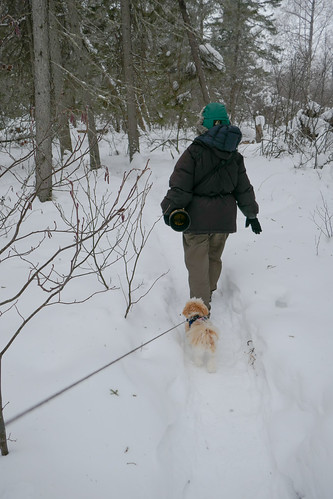
Pip stays right at my heels/ Russ is holding the least and taking the photo
Notice how close Pip sticks to me. She and Russ have to let me go first in case there are any birds. It's the law.
Chickadee on frosty branch

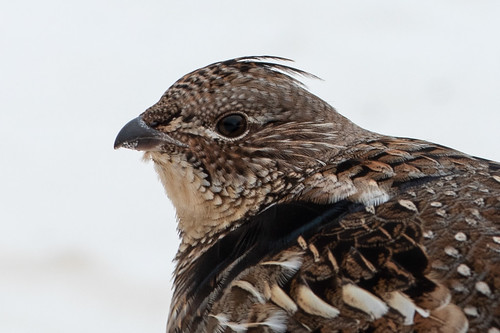
Then we headed to Owl Avenue and the Friends of the Sax-Zim Bog welcome center. Before we even got there, we slowed down for a dark blob on the road ahead of us—a Ruffed Grouse. A car coming the other way passed by, pulling over enough to avoid hitting it, and the grouse retreated off the road into a ditch. We pulled our car over on the far side to see if it would come out. The little guy looked over a snow bank to make sure the coast was clear, and voila!
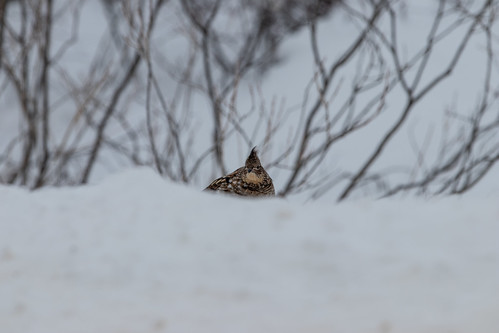
First glimpse of the world's most cooperative Ruffed Grouse

I took some photos of it peering over the snow bank, and then it came closer and closer. I have never in my life been this close to a Ruffed Grouse and got some amazing closeups. This was not on my list of goals for the day.
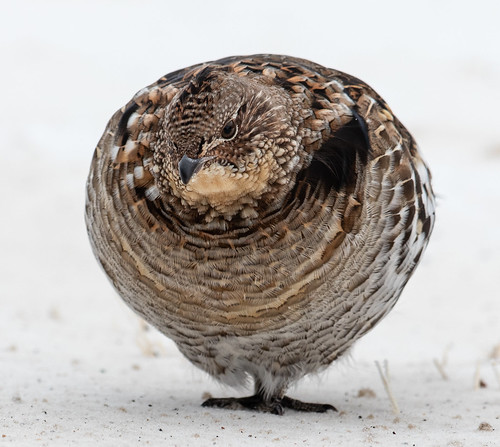
Ruffed Grouse
It was nice to see such a football-shaped bird on the day of the big football game. 

Ruffed Grouse

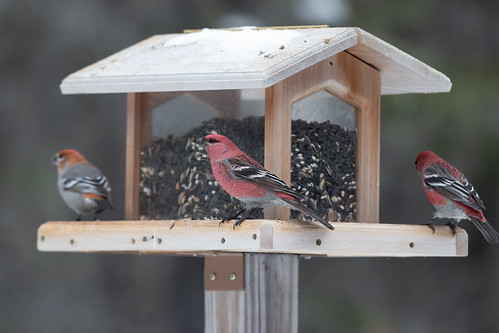
Birders from all over visit the welcome center, keeping the volunteers and staff up to date on where birds are—Clinton Nienhaus told us the best places to go to see Barred, Great Gray, Snowy, and Northern Hawk Owls. I took photos of feeder birds before we set off.
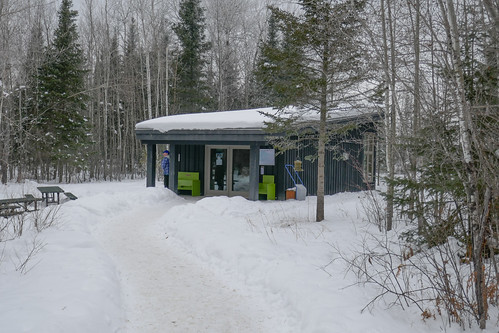

Friends of Sax-Zim Bog welcome center

Clinton Nienhaus

Pine Grosbeak

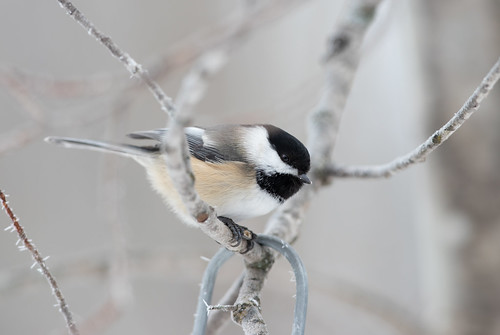
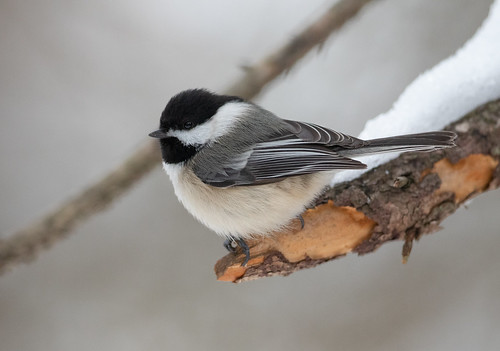
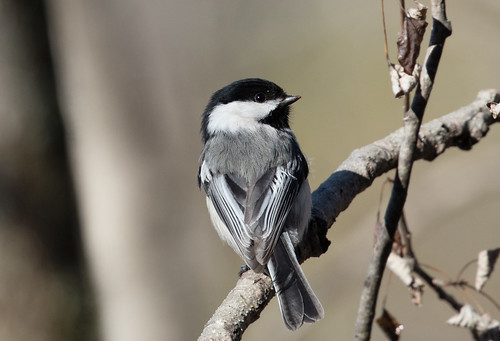
Black-capped Chickadee

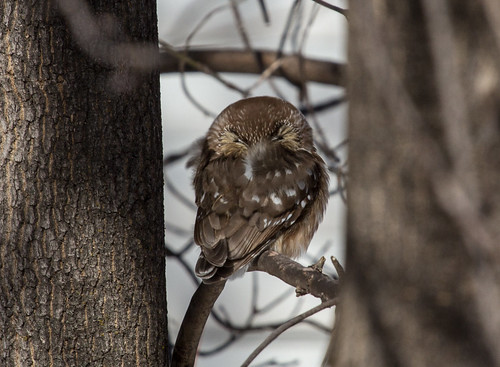
A Barred Owl has been hanging out right at the intersection of Owl Avenue and Arkola. When we got there, a group of people were photographing it, tucked into the branches of a frost-covered spruce. That was a lifer for my dog. Seeing the owl at all fulfilled one of my goals—getting photos was icing on the cake.
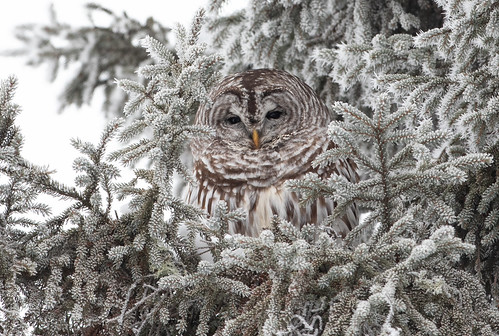
Barred Owl roosting

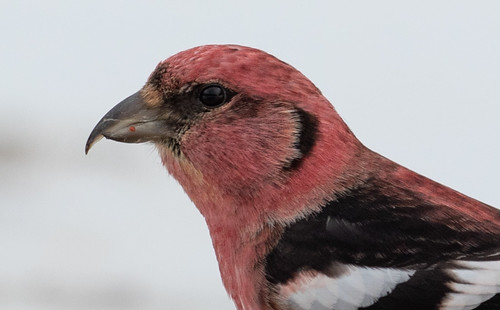
Then we headed to McDavitt Road, where we might find a Great Gray or a Northern Hawk Owl. Before we got to the right spots, we came upon more little blobs in the road, and birders standing right near photographing them. Again I got the best photos I’d ever taken of a species, this time White-winged Crossbills.
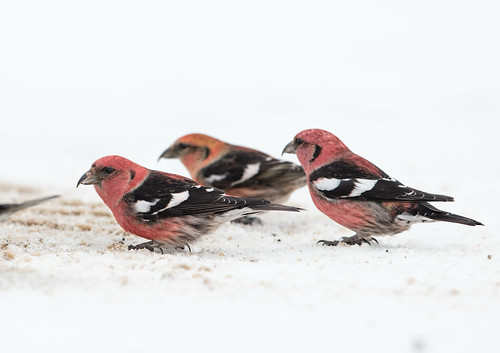
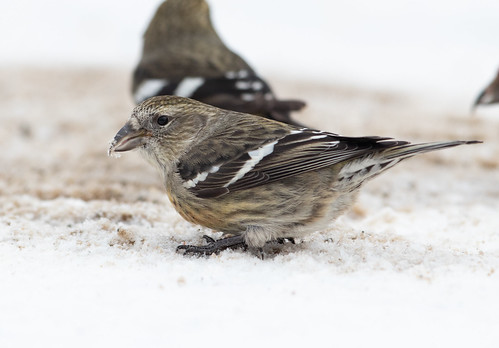
White-winged Crossbill

White-winged Crossbill

White-winged Crossbill

The hawk owl was exactly where people have been seeing it, in a clearing off a little foot trail. My photos against the gray sky were far from my best, but I was thrilled nonetheless.
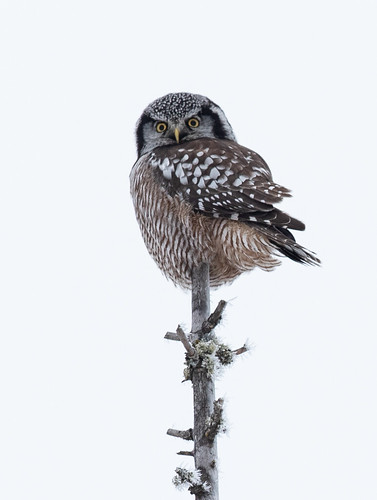
Northern Hawk Owl

Then we went back to McDavitt to see a group of birders photographing a Great Gray Owl who was perched less than 90 feet away. My photos capture the bird and the soft, magical quality to the gray day.
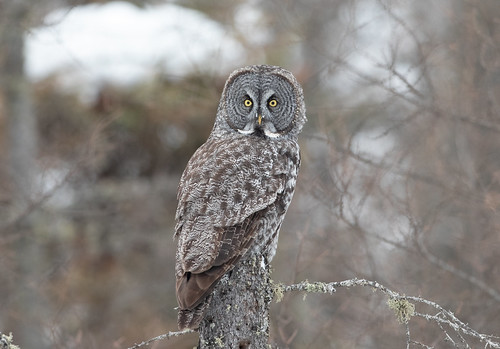
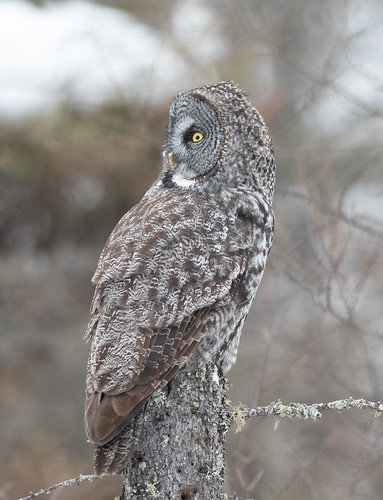
Great Gray Owl

Great Gray Owl

It was already getting late. On our way back toward our final goal bird, we passed the Barred Owl corner again. This time the bird was out in a deciduous tree in the open, apparently hunting. We stayed in the car to avoid stressing it, but it was close to the road so my photos show a focal length of only 50 feet.
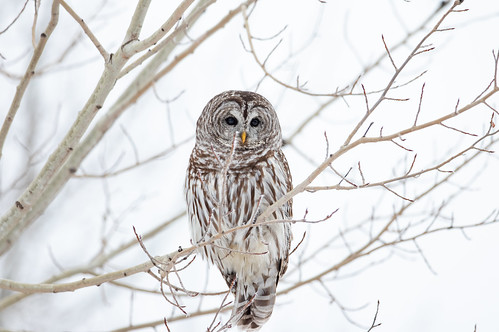
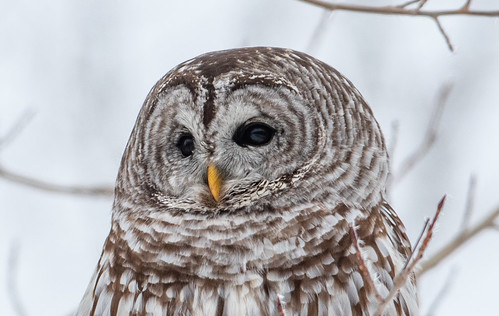
Barred Owl

Barred Owl

We found one of the two Snowy Owls that have been hanging out in the bog, but it was at least an eighth of a mile away and probably closer to a quarter mile. Russ's and my photos were very gray, but the bird is identifiable.
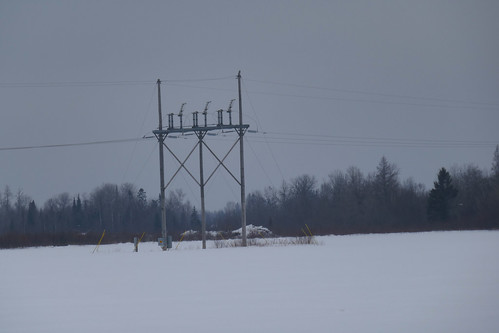
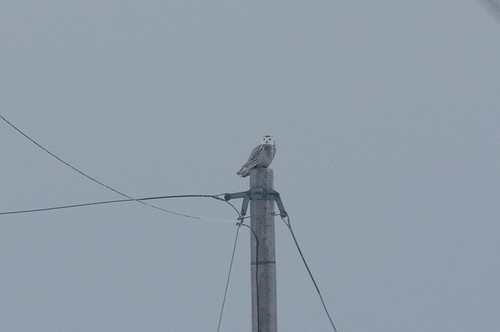
Distant Snowy Owl

Distant Snowy Owl

By day’s end, I had achieved only one my three goals, but had fulfilled that one shockingly well—FOUR owls! And the other wonderful birds seen made this one of my finest birding days ever. Russ’s and my Superb Owl Sunday turned out to be truly superb. 
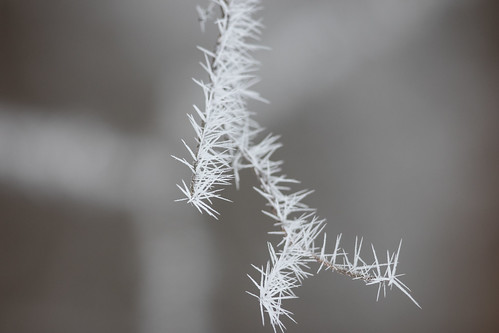
Hoarfrost

Superb Owl Sundays with Russ: A little history

Boreal Owl

Back in the 1980s or 90s, I noticed that the term Super Bowl can be written with the exact same letters in the exact same order to spell Superb Owl. Since I never quite figured out football, I started celebrating the day by going out looking for owls.

Over the years, I’ve gone out many times, sometimes with friends, sometimes alone. I’ve found at least one owl every one of those times except last year when I went out with Lisa Johnson—for some reason we had very bad owl karma that day, and got skunked.

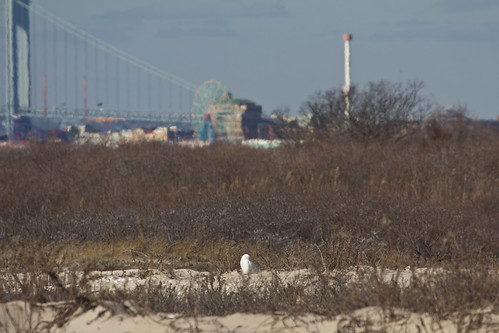
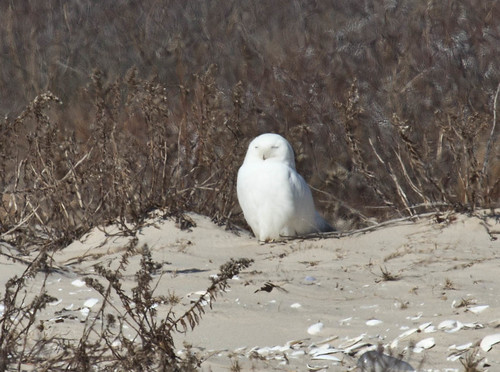
In all those years, I’ve only gone owling three times with my husband. We got away to New York City in February 2012, and so on that Superb Owl Sunday, Russ and I drove over to Breezy Point Tip in Queens with our daughter Katie and her now-husband Michael. I’d heard that there were Snowy Owls in the dunes above the beach, and sure enough, we saw both a pure white adult male and a more heavily marked younger bird. I only managed photos of the all-white male.

Snowy Owl in the Big Apple

NYC Snowy Owl

By the following Superb Owl Sunday, Russ’s mom was living with us so we couldn’t get away for a full day at all anymore, but that was the year I was doing my Big Year and I wanted at least one birding adventure with my husband. So after we had his mom settled in for the morning that Sunday, we went up to Two Harbors.

That year there were Boreal Owls all over the place. Along the freeway en route, we passed two clusters of birders with cameras and spotting scopes pointing into the trees, and as I suspected and confirmed later, they were indeed looking at Boreal Owls. But I wanted to find my own, and I wanted it to be in my favorite little spot in Two Harbors where an alley runs along a wooded ravine, so we went straight there. 

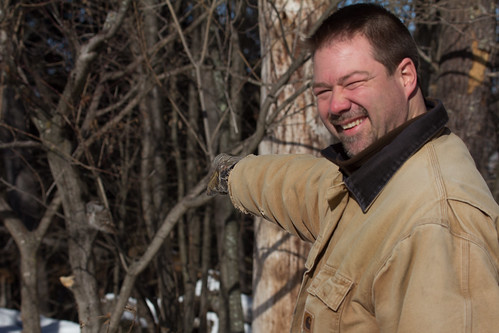
We’d parked and started walking when one of my friends, Jim Lind, saw us and rushed down to say hi and tell us a saw-whet owl was just a few blocks away roosting in someone’s back yard. Jim and Russ had never met, so we stood chatting in the alley for a few minutes and then—WHOA! Jim looked up and said, “Boreal Owl!” 

Jim Lind pointing out Boreal Owl
Jim Lind pointing out the Boreal Owl.
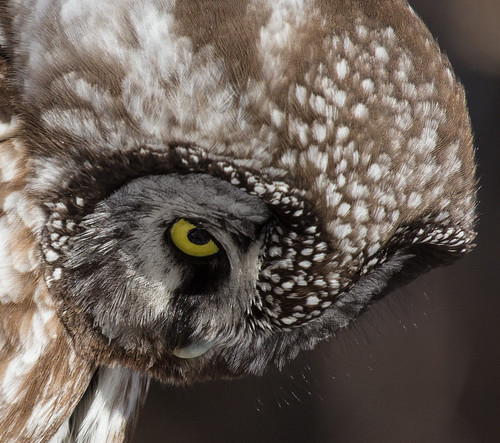
Boreal Owl
It was so close from that vantage point, with my 400-mm camera, that you can make out the tiny bristle feathers that run along the edge of the facial disks.

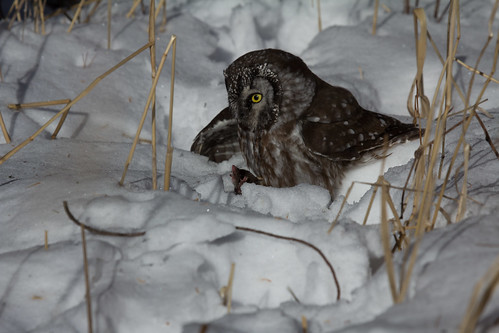
It was sitting in a branch right even with us, only 20 feet away, based on my camera’s focal length data. The sun was behind us giving perfect light as the little owl sat posing for some of the best photos I’ve ever taken of any bird. After Jim left, the little predator dove into the snow, pulled out a
shrew, and ate it.

Boreal Owl

Russ and I watched it for a good half hour before we moved on. I felt secure assuming we weren’t bothering it—we’d been talking with Jim for two or three minutes without even realizing it was there, and it didn’t seem to pay us any mind while we were photographing it. Then we moved on to see the roosting Saw-whet and headed home.

Northern Saw-whet Owl

That’s the last time Russ was able to go out with me on Superb Owl Sunday until this year. And this year ended up being my best Superb Owl Sunday of all. But that's for another blog post.

Russ looking at Boreal Owl
Russ looking at our Boreal Owl. (I hardly ever remember to take pictures of him!)

Saturday, February 2, 2019

Silence Is Golden

Laura recording birds

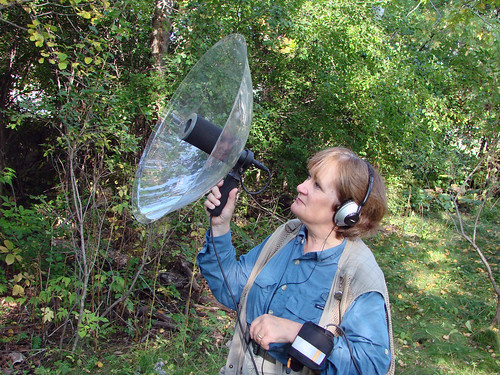
Last week I ran as a radio rerun a "For the Birds" program that originally aired in 2000, about the silence of winter. The year after I did that program, I got some high-quality sound recording equipment and started appreciating how tragically rare silence is.

I hardly needed absolute silence to capture a pure rendition of the song of a warbler or thrush. I could limit my bird recording to calm, rainless days, and I learned a few microphone positioning tricks to minimize the effects of some natural noises.

But I had no chance of getting a clean recording in my own backyard no matter how perfect the meteorological conditions. I live in a very quiet neighborhood in Duluth, at least by the standards I’ve always used to define a quiet neighborhood. With my recording equipment, I discovered how many people had switched to high-efficiency gas furnaces—a great thing in every way except their noise level. And in summer, there are few half-hour blocks or time from early morning till evening when no one within hearing range is mowing a lawn. I’m 5 blocks in two directions from heavily used roads where truck traffic is common, and even on Peabody Street, cars come by way more often than I realized before I started recording birds.

I’m not the only one who notices small city noises. On January 17, the New York Times ran a story about how Stradivarius violins are, little by little, reaching the end point in their ability to produce their uniquely exquisite sounds. They wrote:
So that future generations won’t miss out on hearing the instruments, three sound engineers are producing the “Stradivarius Sound Bank” — a database storing all the possible tones that four instruments selected from the Museo del Violino’s collection can produce…
“This will allow my grandchildren to hear what a Strad sounded like,” said Leonardo Tedeschi, a former D.J. who came up with the idea for the project. “We are making immortal the finest instrument ever crafted.”  
The Museo del Violino is in Cremona, a city a bit smaller than Duluth, with a population of 72,000. The Stradivarius sounds are being played and recorded in an auditorium associated with the museum. But the project hit a roadblock. According to the article:
In 2017, the engineers thought their project was finally ready to get underway. But a soundcheck revealed a major flaw.
“The streets around the auditorium are all made of cobblestone, an auditory nightmare,” Mr. Tedeschi said. The sound of a car engine, or a woman walking in high heels, produces vibrations that run underground and reverberate in the microphones, making the recording worthless, he explained. “It was either shutting down the entire area or having the project not seeing the light of day.”  
Fortunately, the mayor of Cremona happens to be president of the Stradivarius Foundation. He ordered the streets around the museum to be closed for five weeks and appealed to people in the area to keep it down.
“We are the only city in the world that preserves both the instruments and their voices,” Mr. Galimberti said. “This is an extraordinary project that looks at the future, and I’m sure people from Cremona will understand that closing the area was inevitable.”  
Stopping all human noisemaking in one small area of one small city for five weeks turned out to be hard but doable, in a place where everyone understands how important it is to preserve Stradivarius tones. It’s impossible to stop traffic along a stretch of highway, much less get people to agree to suspend all activity in an area, just so someone can record natural sounds that we can hear every day during the right season. Silence really is golden, and even harder to come by.

Friday, January 25, 2019

Black-capped Chickadee Musings on a Frigid Day

(This transcript of a program from the 1990s seemed worth another look.)

Black-capped Chickadee

When we're in the midst of a blizzard, while snow is swirling and piling up, sometimes a person needs to hunker down for a bit with a cup of coffee or cocoa and stare at a rectangular piece of glass. A TV set or computer monitor satisfies this fundamental biological need for many people, but I prefer to stare out my dining room window. The frigid northern winter penetrates the walls, making the house a bit chilly, but the cocoa warms my tummy, and chickadees zipping in and out of the feeders warm my heart.  

Black-capped Chickadee

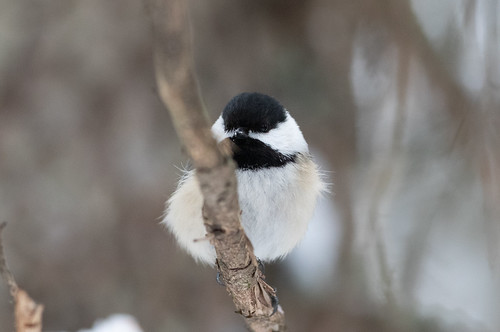
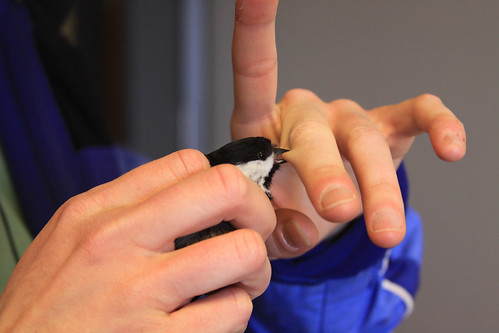
What is it about these creatures that so captivates even the most rational of us? Perhaps it's their tiny size: it takes three chickadees to balance a first class letter. But if size were the chickadee's main attraction, wouldn't we like mice and cockroaches even more? Chickadees seem gentle and sweet, but bird banders and birch trees can attest that that tiny chickadee beak packs a wallop.

Taking revenge

Black-capped Chickadees building nest

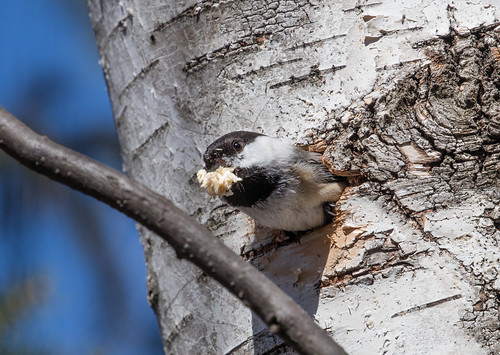
They seem so peaceable in their little flocks, but the sweet gurgles that they make are really aggressive warnings to one another to keep their distance. The whole reason chickadees grab a seed from a feeder and carry it off into a tree to eat it is because they so dislike being close to other chickadees.   

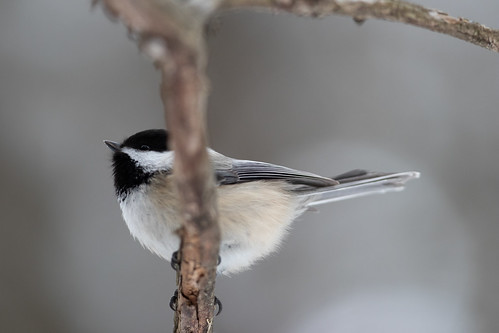
One authority on chickadee behavior and natural history, Millicent Ficken, told me that she got irritated by people who talk about sweet and cheerful chickadees. She maintained that optimism is in the eye of the beholder, and that chickadees struggle for survival in a harsh and bitter world with no more cheerfulness or optimism than any of us would if we were stuck outdoors in twenty below temperatures relying on our wits and bodies alone. She studied chickadees for decades, so I suppose she ought to know, but when I look at chickadees on a bitter morning, even if I'm stuck outdoors right with them, I warm right up. When I look into their bright black eyes, I see curiosity, intelligence, and I'm pretty sure I see optimism. I've never yet seen bitterness, resignation, or despair. Sure they like to keep their personal space, but isn't it the height of civilized behavior to warn others away in the gentlest of terms? Their courtship Hey, sweetie song may indeed be nothing more than a mechanical response to a hormonal surge, but what a pleasant response it is.   

Black-capped Chickadee

Walt Whitman once wrote that "You must not know too much, or be too precise or scientific about birds." I like being precise and scientific about them. I just try to remember that true understanding and knowledge come from the heart as well as the brain, and that a closed heart is just as limiting as a closed mind. No matter what the weather brings, I hope those tiny little metabolic wonders will ever continue to warm my spirits and bring sunshine to the gloomiest days.  

Black-capped Chickadee

Monday, January 21, 2019

Letter from Listener: Turtles Falling from the Skies


Last week I received an email from a reader of this blog (which serves as a transcript of “For the Birds”) about an account Steve Lorentz sent. Steve had watched a crow dropping some sort of item from the sky and retrieving it, apparently playing a game of catch with itself. I added my own stories about a crow I’d rehabbed playing ball with my little boy, and about gulls, which are known to drop various shellfish from the sky to break them so they can eat the meat within. In response to this, Chelsea Baylor wrote:
Several years ago, I was walking the path by the Skokie Lagoons (in Skokie, IL) when I saw ahead of me two young men in earnest discussion over something that one of them was holding.  I came alongside of them and asked what they had.  It was a very small baby turtle.  I advised them that they should return it to the lagoon.  Yes, they would put it into the lagoon, but in fact, it hadn’t come from the lagoon.  It had fallen from the skies and landed on the path directly in front of them.  They were thoroughly mystified!   
Their mystification may have been compounded by being new to the US. Their English was halting, and I guessed they were probably Asian graduate students, or maybe post docs from the Botanical Gardens.  In any case, heaven-sent turtles were distinctly new to them. 
As best I could, I conveyed that it must have been dropped by a bird, but I didn’t think to put it together with the bird dropping the hard-shelled turtle onto the macadam pathway.    And I should have known – in Woods Hole, MA it was positively dangerous to sit at the base of the sundial by the Marine Biological Laboratory. The cement base made a favorite target for seagulls and their clams.
Herring Gull detail

Hearing Chelsea's account about the turtle dropping from the sky reminded me of how bird behavior sometimes intersects mythology and history—and in this case, both at the same time. The Greek playwright Aeschylus died in 455 BC—the cause of death was said to be a tortoise dropped by an eagle from above.  


Aeschylus was supposedly bald, and the story has come down that the eagle mistook his head for a rock. Birders figure the bird in question was more likely a Lammergeier, a vulture fairly common in southern Europe back then. Lammergeiers often carry large bones high in the air and drop them on rocks to shatter them—then they fly down to eat the exposed marrow. Presumably this method would also work for tortoise shells.

All the representations of Aeschylus that I’ve found show him with a pretty full head of hair, at least in front, but it makes a good story. Pliny wrote that Aeschylus was trying to stay outdoors in the first place because of a prophesy that he’d be killed by a falling item, though I’m not sure how being outdoors would lower the probability of that. In at least one version, I read more specifically that he’d been warned of a house falling on him. That story does a better job of explaining why he avoided being indoors, at least with the explanation that a tortoise shell amounts to the reptile’s house.

Whatever the mythological underpinnings and historical accuracy of Aeschylus being killed by a tortoise dropped on him from above, I’d be shocked and amazed to see a turtle fall down from the skies at the Skokie Lagoons or anywhere else. Like Aeschylus, I think staying out of doors as much as possible is a good thing that promises a longer, happier life, and I suppose I base that on a prophesy, too—not a prophesy of doom and gloom and falling houses, but one that promises that I’ll see many more birds outside than if I stay indoors. Chelsea’s wonderful story about this surprising experience made my day.

Sunday, January 20, 2019

The Googlable Laura


One of today's CBS Sunday Morning segments was about podcast production—many podcasts are done with an actual staff and underwriting that supports professional-level promotion as well as production. Me, I’m just small potatoes.

Yet somehow both Wikipedia and Google take notice of my work. After I did a blog post about why Muhlenberg College professor Dan Klem, who pioneered research into bird-window collisions, deserves much more recognition, Wikipedia used that information as a starting point to create a whole entry about Klem,  using my photo of him and citing me in the references.

If you google the term “Most adorable bird in the universe,” my Flickr photos and blog posts about the Cuban Tody are invariably at the top of the results.

My blog posts and web pages are also at or near the top of the search results when people google several topics I’ve covered rather thoroughly, such as the owls of Harry Potterbird tongues, whether feeding jelly to birds is good or bad, why baiting or feeding owls is bad, whether birds fart…just the kinds of questions inquiring people ask. I haven’t written about most of these topics in years, but information like this stays current and accurate over time, and somehow Google's algorithms send these kinds of questions my way. 

Last week, someone in Bala Cynwyd, Pennsylvania, apparently googled “twin chicks,” “double yolked eggs hatching,” or something like that, and found my blog post about “Twins and Double Yolks in Bird Eggs.” The Narberth-Bala Cynwyd Patch posted an article Thursday titled “Twin Chicks Born At Bala Cynwyd Middle School,” about a class studying a unit on embryology and genetics. As part of their studies, the students received 24 chick eggs. The eggs hatched over the weekend, and when the students looked in on them on Monday, January 14, what to their wondering eyes should appear but 30 chicks! If this is accurate, it means that at least six pairs of twins had been produced, which is one of the most extraordinary things I’ve ever heard of.


The newspaper article quoted one student, Danielle Gesser Sapir, who said,
This is beyond rare, for the most likely explanation would be six twins in a batch of 24, which (as two of our math teachers calculated) is a one in a quintillion chance. Our research has shown the probability of having a double yolk is rare, and having two chicks born from the same egg is even rarer.
Danielle also noted,
When twin chicks are born, they usually need help such as a human cracking the egg shell for them. Since all the chicks looked perfectly healthy when we came in on Monday and since none (as far as we're concerned) had aid at birth, this is a confusing event.
The article also quoted my blog, which students or the reporter must have googled:
"In one study of more than 1100 chicken eggs, double yolks were found only three times – that is, in less than one-third of one percent,” according to Laura Erickson, known as the "Dr. Ruth of Ornithology.” “In another, larger study, 2.8 percent of chicken eggs were double-yolked. Very few double-yolked eggs hatch.”
I don’t get paid in money for my podcast or blog, but discovering that my work is useful for students a thousand miles away is more rewarding than money would be. It’s still mystifying how two and a half dozen chicks hatched from two dozen eggs, but life is filled with mysteries—during trying times it’s wonderful when a mystery is as fluffy and adorable as six extra baby chicks.

Monday, January 14, 2019

Letter from KAXE listener Stephen Lorentz

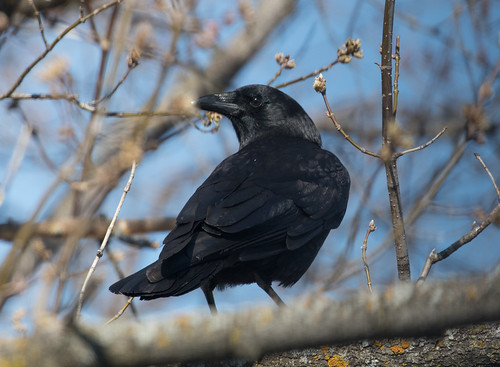
American Crow

Back in December, I got an interesting email from KAXE listener Steve Lorentz. He wrote:
I wanted to tell you about something I saw this fall.  I observed a crow hovering in the wind about 250 feet above the ground.  I watched it drop something from its beak and then dive to catch it after about a 40-foot fall.  It appeared to be playing?  The crow missed the catch on the fourth attempt and followed whatever it was playing with to the ground. 
Steve wrote back with a couple of additional details.
There was about a 15-mph wind out of the SW.  Too bad I wasn’t able to ID whatever it was it was playing catch with.  The image I got was of a young person playing catch with a ball but instead of throwing a ball into the air it was dropping it from above.  I almost sensed the crow smiling as it dove and caught the object. 
One of the ways people distinguish crows from ravens is the generalization that crows are rather boring fliers, tending to fly directly from one place to another, literally “as the crow flies.” It’s their big relatives the ravens that we consider masters of complicated flight maneuvers. But crows are notorious mavericks and functionally illiterate, too—they haven’t read that they’re supposed to use their wings for simple, straight locomotion only. And like many other intelligent species, crows indeed spend time playing.

An injured crow I once rehabbed, named Icarus because someone shot him out of the sky, was skittish around me but forged a solid friendship with my toddler son Tommy. Tommy had a bouncy ball about the size of a basketball but much lighter, and he and Icarus often spent a half hour or longer playing catch. Tommy would pick up the ball and toss it to Icarus. Being just over 1 year old, Tommy’s toss was low to the floor to begin with and always ended on a roll. Icarus couldn’t catch it, but he’d position himself so as the ball got near, he’d smack it with his beak, rolling it straight back to Tommy. That was in the 1980s, long before digital photography—it’s one of the many things involving birds or my children that I wish I could have videotaped, or at the very least photographed. This game and Tommy’s and Icarus’s friendship were truly adorable.

For humans and other intelligent species, play can keep our powers of observation and reflexes sharp while exercising our minds. Often there is an added bonus—some forms of play can end up with a practical result. I’ve watched Herring Gulls on the East Coast flying up high while carrying various shelled animals.

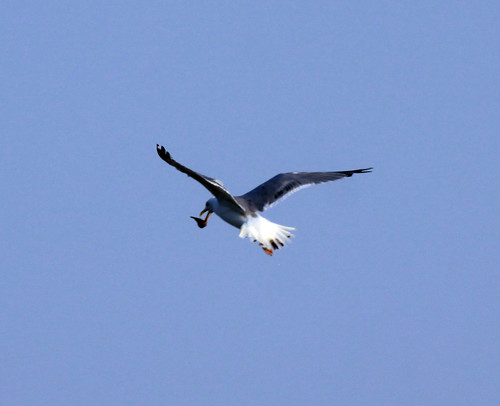
Herring Gull

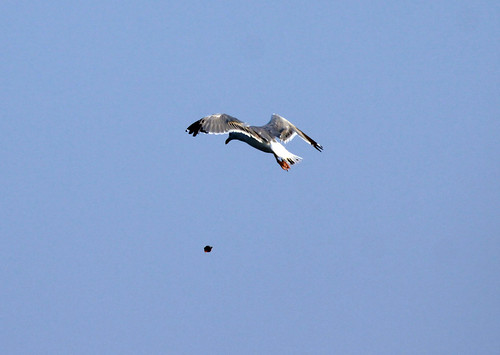
Herring Gull

They suddenly drop the shell to the ground, especially above rocks or low-traffic roads. Then they fly down to see what happened—if they cracked it open, they start feeding on the animal within. If they didn’t, they carry it aloft to drop again.

How did Herring Gulls figure this out? Did one uniquely philosophical bird long ago reason through that hitting the ground from high up would break the shell? Had one been carrying a shelled animal from one place to another, and when it accidentally dropped, discovered that hitting the hard ground opened the shell? Or did gulls start out simply playing, as Steve’s crow was doing, and thereby learned a cool trick?

We don’t know if the crow Steve observed was carrying something edible or not. Catching items in flight could be useful when tiny birds or large insects are winging by, so practicing these maneuvers might someday help that crow get an interesting meal. Meanwhile, that aerial game may well have been nourishing the bird’s spirit. Watching it certainly seems to have nourished Steve’s spirit. As he notes, “You can see interesting birding at all location as you go about your day.” When we keep our eyes and hearts open, the world is a fascinating place. One could do worse than be a watcher of birds.

American Crow

Saturday, January 12, 2019

The Real Crisis at Anzalduas Park on the Mexican Border

(Yet another radio program transcript that elicited at least one angry call from a listener complaining that I got political. These people don't contact me, and never seem to find errors in what I report. They just don't think bird stories should ever have a political point of view, even when about birds that are in serious jeopardy because of a political issue, and so want to remove my voice from the airwaves.) 

Anzalduas Park sign

Last week, one of my favorite birding places made the news. Anzalduas Park, a friendly little gem right along the Rio Grande River, was used for a press conference to highlight what some call the "crisis" of illegal immigration.

I spent my birthday morning there in 2013 when I was doing my Big Year. By then the number of undocumented immigrants coming over our southern border was already much lower than it had been at the peak, during the Clinton administration. In recent years, that number includes more refugee families from Central America than other undocumented people, too; refugees almost always immediately report to authorities because they're seeking asylum.

From The New York Times

As a woman traveling and birding alone, I stay alert to danger, but despite all the time I spent birding along the border that very year, in Texas, New Mexico, and Arizona, often all by myself and of course unarmed, as I was that morning at Anzalduas County Park, even when searching the trees and sky right across the river from Mexico, I never thought about people crossing the border. The signs at the park did warn of some potential problems: above the 10-mph speed limit sign was a warning, “Slow: Children at Play,” and also a sign saying “Watch for snakes.”

Anzalduas Park

I was too busy enjoying the host of wonderful birds in that critical habitat along the Rio Grande to think much about snakes except as photo ops, and didn't luck into seeing any at all.

Great Egret enjoying the view of two countries.

At the park that morning in 2013, I photographed Great Egret, Zone-tailed Hawk, Black and Turkey Vultures, Inca Dove, Ringed Kingfisher, Golden-fronted Woodpecker, Crested Caracara, Great Kiskadee, Tropical Kingbird, Vermilion Flycatcher, Loggerhead Shrike, Northern Mockingbird, Great-tailed Grackle, and Altamira Oriole, as well as several butterflies.

Zone-tailed Hawk

Inca Dove

Ringed Kingfisher

Golden-fronted Woodpecker

20131111-IMG_0649.jpg

Tropical Kingbird

Vermilion Flycatcher

Loggerhead Shrike

Northern Mockingbird

Great-tailed Grackle

Little Yellow

Pearl Crescent

The only one who gave me rather a disrespectful eye that whole morning was a male fox squirrel feeling rather macho.

Eastern Fox Squirrel

It was at Anzalduas Park that I saw the one and only Hook-billed Kite I was to see during my entire Big Year. Indeed, to this day it remains the only one I’ve ever seen in the United States.

Unfortunately, I didn’t get a photo of it. The very moment I saw it flying over the river and started running for a better vantage point, I had an encounter with a real danger not mentioned on those signs—something that constitutes a bigger crisis, to birds and at least a few humans, than illegal border crossings. I tripped on a big wad of monofilament tangled in the weeds on the ground.

Wad of monofilament

I scraped both knees and hurt my wrists but managed to hang onto my camera so was no worse for the wear except missing the chance to photograph that Hook-billed Kite. My only picture of that species remains one of a perched bird I took in Guatemala in 2007.  The only other time I saw one was in Costa Rica in 2002.

Hook-billed Kites are a lot harder to come by than monofilament. Over my years of birding, I’ve found dead birds dangling from it, live birds entangled that I’ve managed to rescue, and entangled birds who weren’t catchable, facing difficulties and almost certainly shortened lives thanks to monofilament. I’ve tripped on it before, too, though never so badly as at Anzalduas that morning—it was so attached to sturdy weeds that it was unyielding and I was running too fast. I of course spent several minutes pulling out that wad to properly dispose of when I got home. I wonder if, when the Secret Service scoured the area before the press conference, they were alert to that clear and present danger. 

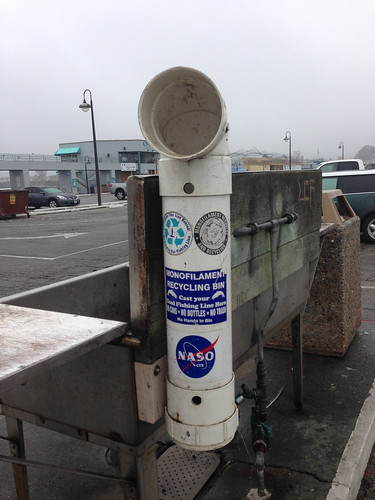
In good fishing areas, I’ve seen plenty of monofilament line receptacles, set out by DNRs, non-profits, Boy Scouts, and volunteers. Most of the people I know who love fishing love the natural world, too, so carelessness about monofilament disposal seems cosmically thoughtless and irresponsible, especially with those receptacles available in so many areas. Of course, sometimes a line gets caught on an overhead wire or branch, and becomes genuinely irretrievable. But most of the line I see is wadded up on the ground, tossed aside like litter. When a receptacle isn’t available, unwanted monofilament should be wadded up and cut into pieces before disposal. Monofilament is not recyclable with other plastics.

Monofilament
Monofilament bin in Santa Cruz, California
After a full morning of birding, I pulled out my bag lunch and sat down at a picnic table. It looked to me as if some people on the other side had the same idea. We waved back and forth as neighbors often do.

Like so many other lovely places along the Rio Grande River, Anzalduas Park will almost certainly be destroyed by any border wall—the park lines the river, and the wall will have to be far enough inland to prevent flood damage. Based on my personal experience, Anzalduas County Park needs a monofilament line recycling bin way, way more than it needs a border wall.

Great Egret