Laura Erickson's For the Birds

Wednesday, February 6, 2019

Tips for Birding in the Bog

Great birding spot, or the greatest birding spot?

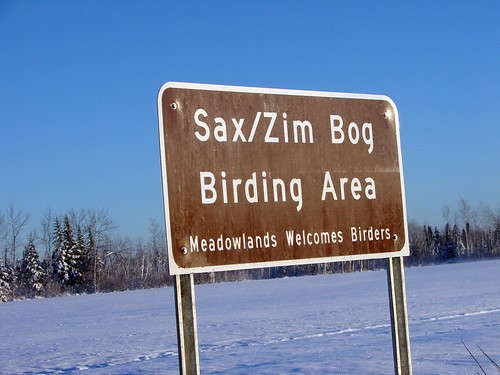
Northern Minnesota has many wonderful attractions, but perhaps the most well-known, at least among birding circles, is the Sax-Zim Bog, especially in winter, and most especially in February. This has been rather a lackluster year, with no irruptions, but it was still an easy matter for Russ and me to see four different owl species on a half-day trip to the bog this weekend.

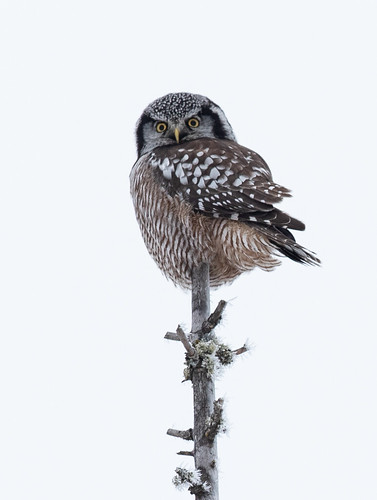
Northern Hawk Owl

We of course can see owls every month of the year, but they are most conspicuous in February, the month providing some of the coldest weather Minnesota can offer. Our coldest day ever, when it hit 60 below zero in Tower, fell on February 2, 1996. Of the top ten coldest temperatures ever recorded in Minnesota, each one at least 52 below zero, one fell in December, three in January, and six in February. As more and more birds grow food stressed, owls that usually stay well hidden in the forest start hunting more out in the open. The hardest to find, the Boreal Owl, is especially more likely to be seen in February than any other month.
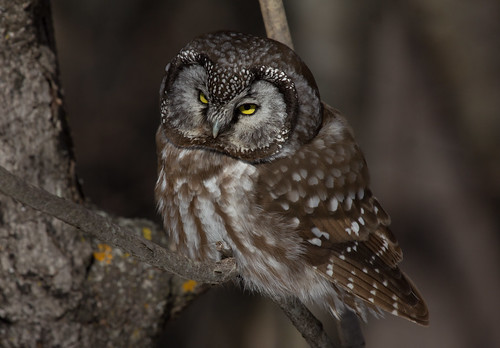
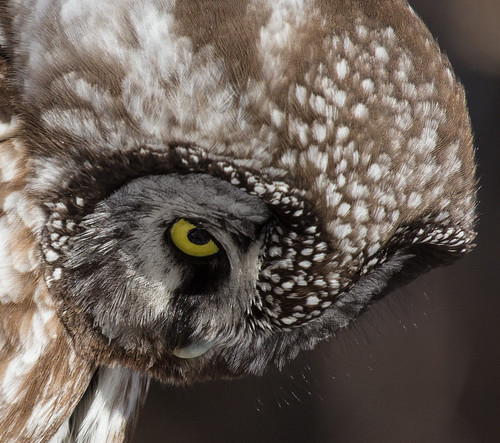
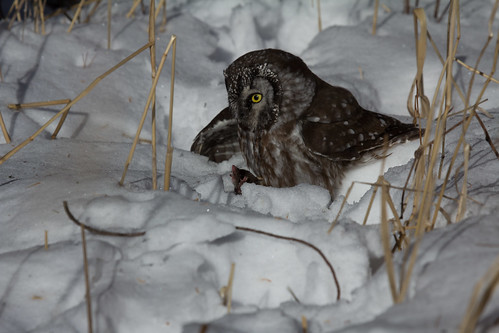
Boreal Owl
This photo was taken in Two Harbors, but the last Boreal Owl I saw was in the Bog.

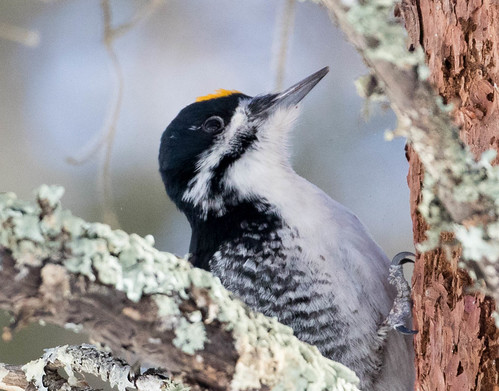
A decade and a half ago, when we had our major Great Gray Owl invasion, I went out with three women from Atlanta, Georgia, on two different days, one to the bog, the other up toward Finland and Ely. It was so cold on one of those mornings that even inside my car, a crust of ice formed on our coffee. I’m sure those women never forgot the cold, but they also never forgot the owls we saw—Great Gray, Northern Hawk, and Boreal—along with a bunch of other northern specialties like Boreal Chickadee and Black-backed Woodpecker.
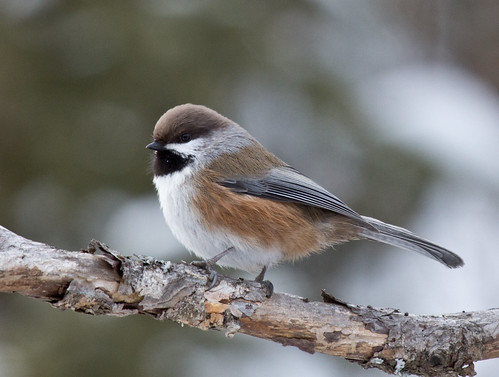
Boreal Chickadee

Black-backed Woodpecker

Traveling to a birding destination for just a few days in hopes of specific birds is always a crapshoot—you really never know if you’re going to luck into seeing any of your most wanted species. For some birders, the fun is trying to see all their birds on their own; others prefer to augment their chances by hiring a birding guide.  And in a remote area like the bog in winter, where cell phone service can be spotty, some of the good birding is many miles from the nearest town or gas station, and ice and snow can make roads treacherous, a good guide can provide serious peace of mind. Most of the local guides up here form a tight-knit group that share with one another their best sightings, giving clients of all of them a definite leg up on maximizing their species count.
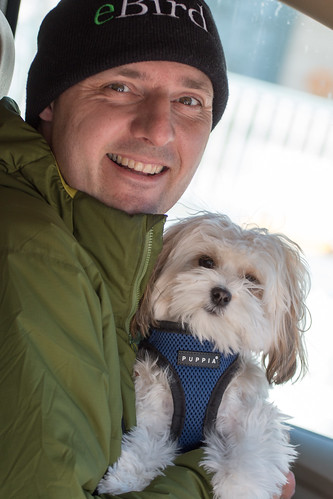
John Richardson and Pip the Birding Dog
John Richardson gets the Pip Seal of Approval as a wonderful guide. His website is skylarkguiding.com 
Pip and her Uncle Erik
Erik Bruhnke also gets Pip's approval. He's at naturallyavian.com
For those who feel comfortable driving around on their own up here, there are a few ways you can increase your chances of seeing your target birds. Before heading out, go to the website eBird.org, and click on Explore. You can look up where individual species you’re hoping to see have been spotted in recent days, or look up specific locations you’re planning to visit. (Here's an eBird listing of recent sightings at the bog. My own sightings aren't listed, because I make my own checklists specific to individual locations within the bog.)

Whether you hire a guide or not, check out the Friends of the Sax-Zim Bog website at http://saxzim.org/birding-the-bog/  You can download a map, get information about birding in the bog and logistical help, including a current map with the best spots marked, and more.


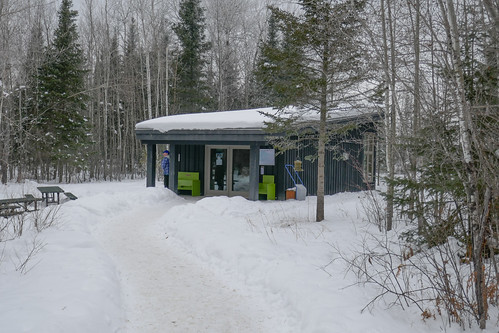
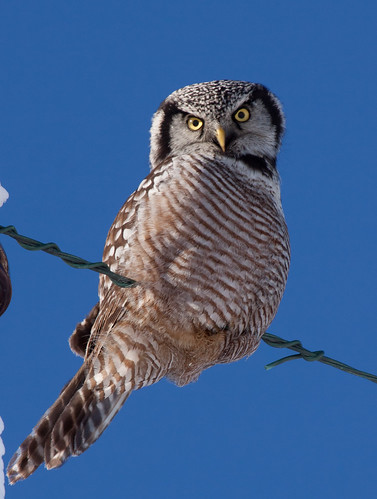
If you go to the bog on your own, make sure to stop at the Friends of the Sax-Zim Bog Welcome Center—if you didn't download a map ahead of time, you can get one there, and volunteers keeping track of sightings can tell you what birds have been seen and where. I knew exactly where to look to find the Barred, Northern Hawk, and Snowy Owls last Sunday thanks to the people at the Welcome Center.
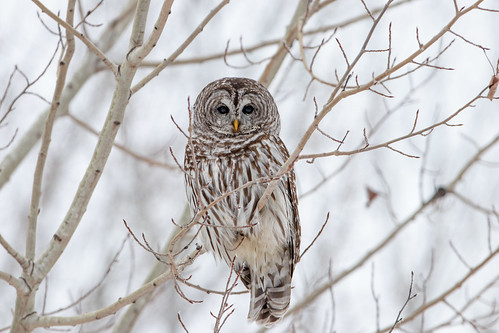
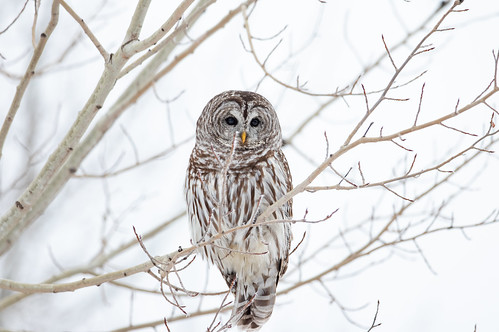
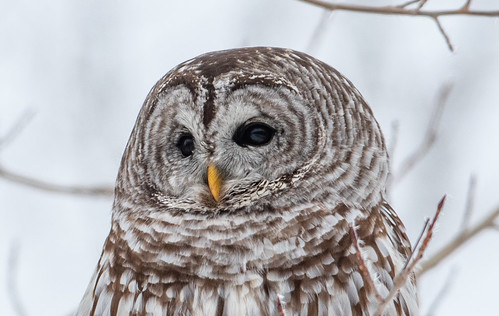
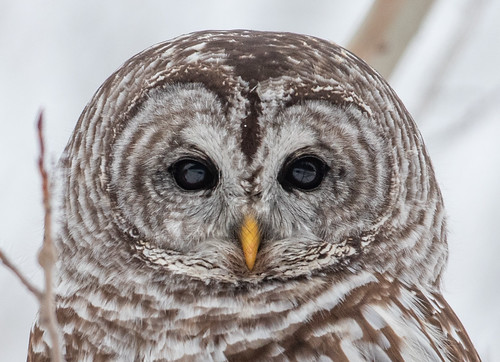
Barred Owl

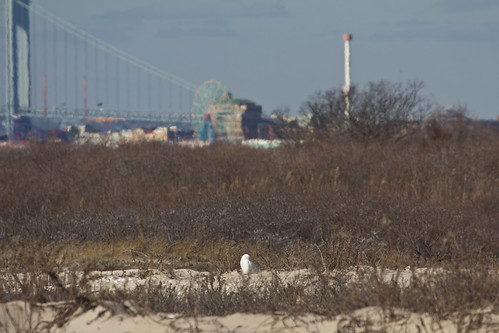
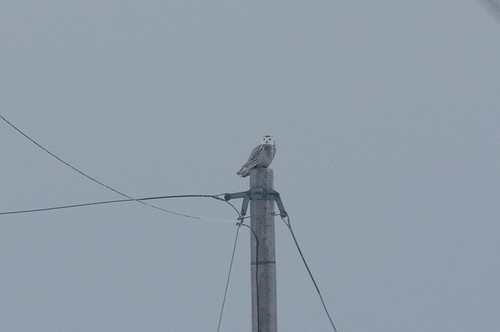
Distant Snowy Owl
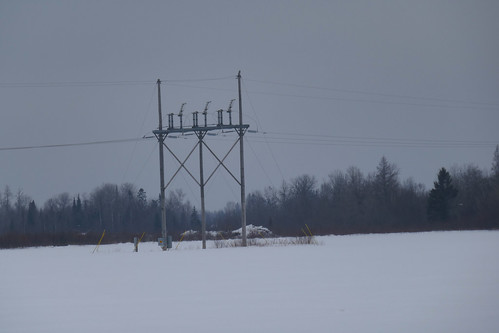
This Snowy Owl was on a power pole exactly where it was supposed to be. 
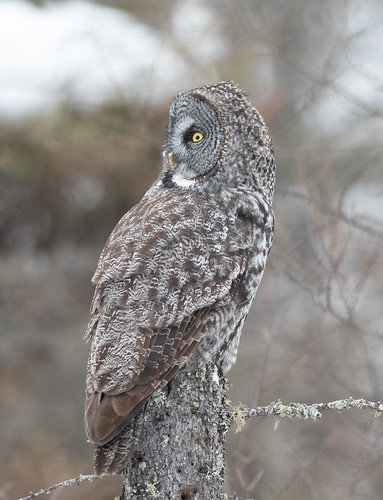
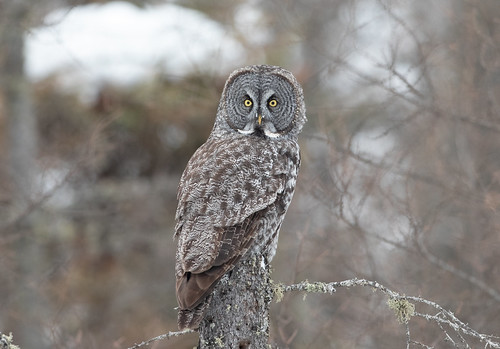
They also told me within a half mile where to look for the Great Gray Owl—sure enough, there it was.

Great Gray Owl

The most important thing to do in order to be safe and see birds is to pay attention while you’re driving. Roosting owls can be tucked in trees, very hard to see if someone in the car isn’t scanning.
Barred Owl tucked in
This Barred Owl would be easy to miss without close scanning, or noticing a group of birders looking up. 


Barred Owl roosting
Once you know where it is, you can't miss!
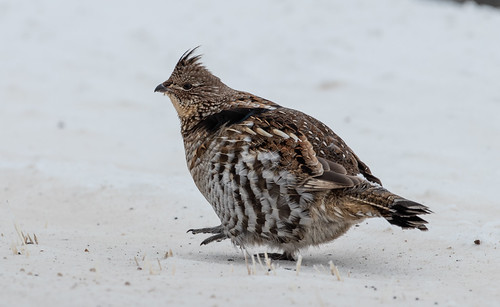
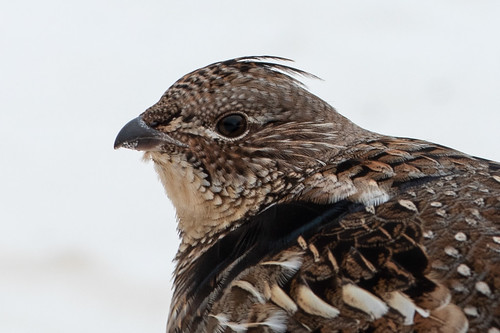
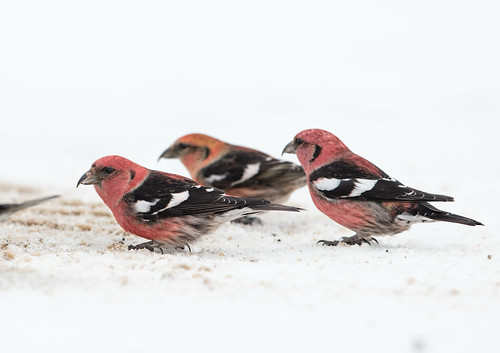
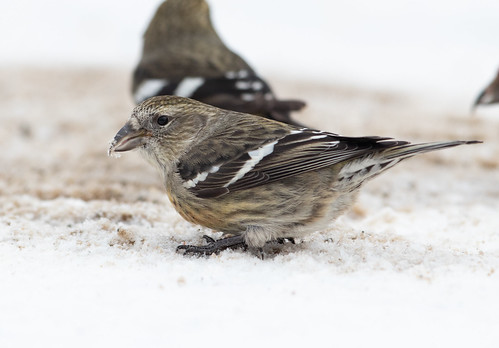
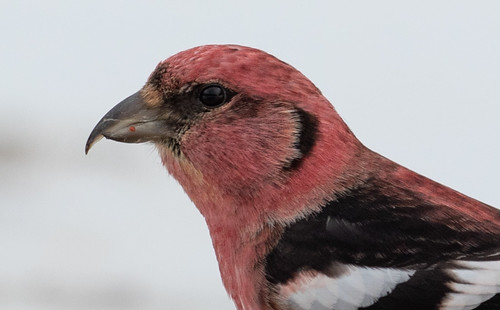
But also scan the road ahead—what may look like clumps of dirty snow may actually be interesting birds or mammals. Sunday, we’d have missed or gotten poorer looks at a Ruffed Grouse and White-winged Crossbills if we didn’t immediately slow down when we saw clumps ahead.

Ruffed Grouse

White-winged Crossbill

If you’re not paying attention, you risk scaring birds off before you’re close enough to identify them, or even killing them. I’ve heard from too many heartbroken birders who killed a Great Gray that flew in from the side without them noticing until it was too late.
Density vs. Mass
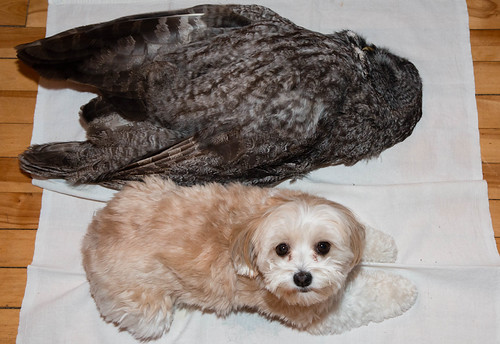
My friend Erik Bruhnke found this poor dead Great Gray Owl on the side of a road last year and brought the carcass to a non-profit for use as an educational specimen. My dog Pip is there to show the size difference and to remind readers how important it is to slow down. (On the day I took this photo, Pip weighed exactly 9 pounds, and the owl, who was not the least bit emaciated--it died of trauma--weighed 3 pounds.)
Always go slow enough to take in all in, while also keeping an eye on your rearview mirror so you can pull off if someone comes up behind. People who live in the bog don’t appreciate being late for work or a doctor’s appointment because birders slowed them down. However, when you do pull over, be careful! The graders used to clear country roads often smooth the snow well beyond the road itself.  What looks like a nice, wide shoulder may actually be a deep ditch. It’s a lot to deal with, which is why a lot of people prefer to pay a guide so they don’t have to drive at all.

The single most important thing to look for, besides actual birds, is birders. It’s shockingly easy, even for experienced owlers, to miss an owl tucked in the forest. When one birder spots one, that helps lots of others to see it, too. So if you spot people looking at something, check it out.
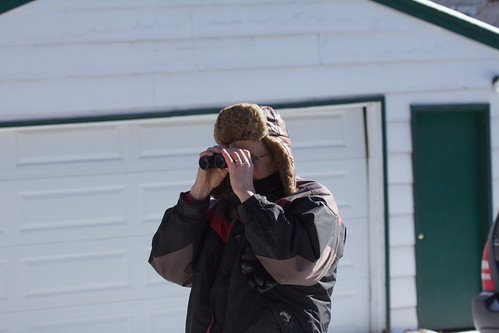
Charles Hagner
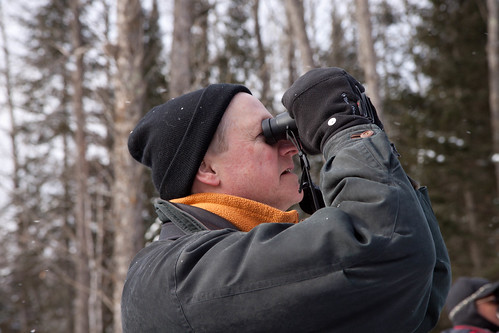
If you see a birder, say, for example, my friend Chuck Hagner here, looking into the trees at the bog, pay attention. 
If the people are staying in their cars, you should, too. And never pull past them before you know what’s happening—it’s the height of rudeness for a birder to pull up between birders and the bird they’re looking at to ask what they’re seeing. It’s also rude to pull ahead of someone rather than behind if you’re going to take advantage of a bird that person found first. You can always pull behind, and then walk toward the people, keeping the cars between you and whichever side the bird is on, to find out what’s happening. If people are photographing, some of them might be recording a video, so be quiet and alert until you’re sure it’s okay to talk.

Birding the Sax-Zim Bog is one of my favorite things about winter. Whether I luck into a day like last Sunday, with lots of owls and photo ops, or whether the birds are few and far between, or whether I get skunked altogether, I always have a good time. There are few guarantees in the world of birds, but if you keep an open mind and an open heart, a February day in the Sax-Zim Bog may be frozen, but like ice cream, it’s guaranteed to be sweet.
Northern Hawk Owl

Monday, February 4, 2019

Superb Owl Sunday 2019

Barred Owl

On New Years Day this year, Russ and I made a date—come hell or high water, or even record-breaking low temperatures, we were going to get out birding together on Superb Owl Sunday. We set as our destination the Sax-Zim Bog. Last Thursday morning, Cotton, Minnesota, in the heart of the bog, had the coldest temperature in the Lower 48, and the fifth coldest temperature ever recorded in Minnesota, 56 below zero. But by Sunday, just three days later, the temperature was 24 degrees—yep, it was an amazing 80 degrees warmer than just a few days before.

As we drove to the bog, I told Russ I had three goals for the day: to see a shrike, to get some good photos of a Black-backed Woodpecker, and, of course, this being Superb Owl Sunday, to see at least one owl.

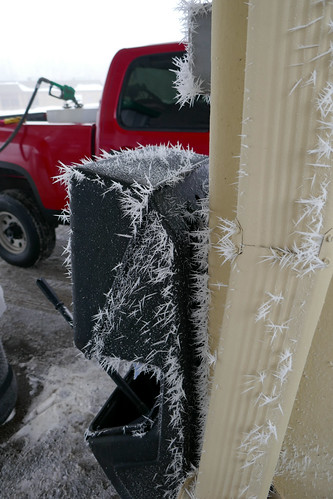
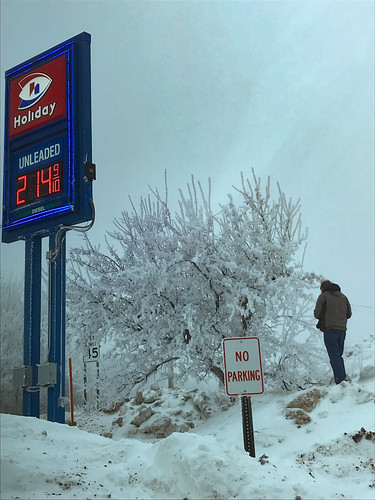
As we drove out of town, there was a beautiful light fog; hoar frost covered all the deciduous trees. We stopped for gas where frost covered everything—even the gas pumps and garbage cans.

Hoar frost at gas station

Hoar frost at gas station

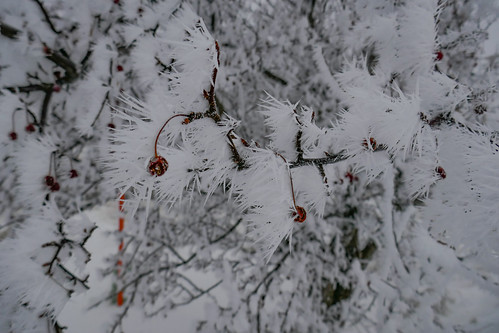
Hoar frost

Russ photographing hoar frost

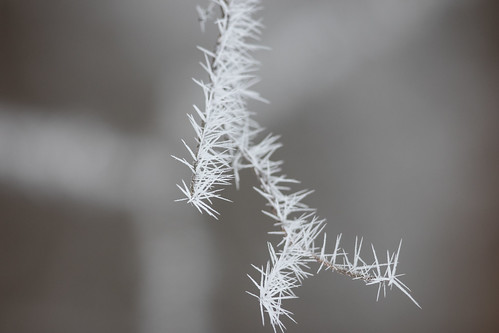
Russ took photos—no matter what else happened that day, the stunningly beautiful, needle-like ice crystals gave the morning a special glow.

Hoar frost

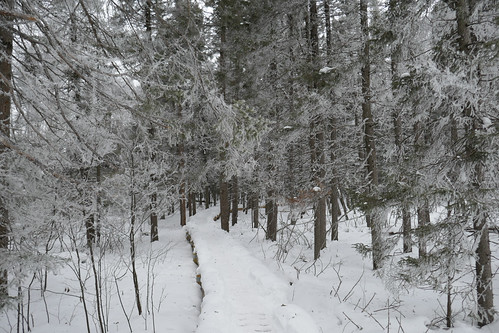
Oddly enough, the fog never lifted all day, the sun never came out, and the temperature never rose higher than that 24 degrees, so for the first time I can remember, the hoar frost never disappeared. 

We made our first stop the boardwalk at the Warren Nelson bog—that’s where I hoped to see a Black-backed Woodpecker. No luck on seeing or hearing one, though all the fresh pieces of bark on the ground provided plenty of evidence that they spend a lot of time in this area. Distant crows making a ruckus suggested an owl somewhere, but we never saw where they were mobbing. I took some photos of the frost and of chickadees at the feeder.

Hoar frost

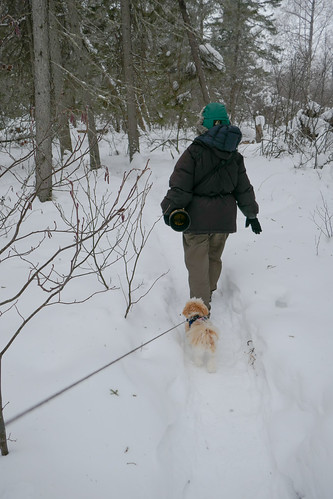
Pip stays right at my heels/ Russ is holding the least and taking the photo
Notice how close Pip sticks to me. She and Russ have to let me go first in case there are any birds. It's the law.
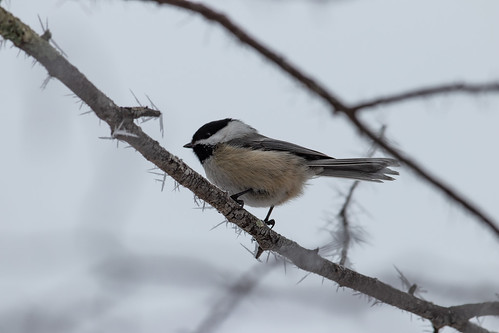
Chickadee on frosty branch

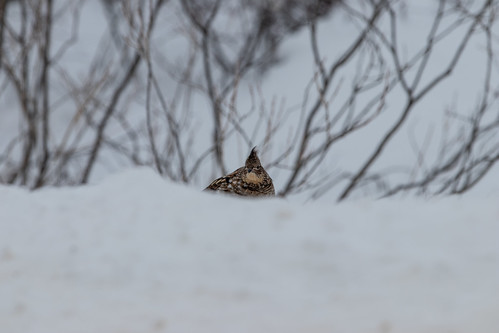
Then we headed to Owl Avenue and the Friends of the Sax-Zim Bog welcome center. Before we even got there, we slowed down for a dark blob on the road ahead of us—a Ruffed Grouse. A car coming the other way passed by, pulling over enough to avoid hitting it, and the grouse retreated off the road into a ditch. We pulled our car over on the far side to see if it would come out. The little guy looked over a snow bank to make sure the coast was clear, and voila!

First glimpse of the world's most cooperative Ruffed Grouse

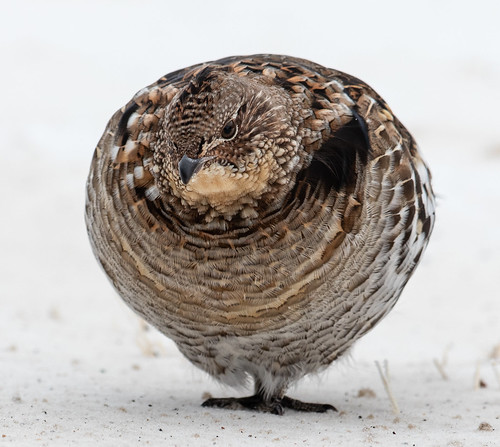
I took some photos of it peering over the snow bank, and then it came closer and closer. I have never in my life been this close to a Ruffed Grouse and got some amazing closeups. This was not on my list of goals for the day.

Ruffed Grouse
It was nice to see such a football-shaped bird on the day of the big football game. 

Ruffed Grouse

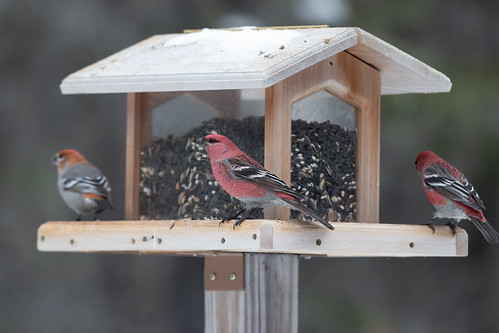
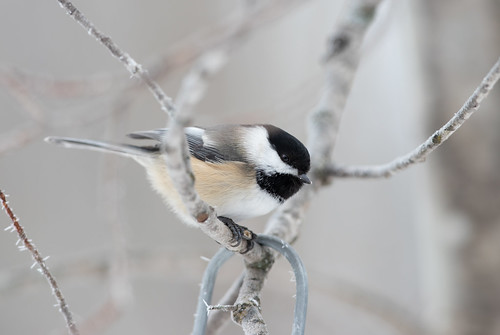
Birders from all over visit the welcome center, keeping the volunteers and staff up to date on where birds are—Clinton Nienhaus told us the best places to go to see Barred, Great Gray, Snowy, and Northern Hawk Owls. I took photos of feeder birds before we set off.

Friends of Sax-Zim Bog welcome center

Clinton Nienhaus

Pine Grosbeak

Black-capped Chickadee

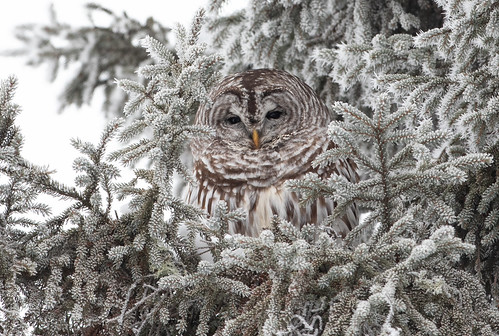
A Barred Owl has been hanging out right at the intersection of Owl Avenue and Arkola. When we got there, a group of people were photographing it, tucked into the branches of a frost-covered spruce. That was a lifer for my dog. Seeing the owl at all fulfilled one of my goals—getting photos was icing on the cake.

Barred Owl roosting

Then we headed to McDavitt Road, where we might find a Great Gray or a Northern Hawk Owl. Before we got to the right spots, we came upon more little blobs in the road, and birders standing right near photographing them. Again I got the best photos I’d ever taken of a species, this time White-winged Crossbills.

White-winged Crossbill

White-winged Crossbill

White-winged Crossbill

The hawk owl was exactly where people have been seeing it, in a clearing off a little foot trail. My photos against the gray sky were far from my best, but I was thrilled nonetheless.

Northern Hawk Owl

Then we went back to McDavitt to see a group of birders photographing a Great Gray Owl who was perched less than 90 feet away. My photos capture the bird and the soft, magical quality to the gray day.

Great Gray Owl

Great Gray Owl

It was already getting late. On our way back toward our final goal bird, we passed the Barred Owl corner again. This time the bird was out in a deciduous tree in the open, apparently hunting. We stayed in the car to avoid stressing it, but it was close to the road so my photos show a focal length of only 50 feet.

Barred Owl

Barred Owl

We found one of the two Snowy Owls that have been hanging out in the bog, but it was at least an eighth of a mile away and probably closer to a quarter mile. Russ's and my photos were very gray, but the bird is identifiable.

Distant Snowy Owl

Distant Snowy Owl

By day’s end, I had achieved only one my three goals, but had fulfilled that one shockingly well—FOUR owls! And the other wonderful birds seen made this one of my finest birding days ever. Russ’s and my Superb Owl Sunday turned out to be truly superb. 

Hoarfrost

Superb Owl Sundays with Russ: A little history

Boreal Owl

Back in the 1980s or 90s, I noticed that the term Super Bowl can be written with the exact same letters in the exact same order to spell Superb Owl. Since I never quite figured out football, I started celebrating the day by going out looking for owls.

Over the years, I’ve gone out many times, sometimes with friends, sometimes alone. I’ve found at least one owl every one of those times except last year when I went out with Lisa Johnson—for some reason we had very bad owl karma that day, and got skunked.

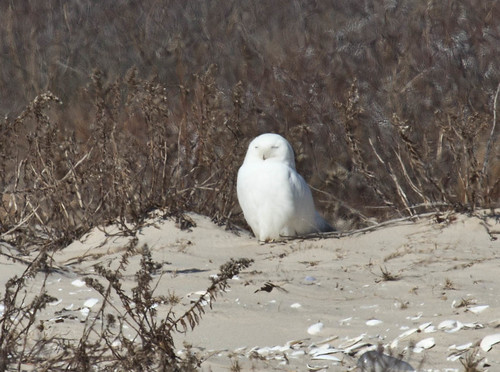
In all those years, I’ve only gone owling three times with my husband. We got away to New York City in February 2012, and so on that Superb Owl Sunday, Russ and I drove over to Breezy Point Tip in Queens with our daughter Katie and her now-husband Michael. I’d heard that there were Snowy Owls in the dunes above the beach, and sure enough, we saw both a pure white adult male and a more heavily marked younger bird. I only managed photos of the all-white male.

Snowy Owl in the Big Apple

NYC Snowy Owl

By the following Superb Owl Sunday, Russ’s mom was living with us so we couldn’t get away for a full day at all anymore, but that was the year I was doing my Big Year and I wanted at least one birding adventure with my husband. So after we had his mom settled in for the morning that Sunday, we went up to Two Harbors.

That year there were Boreal Owls all over the place. Along the freeway en route, we passed two clusters of birders with cameras and spotting scopes pointing into the trees, and as I suspected and confirmed later, they were indeed looking at Boreal Owls. But I wanted to find my own, and I wanted it to be in my favorite little spot in Two Harbors where an alley runs along a wooded ravine, so we went straight there. 

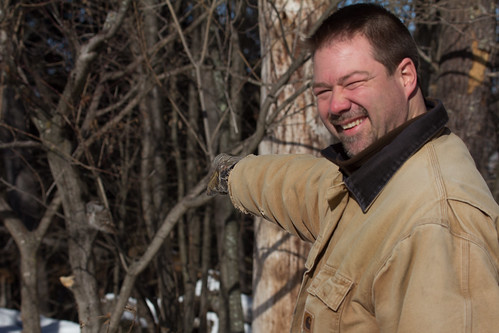
We’d parked and started walking when one of my friends, Jim Lind, saw us and rushed down to say hi and tell us a saw-whet owl was just a few blocks away roosting in someone’s back yard. Jim and Russ had never met, so we stood chatting in the alley for a few minutes and then—WHOA! Jim looked up and said, “Boreal Owl!” 

Jim Lind pointing out Boreal Owl
Jim Lind pointing out the Boreal Owl.
Boreal Owl
It was so close from that vantage point, with my 400-mm camera, that you can make out the tiny bristle feathers that run along the edge of the facial disks.

It was sitting in a branch right even with us, only 20 feet away, based on my camera’s focal length data. The sun was behind us giving perfect light as the little owl sat posing for some of the best photos I’ve ever taken of any bird. After Jim left, the little predator dove into the snow, pulled out a
shrew, and ate it.

Boreal Owl

Russ and I watched it for a good half hour before we moved on. I felt secure assuming we weren’t bothering it—we’d been talking with Jim for two or three minutes without even realizing it was there, and it didn’t seem to pay us any mind while we were photographing it. Then we moved on to see the roosting Saw-whet and headed home.

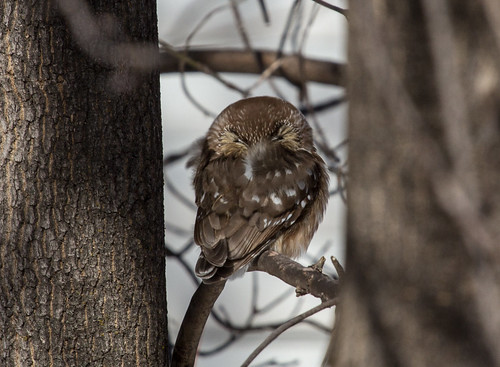
Northern Saw-whet Owl

That’s the last time Russ was able to go out with me on Superb Owl Sunday until this year. And this year ended up being my best Superb Owl Sunday of all. But that's for another blog post.
 
Russ looking at Boreal Owl
Russ looking at our Boreal Owl. (I hardly ever remember to take pictures of him!)

Saturday, February 2, 2019

Silence Is Golden

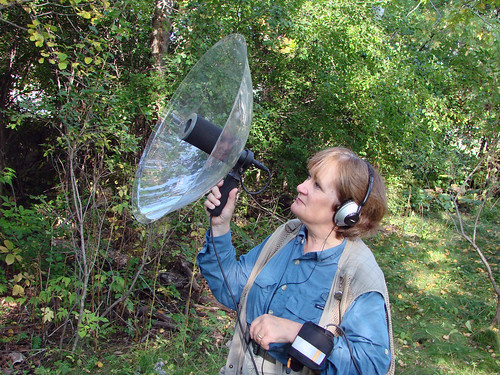
Laura recording birds

Last week I ran as a radio rerun a "For the Birds" program that originally aired in 2000, about the silence of winter. The year after I did that program, I got some high-quality sound recording equipment and started appreciating how tragically rare silence is.

I hardly needed absolute silence to capture a pure rendition of the song of a warbler or thrush. I could limit my bird recording to calm, rainless days, and I learned a few microphone positioning tricks to minimize the effects of some natural noises.

But I had no chance of getting a clean recording in my own backyard no matter how perfect the meteorological conditions. I live in a very quiet neighborhood in Duluth, at least by the standards I’ve always used to define a quiet neighborhood. With my recording equipment, I discovered how many people had switched to high-efficiency gas furnaces—a great thing in every way except their noise level. And in summer, there are few half-hour blocks or time from early morning till evening when no one within hearing range is mowing a lawn. I’m 5 blocks in two directions from heavily used roads where truck traffic is common, and even on Peabody Street, cars come by way more often than I realized before I started recording birds.

I’m not the only one who notices small city noises. On January 17, the New York Times ran a story about how Stradivarius violins are, little by little, reaching the end point in their ability to produce their uniquely exquisite sounds. They wrote:
So that future generations won’t miss out on hearing the instruments, three sound engineers are producing the “Stradivarius Sound Bank” — a database storing all the possible tones that four instruments selected from the Museo del Violino’s collection can produce…
“This will allow my grandchildren to hear what a Strad sounded like,” said Leonardo Tedeschi, a former D.J. who came up with the idea for the project. “We are making immortal the finest instrument ever crafted.”  
The Museo del Violino is in Cremona, a city a bit smaller than Duluth, with a population of 72,000. The Stradivarius sounds are being played and recorded in an auditorium associated with the museum. But the project hit a roadblock. According to the article:
In 2017, the engineers thought their project was finally ready to get underway. But a soundcheck revealed a major flaw.
“The streets around the auditorium are all made of cobblestone, an auditory nightmare,” Mr. Tedeschi said. The sound of a car engine, or a woman walking in high heels, produces vibrations that run underground and reverberate in the microphones, making the recording worthless, he explained. “It was either shutting down the entire area or having the project not seeing the light of day.”  
Fortunately, the mayor of Cremona happens to be president of the Stradivarius Foundation. He ordered the streets around the museum to be closed for five weeks and appealed to people in the area to keep it down.
“We are the only city in the world that preserves both the instruments and their voices,” Mr. Galimberti said. “This is an extraordinary project that looks at the future, and I’m sure people from Cremona will understand that closing the area was inevitable.”  
Stopping all human noisemaking in one small area of one small city for five weeks turned out to be hard but doable, in a place where everyone understands how important it is to preserve Stradivarius tones. It’s impossible to stop traffic along a stretch of highway, much less get people to agree to suspend all activity in an area, just so someone can record natural sounds that we can hear every day during the right season. Silence really is golden, and even harder to come by.