Laura Erickson's For the Birds

Thursday, May 9, 2019

Anhingas!!

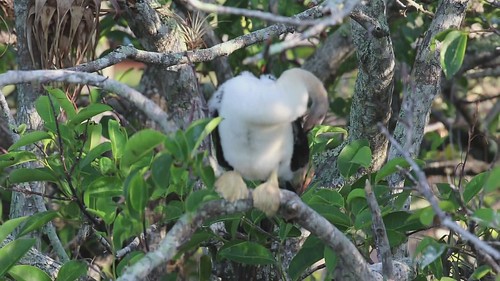
Anhinga chick preening, loafing, and moving about.

Russ and I have visited Everglades National Park on four Florida trips since 1988. We’ve explored quite a bit of the park on these trips, though the park so huge that we’ve still barely scratched the surface. But we’ve gone to one spot multiple times on every trip—the Anhinga Trail.

This trail, which starts at the Royal Palm Visitor Center, is a paved walkway and a boardwalk over Taylor Slough, a freshwater sawgrass marsh teeming with life. The trail is just 0.4 miles long, so it's less than a mile to walk to the end and back including taking the little side loops. The only problems with the trail are that it is so heavily used that it can be hard to make good videos and sound recordings that don't pick up people's voices, and that a surprising number of airplanes fly over, making an even noisier background. But I've made some excellent recordings there early in the morning, when natural sounds are finest and people are mostly still in bed.

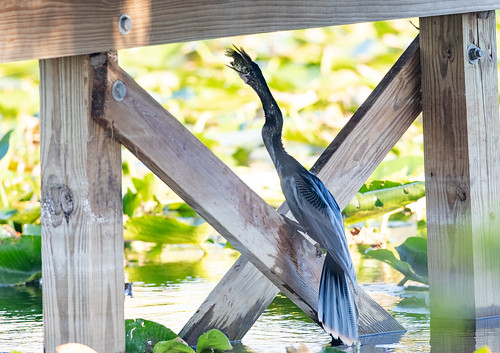
Anhinga
Most people seem to come to the Anhinga Trail to see alligators. This poor Anhinga couldn't attract anyone's attention. 

For such a short, easy walk, the wildlife is amazingly abundant. I could talk about the seven alligators that were all sunning just inches from the wall at the entrance—I had to use the panorama function on my cell phone to get them all in one photo.

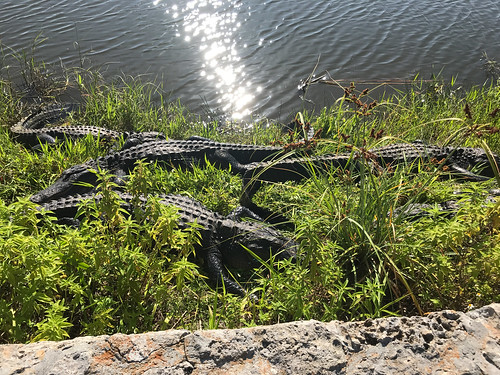
Panorama shot of 7 alligators right next to the Anhinga Trail

American Alligator

People looking at very close alligators

And colorful eastern lubber grasshoppers were everywhere.

Eastern Lubber Grasshopper

But the three times we walked the trail on this trip, I was so absorbed with Anhingas that I didn't pay all that much attention to anything else. Adults were everywhere, flying, swimming, perched on the guardrails and in the trees.

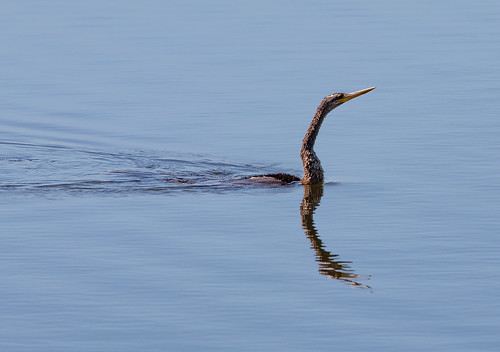
Anhinga

Anhinga

Russ photographing an Anhinga

Anhinga

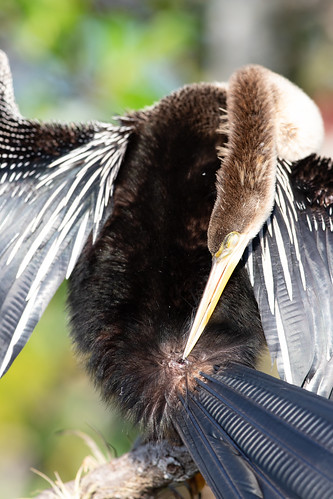
The Anhingas allowed me to come close enough that I even got photographic proof that they do have a preen gland.

Yes, Anhingas have a preen gland.
Yep--the preen gland!
Why must they hold their wings out to dry them, and even flap them to shake out the water, then? Oils from preen glands don't really "waterproof" any bird's feathers. Those oils simply keep feathers in good condition. As birds that fish most efficiently by staying submerged, anhingas and cormorants have wonderfully wettable feathers. When an Anhinga's feathers get soaked, good condition or not, they hold a lot of moisture.
Anhinga
Shaking out wings to dry the soaked feathers.
Anhinga
This female Anhinga is sitting in the typical open-wing posture to help dry her wing and body feathers
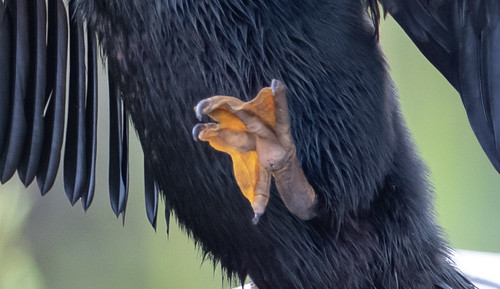
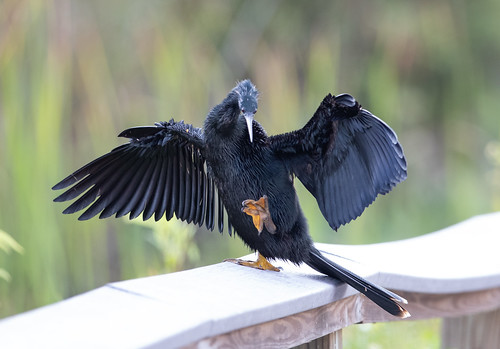
One male sitting on the guard rail seemed to want to demonstrate what "totipalmate" means by holding his foot up to show me. All four of an Anhinga's toes are webbed, unlike the way only the three front toes of a gull or duck are webbed.  
IMG_3788.jpg
"Totipalmate" foot: all four of an Anhinga's toes are webbed.

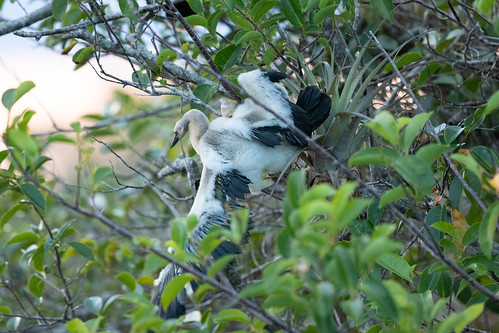
One pair was nesting at the beginning of the trail, and two pairs of fuzzy chicks were tucked into the dense foliage in trees further along, still too young to be making tentative flights.

Baby Anhingas

Anhinga chick

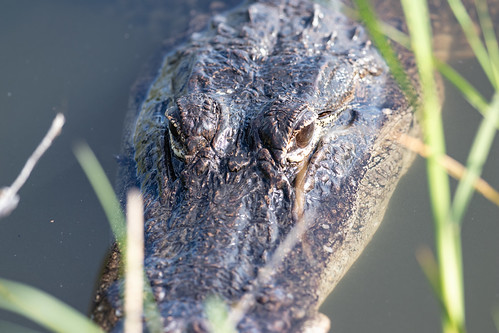
Falling into the water would be lethal—everywhere there were alligators hoping to capitalize on clumsy young birds. Oddly enough, many wading birds, including Anhingas, benefit from those very alligators, which make short work of predators swimming to a nesting tree, too.
American Alligator

But thanks to those alligators, individual babies must cling to their branches for dear life, quite literally. For a chick to simply turn around to face the opposite direction on a branch takes all its concentration and balance. Anhinga feet have strong, gripping toes and sturdy claws, and determination and spunk also help. I watched one baby end up literally upside down when it let go of a branch with one foot trying to move it to the next branch. The other foot stayed latched to the branch, and the baby managed to get its leg and wing hooked to the branch as well. The alligators were left with a fish dinner that night.

Anhinga chick trying to move about in mangrove

Anhinga chick trying to move about in mangrove

Anhinga chick trying to move about in mangrove

While the parents were off fishing, the two chicks spent their time snoozing, preening, looking about, toying with branches and moving around a bit, and watching each other. I took hundreds of photos (all linked to on my Anhinga Page, though the algorithm adds all the photos I've taken at the Anhinga Trail, too).

Anhinga chick figuring out mangrove branches

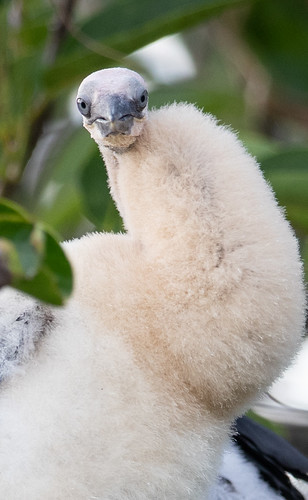
Their heads looked bizarrely tiny when they were facing me directly, especially above all the thick downy feathers on their necks.
Baby Anhinga

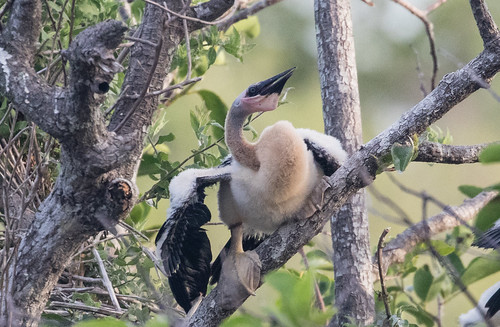
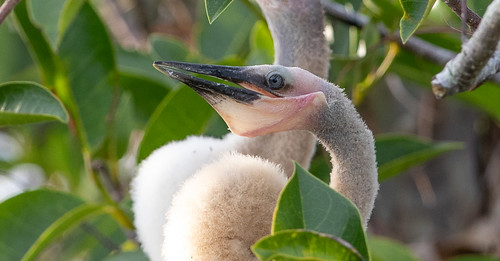
The narrow, streamlined head lived up to the Anhinga’s nickname, “snakebird,” but as befits a species that feeds on rather large fish, the mouth has to be able to open wide. These chicks could somehow set their jaw to make their head much wider, the skin stretching weirdly over the slender bones.

Anhinga chick

Anhinga chick

Baby Anhinga

The moment a parent flew into the tree, the two chicks instantly engaged in a competition to see which could seem most desperate for food. They made non-stop begging sounds (you can hear the recording I made on this trip here) while fluttering their wings and gaping.
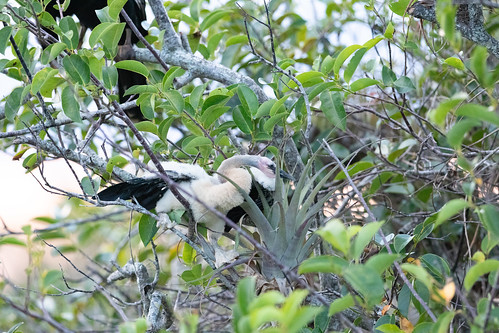
Anhinga chick trying to move about in mangrove

The newly-arrived parent ignored them for several minutes, an important time lag while the adult’s stomach juices softened the fish. The babies waved their wings wildly and tried hopping and climbing between branches and stretching their long necks to get closer, but didn’t seem to influence the feeding schedule.

Adult and chick Anhingas have such long, sharp beaks that the feeding bouts looked dangerously violent, but the babies had grown and thrived being fed this way since hatching with not a single injury to show for it. There were dozens of Anhingas on this short trail—I don’t think we could look in any direction without both seeing and hearing them, and every single one of them had started its life just as these two chicks were, jousting for food with those dagger-like bills. The parents could hardly warn them that they could poke someone’s eye out with that thing when their own bills were even longer, sharper, and more dangerous.

Food delivery from father Anhinga

Food delivery from father Anhinga

Food delivery from father Anhinga

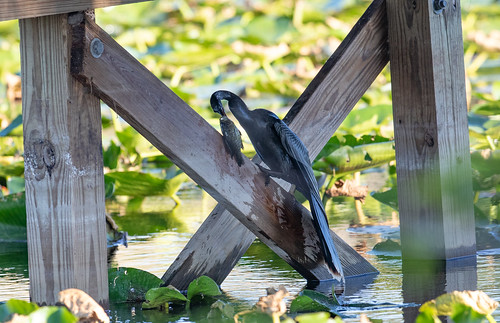
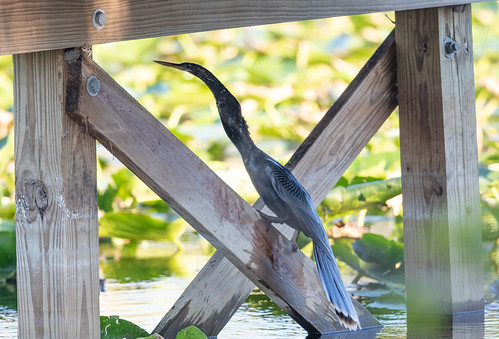
Russ and I went down to the Keys for an overnight, and when we returned, we simply had to check on the little ones again. They were just where we’d left them, a bit bigger but just as adorable. We stuck around to make sure both parents were still alive and well, too. The father snagged a big fish under water and lugged it to one of the boardwalk’s supporting beams. I watched him struggle to swallow it, thinking about the fish's rough scales and fins. No wonder Anhingas always swallow their fish head-first!

Father Anhinga dealing with a very big fish

Father Anhinga dealing with a very big fish

Father Anhinga dealing with a very big fish

Father Anhinga dealing with a very big fish

Father Anhinga dealing with a very big fish

Father Anhinga dealing with a very big fish

I also got lots of photos and videos of the chicks.

Anhinga chick figuring out mangrove branches

Everything about my time on the Anhinga Trail made me happy to be alive on a little planet teeming with such splendid lifeforms. If Russ and I get back one day in the murky future, there’s no way we’ll recognize these individual Anhingas. But we’ll see something of them in every other Anhinga we see. I feel wonderfully rich thanks to these splendid birds sharing their time with me.

Shape Shifters

Baby Anhingas have a very streamlined, tiny head, until they feel like widening their jawbones.

Anhinga chick

Anhinga chick

Wednesday, May 8, 2019

Babies!!

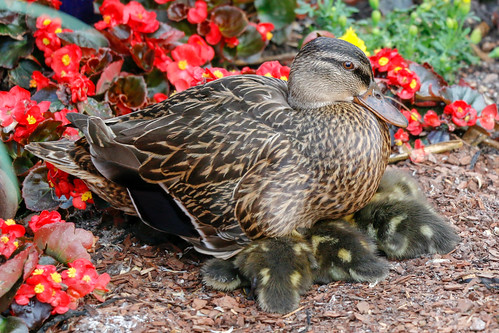
Mallard mother and ten ducklings at Disney World

I’m writing this on May 8, 2019, as snow is falling from the sky and sticking on the ground. Even as the biggest surge of migration is yet to come, a pair of chickadees are nesting in my apple tree, already laying eggs or maybe even incubating, and crows and Song Sparrows and some of our other local residents are also starting to nest. The chickadees shouldn’t have too much trouble—it’s not supposed to get all that cold and they nest in a snug little cavity. Birds usually have a pretty easy time dealing with a bit of bummer weather—it’s us humans who develop unrealistic expectations and romanticize spring. 

This year I’m doing way too much of that, especially after coming home from Florida, where the daytime temperatures were consistently in the upper 80s into the 90s. That kind of weather is why Florida birds are way ahead of the ones up here. I saw lots of baby birds down there. 

I know I have an over-active maternal drive, becoming emotionally invested whenever I make eye contact with a chick. That was obvious the day I took a video of domesticated ducklings—the intensity of my emotions when a turtle grabbed one, and my relief when the mother duck attacked and saved the day, surprised me. 

Turtle hunting duckling

When we were spending time with our son in Orlando, we got to see and photograph a brood of Mallard ducklings—the individuality of the little guys made me think about McCloskey’s classic Make Way for Ducklings, appreciating why the book has appealed to so many readers over generations. The two videos I made of the little family have been extremely popular—apparently just about everyone loves baby ducks. 

Mallard mother and ten ducklings at Disney World

Mallard mother and ten ducklings at Disney World

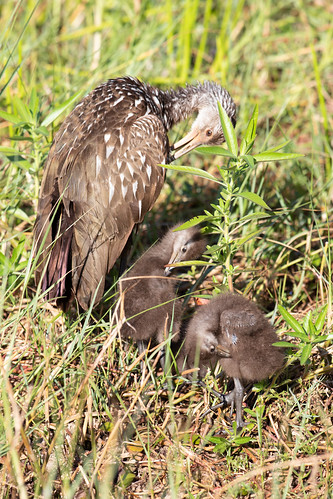
I was hoping we’d see one or two Sandhill Crane families down there—I don’t have any photographs at all of baby cranes. We didn’t even see any adult cranes, but the morning before we drove down to the Everglades, Russ and I came upon a brood of three baby Limpkins at Kissimmee Lakefront Park.

Limpkin adult with chick

Limpkins belong to the same order as cranes, and like crane chicks, the little guys were fluffy, engaging, and photogenic. We stopped by the park again our last day in Florida, and Russ and I were extremely relieved to find the whole family again. I’m not the only one who gets invested in baby birds. 

Limpkin chick

That first day at the park I’d also come across a baby Common Grackle in dense vegetation along the shoreline—I felt a surge of joy to find that little one again our last day. The world has plenty enough grackles, but I wasn’t looking at populations. I was seeing one unique individual—a tiny being to be reckoned with—and was happy that it was given at least a few more days on this planet.

Common Grackle chick

Common Grackle chick

There were loads of baby gallinules—too many to focus on any single one, fortunately, because an alligator swallowed one right in front of me. That happened so quickly that I found myself thinking more about the parents and other chicks scrambling out of reach. It’s a jungle out there.

Common Gallinule

Common Gallinule

We saw one mother Mottled Duck with tiny ducklings, but never were close to them. 

Mottled Duck

In the Everglades, we came upon a few baby Green Herons hanging out and even making tentative flights— they were moving around so much that I couldn’t keep track of which were which. 

Green Heron

Green Heron

Green Heron

All these babies were filling me with so much joy that it’s hard to believe that a couple of other baby birds topped them all—babies belonging to the species that the Anhinga Trail was named for. But that's a topic for another blog post.


Tuesday, May 7, 2019

Interacting with Black Vultures and people on the Anhinga Trail.

Black Vulture

A year ago when Russ and I visited the Anhinga Trail in Everglades National Park, a small group of Turkey Vultures met us in the Royal Palms parking lot. Some stayed politely in the trees surrounding the parking lot, and some took advantage of the first thermals of the day forming over the hot pavement to circle overhead.

Turkey Vulture
Last year: one polite Turkey Vulture
This time, we were greeted by a host of Black Vultures, an entirely different animal with far different approaches to interactions with our species.  They were all up in the trees when we arrived late in the day on our first visit, but when we arrived first thing the next morning, several of them were sitting on cars.

IMG_3273.jpg
This year's Black Vulture gang plotting against us.

Black Vultures eat the rubber on unprotected cars

I vaguely remembered reading about Black Vultures ripping off the rubber from windshield wipers and the rubber seals on windows and sunroofs, so I told Russ we’d better be careful. Our rental car didn’t have a sunroof, but it did of course have windows and windshield wipers. We saw one person putting a tarp over his car, and Russ asked him about it—he said there was a supply of tarps and bungee cords by the bathrooms specifically for protecting cars. The National Park Service website explains this, though we didn’t know about that till we got home.

Black Vultures eat the rubber on unprotected cars

Black Vultures eat the rubber on unprotected cars

Black Vultures eat the rubber on unprotected cars

Russ spent several minutes covering our car, and then several more minutes talking to newcomers and helping them get tarps on their cars. Meanwhile, I started feeling a little sick, so I didn’t get much birding in before we took the tarp off and headed for our planned overnight excursion to the Keys.

At some point along our drive I realized that I’d managed to lose three things: my favorite Tilley hat, my senior pass to the national parks, and a small black foam windscreen for the built-in microphone on my sound recorder. I usually don’t lose things, so this trifecta seemed pretty ominous. Two mornings later, when we were back in Florida City, we headed back to the Anhinga Trail. The gift shop was closed when we got there, but in the parking lot, nowhere near where we’d parked or I’d walked, I found my windscreen. It had a small gouge where a Black Vulture had bitten into it, but the damage was minimal—apparently small foam windscreens aren’t as tasty as the rubber stripping on car windows.  Of course, of the three things I’d lost, that was by far the cheapest and least important.

It was only about 6 am, and the one car already in the parking lot didn’t have a tarp over it. Russ again spent a few minutes putting a tarp over our car while I walked on the boardwalk to where some baby Anhingas had been perching two days before. When I saw a couple strolling along, I didn’t think to warn them about the vulture situation. I got some good photos and recordings of the Anhingas begging and then saw that it was almost time for the gift shop to open. It was in view of the parking lot, and I could see that several vultures were on the other car so I ran out and chased them off. Russ had already chased them off twice and was now leading the couple to the parking lot. By then, the birds had stripped off several inches of weather stripping around the sunroof. We felt bad for the car owners. Like us, they were from Minnesota where people and vultures are expected to be more civilized.

The gift shop was just then opening, and as we walked in the door, I saw my Tilley hat behind the counter. I was certain my senior pass was gone forever, but Russ asked about it just in case, and voila! The employee opened the cash drawer and there it was. Sometimes I feel a little cynical about people. This was just the thing for restoring my faith in my own species even as I lost some of my faith in my own competence.

The staff at the Anhinga Trail are doing a great job of trying to help people and Black Vultures to co-exist. They aren’t allowed to be too specific with their advice—based on the holes we saw in the tarps, nothing is 100 percent effective against a strong-willed Black Vulture with a hankering for destruction or a hunger for rubber. Our rental car came through the experience unscathed, I have a wonderful souvenir in the form of my bitten microphone windscreen, and Russ and I left the Florida Everglades with warm feelings toward the birdlife, including those naughty vultures, and toward the staff and visitors. The day was filled with happy endings for us, even if it wasn't quite so joyful for that other couple.

The three things I lost on the Anhinga Trail in Everglades National Park. A Black Vulture took a bite out of the windscreen, but the other items were just fine when I got them back.
The three things I lost in the Anhinga Trail area. Notice the little bite out of the microphone windscreen.

Monday, May 6, 2019

Book Review: Kenn Kaufman's A Season on the Wind: Inside the World of Spring Migration

American Woodcock
Warblers aren't the only birds that gravitate to the Magee Marsh. I took this photo right from the Boardwalk during the 2018 Biggest Week festival.
So far this year, I’ve been sent several new bird books to review. I just happen to be heading to Panama in July, so imagine my pleasure at receiving from Princeton Field Guides. I won’t be lugging this big book on my trip, but it’s great for studying up on my birds beforehand.


The Birds of Panama, published by a division of the Cornell University Press in 2010, will be the field guide I do bring—it’s heavy enough, what with the tiny country’s big list of 978 species. There isn’t a good field guide app for the birds of Panama yet, but the Cornell Lab of Ornithology’s Merlin Bird ID app does have a Panama pack that I’ve added to my phone.


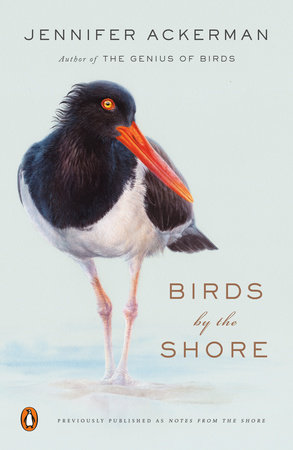
Now that Jennifer Ackerman’s wonderful The Genius of Birds has done so well, Penguin Books just revised and reissued one of her older titles in paperback. is a collection of essays about her experiences with shorebirds and seabirds during the time she lived on the coast of Delaware. It’s a splendid book, genuinely worthy of republication. 


As a Midwesterner living on one of the most important migration hotspots in the country, I’m extremely thrilled about a new book highlighting a hotspot on another Great Lakes shoreline, Kenn Kaufman’s A Season on the Wind: Inside the World of Spring Migration. I wasn't sent a free copy from the publisher, but I bought the electronic version the moment it came out and devoured it.


Kenn moved to the western shores of Lake Erie in Ohio from one of America’s most exciting birding spots, southeastern Arizona, but he hasn’t looked back. For anyone who might think that a top-notch, sensible birder might prefer living somewhere other than the greater Toledo area, Kenn starts his book by explaining what makes the shoreline of Lake Erie such a spectacular place to witness migration. His book focuses first on the geography that makes the small stretch that includes the Magee Marsh so important for birds. He also writes, lyrically, about some of the species, and even individual birds, that make up this astounding display, for example, one particular Blackburnian Warbler:
These small migrants don’t wear license plates or carry passports, so it takes some study even to guess where they’re traveling from and where they’re going. The vast majority of these migrants are navigating solo, not in flocks, though they’ll join up with other birds during their daytime stopovers. Every individual here has its own story—ten thousand separate stories in this little woodlot today, each one an epic.   
Look: here’s a tiny bird with a face and throat of brilliant, burning orange, set off by a sharp pattern of black. You could fall in love with it just for its Halloween colors and its alert, perky behavior. But if you know it’s an adult male of a species called the blackburnian warbler, you can learn more about it. This bird just spent the winter in South America, in misty forests somewhere on the slopes of the Andes—maybe in Colombia, maybe in Peru, more than three thousand miles south of here. Early in spring it started moving north, working its way up through Central America in a series of night flights and daytime stopovers, then flying north across the Gulf of Mexico to the southern United States. Here in Ohio it’s getting closer, but it still has many miles to go before it reaches its destination in some Canadian spruce forest.   
That’s only part of this bird’s story, because last fall, of course, it had to make its way south, flying from Canada to South America. And it wasn’t the first time. This bird is an adult, at least two years old. A little scrap of life weighing about half an ounce, it has probably flown across the Gulf of Mexico at least four times, spring and fall, and traveled untold thousands of miles under its own power. Now it is pushing north toward the breeding grounds, to claim a territory, find a mate, and try to raise another brood, to pass its strong and successful genes along to the next generation of blackburnian warblers. And this is just one individual bird.  
Blackburnian Warbler
I took this photo of a Blackburnian Warbler at the Magee Marsh during The Biggest Week in 2014.

Kenn writes of the dangers these birds face:
Against all odds, these birds must make their long journeys or perish in the attempt. People may imagine them to be cheery little songsters with the freedom to roam the world, but in fact they’re driven by instinct that burns with white-hot intensity, locked in a pattern that leaves no room for choice. Time after time they fling themselves into the air for another long flight or gamble with their lives on a risky daytime stopover. None of them will die of old age. They’ll just keep on performing herculean feats over and over until that moment when weakness or lack of attention or bad luck takes them down.
And Kenn focuses on one particular danger confronting birds arriving by so many thousands along the shore—the threat of collisions with wind turbines, something he and Kimberly have been fighting tirelessly to protect them from. Kenn stresses that it is indeed critical for us to move to clean, sustainable sources of energy, but wind power isn’t the appropriate choice on such a well-documented, critically important migration magnet. I especially appreciate Kenn’s discussion of the nitty gritty practical and political aspects of the issue, the frustrating endlessness of battles, and his successes, while not at all dismissing the critical importance of reducing our carbon footprint. This story is delicately woven through the book, providing a fine balance between natural history and conservation.

Magee Marsh Boardwalk Entrance

Kenn also writes beautifully about the human element—the nearly 100,000 birders that descend upon the Magee Marsh and surrounding area each May to enjoy the spectacle. Exactly ten years ago this week, the Kaufmans and a lot of others started up a huge 10-day annual birding festival they call The Biggest Week in American Birding. It lives up to its name in terms of the length of the event, the number of human participants, and the sheer numbers of birds that everyone gets to enjoy. During the Biggest Week, when people say it’s “dead on the Boardwalk,” they mean you’re likely to see only a dozen rather than 20 species of warblers—the slowest May days there are as good as the best in most places. I’ve been a participant or a speaker at this festival at least five times now, and I can honestly say that I’ve never been anywhere in all my birding life where the concentrations of migrating and resident birds during May are so reliably dense no matter what the weather. 

Birding near the Boardwalk
Excellent birding and friendly crowds near the Boardwalk.

Of course, that leads to crowds of people, too. During the birding festival, parking can be difficult at the Black Swamp Bird Observatory office, but there’s a huge parking lot at the Boardwalk, surrounded by prime birding along the lake and along the woods, so the good birding starts the moment you open your car door. I’ve been there during extremely crowded conditions, but regardless, I can’t remember a time when the birds didn’t vastly outnumber the people.

The Ottawa National Wildlife Refuge also has a huge parking lot, and I’ve never had a problem parking at any of the other hotspots in the area. I love birding all by myself, something impossible to do in this part of Ohio in May now, but sharing this wealth of birds is simply the right thing to do, to say nothing of fun in a different kind of way. Kimberly Kaufman, the director of the Black Swamp Bird Observatory, along with Kenn Kaufman and a host of other Ohio birders, has done a masterful job over the years of promoting birding, making the birding community more inclusive and fun both, and especially promoting the conservation of those birds along the Lake Erie shoreline—the shoreline will continue to welcome these birds not in spite of but because of the huge number of birders from all over thrilling at the migration spectacle who develop a visceral understanding of how vulnerable they are and how important protecting them is.

This year’s Biggest Week festival kicked off on May 3, and will run through May 12. Birds will still be there when it’s over—Prothonotary and Yellow Warblers nest right along the Boardwalk, and migrants will be passing through until close to the end of the month.

Prothonotary Warbler
It's impossible to miss Prothonotary Warblers at eye level along the Boardwalk. I took this photo there last year during The Biggest Week. 
Yellow Warbler and chicks
I took this photo from the Boardwalk on June 10, 2013, during my Big Year. Even a month after The Biggest Week, Magee Marsh is a happenin' place. 
I’m sad to be missing the festivities this year. Kenn Kaufman’s A Season on the Wind: Inside the World of Spring Migration is making me hungry to get back there next year. Meanwhile, his book is worth reading for a better understanding of the migration strategies of different birds and how geography as well as weather determines the annual rhythms of migration. This book, so steeped in love for birds and for one important and beautiful migration magnet, is a treasure.

Black-throated Blue Warbler
Yet another photo taken right from the Boardwalk at Magee Marsh during The Biggest Week last year.