I stayed with my good friend Jeff Pentel last night after a splendid drive out here. It was cloudy through North Dakota, but beautiful--it was light by the time we reached Theodore Roosevelt National Park, and we took a little break. A Sharp-tailed Grouse was moseying around the rest stop in the park, curious about Photon! Driving I-94 through the park we also saw a HUGE black bear, antelopes, and deer. Red-tailed Hawks were abundant, and saw a couple of Northern Harriers, too.
Crossing into Montana, the skies cleared. A coyote ran through a field near enough to the expressway for me to get lovely looks.
And the scenery! It just got better and better as the day went on. Bozeman is spectacular. Jeff has magpies--I can't wait for it to get light so I can take photos! Will add pictures from yesterday later.
Monday, October 22, 2007
Saturday, October 20, 2007
Bismarck, North Dakota
Whew! I got a late start today, but I'm in Bismarck, North Dakota, now, about halfway to Bozeman, Montana, where I'll be spending tomorrow night. It was a lovely drive. The tamaracks in Minnesota were spectacular--brilliant gold, and set off to perfection by the black spruces. I was driving Highway 210, and the few rest stops or places one could safely pull over to the side weren't in view of the most beautiful trees, so I didn't stop along the way for photographs.
On the bummer side, I saw a dead Sharp-tailed Grouse and a dead badger--also, of course, several dead skunks and raccoons and a pheasant as I got further west. But there were plenty of Blue Jays, a few Red-tailed Hawks, and a Bald Eagle. And lots of Red-breasted Nuthatches--more of those than chickadees flew across the road.
Tomorrow I'll be seeing more western birds. I hope hope HOPE I get photos of magpies! And I can't wait to see my good friend Jeff Pentel. I quoted him in my book, but I don't have a copy handy and I'm too tired to go out to my car. I'll sleep well tonight!
On the bummer side, I saw a dead Sharp-tailed Grouse and a dead badger--also, of course, several dead skunks and raccoons and a pheasant as I got further west. But there were plenty of Blue Jays, a few Red-tailed Hawks, and a Bald Eagle. And lots of Red-breasted Nuthatches--more of those than chickadees flew across the road.
Tomorrow I'll be seeing more western birds. I hope hope HOPE I get photos of magpies! And I can't wait to see my good friend Jeff Pentel. I quoted him in my book, but I don't have a copy handy and I'm too tired to go out to my car. I'll sleep well tonight!
Dave Barry Alert!
Oh my gosh! I got an email yesterday from the wonderful Judi Smith, humor writer Dave Barry's assistant. She said when Dave gets back from his book tour, I can interview him for my radio program again! I'm reading his new book, Dave Barry's History of the Millennium (So Far!), finding obscure bird references within (such as people super-gluing turkey rectums shut [in dead turkeys, presumably for cooking purposes]) that I'll talk with him about. I'm leaving today for Utah's Bear River Migratory Bird Refuge (I'll be doing a program about owls there Tuesday night if you happen to be in the neighborhood!) and then on to New Mexico for a statewide environmental education conference next weekend (I'm the keynote speaker!). When I get back I'll schedule the interview, and will podcast it ASAP.
One of my goals in life is to talk Dave Barry into writing Dave Barry's Field Guide to Nature: How and Why to Avoid It. That would be a funny book! Here's a pipe dream--what if I could talk Dave Barry into letting me go through all his archived columns searching out all his references to exploding House Sparrows and dog-scaring toads and other nature subjects to help him research and organize the book?
One of my goals in life is to talk Dave Barry into writing Dave Barry's Field Guide to Nature: How and Why to Avoid It. That would be a funny book! Here's a pipe dream--what if I could talk Dave Barry into letting me go through all his archived columns searching out all his references to exploding House Sparrows and dog-scaring toads and other nature subjects to help him research and organize the book?
Conserve Water!
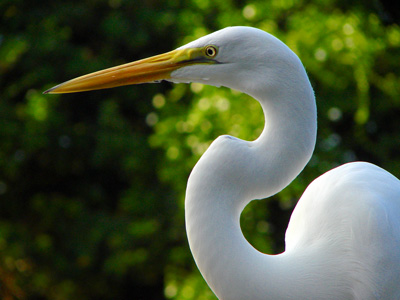
This has been a strange year in Duluth, with Lake Superior reaching its lowest level ever recorded in August, and now basements flooding from the saturated ground after weeks of LOTS of rain. But the drought in the Southeast continues unabated. Most predictions about climate change involve wildly fluctuating weather conditions and flooding in some areas and droughts in others. Atlanta is expected to run out of running water within months if there isn't significant rain there.
Water conservation is obviously critical for us humans, and as usual, what's truly good for us is also good for birds. Here's what I wrote in 101 Ways to Help Birds about water conservation:
13) Conserve water.
Water is a truly renewable resource, evaporating and returning to the air and forming clouds, then raining down on us, with the cycle repeating over and over. The amount of water on the planet remains constant. What changes is the amount of clean, drinkable freshwater for humans and wildlife.
Humans need only 1 to 2 quarts of water per day to stay alive, but we use much more. According to Cornell University’s Science News (January 20, 1997), Americans use about 100 gallons of water per person per day for drinking, cooking, washing, disposing of wastes, and other personal purposes—much higher than the world average of about 22 gallons per person per day. Not only do we use a lot of water in our homes, but agricultural and industrial water use is even more intensive. Farm policies in the United States subsidize the costs of irrigation, exacerbating the problem. As our population increases, the amount of clean water available in lakes, rivers, streams, and our uncontaminated groundwater supply is becoming depleted. Much of the groundwater that provides water used by agriculture, industry, and municipalities is being depleted far more rapidly than it’s being recharged.
How critical is water conservation for birds? Let’s consider just one situation: that of the Aransas National Wildlife Refuge, along the Gulf of Mexico on the Texas coast. People have known for a long time that the fresh water flowing into the refuge is critical for Whooping Cranes and other species that live in the estuary. Cranes, like humans living in San Antonio and other Texas cities, depend on water from the Edwards Aquifer, a source of spring water that feeds the Guadalupe and San Antonio Rivers. Of course, rainwater and runoff also provide fresh water for the rivers, but during dry spells, aquifer springs may contribute more than 80 percent of the fresh water entering the bay. When people remove this water from the aquifer for drinking, bathing, irrigation, feeding livestock, manufacturing, and other uses, the fresh water entering the estuary from the rivers declines, salinity goes up, and the ecosystem changes.
During years when not enough fresh water flows from the rivers into the estuary, marsh salinities increase and blue crab populations decline. Blue crabs are the primary food source for wintering Whooping Cranes, so a scarcity of crabs in the marshes hurts the cranes. In years when salinities are high and blue crabs are few in number, more Whooping Cranes die over the winter. “We found when salinity in the marshes reaches 23 parts per 1,000 (sea water is 35 parts per 1,000), the Whooping Cranes have to fly to fresh water to drink at least twice a day. This forces the cranes to use up more energy reserves, and increases the risk of predation whenever the birds leave the marsh,” Tom Stehn, Whooping Crane coordinator at the Aransas National Wildlife Refuge, told me. The cranes that survive have less to eat and are forced to use up fat reserves rather than putting on fat. Fat reserves are necessary for the cranes to survive their 2,400 mile migration in the spring with enough energy left over to nest successfully. Stehn notes that there is a direct correlation between Whooping Crane breeding success in summer and the population level of blue crabs they fed on the previous winter.
It’s not only Whooping Cranes that depend on fresh water inflows to the estuary. Other endangered or threatened species that live in the bay include Brown Pelicans, Reddish Egrets, and Piping Plovers. The human population of Texas is expected to double in the next 50 years. How will it be possible for us to meet our own needs and those of Whooping Cranes and other birds, especially as changing weather patterns exacerbate the degree and duration of droughts?
The heavy needs of water for the burgeoning development of central Florida have put Everglades National Park in jeopardy, the flow of the Platte River through Nebraska, where migrating Sandhill Cranes stop over every spring, is a fraction of its historical level; and much of the arid West is becoming ever more arid.
In the Southwest, the exploding human population has depleted already limited freshwater supplies, with international implications. Millions of acres of jungle-like wilderness in northern Mexico are now sterile salt flats because of heavy water use in the United States. In the days before the Hoover Dam was completed in 1936, Aldo Leopold recorded clouds of waterfowl in the Sonoran Desert’s largest wetland, the Cienega de Santa Clara. Leopold traveled the Cienega by canoe with his brother in 1922, calling it a “milk and honey wilderness.” “The river was nowhere and everywhere, for he could not decide which of a hundred green lagoons offered the most pleasant and least speedy path to the Gulf,” Leopold wrote. "So he traveled them all, and so did we.” The Cienega is but a shadow of what it once was, and is under threat of more damage from the Yuma desalting plant which, if it goes into production, will feed its toxic saline dregs directly into the Cienega.
The ever-increasing voraciousness for fresh water ensures that problems such as this become more and more prevalent, as we lose more and more of the freshwater reserves we should be protecting for our children and grandchildren as well as for birds and other wildlife.
The worst water use problems in the nation are centered in the West, where water conservation is urgent for humans as well as birds, yet flying over major cities, one can’t help but notice swimming pools sparkling in the sun. Squandering limited water supplies in arid areas increases the likelihood of wildfires and concentrates toxins that run off into rivers and ground water supplies. And even in areas of the country that have much more fresh water, such as the Great Lakes region, ground water and drinking water supplies are becoming more and more contaminated due to intensive agricultural practices and toxins from industry and people. When sewage plants carry too heavy a burden, managers sometimes hasten the treatment process by releasing blended contaminated and cleaned water together, which increases the dangers of disease for both humans and birds. One dangerous organism, Cryptosporidia, got into Milwaukee's drinking water in 1993, causing illness in about 400,000 people and killing more than 100. In the face of that, little attention was paid to the loss of birds and other wildlife.
Chemicals are so pervasive in the environment that one study found 287 different contaminants in human umbilical cord blood. These contaminants included pesticides, fire retardants, and mercury. And a June, 2005 Washington Post article reports on the alarming amount of pharmaceuticals in our nation's waterways, the result of drugs being tossed down the drain and flushed down the toilet. These chemicals, including hormones found in birth control pills, may have human health risks, since water treatment plants only remove a fraction of pharmaceutically-active compounds. Nobody is sure what the effects are, how these substances interact, or the full seriousness of their impacts on wildlife. Nonetheless, most government officials don't seem particularly interested in the issue.
When I was in graduate school, one of my friends who became a biologist for Exxon liked to say, “Dilution is the solution to pollution.” This may be true to a point, but year after year as our freshwater supplies stay constant or even dwindle, the amount of toxins we release steadily increases, making them ever more concentrated rather than diluted. On the shores of the largest, and ostensibly one of the cleanest, lakes in the world, in Duluth where I live, a series of storms in September, 1990, caused storm sewers to overflow and led to a sanitary sewage spill, washing raw sewage and even some medical wastes into Lake Superior. Birders and Duluthians found sick and dead birds all along the shore. One birder brought me three sick Sanderlings, little shorebirds that she found, weak and emaciated, along a popular beach. Parasites multiply rapidly on birds too sick to preen, and these birds were covered with lice and mites. I dusted them with a mild insecticide, but meanwhile, when I first examined the birds, a louse on the sickest bird bit me, apparently transferring to me whatever pathogens were in the bird. A couple of days later I became seriously ill, with a high fever, hallucinations, and difficulty breathing. My symptoms were similar to psittacosis (parrot fever), but blood samples proved negative for that and every other disease the blood was tested for. Meanwhile, my doctor laced me with a broad-spectrum antibiotic and I recovered. But the Sanderling died, and a Common Nighthawk I was caring for at the same time also succumbed. We Duluthians swim and boat in Lake Superior, and draw our drinking water from it, all the while leaking our wastes into the water and trusting that human beings will prove a bit sturdier than little sandpipers.
As public utilities become increasingly burdened with our growing population, and as the anti-tax movement makes it harder to maintain them, we can expect this kind of dangerous situation to happen with increasing frequency, hurting all of us. Even simple sewage backups and overflows can contaminate lakes and rivers. Conserving and using our precious water resources responsibly helps birds and humans both.
How can we make a difference? First and foremost, don’t waste water. The Environmental Protection Agency and many municipal water providers suggest on their websites a great many simple ways we can save water at home. And don’t place extra burdens on your sewer system and wastewater treatment plant. Remember, anything that goes into the sewer system is flushed with water which must be cleaned and the debris removed before it can be returned to open water. In addition, hazardous materials and medicines may not be removed and will increase water pollution. Try not to wash down drains or flush any of the following items:
- Paper products. These do not dissolve, and add to the burden of sludge.
- Lint and hair. These may clog your drain or the sewer system.
- Condoms, underwear, and other non-biodegradable solids.
- Oil, paint, and other toxins. Know where your local toxic waste disposal site is, and use it.
- Cat litter. The sand and gravel can block a sewer line.
Friday, October 19, 2007
A bit more about cats
I just got my copy of an extraordinary book--Silence of the Songbirds by Bridget Stutchbury. It is a very important book about bird conservation, by a scientist with a great mind and a great heart. Here's a brief excerpt:
A tiny, pale warbler, a female common yellowthroat, had been caught in mid-May while she was nest building and was fitted with a tiny backpack that held a radiotransmitter. Over the next week researchers followed her movements for a few hours every day as she finished her nest, laid eggs, and began incubating her clutch of four eggs. One day, she was gone and her eggs were stone cold.
Scott Tarof, a postdoctoral researcher at the University of Wisconsin, went out that afternoon to help a graduate student find out what had happened to their female. The bird's radio signal was coming from the pasture across the road from the study site. The two walked into the pasture thinking they would find the radio tag lying on the ground, but were puzzled when the signal suddenly started coming from the far end of the pasture. As they walked in that direction, the signal moved again; this time it was several hundred yards away in the opposite direction. There was no common yellowthroat to be seen or heard, so they thought they were going crazy or maybe the equipment was not working properly.
After a few hours of frustrating false leads looking for the radio tag in the hot sun, they finally got a steady signal from a clump of grass in the corner of the pasture. They zeroed in on the signal only to find a chewed-up transmitter in a pile of cat poop. The female warbler had been eaten by someone's cat, and Tarof had unknowingly been following the cat that still had the bird, and its radio tag, inside it.
...
To estimate the numbers of birds killed, homeowners in Michigan were asked to count up the dead animals their cats brought home. On average, each cat killed about one bird a week, and though this may not sound like much, the damage adds up because there are so many free-ranging cats near homes and farms. The six hundred cats in this study would have killed more than six thousand birds during a typical ten-week breeding season alone. A similar study in Wichita, Kansas, asked homeowners to bag the contents of the litter box so researchers could later search through the feces looking for feathers. They found bird remains in about 10 percent of the samples, even though the homeowners had not reported seeing their cat bring back a bird in recent days. This suggests that kitty is not as innocent as owners think and that surveys of cat predation underestimate the true scale of the problem. When the Wichita study ended, the homeowners were asked if, given the results of the study, they would now keep their cats indoors; 73 percent said no.
...
Cats are not to blame for the songbird decline, but keeping cats indoors will mean that birds nesint in woodlots near farms and homes will have a better chance of staying alive and producing a healthy number of offspring.
Cape May Feral Cat Colony

Kasey riding home from Ohio
St. Francis of
I personally love cats. When an abandoned cat, part of a similar spay and release program in
There really are no win-win solutions for some horrible dilemmas. And when there are two sides, each gets stuck looking at the side of the tragedy they see clearly, and minimizing the tragedy the other side sees clearly.
But I’ve also held my cat Sasha in my arms as she died from a stroke, after dragging herself with paralyzed rear legs into my bedroom desperately searching for me. She was another stray I took in—she’d been eating redpolls and other birds at my own feeder. I loved that cat very deeply, and was heartbroken when she died.
Individual life—cat and bird—is beautiful, meaningful, and irreplaceable. All the king’s horses and all the king’s men can’t put a mangled dead Piping Plover back together again, and they can’t bring back to life a dead cat. But saying that birds killed by cats aren’t our responsibility or our fault is simply untrue. Cats are not native to
I’ve done my part—in my lifetime I’ve taken in five stray cats and given them a loving home. If feral cat colonies really are necessary, they should be entirely fenced with cat-proof fencing, located in habitat that is already degraded so as not to attract native birds, and situated far, far away from migratory bird pathways. But far, far more work needs to be done to find INDOOR homes for cats. And if we're going to err on the side of compassion, make it not by choosing individual life over individual life, but by giving preference to the most vulnerable populations over the tragically too-abundant species.

Wednesday, October 17, 2007
Mr. President?

Stephen Colbert announced last night that he will be running for President of the United States, in South Carolina. Read the news story here.
Notice that the news story gets the title of his book wrong. It's not "I Am American (And So Can You!)"; it's I Am AMERICA (And So Can You).
I will endorse this candidate if he promises to make me Secretary of Birds if he wins. Otherwise, I'm sticking with Dave Barry, who (and I am not making this up) really did promise to make me Secretary of Birds if HE is elected president. You can hear all about it on this 12-minute radio interview, along with solid proof that I'm no Terry Gross. You can also read the Dave Barry's Christmas Gift-Buying Guide entry about the nighthawk tapeworm I gave him here.
Jealous of Birdchick!
Oh my gosh! The ever-effervescent Birdchick has had two close encounters with Ian McKellen!!!!! How lucky can a person be? I would have given a great deal to get to see him perform in my favorite play of all time, King Lear, which is playing in the Twin Cities right now. I don't know if she's going to see the play, but she did get to see him in a grocery store and on her way to a movie! She writes, "Can I say how much I enjoy just picking him out in the streets among all the other people? It's like finding a Ross's goose mixed in with a bunch of snow geese."
I did find it intriguing that she wrote of her amazing encounters in a blog entry titled, "Weekend of Red-tails." Yes, most of the post is about her heading north to help band hawks. But considering that long first paragraph I can't help but wonder... There IS a nude scene in King Lear, after all.


I did find it intriguing that she wrote of her amazing encounters in a blog entry titled, "Weekend of Red-tails." Yes, most of the post is about her heading north to help band hawks. But considering that long first paragraph I can't help but wonder... There IS a nude scene in King Lear, after all.
Norman Bates' screech owl in Entertainment Weekly
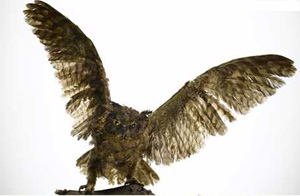 My family subscribes to Entertainment Weekly, since we're all fascinated with movies. This week's online issue includes a quiz to identify movie props that includes a stuffed bird. In the paper copy of the magazine, it tells something about this cool artifact:
Arsenic was often used for preserving birds that are now in museum drawers. This screech-owl looks pretty ragged, but really is in pretty good condition, considering it was supposedly stuffed by an aspiring taxidermist who was getting practice before stuffing his raison d'être. Can anyone tell which species it is?PsychoAs if the Bates Motel weren't creepy enough, director Alfred Hitchcock posed this stuffed owl among other mounted animals in Norman Bates' parlor to amplify the sense of menace. Universal Studios archivist Jeff Pirtle, who now tends to the creature along with a stuffed seagull [sic] from The Birds, says it's in surprisingly good condition, given that the film debuted in 1960. "It was preserved using arsenic," Pirtle explains. Somehow, when you're talking about a Hitchcock prop, a dose of arsenic seems fitting.
Stuffed Owl
Tuesday, October 16, 2007
Cool! Thanks, John Riutta!
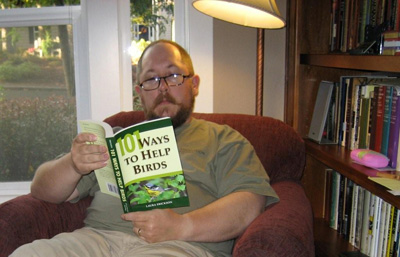
The wonderful John Riutta, "Born Again Birdwatcher," was kind enough to send this photo of himself reading my book.
Subscribe to:
Posts
(
Atom
)