Laura Erickson's For the Birds

Wednesday, July 13, 2016

Endangered Species Act: A Big Success!

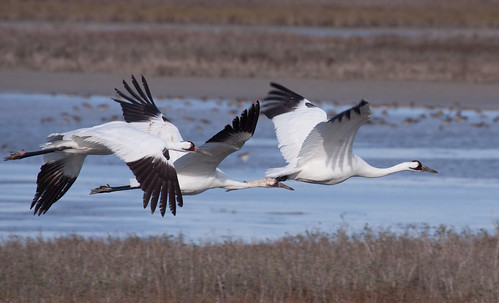
Whooping Crane

One of the most frustrating elements for me of the toxic political climate today is how little facts seem to matter anymore in public discourse. It’s become a common belief that the Endangered Species Act hasn’t worked because, since its passage in 1973, only a handful of species have recovered enough to be de-listed. Just between 2011 and2015, over 50 bills have been introduced trying to dismantle the Endangered SpeciesAct, usually on the grounds that it has been a huge failure. 

How can anyone argue this when Bald Eagles and Peregrine Falcons are so obviously doing well? They say the Endangered Species Act had nothing to do with these species’ recoveries—it was simply the banning of DDT. It takes a certain level of chutzpah for the same people who still decry banning DDT in the United States to seize upon that ban as the entire reason for the recovery of these species, but as entertainment and politics become increasingly intertwined, chutzpah seems the order of the day.

In reality, the Endangered Species Act sets forth provisions for researching the specific needs of each listed species and the causes for its decline, and requires the development of a specific plan of action created by researchers, state departments of natural resources, landowners, and other stakeholders that focuses on the specific needs of that species. Each recovery plan includes benchmarks of success that set a minimum population level at which a species can safely be de-listed, along with an expected timeline for this to happen. The Senate unanimously voted in favor of the Act, Congress voted 390–12 in favor, and Richard Nixon signed it. The U.S. Supreme Court found that “the plain intent of Congress in enacting” the ESA "was to halt and reverse the trend toward species extinction, whatever the cost.”
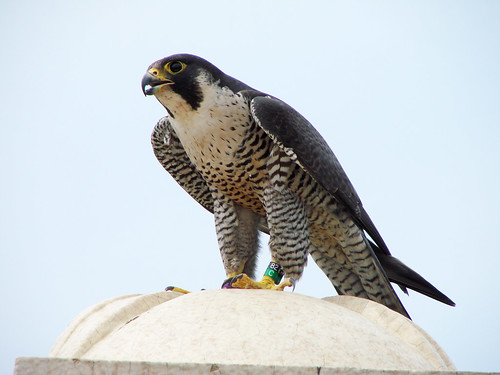
Peregrine Falcon

In the case of Bald Eagles and Peregrine Falcons, the banning of DDT was certainly a primary cause of the endangerment in the first place. But both species had declined over most of their former range to critical levels—nesting Peregrine Falcons had been completely wiped out over the eastern United States. For either to recover, research into nesting requirements and sturdy protections of habitat and nesting areas were crucial; in the case of Peregrine Falcons, painstaking reintroduction projects after developing techniques for captive breeding, all funded by the Endangered Species Act, were also essential.

We humans are an impatient and shortsighted species. Back in 1973, everyone knew what a long, hard battle was needed to bring each species back from the brink, especially because virtually all endangered and threatened species are imperiled not by one easily fixable thing but by an assortment of causes, some very hard to address. But that law was passed 43 years ago—before most people living in the United States today were even born. Nowadays, it’s easy to pull a fast one on people, claiming the Endangered Species Act doesn’t work simply because it does take a long time to bring some species back.

Fortunately, a new report by the Center for Biological Diversity was released this week, documenting just how successful the Act has been with regard to birds, the group of animals most easy to accurately census. Fully 85 percent of the 120 bird species protected under the Endangered Species Act in the Continental United States increased or stabilized their population size since being protected, and the average population increase was 624 percent. For the most part, birds are recovering at the rate and magnitude intended by the Endangered Species Act’s congressional creators and administrative overseers. And birds listed as endangered fared much better than unlisted birds, which on average have declined 24 percent since 1974.


It’s impossible for a significant majority of Americans today to remember the ‘70s, when condors, eagles, osprey, and falcons were virtually gone; when the state bird of Louisiana, the Brown Pelican, had been entirely wiped out in Louisiana; when the extinctions of Black-capped Vireos, California Gnatcatchers, and Kirtland’s Warblers loomed in the foreseeable future. Today, those of us who were adults at the time and do clearly remember are ourselves disappearing. So in coming days I’ll focus on some of the dramatic successes of the Endangered Species Act.
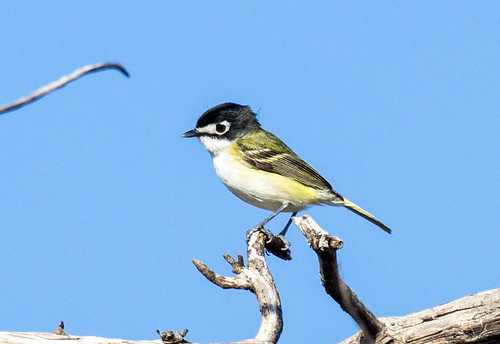
Black-capped Vireo

Tuesday, July 5, 2016

Red-bellied Woodpecker nest update

Red-bellied Woodpecker male with a tasty morsel.

I’ve been checking on my Red-bellied Woodpeckers every day, and every day the chicks, still entirely hidden in the cavity, get noisier and more insistent. When I returned from Maine on June 15, probably only a day or two after they’d started hatching, I couldn’t hear any sounds during feeding time; it took a few days before I could pick up tiny whispery sounds, and I needed my hearing aids to pick up that. When the parents came in with food, they usually brought a few small items, and they spent a minimum of two or three minutes inside the cavity feeding the young, and probably brooding them to help them maintain a healthy body temperature. Baby woodpeckers hatch out in a very undeveloped state, and need a lot of gentle attention to survive, much less to thrive.

As the days passed, the little guys first grew louder during feedings, and then could be heard for seconds, and then minutes, after the parent left the nest. Now I’ve been back for almost three weeks, and the ever-growing babies are keeping up their insistent begging even longer. They’re staying below the cavity entrance so I still can’t see them, but over the weekend the parents started holding food at the entrance now and then, reaching in several times as if to entice them to the entrance hole. Through Sunday the parents still had to go all the way in to reach the chicks, but on the Fourth of July, the babies could climb high enough that both parents could deliver the food while remaining at the entrance hole. Any day now I’ll see the first baby face.

Red-bellied Woodpecker

The nestlings take the food as fast as the parents can deliver it, so feedings are short and sweet—sometimes literally so, because now the parents sometimes bring berries as well as insects. Insistent calling draws the parents back much more frequently now, often with just a single big grub, and feedings last only one or two seconds.

Red-bellied Woodpecker

On Saturday morning, July 2, in one 15-minute period the parents came in 10 times; in the next 21 minutes, they returned only 3 times. On the videos I made, you can hear Hairy and Downy Woodpeckers, flickers, crows, robins, cardinals, Chipping Sparrows, and a Red-eyed Vireo. The Red-bellied parents pretty much ignored them unless one was in the actual nest tree—then a parent would dive-bomb it, sometimes hitting it hard rather than simply giving a warning.

On Tuesday, June 28, a baby squirrel fell asleep on the broken limb on one side of the cavity opening while an older squirrel groomed itself on the limb rising above the opening. The male Red-bellied Woodpecker was inside the cavity, looking back and forth between the two, for about a minute after I arrived. It’s not that he was afraid to tangle with squirrels, but he seemed to be weighing how probable it was that one would enter the cavity while he was attacking the other. He bided his time until the female flew in and aggressively dive-bombed the baby squirrel. Branches obscured my view of much of the action, but she appeared to actually knock the little guy off the branch. I disapprove of squirrels raiding nests, but this little guy was napping, and I’m partial to baby squirrels, too, so I was glad when the little rodent caught the trunk and scurried safely away. Meanwhile, the male Red-bellied came out and the pair drove off the larger squirrel together. Squirrels and chipmunks eat a disconcerting number of baby birds, so diligence is essential even as it distracts from the essential search for food for growing babies.


I start hearing the parents about five minutes before sunrise every morning, and they keep at it, hour after hour, until about sunset. Once the babies fledge in a week or two, the parents will have to maintain their vigilance over a much larger area as the fledglings learn to negotiate the world. Last year I was seeing young Red-bellieds with their parents into September, so raising babies is an all-consuming commitment through the entire season that many of us humans take our vacations, and they can never leave those young at a daycare center for an hour’s respite. Raising baby woodpeckers is not for the faint-hearted, and woodpeckers play such a central role in forest ecology that raising young ones is a job that makes every one of our lives better. They deserve our gratitude.

Red-bellied Woodpecker

Friday, July 1, 2016

Hog Island Audubon Camp

Hog Island

Last month, I spent two weeks on Hog Island in Maine, where I was one of the instructors for two week long programs, one about Breaking into Birding, the other about the Joy of Birding. Hog Island is a small island too close to the mainland to have many of the seabirds people associate with the popular Maine Audubon camp—a boat trip each session brings participants much further from the mainland to Eastern Egg Rock, where Atlantic Puffins have been successfully reintroduced and Common, Arctic, and Roseate Terns nest. The only oceanic birds we saw every day from Hog Island itself were Common Eiders... 

Common Eider

Common Eider

and Black Guillemots. 

Black Guillemot

I saw only one or two Ring-billed Gulls while I was there—instead, the gulls around Hog Island were mostly Great Black-backed, Herring, and Laughing. 

Great Black-backed, Herring, and Laughing Gulls

The landscape looks surprisingly like northern Minnesota until you remember that the water lapping on the shore near your cabin is salt water. Walking about the island from day to day, seeing the changes as the tide came in and out, was disconcerting for someone who has always lived in landlocked states. And when you look into Lake Superior, somehow you never see jellyfish.

Lion's Mane Jellyfish

Moon Jellyfish

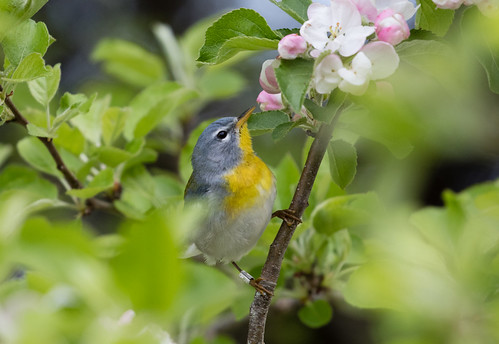
The land birds on the island were pretty much what you’d expect to see in north woods forests, such as Northern Parulas, Black-throated Green, Magnolia, and Blackburnian Warblers, Song Sparrows, Eastern Phoebes. The warblers are of course tricky to see well, though when I first arrived while apple trees were in blossom, the Parulas spent a lot of time at eye level eating tiny insects in the blossoms. 

Northern Parula

Northern Parula

And a lovely water feature with a recirculating pump gave me great looks at a variety of warblers, especially during the dry spell we had the first week.

Blackburnian Warbler

Northern Parula

Yellow-rumped Warbler

A pair of Osprey nests right near the main buildings—these are the famous Steve and Rachel, the subjects of a popular nest cam. I was there when the first two of three eggs hatched. So far the chicks are doing well, but the possibility of Bald Eagles snatching the chicks is a clear and present danger—both of last year’s chicks were taken from the nest when they were about a month old.

Osprey

Near the main buildings, there was also an interesting little population of meadow voles that seemed as interested in us as I was in them. 

Meadow Vole

People arrive on the island on Sunday afternoon, and after settling into their rustic cabins, we start meeting for sessions in the afternoon. Days were mostly spent on field trips with some workshops ending with an evening program.

My favorite day of all was when we spent the morning on a boat trip to Eastern Egg Rock to see puffins. We don’t get up close and personal the way I’ve done on trips to Machias Seal Island, where the Canadian Coast Guard maintains a station and allows a limited number of visitors each day to spend an hour or so in an observation blind seeing puffins and Razorbills at very close range. Only a small staff of researchers are allowed on Eastern Egg Rock, but we got to see plenty of puffins in the water...

Atlantic Puffin

along with lots of terns flying over. 

Terns over Eastern Egg Rock

On the island, we saw some Razorbill decoys but no real ones. 

Razorbill decoys near observation blind

After cruising around Egg Rock, we boated to Harbor Island for a picnic lunch and an invigorating hike.

We spent another day hiking on the mainland, a tradition of the camp since Roger Tory Peterson started it back in the 1930s. On my hike there the first week, we came upon a Hairy Woodpecker nest, the chicks sticking their heads out of the cavity entrance for feedings. 

Hairy Woodpecker nestling

By the following week, they had fledged, but instead, we found a Pileated Woodpecker nest with babies poking out.

Pileated Woodpecker chicks

Pileated Woodpecker chicks

The instructor staff was great fun to work with, including top birders like Tom Auer from Cornell who is part of the eBird team; Charles Duncan, internationally acclaimed shorebird conservationist; Pete Dunne, popular author; Steve Kress, whose seminal graduate research on Atlantic Puffins paved the way for Project Puffin; Wayne Peterson, a top birder and conservationist who is writing the American Birding Association’s field guide to birds of Massachusetts; and John Pumilio, Director of Sustainability at Colgate College.


On the windless Saturday morning between program sessions, when I had the island pretty much to myself, I set my microphone and recorder out near my cabin and let it pick up the bird songs and soft ocean waves. Oddly enough, that happened to be the only morning during the entire two weeks when a late migrant, an Eastern Wood-Pewee, showed up on the island, singing away. He apparently moved on that night, but the recording proves he was there.  That’s the background sound I used for today’s radio program; you can listen to or download the full 37-minute recording here. It’ll keep Hog Island fresh in my mind until I return next year, to Hog Island and also to speak at the LL Bean and the Acadia Birding Festivals.

Hog Island

Thursday, June 30, 2016

One Good Tern Deserves Another: Roseate Tern

Roseate Tern

A few days ago, I wrote about our smallest tern, the Least Tern, and since one good tern deserves another, I decided today to write about the Roseate Tern. When I was in Maine earlier this month, I was hoping against hope to see one, partly because I missed seeing a single one on my 2013 Conservation Big Year even though it’s a species in serious trouble that deserves to be highlighted, and because it is so exquisite, the whitest of all the medium-sized terns. Roseate Terns are primarily tropical, breeding in tropical oceans around the world, and reaching into the temperate zone only in scattered breeding colonies in the northern Atlantic. I saw my lifer on Long Island in New York in June 1993.

Arthur Cleveland Bent, primary author of the series, Life Histories of North American Birds, wrote in 1921, "I shall never forget the thrill of pleasure I experienced when I held in my hand, for the first time a Roseate Tern and admired with deepest reverence the delicate refinement of one of nature’s loveliest productions.” The bird he was holding in his hand happened to have been killed by him—collected for science. 

Roseate Terns paid a tragic price thanks to shooters, far, far more for decorating women’s hats than for science. The trade in wild bird feathers has been illegal for generations, and many more safeguards have been put into place even for scientific collecting, thanks to the Migratory Bird Treaty Act. 
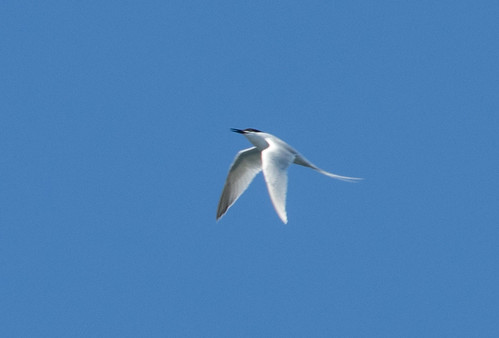
Recovery has been slow, habitat loss still a problem because the beaches where many terns breed are under such heavy pressure for recreation and development. The population here is nevertheless recovering much faster than that in the Caribbean, where eggs are still collected because they’re believed to have aphrodisiac qualities. Despite the problems, individual terns are surprisingly hardy.  The oldest Roseate Tern known to science was at least 25 years, 8 months old when it was recaptured and rereleased during banding operations in Brazil in 1997. It had originally been banded in Massachusetts in 1971.  
I was an instructor at National Audubon’s famous Hog Island in Maine this spring, and got to go on one of the boat tours of Eastern Egg Rock, the small island where Steve Kress devised his amazing Project Puffin, using decoys and puffin sounds to lure Atlantic Puffins back to nesting on the island—they’d been extirpated from almost all of Maine’s islands by egg collectors, hunters, and market shooters. Now the puffins on Eastern Egg Rock are thriving, as are some other species, including Arctic and Roseate Terns. So I figured this was my one shot at getting photos of both species, but especially Roseate Terns.

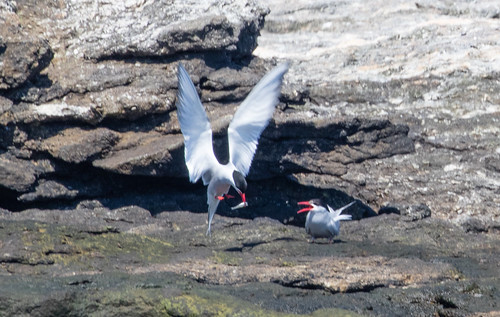
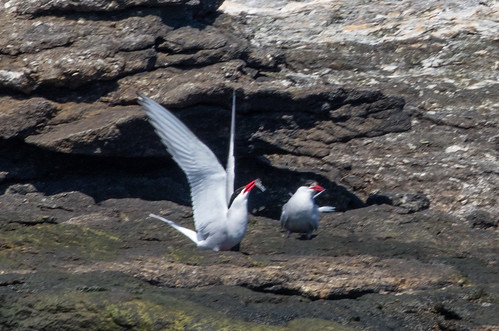
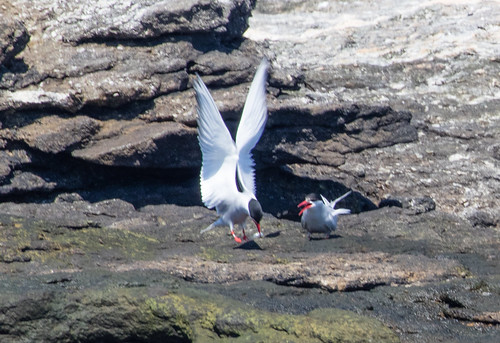
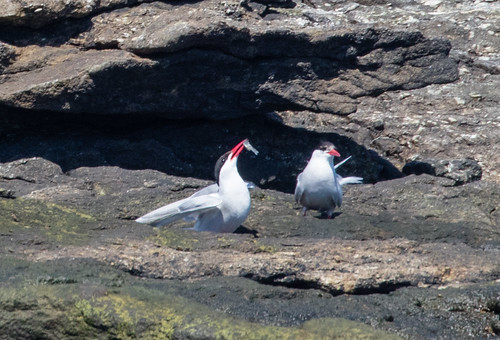
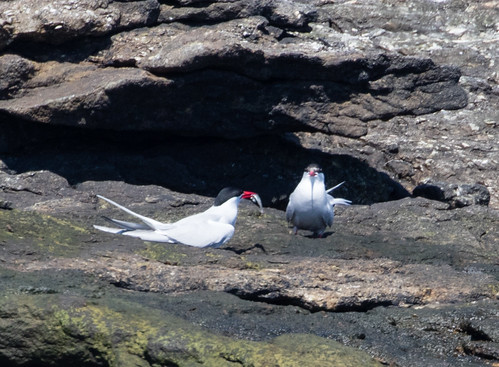
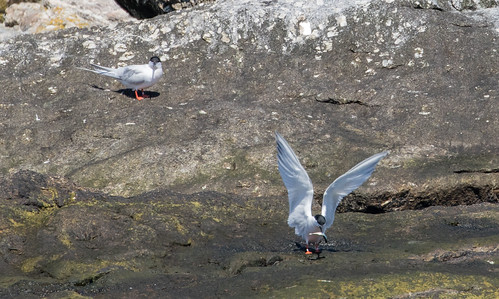
Sure enough, from the boat I got one series of photos of courting Arctic Terns.

Arctic Tern

Arctic Tern

Arctic Tern

Arctic Tern

Arctic Tern

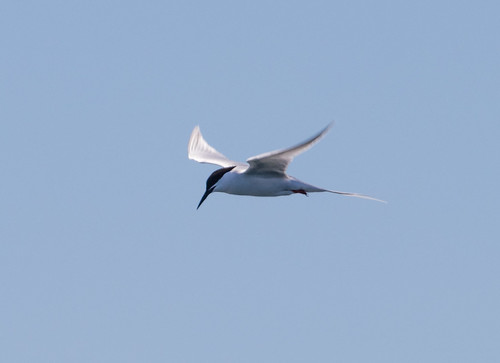
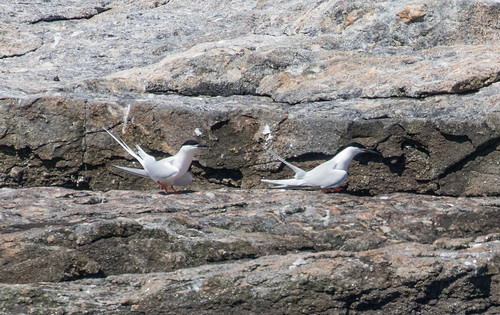
I also got several shots of Roseate Terns, including a couple of courting pairs. 

Roseate Tern

Roseate Tern

All were from a distance so had to be severely cropped to make the birds appear closer—none of these photos will appear in magazines or anything—but they did turn out reasonably well, all things considered, and are the best I’ve taken of either species so far. My camera lens is the new model of Canon’s 100-400 mm zoom lens; the image stabilization is wonderful, and my new camera body (Canon’s 80D) has a wonderful sensor giving a wondrously detailed 24 megapixels.

Although I was there at the peak of breeding season, I wasn’t close enough to see any of the pink suffusion that gives Roseate Terns their names. Fortunately, I’ve already been invited back to Maine for next year, to keynote at two birding festivals—the LL Bean Birding Festival and Acadia Birding Festival. So next year I’ll be back, with several days between festivals to try to have a closer experience with Roseate Terns. If one good tern deserves another, it also deserves a closer look .

Roseate Tern

Sunday, June 26, 2016

Least Terns!

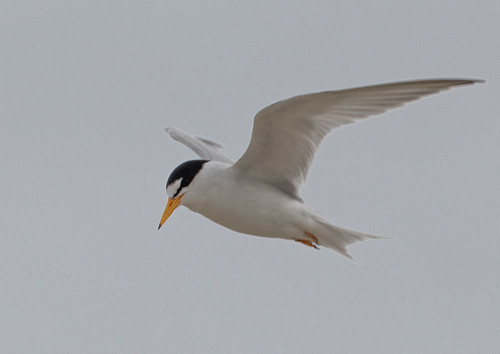
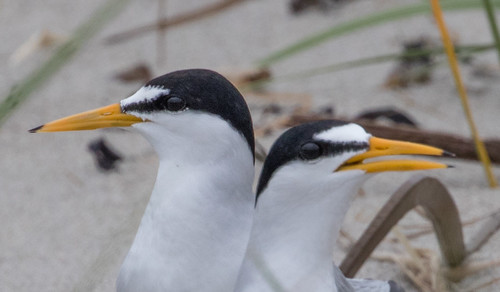
Least Tern

In June 1976, Russ had a professional meeting in Savannah, Georgia, and I tagged along to go birding. I had only been a birder for a little over a year and never anywhere near a coast, so my focus was entirely on seeing what I could find. Russ let me set our agenda during our free time, asking only that we spend a little time at one spot I wouldn’t have chosen—Fort Pulaski National Monument. 

I tried to be gracious about it, but when we went inside, I was overcome with an overwhelming sadness—the very air seemed oppressive, in exactly the way I felt when we visited the Alamo. I couldn’t take it but didn’t want to dampen Russ’s enjoyment, so I stepped outside to stroll around the grounds a bit. That’s when I saw my lifer Least Tern—both a splendid bird and an important milestone—Number 200 on my lifelist. 

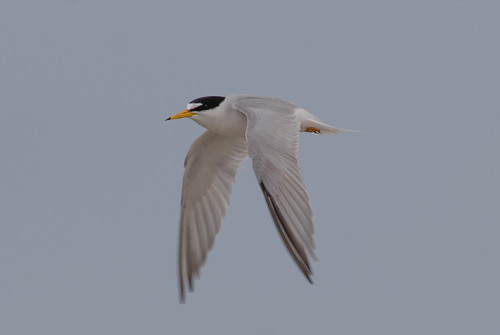
This tiniest of all terns, lovely and graceful, nests on sand beaches and occasionally stony flat rooftops. This was the peak of the nesting season, but I didn’t know enough about Least Terns back then to even think to look for the nesting area. Instead, I stood, transfixed, watching several of these dainty birds catching fish in the moat around the fort. 

Least Tern

For both Russ and me, that afternoon proved to be one of the most memorable of our trip. Since then I’ve seen them in California, Delaware, Florida, Georgia, Iowa, Maine, New York, Oklahoma, South Carolina, and Texas. I missed a Duluth sighting in 1986.

Least Terns are widespread and common here and there along the coasts and rivers of the United States and a bit of Canada. They require sandy beaches and spits for nesting, which are also among the areas people use for recreation, residential and tourist development, and water diversion, so it’s small wonder that the North American Breeding Bird Survey data show that Least Tern populations declined by about 88 percent between 1966 and 2015. The North American Waterbird Conservation Plan lists Least Tern as a Species of High Concern, and the species is on the 2016 State of North America's Birds' Watch List. Least Tern is classified as threatened, endangered, or as a species of concern for most states because of loss of nesting habitat, and the interior population has been federally listed as endangered since 1985.

20160611-IMG_9620.jpg


Fortunately, when individual birds find a satisfactory spot to nest, they don’t seem to realize they’re imperiled—they go about their business and hope for the best, pretty much as we all go through life. Indeed, the oldest known Least Tern lived to be 24 years old. It had been banded in Massachusetts in 1957, and was killed by a predator in New Jersey in 1981. 

Male Least Tern delivering a fish.

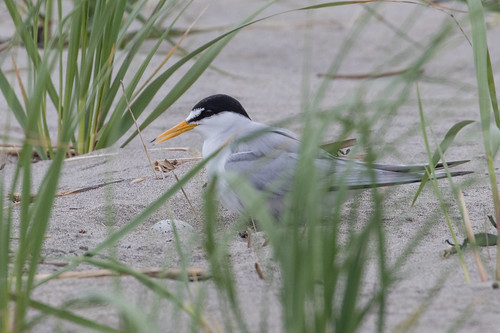
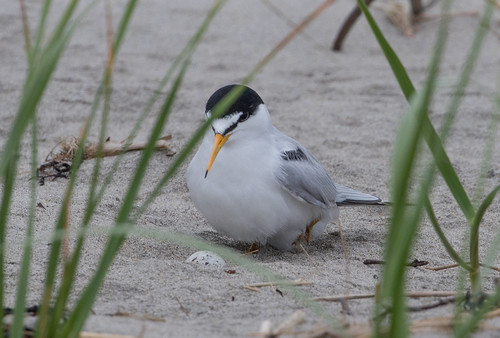
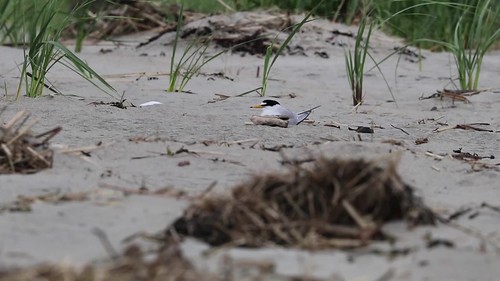
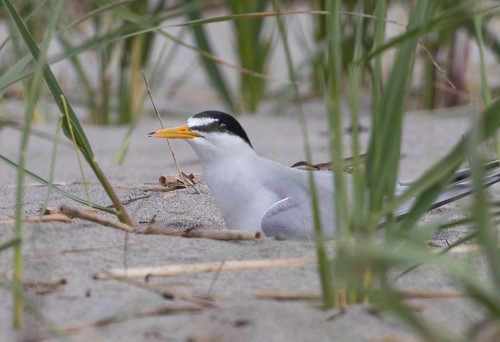
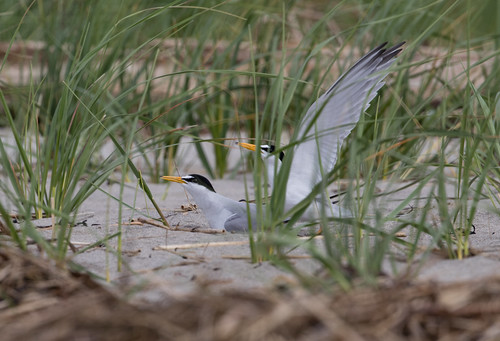
Russ and I spent a splendid day with Least Terns at Popham Beach State Park in Maine a couple of weeks ago. This beach provides lots of recreation for people while setting off a wonderful swath of habitat for Least Terns and Piping Plovers. I counted a bare minimum of 25 Least Terns that day. The fairly large numbers meant that some of the birds had to nest closer to the edge of the roped off area than others, and two pairs were nesting close enough for me to photograph. Both of them had so far produced a single egg. 

Least Tern nest

Least Tern nest

A complete clutch may contain just one egg but more often 2 or 3. According to the Birds of North America Online, incubation begins after the first egg is laid but nest may be inconsistently attended until the clutch is complete. I did see both females incubating their single egg, but also saw them standing a short distance away, so these eggs were probably laid that very day or the day before and the birds will probably produce one or two more. 

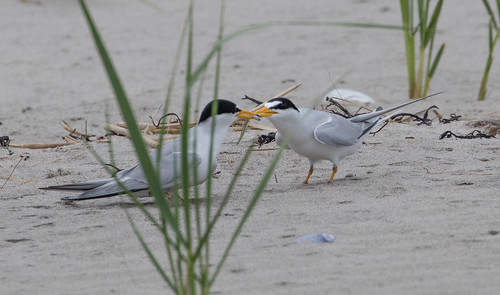
Male Least Tern flies in with fish; both fly off.

Least Tern nest

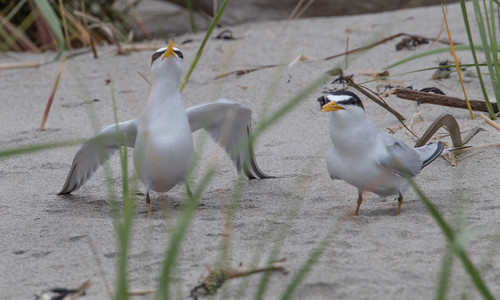
I saw males fly in several times to deliver fish, and got photos and even video of this happening with the two nearby females. It was so thrilling to see courtship behaviors and flying and roosting and nesting birds. I'll enjoy the pictures and videos for years, each one bringing back to me yet another moment of the lovely day Russ and I spent with them. 

Least Tern nest

Least Tern nest