Laura Erickson's For the Birds

Sunday, July 17, 2022

Alaska, Part 7: Birding in Anchorage

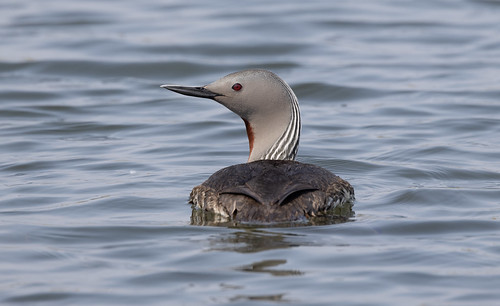
Red-throated Loon

Russ’s and my birding trip to Alaska, a tour organized by Victor Emanuel Nature Tours, was divided into two parts, each beginning and ending in Anchorage. Our home base was the Holiday Inn Express near the airport. When we left for short trips, the hotel was happy to keep our extra stuff in their storage room, which was wonderfully convenient. And we saw the very first official bird of the Victor Emanuel tour—Common Redpolls near what appeared to be an active nest— right there in the hotel parking lot! 

Our first and last Alaska moose greeted us when we arrived and bid us farewell at the Anchorage airport.

Russ and I arrived in Anchorage at night on June 11 and spent June 12 walking around Anchorage and birding near the hotel. We met our tour group in the hotel lobby at dinnertime. The next morning, we flew northwest to Nome for four nights. When we returned to Anchorage, we spent a full day birding there before heading north for two days in and near Denali National Park. After our return to Anchorage, we headed south for two nights on the Kenai Peninsula in Seward, and then returned to Anchorage for our final dinner together. Most people flew out the next morning, but Russ and I took an evening flight so we could sleep in our last morning and spend a few more hours birding on our own. So of the 14 nights we spent in Alaska, 6 were in Anchorage.  

Anchorage is Alaska’s largest city; its population of over 290,000 is well over three times that of Duluth. Our first day there on our own, Russ and I discovered Lake Hood Seaplane Base near the airport, just a short walk from the hotel. We headed there again to close out our final day. 

Last afternoon in Alaska, Russ and I returned to Lake Hood

It’s a popular city park, and despite the noise and disruption from all the seaplane activity, birding was pretty nice, especially if you like ducks, Red-necked Grebes, and magpies.

Barrow's Goldeneye

Red-necked Grebe

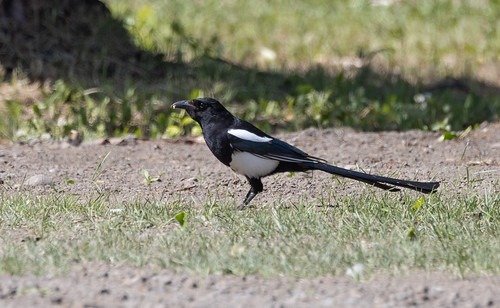
Black-billed Magpie

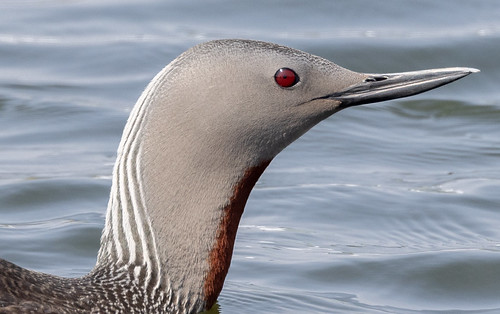
At the very end of our last afternoon, off one of the seaplane piers there, I got splendid photos of a stunning and shockingly close Red-throated Loon—a magnificent final bird to close out a wonderful trip.  

Red-throated Loon

Red-throated Loon

That last day, we’d also gone to another cool little spot just behind our hotel, where we saw several common songbirds such as Alder Flycatcher...
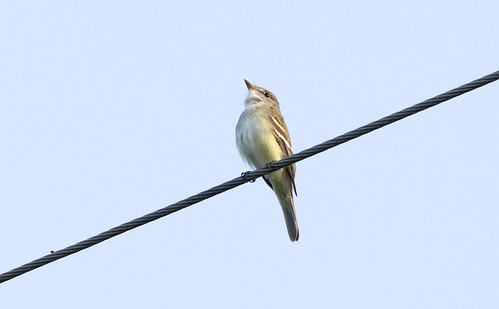
Alder Flycatcher

White-crowned Sparrow...

White-crowned Sparrow carrying food

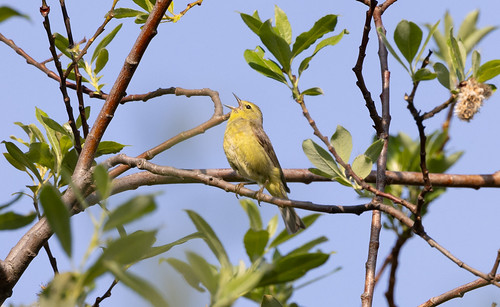
...and Orange-crowned Warbler.

Orange-crowned Warbler

A pond there had several ducks including a Green-winged Teal mother and ducklings. 

Green-winged Teal and ducklings

I got some closeups of a gorgeous magpie with a badly deformed or injured beak right near the hotel. 

Black-billed Magpie

Birding at these two places right close to the hotel was pleasant but very low-key compared to some other spots right in Anchorage that we visited with the full group. On our first morning of the tour, we had a little time to kill before we headed to the airport for our Nome flight, so some of us made a short visit to Westchester Lagoon. Just standing in one spot near the parking lot of this splendid park, we enjoyed a wonderful assortment of waterbirds. This being nesting season, we spied Short-billed Gull and distant Arctic Tern and Red-necked Grebe chicks as well as adults on nests.

Short-billed Gulls--adults and chicks

Red-necked Grebe on nest

An extremely cooperative Short-billed Gull and Arctic Tern posed on nearby structures for wonderful photo opportunities. 

Short-billed Gull

Arctic Tern

Anchorage has several other wonderful parks, too. After birding a bit at Westchester Lagoon on our full day of birding in Anchorage on June 17, we headed to Kinkaid Park and took a trail called the Mize Loop, a superb, woodsy path where in addition to some lovely common birds such as a nearby Swainson’s Thrush, we got to spend time watching a nesting pair of American Three-toed Woodpeckers feeding young.

Three-toed Woodpecker

Three-toed Woodpecker

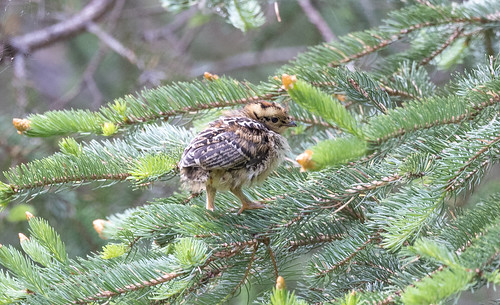
Wonderful as that was, I was even more thrilled to see a gorgeous female Spruce Grouse with her adorable chicks.  

Spruce Grouse hen with nearby chicks

Spruce Grouse chick following mommy

Spruce Grouse chick

Then we went to a fantastic place, Potter Marsh, with an incredible boardwalk that kept us safely above a stunningly beautiful bull moose who ignored us as he munched on vegetation below. 

Moose

Moose

This marvelous marsh is huge, with nesting Trumpeter Swans and a wonderful assortment of other water and land birds. 

Beyond the marsh following the highway out of Anchorage a bit, we kept scanning the Cook Inlet for a beluga whale. The belugas inside the Cook Inlet are genetically different from the belugas everywhere else. I’ve never seen a beluga at all, and was especially sad not to see one here because the Cook Inlet population of beluga whales is critically endangered. Way up on the cliffs rising above, we saw Dall’s sheep.

Dall's Sheep

At a nice parking pull out, a wonderfully cooperative Golden-crowned Sparrow posed for lots of photos.  

Golden-crowned Sparrow

All in all, there is prime birding in and near Alaska’s largest city, and it’s not that much of a drive to two more of Alaska’s wonderful birding and nature destinations, Denali National Park and the Kenai Peninsula. Next time I’ll focus on our wonderful Denali experience. 


Friday, July 8, 2022

Acorn Woodpecker in Minnesota!

Acorn Woodpecker in Minnesota!

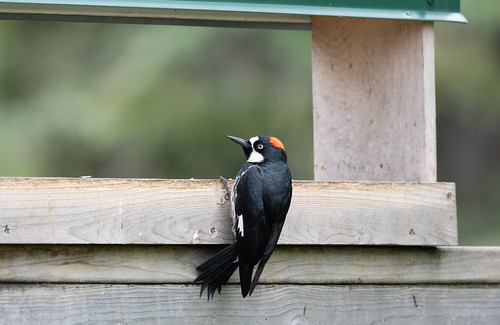
On July 2, Russell Stewart was looking out at his feeder when what to his wondering eyes should appear but a strikingly beautiful woodpecker that he didn’t recognize. He looked through his field guide and nothing that could be found in Minnesota matched it. The one species that did match belongs more than 1,200 miles from his Carlton County home: an Acorn Woodpecker!

Acorn Woodpecker in Minnesota!

The Acorn Woodpecker is a fascinating bird with a clown-like face belonging to the same genus, Melanerpes, as our Red-bellied and Red-headed Woodpeckers. But unlike those relatives, the Acorn Woodpecker lives communally. Each bird belongs to a community, searching for and storing food in communal granaries that the entire community shares. 

Acorn Woodpecker granary
I took this photo in southern California. (Unless a caption says otherwise, all the photos on this post were taken of Russell Stewart's Acorn Woodpecker.)

This communal life extends to nesting. A single nesting community involves two cohorts: multiple related females in one and multiple related males in the other. About 1– 4 females and 1– 8 males are breeders, and 1–10 other birds, related to the breeders, are helpers. Because of these unique habits and because several Acorn Woodpecker communities are conveniently located near California universities and colleges, a great many researchers have pretty thoroughly studied the species. 

Acorn Woodpecker in Minnesota!

Acorn Woodpeckers have two distinct ranges in the United States: in western-most Oregon and much of California, and in eastern Arizona, western New Mexico, and a bit of southwestern Texas. 

I’ve seen Acorn Woodpeckers many times, mostly in California and Arizona, but also in New Mexico and at Big Bend National Park in Texas, and in Mexico and Costa Rica, but until Russell Stewart’s bird turned up, I’d never seen one outside the species’ normal range. Acorn Woodpeckers are considered non-migratory except for one population near the Huachuca Mountains of southeastern Arizona, where not enough acorns grow each year to provide a big enough winter supply for each community. But these birds hardly migrate to Minnesota—they head south, probably to Mexico’s Sierra Madre.  

Birds have wings and each individual has some agency over its own life, so individual migratory and even non-migratory birds occasionally turn up well out of range. There are two previous records of Acorn Woodpeckers in Minnesota: one appeared at Crow Wing State Park near Brainerd on November 9, 2009, and one at a house in Detroit Lakes on September 14, 2016. Those birds weren’t what birders call "chasable"—they were seen only a single day each, so birders who might have tried to find them after that one day wouldn't have succeeded.  

Acorn Woodpecker in Minnesota!

If Russell Stewart's Acorn Woodpecker followed that pattern, we’d probably never know that it had appeared in Minnesota at all. But the day after he first noticed it, Russell Stewart got good enough photos to confirm his identification, and appreciating just how extraordinary it was for an Acorn Woodpecker to appear in the state, he signed up for eBird just to report it. In less than an hour, Kim Eckert turned up at his place to look for it. Kim is the first birder ever to have seen more than 400 species in Minnesota and leads the state in birds seen. He warned Russell Stewart that a lot of other birders were likely to turn up, and sure enough!

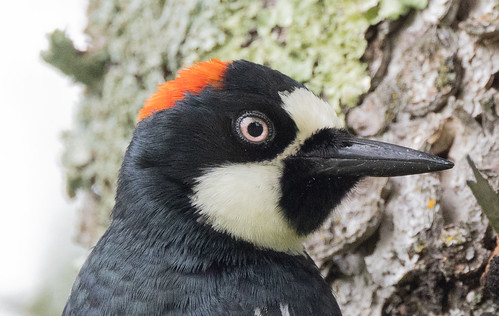
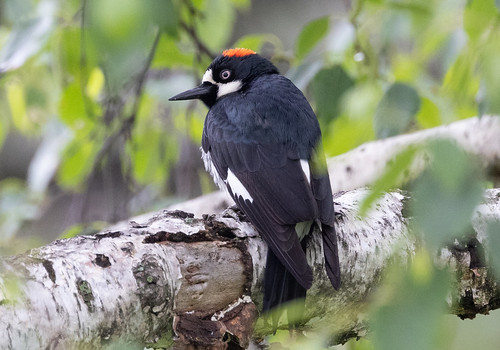
I couldn’t get away that day or the next, but by the morning of July 5 when I finally got there with my friend Paula Lozano, at least 100 birders had descended upon Russell Stewart’s house. The vast majority of birders are very respectful toward homeowners hosting a rare bird, and I’m happy to say that the ones who turned up at Russell Stewart’s lived up to that reputation for politeness. Most homeowners are pretty polite to birders in return, but Russell Stewart went far, far beyond mere politeness. When I got there, the bird was in a birch tree in his yard, and a bunch of birders were standing right next to his porch, with Russell Stewart himself making sure everyone saw it. He had done his homework, explaining that although this bird had a large red spot on the crown, she was a female. All Acorn Woodpeckers have a large white face patch. The red crown on males extends all the way to this patch.

Acorn Woodpecker
I photographed this male at the feeding station at Cave Creek Lodge in southeastern Arizona in 2013.

The red crown on females is separated from the white face by a black forehead. 

Acorn Woodpecker in Minnesota!

While I was there, the bird flew to the feeder for some sunflower seeds.

Acorn Woodpecker in Minnesota!

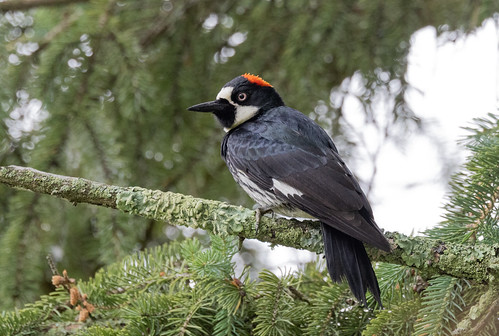
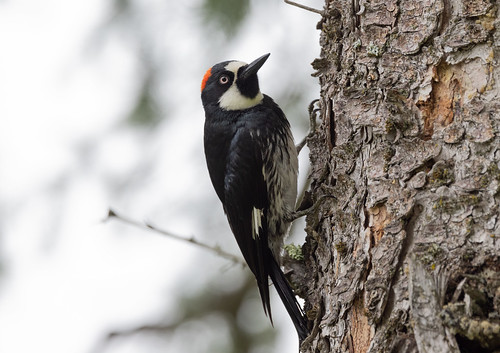
Then she flew to the spruce trees along Russell Stewart’s driveway where I took a lot of photos. 

Acorn Woodpecker in Minnesota!

Acorn Woodpecker in Minnesota!

Acorn Woodpecker in Minnesota!

She returned to the birch, back to the feeder, and then flew to the woods on the other side of the road. I spent some time getting to know Russell Stewart, and then Paula and I headed back to town. 

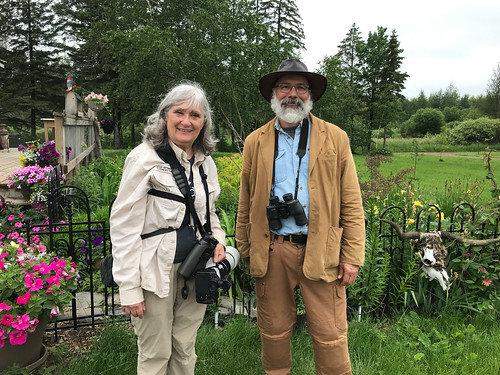
Russell Stewart, who found the Acorn Woodpecker on his property
Russell Stewart, the founder of the feast

As far as I know, Wednesday was the last time the bird appeared. It’s impossible to know which direction she headed off in. If a female Acorn Woodpecker turns up anywhere else in the Midwest this summer, there’ll be a reasonable chance that it’s this one, but she wasn’t banded, so there is no way we can ever be certain. 

It’s always fascinating when a bird turns up so far from its home, and thrilling to be able to see it, especially when we have a reasonable hope that it was healthy and has a good chance of returning to its natural range. It’s hard to know what sent this bird our way. Was it one of the fires that are destroying so many California trees in recent years? The horrible drought in the Southwest? That’s another thing we’ll never know—she wasn't talking. 

Acorn Woodpecker in Minnesota!

But we do know for certain that one female Acorn Woodpecker turned up for four wonderful days at Russell Stewart’s house in Carlton County, and thanks to his generosity and hospitality, after figuring out that birders and the ornithological community at large would want to know about such a rarity and sharing it on eBird, a host of birders, including me, got to enjoy this extraordinary bird, too. 

Acorn Woodpecker in Minnesota!
You can read John Myers's Duluth News Tribune story about Russell Stewart's Acorn Woodpecker here. 

Thursday, July 7, 2022

Alaska, Part 6: Birding the Nome-Taylor, or Kougarok, Road

Driving through the tundra

Now that our Alaska tour group had birded the road heading out of Nome to the northwest—the Teller Road—and the road heading to the northeast—the Council Road—it was time to head more directly north, on the Nome-Taylor or Kougarok Road. 

We didn’t drive the entire 85-mile road on June 15—the plan was to bird our way to what birders call “Curlew Mountain,” at Milepost 72.5.  

Seward Peninsula showing three roads out of Nome

The birding along the Kougarok Road was spectacular. Birds of prey included a few Short-eared Owls and a distant Golden Eagle on its nest.

Golden Eagle on nest

American Golden-Plovers were stunning. 

American Golden-Plover

American Golden-Plover

That was a day when Russ and I were sitting in the last seats in the van, but since most of the travel didn’t involve getting in and out of the van—everyone saw most of the birds through the windows—it didn’t matter much until a pair of Pacific Loons in a pond swam right next to the road for amazing views. That was the moment I wished the hardest that the van windows opened. Two layers of window glass made what could have been shockingly wonderful photos hazy, but it was still thrilling to see them and the pictures I took may always be the best Pacific Loon photos I’ve ever taken. 

Pacific Loon through the van windows

Pacific Loon through the van windows

Pacific Loon through the van windows

We arrived at Curlew Mountain about 2 PM as one discouraged group was coming down, not entirely certain they'd seen one. (To be successful at finding new species, we birders really do need to study up to make sure we can recognize the ones we want to see. People do often mistake Whimbrels for Bristle-thighed Curlews, so learning how they differ in plumage and sound is essential!)

A birding group coming down "Curlew Mountain"

Barry and Erik had allotted 3–4 hours to either find the Bristle-thighed Curlews or get discouraged enough to turn back. As soon as we stopped, everyone put on boots. Birding websites strongly recommend NEOS overboots, which is what our leader Barry Zimmer wears for this particular trek, so Russ had bought a pair specifically for this hike. Erik Bruhnke told me he wears rubber boots for this hike, and I figured I could probably get by with my trusty old LaCrosse rubber boots.

Booted up and ready to tackle Curlew Mountain!

On some of these trips, every participant falls at least once—tundra tussocks look innocuous but are very difficult to negotiate while keeping your balance—but at least there’d be a soft landing onto thick herbaceous vegetation. The big danger is twisting an ankle. I knew I’d need a little more ankle support than my rubber boots could give, so before donning them, I wrapped my ankles in Ace bandages. I also grabbed one of my hiking sticks—I can’t use both because one hand is always holding my camera—and as soon as all of us were booted up, we headed up the dome. 

Bristle-thighed Curlew

Erik led the group up a trail that was worn into the hillside by so many birders, over so many years, making this same quest. Barry set off on a different route to widen the area that he and Erik could see and hear. Our climb was narrow, muddy, and slippery, but not what I’d call arduous, and with my walking stick, it was a piece of cake. Barry, off to one side on the tundra vegetation, was the only one out of all of us who fell. 

Half the people who try to find the Bristle-thighed Curlew fail. I thought about the other half—the half I wanted to be part of—and focused my eyes and ears on searching for the bird. We hadn’t hiked more than ten or fifteen minutes—the vans were still in view and we were still quite a distance from the crest of the dome where most sightings are made—when Barry saw one, and then a pair! Erik made a cool imitation with his own voice and they flew over! Hokey smokes! Two Bristle-thighed Curlews before any of us had broken a sweat. 

Bristle-thighed Curlew

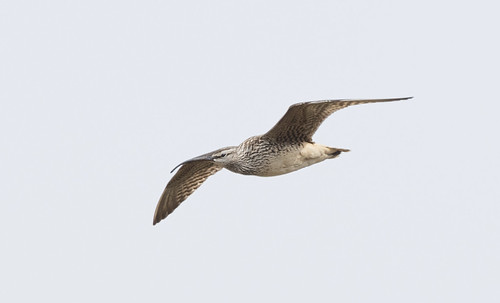
I got photos of one flying over and then of the male, who landed a couple hundred yards from us, allowing very good scope views and some marginal photos. 

Bristle-thighed Curlew

We took photos of our triumphant, happy group, the curlews still in view, and then headed back down, making it to the vans a mere 37 minutes after we’d headed out! 

Success! (a reenactment)

We birded the way back, picking up a very distant Northern Shrike (the only one we’d see on the whole 2-week adventure) and a lovely Merlin, closer, perched in the fog. 

Merlin in the fog

We also saw musk oxen for the last time in Nome.

Musk Ox

When we got back to town, we got a group photo by the Iditarod finish line.

End of the Nome leg of the trip

Erik took a photo of Russ and me there. What a perfect way to end a perfect Nome adventure. 

Russ and me in Nome, photo by Erik Bruhnke 

The next morning we'd be flying back to Anchorage for the Grand Alaska Tour, Part II. 

Heading back to Anchorage from Nome