Laura Erickson's For the Birds

Sunday, March 11, 2018

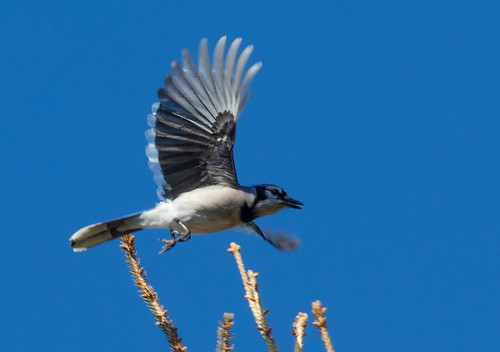
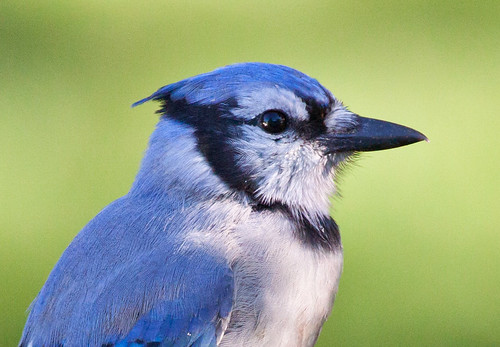
Laura's Best Bird EVER! Chapter 3. Ludwig the Blue Jay

(Some of this is reworked from earlier blog posts for my Best Bird EVER series.)
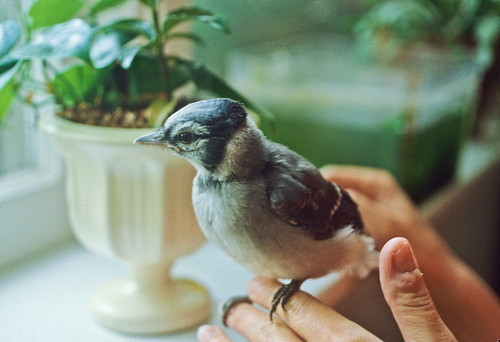
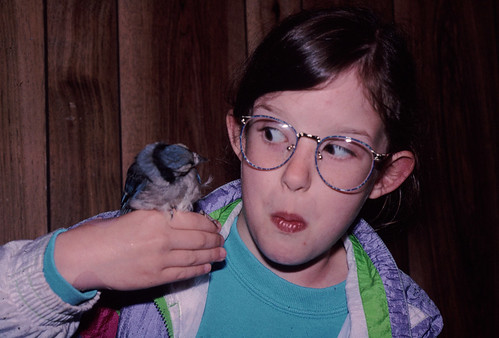
Lugwig the baby Blue Jay

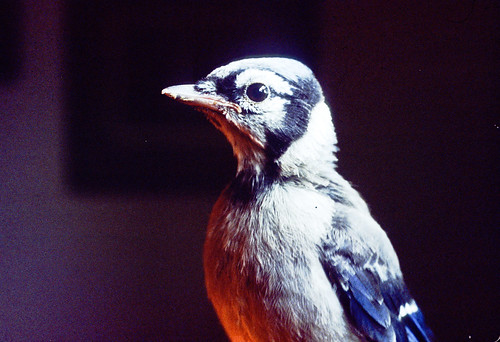
In 1979, when I was birding in a park in Madison, Wisconsin, with my dear friend Ken Wood, we came upon a hilarious sight: a Blue Jay fledgling who was quite literally playing on the playground slide. He’d hop up to the bottom and then flutter as hard as he could to work his way up the slippery slope. He never got even halfway up before gravity took over; he’d make a quick about-face and flap his little wings as hard as he could, sliding down to the bottom; he’d stay aloft for a second or two before dropping to the dirt below. Then he’d start up the slide all over again. It was one of the most adorable things I’ve ever seen. Ken took photos of the little jay, and then we went home.

An hour or so later I started growing uneasy. I vaguely remembered seeing adult Blue Jays flying back and forth overhead, but they completely ignored the fledgling even when Ken and I picked it up for a couple of photos. So Russ and I went back to the park just in time to discover it in the mouth of a golden retriever. Fortunately, it must have been a well-trained hunting dog because it held the little bird gently, and when I reached out to take it, the dog handed it right over! There were a few drops of blood and a good supply of saliva on the little guy, but otherwise he seemed fine.

I’d noticed two peculiar things—two jays flew over, completely ignoring the situation, and the baby didn’t make a sound. I surmised that his parents weren't paying attention to him, and had perhaps outright abandoned him, because parent Blue Jays find and recognize their chicks in part by voice. One that didn't make a peep in the mouth of a dog was probably defective from an adult Blue Jay's perspective. 

From the moment that little bird's eyes met mine, an electrical surge seemed to go through me, sparking a love affair. As captivating as Blue Jays are to my eyes, it turns out they’re even better at capturing my heart.

Riding home, the beautiful little jay snuggled into my hands and looked at me with bright, trusting eyes; I was scared to death of screwing up. So the first thing I did when I got home was to call a friend of mine who worked for the US Fish and Wildlife Service. He’d raised a baby magpie many years before, and was a treasure trove of valuable information about diet and care. I was a teacher and still had a few days of school to go, so I brought the bird with me every day, carrying him in a shoebox on the bus. I fed him every 15 minutes, whether I was in the middle of a lesson or at recess. The kids in my classes were as charmed as I, and that meant that 60 more people were invested in his survival, too.

He never made any sounds at all for the first three or four weeks. I thought he must be deaf so I named him Ludwig. But on the last day of school, he proved beyond a doubt that he could hear perfectly well. I brought home a box with all my desk stuff, including an orange bell from Russ’s and my Parker Brothers’ Pit game that I rang when I wanted the kids to settle down—the kind of bell with a button on top.
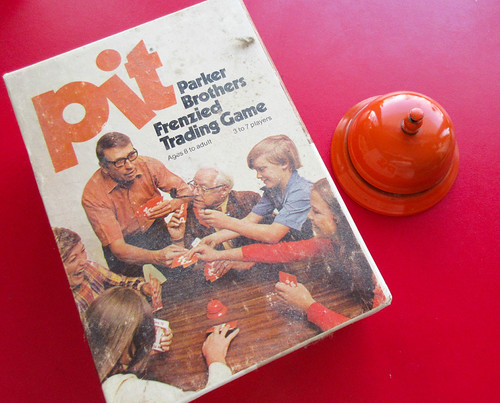
Pit, the Parker Brothers game

As I was putting things away in our apartment, Ludwig looked curiously at it, so I pressed the button and it rang out. He instantly hopped up and pushed the button with his beak, but he was very little, so his breast pressed against the bell, dampening the sound. When he stepped back, I rang the bell again and his crest popped up and he hopped up to try it again, but again the sound was dull. I showed him how it worked a few more times, but then Russ and I went to another room to watch TV. Maybe 20 minutes or a half hour later, we heard a clear “Ding!” A few seconds later, we heard another “Ding!” and then a “Ding! Ding! Ding! Ding!” I went running in to see Ludwig hitting the button over and over as he hovered, wings beating furiously, above it. He seemed very pleased with himself, and especially pleased that we had witnessed his accomplishment. After that, he pretty much lost interest in the bell. I kept it on the table, and every now and then he’d notice it and fly up to ring it once or twice, but he had moved onward and upward.
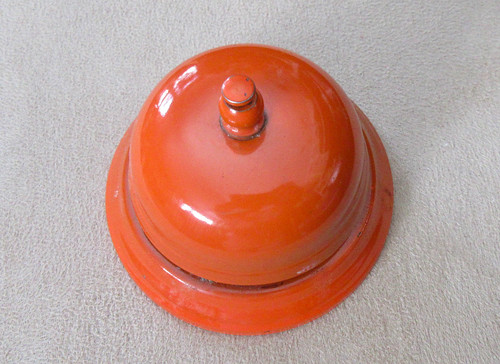
Bell from Pit, the Parker Brothers game

There are no evolutionary advantages whatsoever conferred on a bird for mastering bell ringing. But curiosity, tenaciousness, figuring out cause and effect, and keen observational skills are excellent qualities for an opportunistic omnivore, be it a Blue Jay or a human being. The longer and more closely that I observed Ludwig, the more I grew to understand that Blue Jays exemplify the very best of what an intelligent, sociable species can be.

Ludwig thrived. But being raised by a human instead of a Blue Jay family meant his education was different from what a normal Blue Jay would have. The first time Ludwig took a bath in my kitchen sink, he soaked himself so thoroughly that each flight feather became a sodden, stringy, heavy mess. He hopped up to the edge of the sink with no problems, but when he tried to fly across the room to the table, he dropped to the floor like a rock.  I picked him up on my finger and he stayed put while drying off. It took half an hour of preening to get his feathers back into flying condition.

I had learned that there was no way I’d qualify for a permit to keep him permanently, so right when he was starting to take short flights, I started taking him outdoors so he could learn some of the skills he’d need to become independent. It was of course terrifying the first time I set him on a bush—what if he flew off and I never saw him again? How would he survive? I realized that parent birds are way, way better at keeping track of their fledglings, and are ever so much more able to reach them in high trees, than I could possibly be. Fortunately, fledglings also keep track of their parents, and the first week or so, Ludwig never strayed far from me. When I couldn’t stay out with him, he’d happily come inside with me, at least at first. As he got more independent, especially after he discovered mulberries in the back of the yard and delectable fruits further afield in the neighborhood, sometimes he didn’t want to come in with me. I was more and more feeling like Samantha on the show “Bewitched,” when she’d call, “Mother! Mother!” into the bushes, making her neighbors think she was crazy. Calling “Ludwig!” seemed even more bizarre. Sometimes I’d be forced to leave him out—when he was ready to come in, he’d look through our apartment windows until he saw us and peck at the glass to catch our attention. He was starting, at long last, to make Blue Jay vocalizations. Whenever he wanted me, he’d make a squawk that sounded like “Ma! Ma!”

One time a huge storm blew in while Ludwig was outside. As the ominously dark clouds built up, I searched and called, but he didn’t come. When the deluge descended, I gave up and went inside. Every lightning bolt and blast of thunder made me more anxious. When the rain finally stopped, I ran out and called for him. I couldn’t find him in my own yard or nearby, so I hopped on my bike and started riding through the neighborhood, calling his name. Finally, a few blocks away I found him, sitting on a telephone line directly above a bus stop, feathers so plastered against his body that he didn’t look anything like a blue jay—just a gray, sodden mass squawking “Ma! Ma!” A dozen or so people were waiting for the bus as I pulled my bike to a stop. That was back when I still clung to a shred of a sense of dignity, and felt my face grow hot as I called, “C’mon down, Ludwig!” He dropped like a rock, fortunately onto the slim patch of grass between the sidewalk and the curb. He hopped up to me yelling, “Ma! Ma!” as the people stared and laughed.

Thanks to this spunky little Blue Jay, my sense of dignity slowly dissolved. That radar system so desperately focused on any sign of disapproval or ridicule makes it hard for people to follow their own lights. Some of us get so wrapped up in self-consciousness that we forget that absurdities creep into everybody’s life. We need to outgrow it to become genuine human beings, which intriguingly, means being able to live more like Blue Jays. That was one of the important lessons I took from those magical days with Ludwig.

One morning I found a bright red little rubber-band-powered propeller in my Rice Krispies. I wound it up, and up shot the propeller. Ludwig was spellbound as it floated through the air; suddenly he took off after it, grabbing it in midair. I called, and he brought it to me. That’s how we learned to play a fun game of fetch. It was even more fun outdoors without walls or ceiling to get in the way. Over and over I’d shoot it up and he’d race after it and bring it back. One time it landed on our apartment building’s slanted roof. He flew up to retrieve it, but the moment he landed on the hot roof tiles, he keeled over on his side. His crest went up, one wing and his tail spread out, his beak opened, and he froze. I thought he was having a seizure. When I called, he didn’t move. In a panic, I rushed to the basement where our landlord kept a ladder, lugged it out, and climbed up to the roof. I’m scared of heights, but didn’t even think of that as I rushed toward him. But as my hand reached out to grasp him, he shook his head, stood up, grabbed the propeller, and flew onto my shoulder as if asking what was up?

That was the first I learned about sunning. Many birds get into this posture on hot, sunny days. This innate behavior raises the temperature of a bird’s skin and feathers, and is possibly done in order to banish some parasites. Over the years I’ve seen many birds sun bathing, but this first time, before I understood it, I was petrified thinking Ludwig was dying.

Ludwig had a collection of toys that he stored in a little ceramic cup. I gave him some shiny buttons, a rubber band, that Rice Krispies propeller, and an old ring. Now and then he’d fly to the cup and take out his treasures one by one, arranging them in a line, and then put them all back into the cup. Once in a while, he’d fly off with one and hide it somewhere. Once he wedged a button in the crevice between the window frame and the sash, and we had to work it out with a knife before we could open the window.

One day I gave Ludwig a few sunflower seeds. He tucked them away with his other toys, not realizing they were food. A few days later I bit one open and ate the seed in front of him, then cracked open another and gave him the seed. He was thrilled! Years later, when we first gave our children Starburst candy, they loved how each piece came in a colorful wrapper—after that they always called Starburst “present candy” because of the wrapping. That reminded me of how Ludwig loved sunflower seeds for the packaging as much as for the seed magically hidden inside.

A family of Blue Jays lived somewhere near us, and whenever Ludwig found himself on their territory, the adults would chase him off, sometimes following him a ways. He quickly discovered that they were afraid of me, and occasionally actually seemed to taunt them to get them to chase him into our yard, where he’d alight on my head and turn to face them defiantly. As their babies grew more independent, the adults grew more tolerant of Ludwig.

By summer’s end, he was spending most nights outside and only once or twice a day coming into our yard.The last day I saw him was the last day of summer vacation. Through that fall and winter, whenever I saw a Blue Jay, I wondered if it could be Ludwig.

When Russ and I were in Chicago during spring vacation, a warm breeze floated into Madison. Our next-door neighbor was out sunning herself when she spotted a Blue Jay alight on each of our apartment windows, peeking in and tapping on the glass. He landed on her lawn chair and studied her a bit, and then tried the windows once more, and finally flew off. I felt so sad when she told me I’d missed him, but so joyful to know that he’d survived the winter. He had a whole rich life ahead of him. Four decades later, I still feel a quiet joy knowing that even as he was leading his life as a proper Blue Jay should do, he kept in his mind a little memory of me. Ludwig was the Best Bird EVER!
Thursday, March 8, 2018

Favorite Bird #2: Jim Baker's Blue Jay

Blue Jay

This week we inaugurated a new, interactive feature on For the Birds, allowing listeners to call or send in a brief sound file saying what their favorite bird is. And since it is National Blue Jay Awareness Month, it’s hardly surprising to hear from this caller:
This is me, Jim Baker. My favorite bird is the Blue Jay because DUH! The Blue Jay is Nature’s Perfect Bird. And if you want to attract Blue Jays to your feeders, instead of all the riff raff of the bird world, get the bird feed rocket scientists recommend most, Baker’s Blue Jay Blend. Available only at Baker’s Blue Jay Barn, “Up the Shore a Ways.”
I googled to see if any recent research about Blue Jays has made the news, but the only story I could find was about the Toronto Blue Jays, which hit a mere 5 triples in 2017, a record low for any team in any season, including in strike years. An all-time record for any kind of Blue Jay is certainly an interesting fact, though not quite what I was looking for. With a more sophisticated search, I came across the fact that a Blue Jay banded in Newfoundland in 1989 was found dead, caught in fishing gear, in 2016, when it was at least 26 years, 11 months old, shattering the longevity record for Blue Jays by over 9 years.

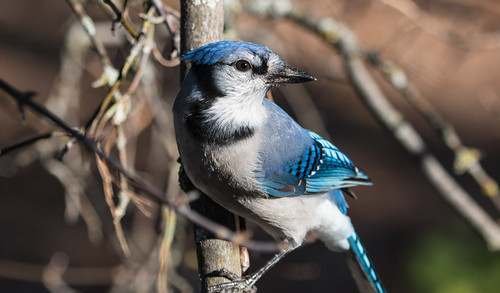
There may not be any other recent research breakthroughs about Nature’s Perfect Bird, but a long history of Blue Jay research has taught us a lot. I often hear from people who think Blue Jays are bullies at feeders, but those people are misinterpreting what they see. Songbirds scatter when a Blue Jay flies in, in part because the shape, with rounded wings and a long tail, is just close enough to that of a Sharp-shinned Hawk that no sensible bird wants to linger a split second to verify the identification.

Blue Jay

Sometimes Blue Jays make a Red-shouldered Hawk cry or other predator call before flying in, too. For one brief, shining moment when they land in the feeder, they have it all to themselves.

But once they’re eating, Blue Jays are not very assertive. In a study at Florida bird feeders, Red-headed Woodpeckers, Florida Scrub-Jays, Common Grackles, and gray squirrels strongly dominated Blue Jays, often preventing them from obtaining food. The jays have a longer reach than tinier birds, but are no more bullies against goldfinches than other goldfinches are. Their crest pops up when they’re being aggressive in territorial defense, protecting their families, or squawking because they just saw some form of danger. They usually keep the crest down while dining.

Blue Jays are among the most intelligent of birds, but are much harder to study in the wild than the more sedentary Gray Jay and Florida Scrub-Jay. Blue Jays are certainly noisier—they could squawk their heads off all day without scaring away their favorite food—acorns. The quieter, sneakier jay species eat much more meat. One strategy the Gray Jay and Florida Scrub-Jay share for getting meat is to steal it from larger animals. They are so quiet when they see large mammals, such as humans, because they want to sneak in and steal our food.

All jays sometimes raid songbird nests to take eggs or young. Most species eat the plunder themselves as well as feeding it to their young. Fully 88 percent of a Gray Jay’s food is animal-based. You can't see Gray Jays in late spring and early summer without lots of littler birds anxiously trying to chase them away. But an adult Blue Jay’s diet is 88 percent plant-based, so it doesn't need to eat baby birds. Its rapidly growing babies do need animal protein, so virtually every bit of the baby birds a Blue Jay steals goes to feeding its hungry nestlings. Meanwhile, the Blue Jay habit of squawking conspicuously at potential predators provides an important neighborhood watch service for the whole community, so other songbirds never trying to chase a Blue Jay away unless it’s actively approaching a nest.

So Blue Jays are not as bad as some people think, and of all the birds in the known universe, they're the only one about which Mark Twain wrote an entire story, "Baker's Blue Jay Yarn." For the past 30 years, For the Birds' own Jim Baker (voiced by my treasured friend John Keenan) has been helping me share that connection between Blue Jays and good humor. Whether it's National Blue Jay Awareness Month or not, it's always a good time to smile, and Blue Jays can give us plenty of reasons for that.

Katie and baby jay

Wednesday, March 7, 2018

Apple's Windows

Vikings Poster

When I started working at the Cornell Lab of Ornithology, I had to switch from a PC to a MacBook in order for my design files to be compatible with those of Cornell’s designer. It was a hard transition, and I hear going the reverse is even trickier, so I’ve long known that Apple users have problems with Windows. A news story this week explains how Apple employees can even be physically injured by windows.

The brand new building housing Apple’s headquarters in Cupertino, California, designed by architect Norman Foster, is surrounded by 45-foot tall curved panels of “safety glass,” named not because it’s been designed in any way to prevent humans, birds, or anyone else from crashing into it, but because it crumbles when broken. The workspaces inside Apple’s building, called “pods,” are also made with a lot of glass.

In the same way that knowledgeable people warned the designers of the US Bank Vikings Stadium that it was going to kill lots of birds, Apple was warned by contractors that a building made almost entirely out of glass could pose health and safety risks to human beings. And sure enough, employees have been crashing into those transparent walls. Some news sources say that a few employees put post-it notes on the glass to make it more visible, but those keep being removed so they don’t detract from the building’s aesthetics. I personally think that injured people and hurt and dead birds detract from the overall aesthetics of any environment, but apparently corporations and some architects have more tunnel vision when it comes to the meaning of aesthetics.

This isn’t the first time Apple has had to deal with people crashing into glass, either. In 2011, an 83-year-old woman walked into the glass wall of an Apple store, breaking her nose. She sued the company, arguing it should have posted a warning on the glass. The suit was apparently settled without cost to Apple, according to a legal filing in early 2013. Again, the bottom line for corporations usually wins over living, breathing human beings, and much more so over birds. When birds collide with glass, they never get a legal filing at all. 

Dr. Daniel Klem has devoted his entire career to researching the issue of birds colliding with windows. He was first to realize and to publish his findings that somewhere around a billion birds are killed by windows every year in the United States alone. Many prominent, well-funded ornithologists and organizations pooh-poohed his findings until their own research verified his work.

People haven’t focused that much research into humans colliding with glass—we know it happens, and because normal people think that’s a bad thing, we usually take precautions to make sure glass is visible where people are likely to be coming and going. It’s depressing that we don’t take reasonable precautions to protect birds from collisions, but absolutely shocking that a huge corporation puts a silly concept of aesthetics above the safety of their own employees and customers. I hope that Apple’s human casualties finally open some architects’ and corporations’ eyes to the hazards of glass.

Tuesday, March 6, 2018

Favorite Bird #1: Lisa's Gray Jay

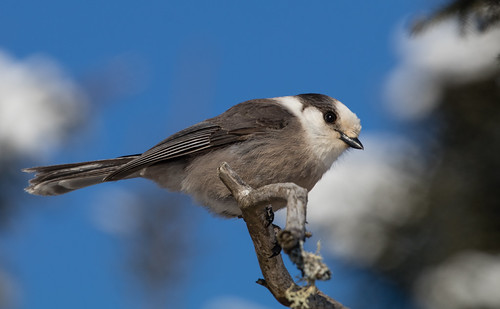
Gray Jay

For more than thirty years, since I started producing For the Birds, I’ve wanted to make it more genuinely interactive for listeners. How I wish I had an affordable way to record phone calls in my home studio! I don’t get any financial support for producing the program or podcast, and can’t get to the KUMD studio too often to use their equipment. I’d love to take questions from listeners, hearing their voices rather than just reading their letters on the air. I’d also love to hear about people’s favorite birds. Birds touch our lives in so many different ways, and there are so many different kinds of birds, that hearing what birds are the favorites of different people can broaden our own appreciation.

Some day I’ll figure out how to record back-and-forth conversations with listeners, but for now, I can at least accept sound files emailed to me at favoritebird@lauraerickson.com, or voicemail messages on Lisa Johnson's KUMD number's any day after 2 pm Central Time: 218-726-6755. Give your first name, and say what your favorite bird is and why. Recordings should run 15-30 seconds or so.

And speaking of Lisa Johnson:
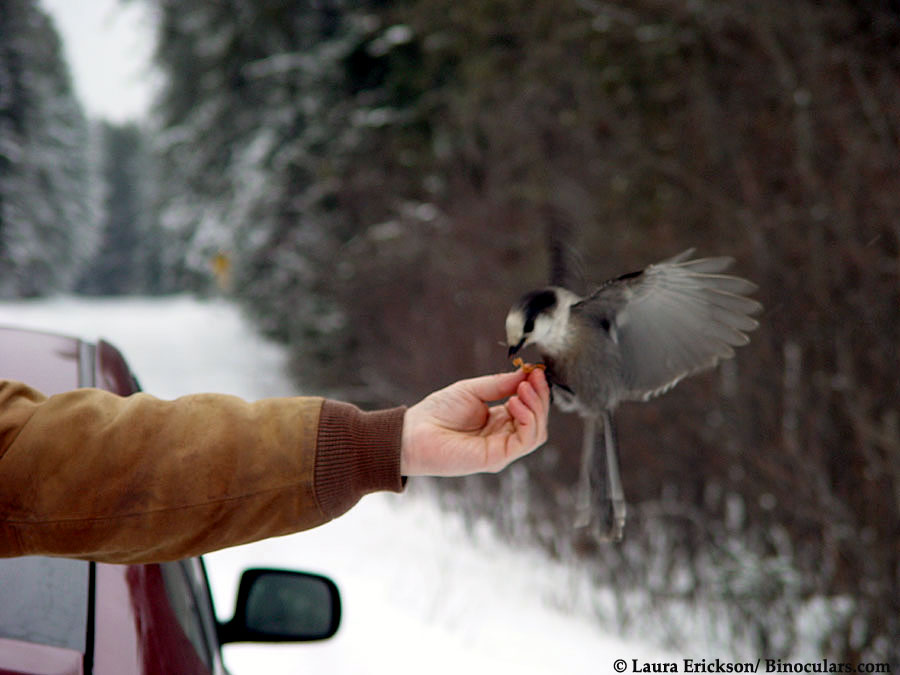
Hey, Laura, It’s Lisa. I think my favorite bird is the Gray Jay. They’re friendly, they’re fun, they come flying in really low and slow and they get right up close so you can get great photos, and they really seem to appreciate a good premium dog food. 
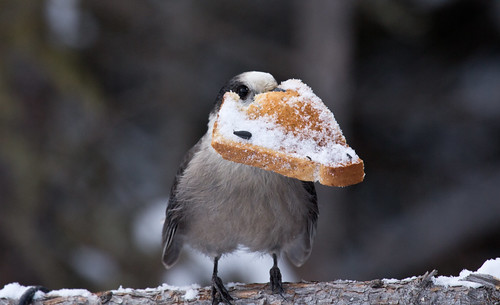
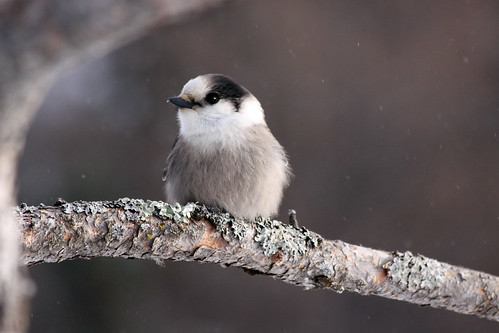
Gray Jays, which look like chickadees on steroids and fly in on silent wings like the ghosts of our northern bogs, are one of my own most treasured birds. I’ve felt singularly bereft on the rare occasions that I’ve not seen one during a visit to the Sax-Zim Bog. As Lisa notes, Gray Jays depend in part on animal-based foods, and quality dog food can be a healthy addition to their diet. Peanuts and peanut butter are other favorites.

Gray Jay

Naturalists at Algonquin Provincial Park have learned that those Gray Jays that approach and take food from people seem to survive longer and raise young more successfully than Gray Jays that avoid us. The researchers don’t believe this is because the jays actually need the particular foods we offer or that anything we give them is higher quality than what they can get in the wild—the researchers think it’s simply because those Gray Jays that check us out and know how to capitalize on the food we carry about, whether they’re living up to their nickname “camp robbers” or taking handouts, seem more curious and adaptable than the jays that don’t. Curiosity and adaptability are important qualities for any omnivore, especially one that spends most of the year in a hostile, frigid environment.


Gray Jays are nesting right now, even as winter will be hanging on for several weeks more. They can nest so very early because they’ve been hoarding food—mostly bits of fruit and meat, since autumn. They coat each wad of food with saliva, and then tuck it into a wedge of tree bark or other hidden place.

Unfortunately, winter thaws and warm spells, which are increasingly common with climate change, cause a horrifying phenomenon for them that the Algonquin park researchers call “hoard rot.” Those of us who have had to throw food out after a power outage should be able to sympathize.

Careful long-term studies at the park have shown that the Gray Jay population there has declined by 50 percent since the 1970s, in large part because the jay’s reproductive rate drops dramatically in warmer winters. In particular, the jays have completely disappeared from areas with lots of maples, but are holding out more strongly where black spruce is prevalent. Scientists think that black spruce bark provides more protection from rot than other hoarding substrates. Unfortunately, black spruce is also vulnerable to warming trends. The Living Bird, the Cornell Lab of Ornithology’s quarterly magazine, has a wonderful article about Gray Jays in the current issue, titled “Spoiler Alert: Can Gray Jays Survive Warmer Winters?”

Gray Jays are also in the news right now because the American Ornithological Society is considering changing their name back to Canada Jay, the first official name given to what ornithologists call the “nominate subspecies.” Canadians of course approve of this for their beloved corvid. Some argue that because there’s a Blue Jay, Green Jay, and Brown Jay, the name Gray Jay makes sense, but then again, there’s also a Mexican Jay, a Yucatan Jay, both California and Florida Scrub-Jays, and other geographic names. Canada Jay is the name in my trusty old Audubon Land Bird Guide and the life history by Arthur Cleveland Bent, too.

I don’t really have a preference between Gray and Canada Jay—I’d prefer giving primacy to the name used by Cree First Nations people, wisakedjak, which means the trickster spirit of the forest and is where the nickname "Whiskey Jack" comes from. By any name, Lisa’s favorite bird is a splendid one deserving of our respect, concern, and protection.

If you have a favorite bird you’d like to share with our listeners, let me know your first name, what the bird is, and why. You can either attach a 15-30 second or so sound recording to an email sent to favoritebird@lauraerickson.com or as a voicemail message, ANY DAY AFTER 2 PM CENTRAL TIME at 218-726-6755, Lisa Johnson’s number at KUMD.

Gray Jay

Friday, March 2, 2018

Laura's Best Bird EVER! Chapter 2. Black-capped Chickadee

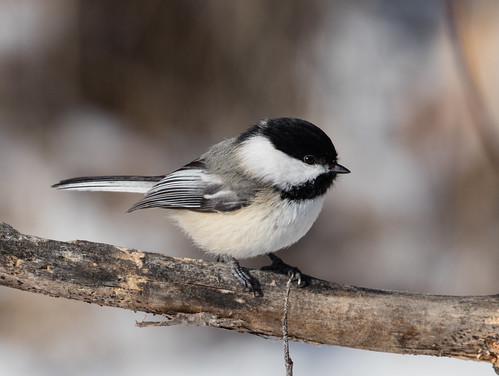
Black-capped Chickadee

Yesterday I inaugurated my Best Bird EVER! ™ series talking about the very first Blue Jay I ever saw. Even though this is National Blue Jay Awareness Month, March 2 is Chickadee Day for me, because it’s the anniversary of the very first Black-capped Chickadee I ever saw. Most of Laura’s Best Birds EVER! ™ weren’t lifers—something more important than just being the first time I ever saw one made them memorable. But the very first day I set out with my first field guide to try to find a bird was a make or break situation, and one cooperative little individual inviting me into the world of birding made all the difference.

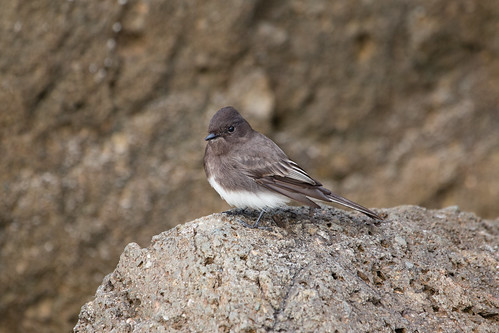
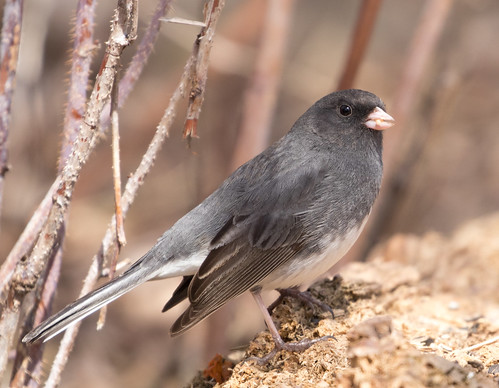
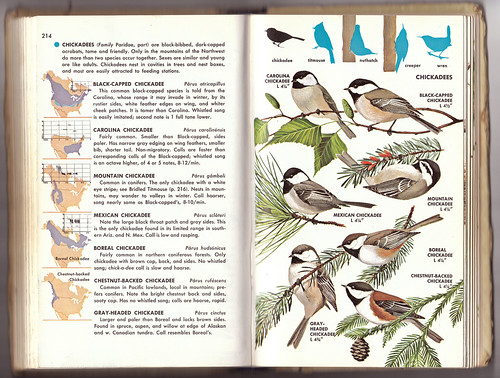
Russ’s mom gave me my first field guide for Christmas 1974—it was the Peterson guide, and I read it cover to cover. Then I bought and read the Golden Guide cover to cover. That was information overload. In the middle of the Golden Guide, I saw a slate-colored bird with a white tummy and white outer tail feathers. I thought that plumage was wonderfully distinctive, and that it would be impossible to mistake the Black Phoebe for anything, but toward the end of the book, there it was again, only it was now called the Slate-colored Junco.

Black Phoebe

Dark-eyed Junco

Reading the text, I could see that the Black Phoebe wagged its tail and that its black bill wasn’t shaped like the pinkish, conical bill of the junco, and the map for the Black Phoebe showed it didn’t come anywhere near Michigan where I lived, but it was disconcerting to say the least to see that birds that had such a similar color pattern could be entirely unrelated. I could also see that loons and grebes, which sure looked like ducks to me, and coot and gallinules, were far apart, in different directions in the book, from the ducks; that the herons and cranes were spaced far apart but looked similar; and that the gulls and terns looked a lot like seabirds that were in entirely different sections. I had no idea how anyone could learn them all. 

I finished the books in late February and set out on March 2 to start birding. I went to Baker Woodlot on the Michigan State University campus, and spent a long time—at least a half hour and probably closer to 45 minutes—searching for a bird. It’s funny to think back from this vantage point, when I can hardly step out of my car anywhere in the Midwest without hearing at least one bird. Until natural sounds became distinct voices for me, they were just part of a general soundtrack of the outdoors that I’d never made sense of.

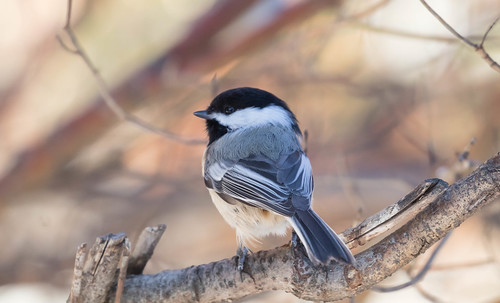
But I walked here and there on the trails, and finally, there it was—a bird! It was very active, flitting from branch to branch, and tree to shrub. I was pretty sure it wasn’t going to be in the first half of my Golden Guide, but didn’t feel confident of that, so I started at the very beginning and rifled through the pages. In the middle, I found a whole page of birds that looked almost identical, and just like my little bird, which stuck around, still flitting about close by. Those birds were all called “chickadees,” but what if there were other birds with black caps and throats and white cheeks? I stuck my index finger in the page and kept going just in case.

GoldenGuideChickadee.jpg

But there weren’t any other birds like this one, so I went back to the chickadee page. The Mountain Chickadee had a line through its eye, the Boreal Chickadee had a brown cap, the Gray-headed Chickadee had a gray head while mine had a shiny black cap, and the Chestnut-backed Chickadee was rusty brown, not gray on the back. So that left me with three choices. Fortunately, my little bird was sticking around while I studied the book. The Mexican Chickadee lived too far away.

But how could I pick between the Carolina Chickadee and the Black-capped Chickadee? I was in southern Michigan, which seemed further north than the range of the Carolina Chickadee, but the map didn’t show state lines, and these were birds, so I presumed they could fly about if they wanted—indeed, the description of the Black-capped Chickadee said that the ranges could overlap in winter. One hint of the Black-capped that the book mentioned was “It is tamer than Carolina,” and my little bird sure seemed tame, sticking right by me still. But most of the differences seemed both subtle and requiring familiarity with both in order to decide—the Black-capped had “rustier sides, white feather edges on wing, and whiter cheek patches.” That seemed pretty subtle and tricky. 

Based on the descriptions, I could have easily chosen between them had my bird sung the Hey, sweetie! song, but it didn’t. It did make a lot of chickadee-dee-dee calls, and according to the book, the Carolina Chickadee’s “Calls are faster than corresponding calls of the Black-capped.” I couldn’t hear both to make a determination, but I listened hard the whole time my little bird stuck around, and when it finally flitted off into the woods, I raced along the path back to my car and headed straight to the university library to listen to recordings. For certain, it was a Black-capped Chickadee, Number One on my lifelist.

How could my first experience teasing out a bird identification have possibly been better? Every time I flipped through my book, I grew a bit more familiar with the layout and the possibilities. To figure out my first one, I needed to use the maps, plumage descriptions, descriptions of songs and calls, hints about behavior from both the text and noticing how the various chickadees perched in different ways in the illustrations, and also learned to use the university’s listening library. I couldn’t have been certain about my first bird’s identity had it not been so cooperative, sticking by me as I went through that long, deliberative process. At the time, I didn’t know a single experienced birder, so when I did figure it out, there was no one to ridicule my ignorance, taking so long to figure out a simple chickadee, and meanwhile, there was that memory of the friendly little bird chickadee-dee-dee-ing so close to me for so long, the most patient teacher in the world, as if it was specifically trying to welcome me into the world of birding.

From the very start, chickadees were far more than just a bird to identify and add to my lifelist. That very first chickadee I ever saw seemed cheerful and friendly and somehow almost as interested in me as I was in it. Throughout that first spring and then the rest of the year, and for the 43 years to follow, just about every time I went out birding anywhere in that great big range where Black-capped Chickadees live, I could find them. This was a bird I could count on, through thick and thin, as I embarked on a lifetime of birding. And it all started with one approachable, friendly, and welcoming individual. Yep. That first Black-capped Chickadee was Laura’s Best Bird EVER! ™

Thursday, March 1, 2018

Laura’s Best Bird EVER! ™ Chapter 1. Blue Jay

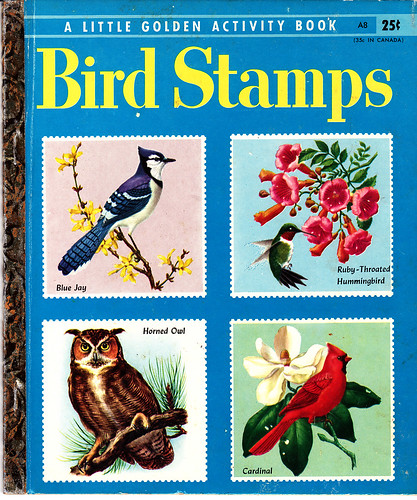
Little Golden Activity Book: Bird Stamps

When I was seven years old, during the summer before I started third grade, my family took a vacation in Williams Bay, Wisconsin, on Lake Geneva. We stayed in a little cottage in a neighborhood full of cottages, many owned by Chicago firefighters. Some of them rented out the ones they owned, usually to other firefighters like my dad.

Before we left, my dad told us we were going to take a vacation in the country. I was skeptical, because that’s also what he’d said before we moved from the city to our blue-collar suburb. To me, going to the country was supposed to mean that you could see cows, and there were no cows at all in Northlake. But this time my dad was right—on the way to Lake Geneva, we really did see cows!

Of course right in Williams Bay, there were no cows, and the cottages were more closely spaced than the houses in my blue-collar suburb. I was hoping to see more birds than I’d seen in Northlake so far. I didn’t have binoculars—my mother had told me that only soldiers, spies, and peeping toms had those—and I didn’t know how to search through branches to find birds anyway.

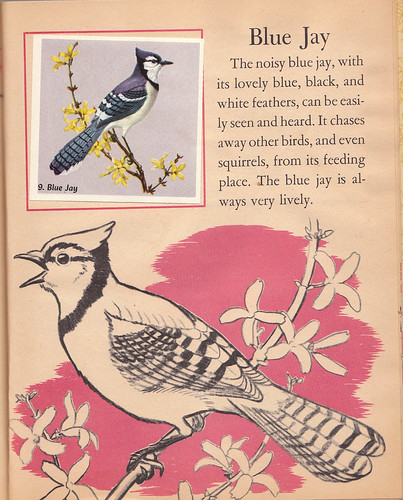
But one morning I heard a squawk, looked up, and lo and behold, there was a Blue Jay! I saw the exquisite plumage and the extraordinary crest, and knew exactly what it was, because the Blue Jay was one of the 18 birds in my “Golden Activity Book,” Bird Stamps. And not just any bird in the book—it was the very first bird depicted on the cover. I had so longed to see one, and now, here he was, yelling his head off, seemingly just as pleased to make my acquaintance as I was to make his.

Blue Jay page (Little Golden Activity Book: Bird Stamps)

Almost 60 years later, the thought of that moment is still seared into my memory. I never saw another Blue Jay throughout my entire childhood—the next one I saw was on March 23, 1975, in Lansing, Michigan, three weeks after I started birding—it was #14 on my lifelist. That one was pretty wonderful, but something in my throat, and in my heart, still seems to catch when I think of my very first Blue Jay. When I remember the thrill and elation I felt, the joyous sense of accomplishment that I’d identified it all by myself from my precious Bird Stamps book from my Grandpa, the vividness of its plumage and exuberance of its call—all this gives me a sense of certainty that that Blue Jay was my Best Bird EVER! ™ (I'm going to pretend I have an actual trademark on this phrase.)

Since that memorable day so long ago, I’ve seen over 2,000 species, including a few of the rarest birds on the planet, such as the California Condor and Horned Guan; some of the most spectacular ones, such as the Cuban Tody and Resplendent Quetzal; some birds with the coolest sounds, such as the Willow Ptarmigan and Winter Wren. I’ve seen birds at moments when I desperately needed a beautiful natural interlude, such as the four Buff-breasted Sandpipers that appeared like a vision on my first walk after my father’s funeral, or the Evening Grosbeak flock that Russ and I awoke to the morning after his first painful night at home from the hospital after cancer surgery. Russ had loved Evening Grosbeaks since we moved to Duluth—they were always in the yard as our children played—and now they provided balm to his soul and mine for the next five weeks, a constant presence in our yard right when we needed them most. That flock was definitely the Best Birds EVER! ™

And that’s exactly the thing about the Best Bird EVER! ™ Whether it’s an individual bird or a whole flock, it stirs your soul in a way you'll never forget. That very first Blue Jay in Lake Geneva was the first of many Best Birds EVER! ™ for me. It wasn’t even the last Blue Jay among those memorable birds, either.

The one thing rarer than a blue moon is a month without any full moons at all, which February 2018 was. That means that even though it was National Blue Jay Awareness Month in January, we’re starting another National Blue Jay Awareness Month today, because like January, March will also have a blue moon. So this month I’m starting a personal project called Laura’s Best Bird EVER! ™ In upcoming programs, I’ll feature several more individual Blue Jays that managed to touch my soul in deeply spiritual or magical ways. And I'll talk about a few Best Birds EVER! ™ that aren't jays at all. National Blue Jay Awareness Month won’t come again until October 2020, so I plan to enjoy this special one while I can.

Tuesday, February 27, 2018

Olympic Gold and Duluth's Curling Club!
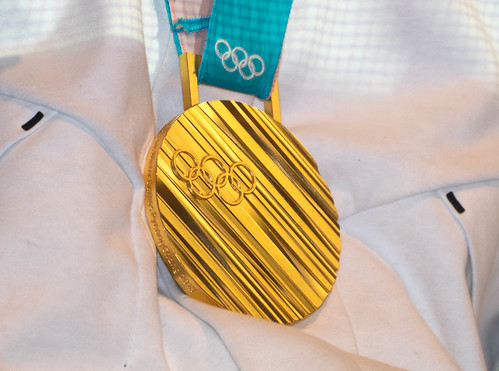
Olympic Gold!
All that glitters is not necessarily avian.
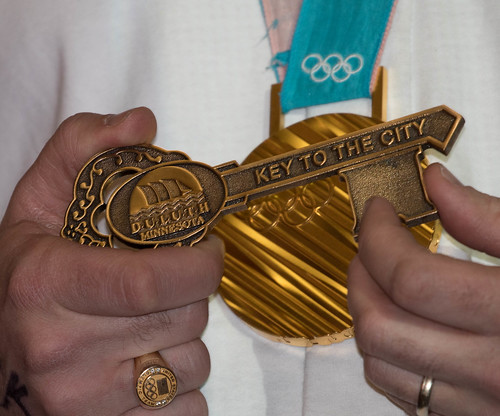
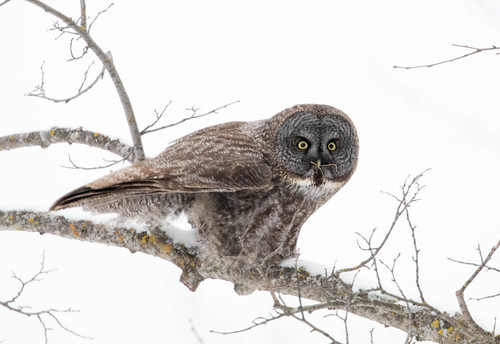
Today the City of Duluth, the City of Superior, the Duluth Entertainment and Convention Center, and the Duluth Curling Club honored the Olympic champions, so Russ and I went to the DECC to see them. It was wonderful fun.

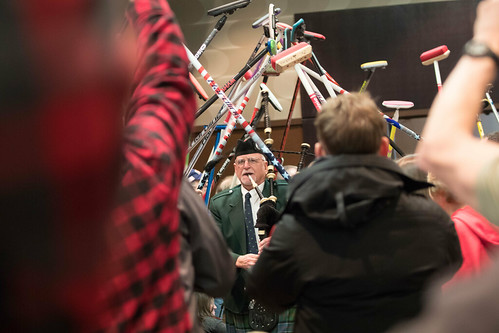
Bagpiper leading in the team
The curlers were ushered in by a bagpiper under a canopy of curing brooms.

John Shuster

Joe Polo

Tyler George and John Landsteiner

Chad Salmela
Chad Salmela, who announced some of the sports for NBC.

Superior Mayor Jim Paine and Duluth Mayor Emily Larson
Superior's and Duluth's mayors made a proclamation.

Duluth Mayor Emily Larson and John Shuster

Key to the City of Duluth

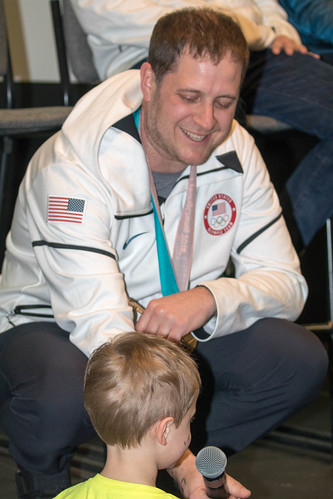
John Shuster and his son
John Shuster's son led the crowd in chanting USA!
Laura talks to John Landsteiner
Proof!

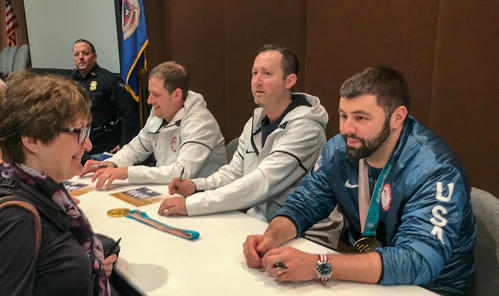
Autographs from the Curlers!
They handed out these photos for free so we could get them autographed!!
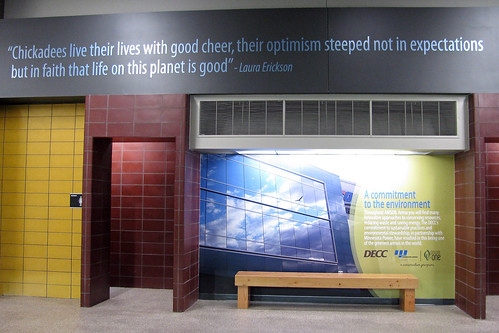
I have a very minor link to the Duluth Curling Club. Their official home is at the Duluth Entertainment and Convention Center (DECC) where this celebration was held. The DECC has a quote by me as part of the permanent decor!!

DECC AMSOIL Arena

Monday, February 26, 2018

Of Lifer Owls and Extraordinary Sporting Wins

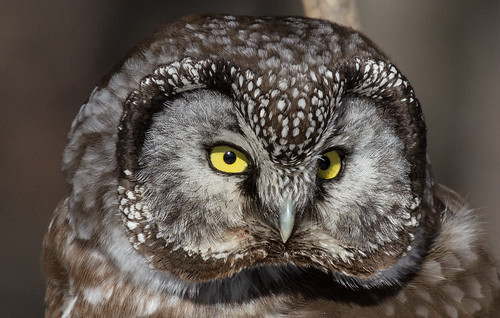
Boreal Owl

Just about three years ago, on March 20, 2015, I drove down to Chicago to pick up my new puppy, Pip. As I walked to the car from the breeder’s house, Pip in my arms, we passed a tree with a singing House Finch, and Pip looked up through the still-bare branches to see him. That was the number one bird on her life list, and her interest in the little guy seemed an auspicious start to our life together. That first day, just paying attention between the breeder’s house in Park Ridge and my sister-in-law’s house in Chicago proper, we got Pip’s lifelist up to ten, and by the time we made it home two days later, it was at 33.

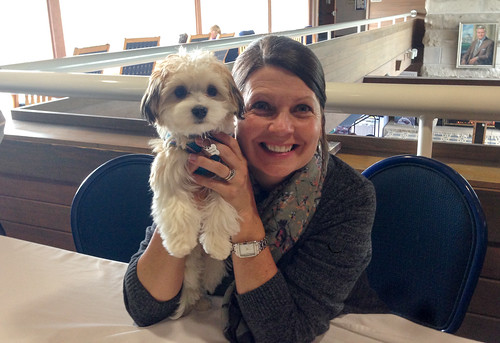
Pip's first day with me!
Pip just after adding her first bird to her lifelist.
I was still recovering from my heart attack, which had happened just five weeks before, so I wasn’t very active birding that first spring with her, but the day after we got home from Chicago, crows yelling their heads off alerted us to a Great Horned Owl just three doors down. That was the first owl on Pip’s lifelist, and being so close to our yard, it reinforced my commitment to stay with Pip any time she went out after dark. (Now as an adult weighing 9 pounds, Pip weighs almost twice what the heaviest Great Horned Owl on record weighs, and more than twice what one of their favorite prey, snowshoe hares, weigh, but when she was a three-pound puppy, she’d have been easy pickin’s. Even at full weight, she’s small enough that she could be killed easily by a Great Horned Owl, but too heavy for it to carry her off. An owl would have had to eat her on site.)

The week after I brought Pip home, we saw the other large owl that could make an easy meal of her—a Snowy Owl in Superior. It was more than a month before Pip saw another wild owl—an Eastern Screech-Owl in Ohio during the birding festival called the Biggest Week in American Birding. She was already familiar with screech owls because of my little Archimedes, but the Ohio bird was her first in the wild.

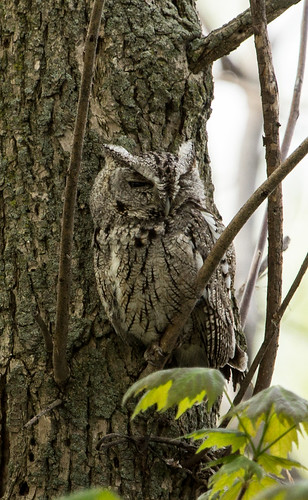
Eastern Screech-Owl
I saw this Eastern Screech-Owl at the Magee Marsh the year before Pip was born. But it COULD be the one she saw, too. 

Pip added lots of birders as well as birds to her lifelist in Ohio.

Pip and her Uncle Drew
J. Drew Lanham and Pip are good friends! And Pip got to hear his voice this December on the radio when Drew and I were guests on Science Friday!

Kim Kaufman and Pip!
Kimberly Kaufman and Pip

Pip and I didn’t see another owl until that September, when a saw-whet was calling and hunting in my backyard one evening. And then we went more than a year before Pip added another owl to her lifelist. That was about one in the morning on November 3, 2016, the night my beloved Chicago Cubs won the World Series. The game was over at 11:47 pm, very late for me, but I was so elated that I couldn’t pull myself away from the TV for over an hour. When I took Pip outside, a Boreal Owl was calling away, and moving from one neighbor’s yard to another to my yard, apparently actively hunting. My education owl Archimedes was trilling in response. Nature itself approved of the Cubs finally winning, and Pip was still wearing her little Cubs jersey as she added this splendid lifer.

Pip loves her Cubbies!

That was it for owls on Pip’s lifelist until just this week. On Monday, February 19, exactly the day the Duluth Curling Club, a.k.a. Team U.S.A., started winning games in the lead-up to Olympic Gold, Pip started seeing owls again. That is when we went birding with my friend Susan Szeszol.

Susan Szeszol with me and Pip.

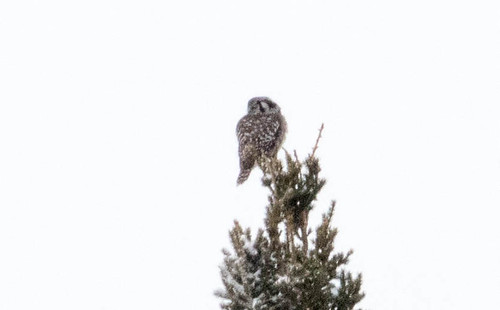
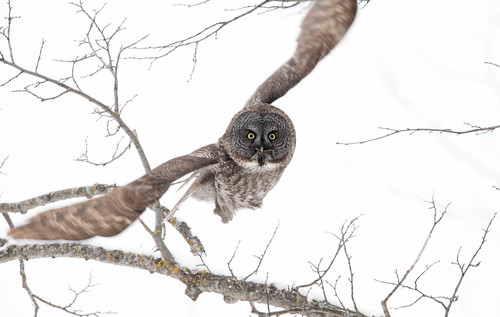
Susan had come up from Chicago to the Sax-Zim Bog Winter Birding Festival, but with a delayed flight, she missed her Saturday field trip. On her Sunday bog field trip, during the snowstorm, she saw a Boreal Owl but didn’t get to see Northern Hawk Owl or Great Gray Owl. So on Monday morning, Pip and I took her birding closer to our own neck of the woods, where we found both of those two owls. The hawk owl was too far away for good photos...

Northern Hawk Owl

... and the great gray flew too quickly...

Great Gray Owl

Great Gray Owl

... but nevertheless they were lifers for both Susan and Pip. Tragically, I forgot all about my practice of serving brownies after seeing owl lifers.

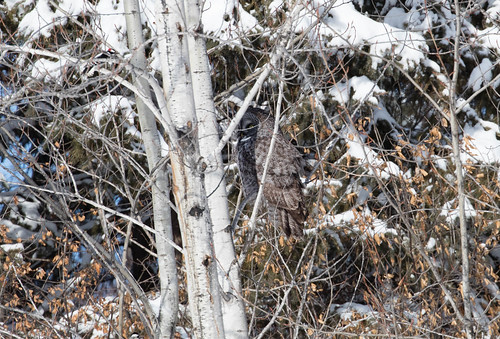
Then on Friday, I heard crows cawing somewhere nearby and took Pip to check it out. We found another Great Gray Owl, this one barely photographable, roosting in the aspens across from St. Michael’s Church.  Those noisy crows, intrepid little chickadees, a couple of Downy Woodpeckers, and a Red-bellied Woodpecker bombarded it as it sat tight. I didn't get any photos showing the actual bombardments, but if you look carefully above and to the left of the owl, you can see a Downy Woodpecker raining expletives on the poor bird.

Great Gray Owl roosting in my neighborhood

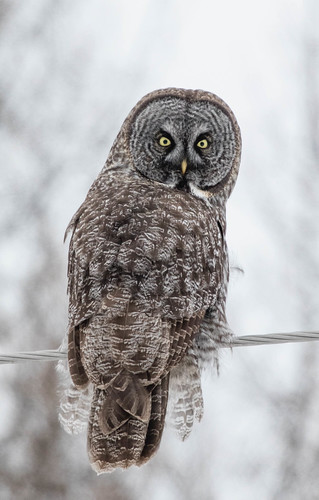
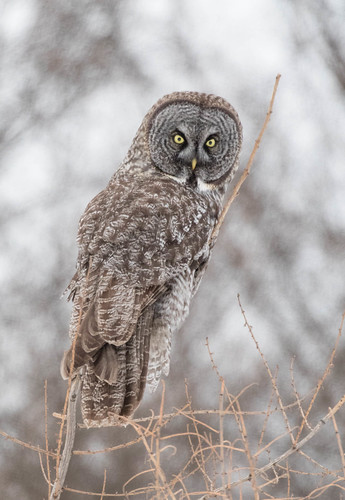
Then on Saturday, Pip and I went to the bog again. This time we got even better looks at a Great Gray Owl, on the power line on our side of Highway 7; after several minutes, it dropped to a lower perch for a while. Pip was fascinated—I think this was her best look at any owl ever except for Archimedes. I was so darned intent on photographing the owl that I didn't even think to take a photo of Pip watching it.

Great Gray Owl

Great Gray Owl

Apparently thanks to the Duluth Curling Club having just won the Olympic Gold Medal at 2 am that very morning, Pip and I also saw a Boreal Owl—a Boreal Owl seems to appear for Pip right after extraordinary achievements of our favorite teams. As with the owl after the Cubbies' win, I couldn't take a photo—too many people had hiked too close to the owl already. This time Pip wasn’t wearing a Duluth Curling Club jersey, but apparently whatever deity arranges these wonderful coincidences knew what was in our hearts. Susan had returned to Chicago with the northern owl trifecta. Pip had two lifers and now yet another acknowledgement that Nature itself approves of our beloved teams. That was a win for all of us.


Tuesday, February 20, 2018

Get a grip!

Ruffed Grouse

Birdwatching is like a box of chocolates: you never know what you’re going to get, but it’s certain to be sweet. That’s what I always say, and that was exactly what happened this weekend at the Saz-Zim Bog Winter Birding Festival. I’d brought my little birding dog Pip along because she needed a few lifers that have been appearing now and then, in particular the Great Gray and Northern Hawk Owls. We missed out on them in the bog, but did get one really cool and unexpected treat.

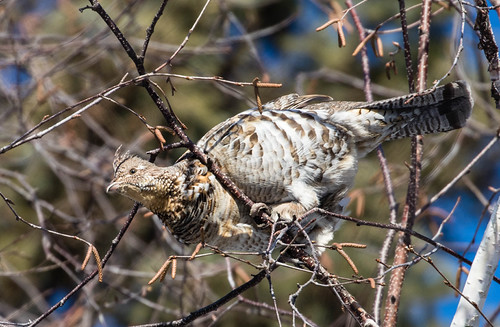
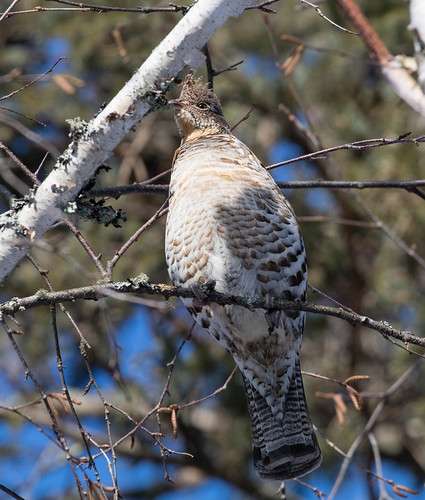
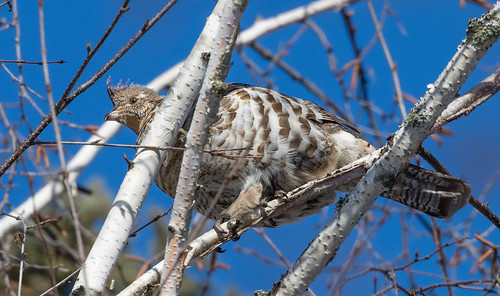
I spent Friday and Saturday nights with my good friends Gail and Chuck Prudhomme in Meadowlands, and headed out Saturday morning with Pip to go birding on our own. But before we even made it to the car, I spotted a Ruffed Grouse in a birch tree. The sun was shining as I aimed my camera toward it and started clicking away. I ended up with a series of detailed photos at close range, showing the grouse eating buds, its feet gripping branches and even small twigs—easily my best Ruffed Grouse photos ever.

Ruffed Grouse

Ruffed Grouse

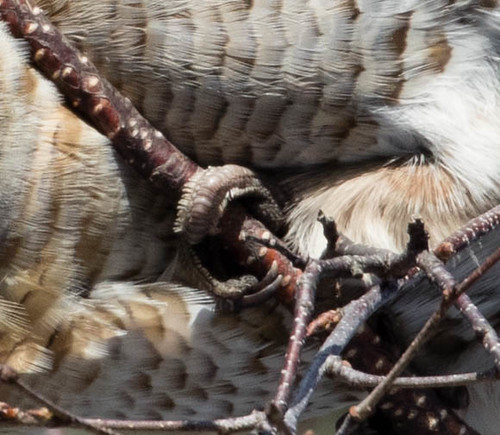
Up until Saturday, I’d seen grouse feet at close range only in museum drawers, but those feet are so fascinating in life that I was thrilled to have a close-up view of them in actual use.

Ruffed Grouse toe pectinations

Every year in mid-September, long, stiff projections start growing from the scales on the sides of grouse toes. It takes about three weeks for these growths, called pectinations, to reach full size. Those growths fall off in the spring—usually in late April or early May, but sometimes as early as late March.

The stiff pectinations greatly expand the surface area of the grouse’s feet, so are usually explained as “snowshoes,” because they presumably help Ruffed Grouse walk on the surface of deep snow without sinking. Gordon Gullion had another explanation which makes sense, too—he believed that the pectinations help the grouse grip icy branches while feeding on buds.

The two explanations both seem not just plausible but equally important for grouse survival in their range, where winter weather includes both ice storms and deep snows, in the same way that my good winter boots have grippy soles for walking on ice and are high enough for walking in deep snows. It’s nice to have foot coverings that do the job no matter what the weather throws at you.

Like most birds up here, grouse plumage is thicker in winter than in summer—they lose feathers in spring before they start replacing them. The ones up here are well feathered on their tarsi—what we intuitively but not quite accurately call their legs. My photos show that thick feathering, too. They can also take refuge from cold and wind under a literal blanket of snow when that is available.

One of the Ruffed Grouse’s most important winter adaptations isn’t visible on the outside—two blind offshoots where the large and small intestines meet, where our appendix is, called caeca (or ceca), grow enormous in winter. Within the caeca, digestion of aspen and birch buds takes place thanks to anaerobic bacteria that produce an enzyme to break down cellulose in the woody tissue. In spring, when the diet changes to more digestible leaves, fruits, berries, and insects, the caeca shrink.

So surviving winter is, for Ruffed Grouse, a literal as well as figurative matter of intestinal fortitude. It’s hard to say whether their special foot adaptations help them maintain their emotional equilibrium in winter, so I don’t know how well those pectinations help them, in the figurative sense, to get a grip. But sometimes a literal grip is all anyone really needs.

Ruffed Grouse