Laura Erickson's For the Birds

Tuesday, May 1, 2018

Basal Cell Carcinomas: an Occupational Hazard of Birding

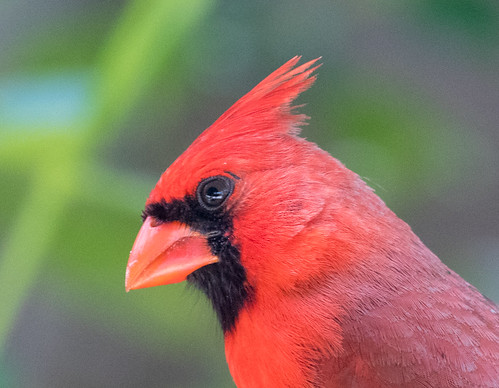
Northern Cardinal

Every now and then I wish I were a bird. Not so I could fly high in the sky, above the clouds, or look down upon the world from an aerie—I’m scared of heights. Of course, being a bird might put an end to that, but flight is not why I envy birds. 

I envy them for their feathers, especially the skin protection feathers afford. Those of us poor, bare forked animals out on Lear’s heath can get too cold or too hot without the insulation feathers afford; we can get soaking wet without the rain resistance of well maintained plumage; and we can get skin damage without a covering of feathers to protect us from the sun. Once baby birds feather out, they are usually well protected except for those poor unfortunate Blue Jays and cardinals that molt all their head feathers simultaneously. 

I’ve just about always been careful about using sunscreens and sunblock, and almost always wear a hat. Even if sometimes it’s just my Cubs baseball cap, it still has a nice shading brim, and more often I wear my Tilley wide-brim hat. Protecting myself from sun isn’t a recent habit—I burn easily, never enjoyed sunbathing, and you can count the number of times I’ve worn a swimsuit on a beach in my entire lifetime with the fingers on one hand. But for any birder, sun exposure is an occupational hazard, and that’s even more true for a bird photographer. No matter how much sun block I put on my nose, and no matter how often I put it on, it smears off on my camera. That’s one reason I like my Canon 80D rather than one of their more professional lines—it has a swivel LCD screen, which I can keep closed while shooting so I don’t damage it. But that protects my camera, not my nose. When I had breast cancer, a genetics-screening showed I have what’s called the ATM mutation, which is associated with several cancers. It seems to make it harder for cells to repair themselves after minor damage, such as radiation, so I may just be genetically more vulnerable. 

So far, ironically, my nose hasn’t developed skin cancer. I had two basal cell carcinomas removed in December 2014, one along the hairline on my forehead, in an area that has always been covered by my thick Irish hair as well as a hat, and one next to, but not on, my nose. Then last month during my routine annual checkup, my dermatologist found another one, this one in the narrow area between my nose and my lip. These were all easily and safely removed via what’s called Mohs surgery. The procedure, which is rather like mining for cancer cells, removes a layer where the cancer was detected, and based on what shows up in a microscopic examination, a second layer may be removed, and another, until the margins are cancer free. I had the procedure done on Monday morning, and my dermatologist had to go in a second time but only in one quadrant, and that was that. Even with stitching my face up, the whole thing was done by noon. 

I’ll have to be careful this spring and summer to protect the surgical site—I’ll probably wear a small bandage over the wound whenever I’m outside until I’m completely healed. We who love nature have to find our own ways of dealing with the sun. Hats and sunblock are of course vital. Birds do their best to help us, maximizing their singing around dawn rather than when the sun is highest and most deadly. Indeed, the worst time for watching and photographing birds is when the sun is highest, both in terms of how cooperative the birds are and in terms of how much glare the sun produces in our photos. I’ll keep on keeping on as long as my body lets me, and I’ll keep trying to take care of it on general principle—after all, it’s gotten me this far. Watching birds may increase my risks of skin cancer, but it’s also a major part of what gives my life joy and meaning. And any time of day at any point in our lives, that’s what really matters.
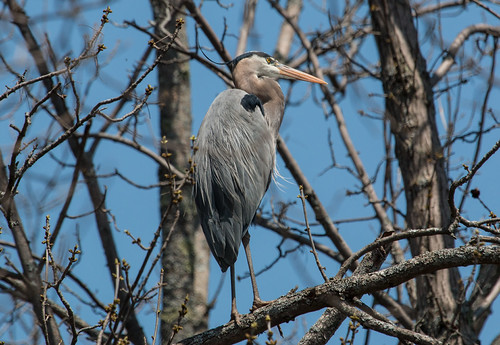
Listener Favorite: Steve Dahlberg's Great Blue Heron

"Dad" the Cornell Great Blue Heron

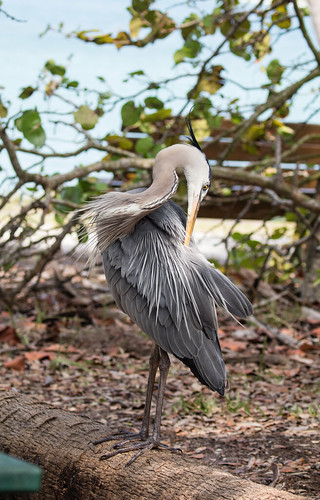
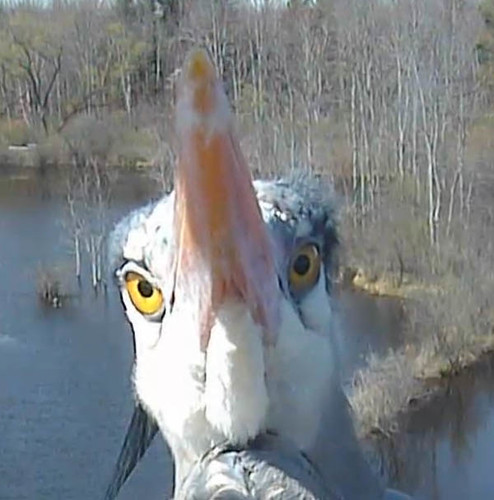
In 2009, when I was armed with my very first good camera and was working full time at the Cornell Lab of Ornithology, I took daily walks through Sapsucker Woods, photographing whatever I could. One particular Great Blue Heron was exceedingly calm around people, giving me lots of opportunities to take his photo, so I took hundreds. I loved parking myself on a bench or tree stump and just watching him, with his calm, Zen-like manner and patience. In every photo that showed his feet, I could see that he was missing his right hind toe and the claw from his left middle toe.

Great Blue Heron

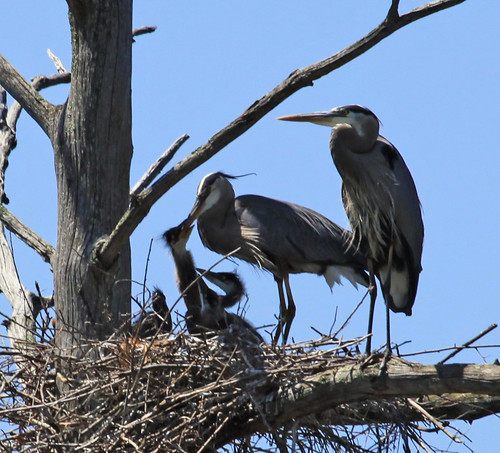
That same spring, someone sent out an email to tell us all that he’d just seen a pair of Great Blue Herons carrying sticks up to a big dead white oak tree in the middle of the pond right outside the Lab. We watched the male carrying up a LOT of sticks, one by one, delivering them to the female who simply could not wedge the sticks into the tree to stay—the oak was so old and had been worn so smooth that there were no little crevices to make it easier to wedge a stick in place. No one kept count, but the male brought in dozens of sticks, each falling into the pond. One time in apparent frustration he tried to show the female how it was done, but the issue wasn’t her skill, it was the tree itself. She gave him sort of an “I told you so” look—she'd have rolled her eyes if Great Blue Herons could do that—and off he went to find yet another stick. Finally, a stick stuck. Only a few more sticks dropped before a second stayed in place, and then they were in business.

Great Blue Heron family

I was fascinated, and spent the entire season photographing the pair and their four nestlings, all of which successfully fledged. Then in 2012 when I was back at home, the Lab installed a nest cam and I could watch the birds up close and personal. I have no idea whether the female was the same bird as in 2009, but I know the male was the same, because of that missing toe and claw.

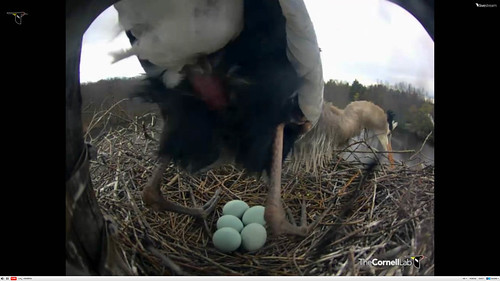
Great Blue Heron brood patch

He nested another few years before the nest came crashing into the pond along with the main weight-bearing branch, fortunately before any eggs were laid that year. Months later, he got into a fight with another Great Blue Heron, seemed injured, and never returned the next spring. I believe the final tally of young he successfully fledged on that pond during the time he was under our observation was at least 21. We have no idea whether he nested somewhere else before 2009, and also don’t know if he nested somewhere else after the nest blew down in 2015.

I’ve always liked Great Blue Herons well enough, but never grew fascinated with the species until I got to know this one individual—to see up close and personal how patient he was with his nestlings, and how he always dropped his fishy meals closest to the tiniest nestling to give the little guy a fighting chance; to see how he stayed on the eggs during a snow storm, not budging from sunset one night until late afternoon the next day, when he finally flew off, apparently to give a piece of his mind to the female, and then returned to the nest until she finally appeared. To know any kind of bird really well, learning how it negotiates life on this beautiful but fraught planet, is to love that bird. Last week I heard from Steve Dahlberg, who hears me on KAXE. What he wrote captures beautifully what makes this bird uniquely special:
Like many other listeners, it’s hard for me to pick a single favorite bird and there are lots of stereotypical ones I could pick.  The one I chose is the Great Blue Heron. There’s something about its majestic stillness when it hunts and its calm solo flights that has a profound effect on me whenever I see one.  I think they are the monks of the bird world, living always in the quiet eternity of the present moment.
Great Blue Heron

“The quiet eternity of the present moment.” That is so perfect, so apt for this particular bird, and something to aspire to in our own lives, at least occasionally. As I watch for my first Great Blue Herons of spring to fly in on deep, steady, patient wingbeats, knowing they’ll get here soon enough, I’ll practice being patient myself.

Great Blue Heron

Sunday, April 29, 2018

Spring Update

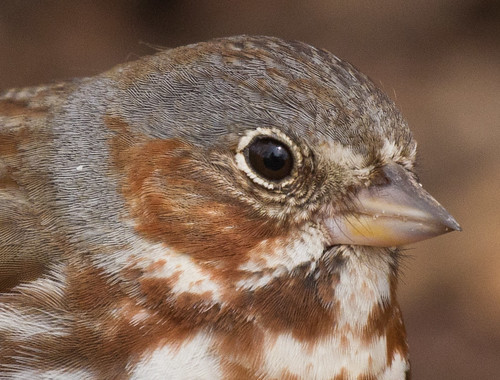
Fox Sparrow detail

Every year, with rhythmic if not quite clocklike predictably, my Facebook friends complain about the spring weather—there’s still too much snow, ice-out is taking too long, where are all the migrating birds? On the very same days that I read those posts, my Facebook friends post about how the snow is gone, the temps are reaching the 80s, and how they’ve got Carolina Wrens nesting on their porch again. Photos just yesterday ran the gamut from pock-marked snow and ice-covered lakes and a late Snowy Owl to blooming flowers, orioles, and hummingbirds. Of course, that’s because I have Facebook friends from all over. I smile not only at the predictable nature of spring migration but also at the predictable nature of our own reactions to the predictable unpredictability of spring.

It’s hardly news when a robin sings, or a chickadee carries nesting materials, or a White-throated Sparrow arrives in April, but there’s such a feeling of joy when we see it again for the first time each year, as if we harbored a deep-rooted fear that maybe this year no robins would sing, and no chickadees would nest, and White-throated Sparrows would actually disappear. Rachel Carson understood this deeply-rooted need for annual predictability and repetition when she wrote:
There is symbolic as well as actual beauty in the migration of the birds; in the ebb and flow of the tides; responding to sun and moon as they have done for millions of years; in the repose of the folded bud in winter, ready within its sheath for spring. There is something infinitely healing in these repeated refrains of nature, the assurance that night after night, dawn comes, and spring after winter. 
Spring to a nature-lover is like Christmas to a Santa-believing child—there’s such intense impatience during the waiting, then such intense magic, and suddenly it’s all over for another year. Up here we’re still a bit in the waiting stages, but when the floodgates open to hummingbirds, orioles, warblers, and Rose-breasted Grosbeaks, we can’t possibly take it all in before things settle back down as migration eases into the breeding season.

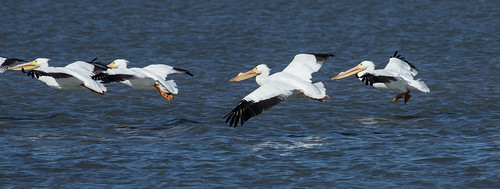
American White Pelican

My friend Lisa has been impatient for American White Pelicans; a listener named Richard Wright called her to report them arriving in Fond du Lac on April 22. We each have a few things we especially savor. I particularly relish hearing Fox Sparrows and Juncos singing. I’ve only had 3 Fox Sparrows and 30 juncos at most this spring, and very few songs, but to fill the void I’ve pulled out a recording I made in my backyard on April 21, 2011. That’s what I played in the background of today's podcast—just hearing it makes me very happy.

I try to savor each day as it unfolds. I am trying to be a more consistent eBird user. I kept track of every bird when Russ and I were in Florida last week, but I’ve been sloppier about it at home, even though keeping my backyard sightings on eBird can be lovely to look back on. Most of the spring migrant sparrows I love haven’t returned yet, but the number of juncos changes from day to day, from none all winter to a couple last week that I neglected to post on eBird, to 6 on Thursday, 15 on Friday, 30 on Saturday, and 10 on Sunday. On many years my junco numbers peak at a much higher number than just 30, but I don’t know how many are still south of here, so won’t know for at least a week if Saturday was the peak. Trying to stay in the habit of eBirding when my daily lists number less than 20 species is good discipline and practice for when migrants start rushing through. It won’t be long now.

Saturday, April 28, 2018

Some choices for notecards/prints

I'm creating notecards and 8x10 photos as premiums for people who have donated on my Go Fund Me campaign at appropriate levels. I have over 20,000 photos on Flickr, which can be a little overwhelming. Here are some choices:

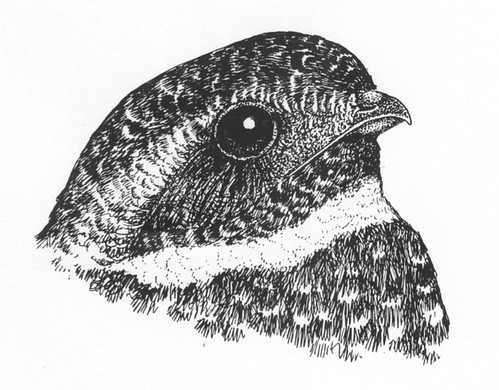
This isn't a photo: it's the drawing that Jeff Sonstegard did of my education nighthawk Fred for my first book (For the Birds: An Uncommon Guide). I bought the rights to it from Jeff when the book came out.

Fred the Common Nighthawk

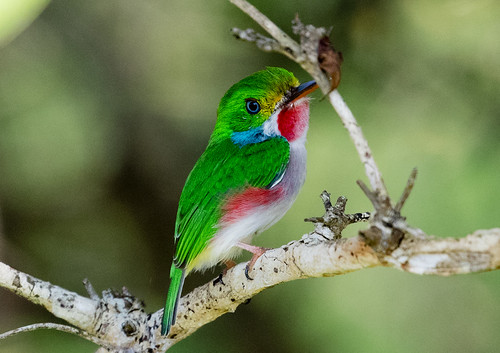
Here is the most adorable bird in the universe, the Cuban Tody. People who donate $5 or more are getting a 4x6 print, but I'll get notecards made of this, too.

Cuban Tody!!

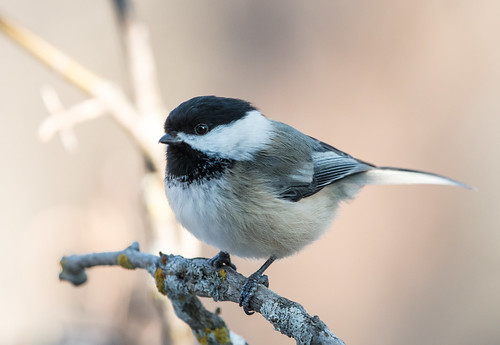
This isn't just ANY chickadee. This is my special guy--the chickadee who had an overgrown beak and was also missing its three front toes on its right foot. He nested across the street from me and successfully raised at least 5 chicks. (I watched three of them fledge!)

My little chickadee

And this isn't just any Great Blue Heron: This is "Dad," the wonderful male who built the nest in the pond outside the Cornell Lab of Ornithology while I was working there--the same male who raised five babies in that same nest in view of the cam in 2012, 2013, and 2014. This is the last photo I took of him, in spring 2015.

"Dad" the Cornell Great Blue Heron

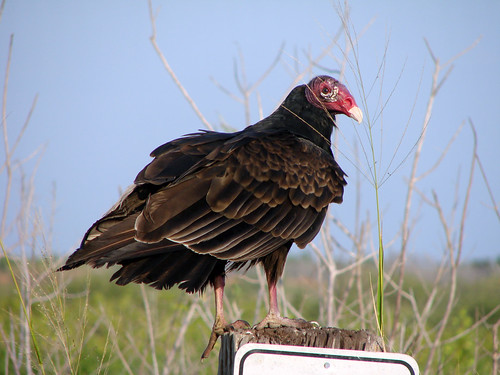
I have several Turkey Vulture photos, but something about this one appeals to me. He or she didn't seem to mind me photographing him/her in the least.

Turkey Vulture

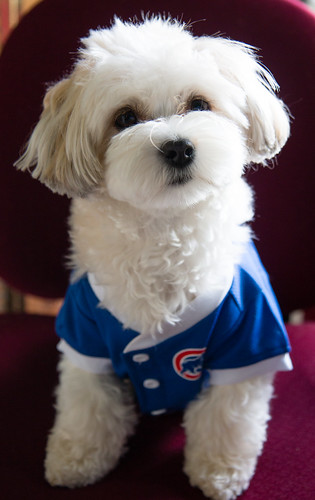
I have no idea how to choose a photo of Pip. Here are a couple of possibilities.

Pip waving

Pip loves her Cubbies!

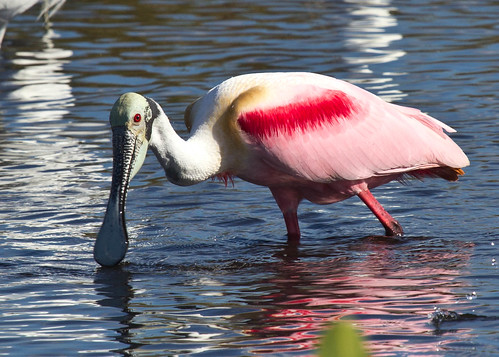
Here's a friendly guy from Florida.

Roseate Spoonbill

This isn't just any Boreal Owl--it's the one I saw on Superb Owl Sunday with my husband Russ during my Conservation Big Year. Russ didn't get to go out with me at all that year except that one day.

Boreal Owl

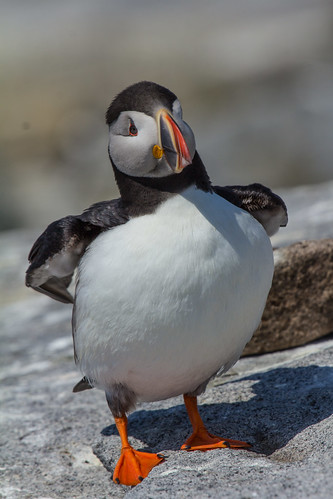
I took this on Machias Seal Island during my Big Year.

Atlantic Puffin

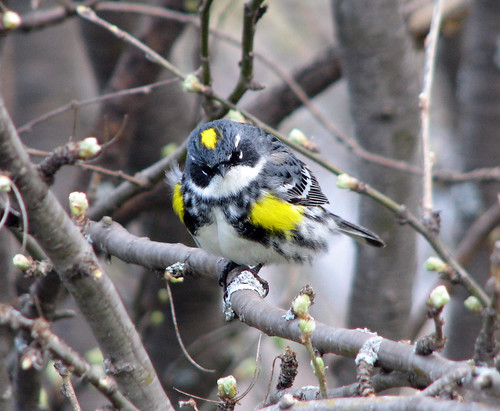
THIS is the photo that made me, officially, a National Geographic photographer. It appears in the book I wrote for them, the National Geographic Pocket Guide to North American Birds.

Yellow-rumped Warbler

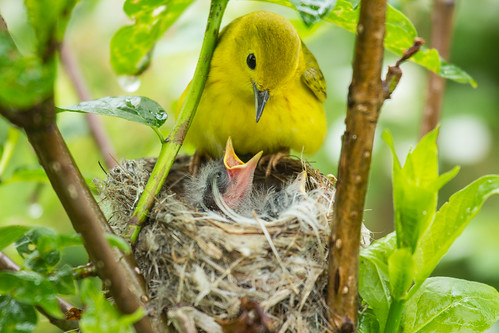
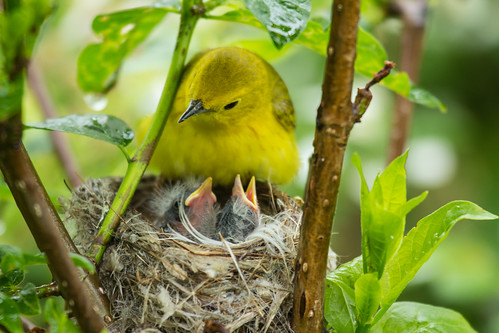
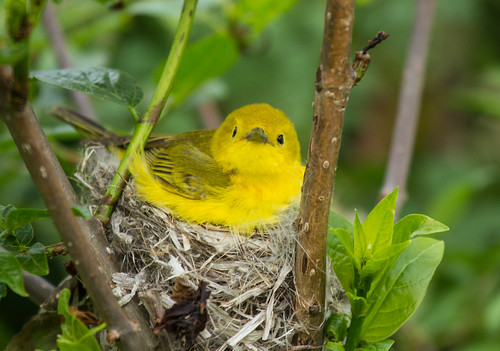
Some adorable little children discovered this perfect little nest right near the Magee Marsh boardwalk.

Yellow Warbler

Yellow Warbler

Yellow Warbler


If you have other suggestions for choices for prints or notecards, let me know.

Thursday, April 26, 2018

Thank you SO much!

Great Blue Heron

I’m writing this on my brand new computer, and tomorrow being a very important day to me, I’m going to place an order for the camera lens of my dreams: the Canon 300mm f/2.8 that will make photography in dark woods, at dusk, and under overcast skies so much easier.

What’s so important about tomorrow? It’s Ulysses S. Grant’s birthday, and it’s also the 6th anniversary of the first two eggs hatching in the Great Blue Heron nest under the Cornell Lab of Ornithology’s watchful nest cam. I was a moderator in Cornell’s heron cam community where I made dear and permanent friends, many of whom contributed to my Go Fund Me campaign.

Pips in Great Blue Heron eggs

I’ll be depleting my checking and savings accounts to make tomorrow’s purchase, but there is no way I could have bought these two important but truly luxury items at all without the generous contributions that are covering fully 2/3 of the cost and, indeed, making both purchases possible in the first place. It feels wonderful to know that so many people were willing to support my volunteer work on my blog, photography, and podcast in such a tangible way. I hope I can make my work even better in the coming years thanks to my new equipment.

I’ll be closing down the Go Fund Me campaign at midnight as April transitions into May. I’ll have the camera lens in time for The Biggest Week, the Iowa Ornithologists Union meeting, and the Acadia Birding Festival. With luck, I'll be able to take some amazing warbler shots over the coming spring. It’s been faster and easier processing the sound files for my production of For the Birds, and because the new computer is significantly faster than my old one, it’ll be easier and quicker to archive more old programs as well. 

Now that Russ’s and my trip to Florida is over and I’ve taken care of two exhausting speaking gigs this past week, I’ll have time to focus this weekend on ordering prints and notecards as gifts for these many contributions. That, too, will more easily be done on the new computer.

And all of this is possible because of YOU. I can't thank you enough.

Yellow-rumped Warbler


Wednesday, April 25, 2018

A day in Port Wing

This is a transcript of my podcast for April 25, 2018. You can hear it (with the children's voices) here, on the program page.


I got to spend a day in my old stomping grounds in Port Wing, Wisconsin, last week. I knew it was going to be a wonderful day when the very first thing I saw when I woke up was a bobcat. I had to be at South Shore School at about 9:30, but that left me a bit of time for a walk on Big Pete Road, on the eastern side of a protected boreal forest. I wasn’t out long, but did see eight Red Crossbills flying over, heard Sandhill Cranes calling in the wetlands adjacent to the forest.

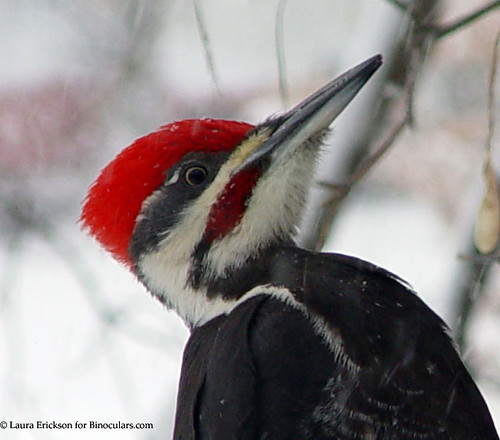
Most fun of all, watched three Pileated Woodpeckers working out their romantic and territorial entanglements. One male had been calling from and drumming on a big, dead pine for several minutes when a female flew in and joined him. Suddenly a second male flew in—this one wasn’t so welcome, and he and the first male did some interesting displays at one another before the new arrival took off, the first male following as if to make sure he entirely left the territory. Then he flew back to his pine tree and hammered a victory drumroll.

Jeepers the neighborhood Pileated Woodpecker

Too soon it was time for me to leave, but fortunately, I was headed to South Shore school. My friend Deanna Erickson, the Education Coordinator at the Lake Superior National Estuarine Research Reserve, has been working with teachers in Port Wing for the past four years, helping them incorporate outdoor learning and Lake Superior into their classrooms. This year, some students will be making signage for a DNR restoration project where my beloved Port Wing sewage ponds are now becoming a restored wetland, and I was going to spend the day with three groups of kids learning about the birds of the area.

I got to the school a half hour before Deanna, when the organized program would begin, so I got to spend some time talking individually with some of Erika Suo’s third and fourth graders. Erika has done a wonderful job of getting her kids started learning about birds. Some of them told me what their favorite birds are. Birds of prey always are among the top picks whether I’m talking to kids or adults, and the speedy Peregrine Falcon always makes a huge impression.
1) My name is Dexton and my favorite bird is the Peregrine Falcon. I like it very much because it is the fastest animal on earth.  
2) Hi. My name is Sylas. My favorite bird is the Peregrine Falcon. I like it because it’s the fastest bird in the world and a great hunter.
 I’d seen two Bald Eagles that very morning in Port Wing—there are at least a couple of nests in my favorite haunts there, so I’m not at all surprised that they have fans.
3) My name is Aydan and my favorite bird is the Bald Eagle because it’s very rare and unique. 
 My own favorite bird made the cut.
4) Hi. My name is Sophie and I like the chickadee because it’s small, cute, and it’s fluffy.
 This was the first week that I’d heard robins singing their lovely spring song, and I got to watch several running in the marshes.
5) My name is Richard and I like the robin because they always stick together.
 Even when it’s not National Blue Jay Awareness Month, Mark Twain’s favorite has its ardent fans.
6) Hi. My name is Maddie. My favorite bird is the Blue Jay because it is intelligent and aggressive. 
Listening to these bright, articulate, knowledgeable kids gives me hope for the future of birds and of human beings.


Monday, April 23, 2018

A visit to Northern Wisconsin

Golden-winged Warbler

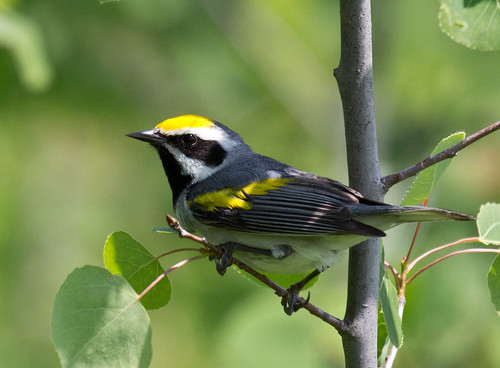
Last week I spent an evening in Ashland, Wisconsin, at the Northern Great Lakes Visitors Center, giving a talk about warblers for the Friends of the North Pikes Creek Wetland, a valuable and unique wetland area in Bayfield County that includes a trout stream and forests important for the declining Golden-winged Warbler. The Friends group is working tirelessly to protect and enhance the wetlands and to promote responsible recreational use of this resource and the education of the community, particularly local K-12 students. It felt wonderful helping raise awareness about this worthy organization. And driving to Ashland, I was getting a lovely sense of spring, seeing Turkey Vultures, robins, and Red-winged Blackbirds here and there despite the snow.

After the program, I drove to Port Wing, Wisconsin, where I was to spend the night. On the way down County A from Iron River, just as I was getting to Town Line Road, a wolf crossed in front of me. I see and hear coyotes way more often than wolves, but any time I see either it’s exciting. I thought about how lucky I am to live where I do, where most people really do seem to understand the value of wildness and of wildlife.

That night I got to stay by myself in a house right next to a wetland. I’m not quite as resilient as I was when I was younger, so I fell asleep almost immediately and didn’t wake up until just after sunrise. That meant I didn’t get any recordings of night or pre-dawn sounds, though robins were singing away.

The sun was still rosy when I looked out at the wetland without my eyeglasses. And what to my wondering eyes should chance to pass by but a big gray shape that looked for all the world like a cat with a short tail and pointy ears. Not only was I not wearing my glasses—I also didn’t have my binoculars right there. I couldn’t trust that it would still be there if I ran and got them, so I kept watch as it moved steadily and deliberately over the snow-covered ice and disappeared into the shrubs and weeds along the edge of the marsh at Washington Avenue. I was certain it was a bobcat, but despite how close as it was, to my nearsighted eyes it was little more than an evocative shape. Once it was gone, I went for my binoculars and looked out again. I didn’t know what I’d see this time, but I was certain I’d blown my chance of a close look at the bobcat. But suddenly out it came, now headed the other way. And if the full side view wasn’t enough, it stopped and turned its head to face directly at me. I hadn’t brought my camera, but those eerily haunting eyes burned themselves into my memory. I’ve spent a lot of my lifetime outdoors in good habitat, yet this was the first wild bobcat I’ve ever seen. I was thrilled.

Bobcat! (A re-enactment)
BOBCAT!! (A reenactment. I didn't have my camera along, but my dog Pip helped me recreate the moment.)
The Port Wing wetlands are on the edge of town, and a sizeable chunk of the area between them and the lake includes houses and dirt roads. The big spaces of land encircling the small town are mostly private, and although wolves, bobcats, coyotes, and even a mountain lion can be occasionally found there, they don’t have much space that they can count on—land that truly belongs to them. This wetland that felt magically like wilderness for that brief, shining moment is but a narrow, fragile strip open to a wide range of human uses. Indeed, a few cars going down Washington, Highway 13 traffic, and the sounds of boats squelched any sense of being in actual wilderness.

We humans no longer live on the edge of vast wilderness. The tiny dregs of wildness that we manage to hold fast to survive only as long as we allow it to. I felt proud that I’d helped another fragile little place, the North Pikes Creek Wetland up in Chequamegon Bay, the night before, and hope that there will always remain among us humans at least a handful of people willing to do what they can to protect what little wild land remains. We owe it to the human spirit and soul as well as to the creatures with whom we share this lovely planet.

Sunday, April 22, 2018

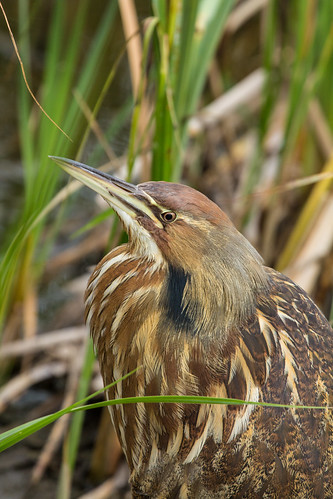
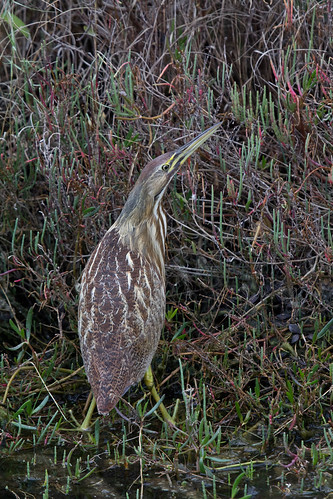
Listener Favorite: American Bittern

American Bittern

Sometimes we have encounters with birds that seem utterly wonderful and amazing, even if the bird we encountered isn’t our favorite bird of all. Last week I received a phone call from a listener who didn’t identify herself telling about her most memorable encounters:
I’m calling about my best bird ever. I saw this bird on April 27, 1985, and it was memorable in that first I heard him sounding like an old-fashioned washing machine on its last legs. I had no idea what I might be listening to but stayed around that swampy area and finally caught sight of him with his head pointed straight up, and he kept croaking away. That was the first sighting of my American Bittern. 
And a couple years later I was treated to an unexpected sight when I saw a male American Bittern enthusiastically (according to me) trailing after a female as they walked down our driveway, and I thought that was unusual to be out in the open so, but I think when you come right down to it my favorite bird is the chickadee because he’s always there and gives so much pleasure. Thank you.
 I lucked into seeing my very first bittern calling out in the open on a college ornithology field trip. I’d already heard the bizarre call on my Peterson bird record, and our professor got the bird into his spotting scope and told us all what it was, so as wonderful as it was to see the bird making its amazingly cool calls the very first time I saw one, it wasn’t any kind of mystery for me to tease out. And unlike our fortunate caller, I’ve never ever seen a bittern walking around on my driveway.

American Bittern

The Medieval Latin word for bittern, butaurus, was constructed from the Middle English name for the Eurasian bittern, botor. In Pliny's Natural History, a comprehensive book, written in Latin, about what was known about the natural world, Pliny the Elder wrote that the derivation of the word was from Bos (ox) and taurus (bull), because the bittern's call resembles the bellowing of a bull.

Here in America, our bittern has several nicknames including “stake-driver,” “thunder-pumper,” “water-belcher,” and “mire-drum,” all to describe the bizarre quality of the call. Of course, the bittern and the Green Heron have also been given another nickname, “shitepoke,” but for an entirely different reason: the *shite* comes from a four-letter vulgarism referring to something that streams out of the birds on takeoff. I don’t know if Pliny the Elder paid attention to that or carefully diverted his eyes to avoid seeing anything so unseemly. 

Bitterns are in the heron family, and feed on fish, frogs and tadpoles, snakes, insects, voles, and other aquatic or wetland critters. Their most common insect prey include water striders, giant water bugs, water beetles, water scorpions, grasshoppers, and especially dragonflies—they can capture those in midair. Like other herons, they swallow their prey whole, head-first. 
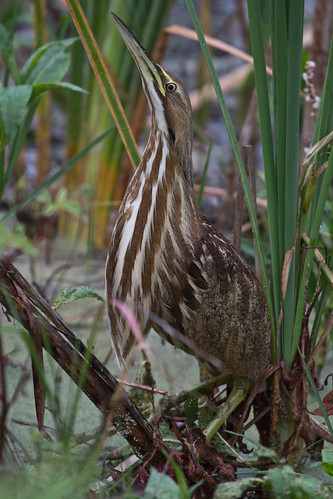
Bitterns stalk their prey in a slow, deliberate kind of way, or just sit patiently waiting for the food to come to them. Their powerful neck muscles give them a fast and furious jab, a supremely effective means of grabbing the quickest swimming critters. Their cryptic coloration, with the vertical streaking along the neck, makes them almost invisible in a cattail marsh. But that coloration doesn’t help much when the birds arrive in spring before snow has melted—I’ve seen them standing with their bill up in the middle of a snow-covered, frozen marsh, standing out beautifully against the white background. My best photos were taken in Texas and Florida in winter, when the birds are usually silent but fairly easily seen from boardwalks in popular birding spots. 
It doesn’t surprise me that my unnamed caller didn’t think of the bittern as her favorite bird. Magical as her encounters were, bitterns are here only part of the year, you usually have to work pretty hard to see them, and they’re only found in wetlands where mosquitoes also abound. But magical encounters don’t lose their power and beauty just because the bird isn’t our absolute favorite. Wherever we go birding, from a sewage pond to an enchanted forest, and whenever we go there, there is always the possibility of a magical, or at least wonderfully memorable, encounter with some bird. When you're birding, something wonderful is always right around the corner, and while we wait, we can always count on our dear little chickadees. Our time spent in the natural world nurtures our sense of wonder, the very source of faith, hope, and love. 

American Bittern

Thursday, April 19, 2018

Listener Favorite: Val's Great Crested Flycatcher

Great Crested Flycatcher

I just got an email from my good friend Val Cunningham, who has written several fine books about birds as well as a column for the Minneapolis Star-Tribune. Regarding favorite birds, she writes:
I agree about how tough it is to choose just one bird, as a matter of fact, it’s impossible. I love all your choices, and then some.   
But may I toss in a bird that might be called my Most Rewarding Bird Ever? I worked and worked on this bird for weeks before I could finally nail down its identity.   
This was way back in the 1980s, when I’d barely begun birding and was still at the stage of reading a field guide and eagerly anticipating new birds I might see. It was early summertime, and since I am self-employed, I can be out and about at any time of the day.   
Riding my bike through a large park near my home I heard the most amazing sound, sort of a big ‘burp’ followed by some gasping ‘wheep’ sounds, repeated over and over. Screeching to a stop I hauled my binoculars out of the bike basket and scanned the nearby woods, but could not find the bird, even though it repeated its sounds over and over.   
As I walked through this park the next morning, I heard the sounds again, in the same wooded area, so I spent many minutes waiting, watching and scanning. But I couldn’t find the bird.   
This occurred over and over for the next several weeks, and I was becoming more and more eager to discover what this bird was. (This all took place before there were bird song apps, and great sites like the Cornell Lab’s All About Birds, that would have made short work of this identification challenge.) .  
Then, one gorgeous morning, as I stoood across the street and listened to the burp and wheeps, a bird flew to the top of one of the trees. Focusing my binos on him I saw a reddish back, a yellowish front and a tall crest, a gorgeous bird. Racing home I got out the field guide and paged through until I found it: a great-crested flycatcher!   
Part of my joy about being able to put a name to a new bird was the weeks-long patience it required, it was almost as if the bird and I were working together, he offering tantalizing sounds and me waiting patiently to see him.  
I wouldn’t say that great-crested flycatchers are my favorite bird ever, but this was one of my favorite birdwatching experiences ever.
Val’s observations seem particularly timely for me, because Russ and I just returned from a trip to Florida, and those burps and wheeps and other cool sounds were a highlight of our three days in the Everglades. I’d brought my recording equipment and managed to get a few recordings, which are serving as the background of this podcast. The Great Crested Flycatcher is a splendid bird by any measure—the sounds it produces give it a fun uniqueness that I’ll be looking forward to hearing up here in just a few short weeks.

Wednesday, April 18, 2018

Dangerous Spring Weather

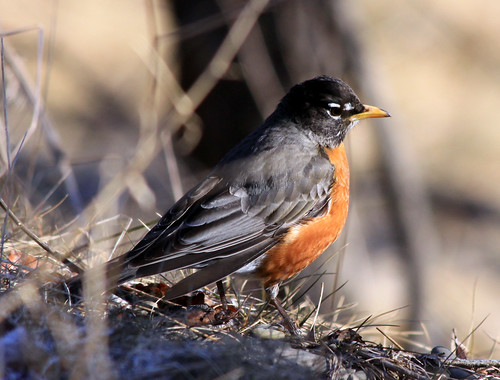
American Robin closeup

Back in 1982, Russ and I left Duluth for Arizona at the end of March and didn’t return home until April 17. When we left, we had lots of redpolls at our feeder, and there was lots of snow on the ground, so I paid a local boy to keep my bird feeders filled each day, telling him he could stop after the snow melted and the redpolls disappeared. But when we got home, the snow was deeper and there were even more redpolls visiting our yard than when we’d left.

There’s a reason April Fools Day is set in April. The problem is that many of our migrating birds are playing games of probability, partly driven by genetics. If the first robins of spring happen to be early birds in a year when spring arrives early, they do indeed get the worms, along with top-notch territories and a jump on the more cautious or lackadaisical robins, and that year a bumper crop of baby robins will carry the antsy early bird genes. But in years like this, when there are no worms available for the early birds, the earlier robins end up hungry as late winter fruit supplies grow badly depleted and worms are securely buried under frozen topsoil and inches of snow.

I’ve received a few emails about robins visiting suet feeders, and I expect that when they wend their way up here, Yellow-rumped Warblers will be visiting feeders as well.

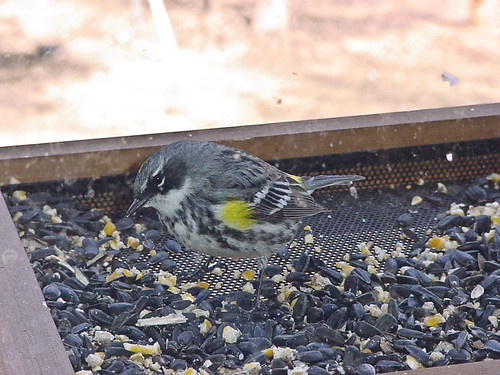
Yellow-rumped Warbler

There is always mortality during spring migration—whenever birds leave there are perils galore, including collisions with windows and lighted towers, predation, habitat destruction and loss, and all manner of other hazards before we even start considering the weather. Songbirds are tiny mites, many weighing significantly less than an ounce, yet they power their way through hundreds or thousands of miles without benefit of GPS, restaurants, hotels, or any of the other amenities we mere humans consider necessities on a trip. And whatever the weather, they make this journey naked as jaybirds.

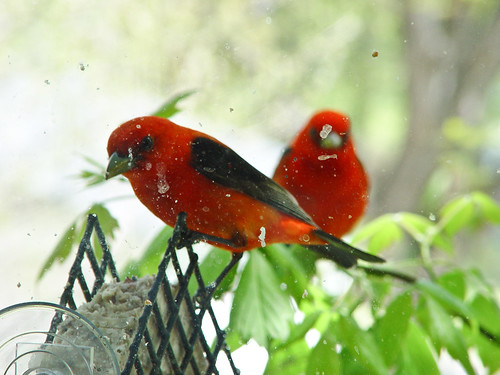
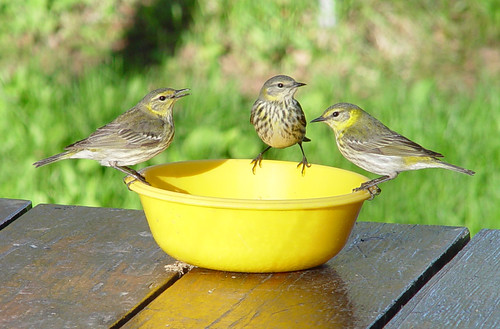
Storms can kill a lot of birds, especially tornadoes and ice storms. Deaths from this kind of extended cold aren’t nearly as dramatic but are still significant. In 2004, after what seemed like an early spring in April, we had a crushing cold snap in May, after a great many of the insectivores that winter in the tropics had arrived. Scarlet Tanagers and Cape May Warblers became regulars at some fruit and sugar water feeders alongside Baltimore Orioles.

Scarlet Tanager at suet

Cape May Warbler

My own feeders certainly helped the dozens of birds that discovered them, but I hated thinking about the countless birds that never did find a feeding station. There’s a lot of controversy involved in providing jelly for birds, but that particular year, jelly feeders kept a lot of birds alive until spring finally arrived.

This year is shaping up to be a seriously bad one. This morning the Raptor Education Group of Antigo issues a Bird Emergency Alert. Marge Gibson posted:

Last night, into early morning, I took over fifty phone calls, texts and Facebook messages. Most were about weak and dying warblers, robins and woodcocks. Please understand this is an extraordinary situation. More snow and cold temperatures are predicted for Wednesday and Thursday. The birds require your help. YOU CAN MAKE A DIFFERENCE!   
This is not a normal spring. The birds can deal with some snow and cold, but not deep snow (30 plus inches) and sustained cold. They have slipped into hypothermia, unable to maintain their own body temperature or keep themselves warm any longer. Birds that eat insects cannot find natural food. They are starving. 
If you see a bird that you can pick up, PLEASE do so. Put it in a cardboard box, not a cage or a carrier. Put a towel in the bottom of the box and bring them into a warm area. Put a heating pad on low under part of the box. Cover the box to create an "incubator" of sorts. You are looking for a temperature of about 80 degrees. Put food in the box. Live or dried mealworms and live waxworms work. (obtain from Wildbirds Unlimited ,Gas station/Fleet Farm/Walmart anywhere that sells fishing bait) Keep bird/box away from family pets. Transport the bird as soon as you can to our facility or your local avian wildlife rehabilitation center. 
If you cannot transport the bird, we will try to find a volunteer transporter. If weather again becomes hazardous call for more instructions. Keep the bird warm, well fed, a small non-tip dish of water in the box in the meantime. Do not release while weather conditions remain challenging. 
AGAIN: Please keep your bird feeders full. Robins can eat cut-up raisins, dried mealworms, shelled sunflower-seed pieces, frozen blueberries, crumbled suet blocks. Put food on the ground where you see the birds. Robins congregate along rural roads, near stands of pine,spruce or other conifers. You can also feed them in those locations, Make sure the food you put down is off the roadway. If you see a bird in need, PLEASE pick it up and put it in cardboard box with a towel in the bottom. Bring it into a warmed area. Birds are dying of malnutrition and hypothermia and need assistance to get through this horrific weather. Call REGI at 715-623-4015 or your local avian rehabilitator for guidance. We continue to operate without full staff due to weather conditions. 
Thank you for your help. We are in desperate need of volunteer drivers for this event specifically. Please call 715-623-4015 or leave a message on Facebook if you can help us. Birds are coming from Marshfield, Stevens Point, Pittsville, Adams Friendship, Wausau, Shawano, Marion and all of the surrounding areas.