Laura Erickson's For the Birds

Thursday, March 3, 2022

Chickadee Day, 2022: It was the worst of times, it was the best of times.

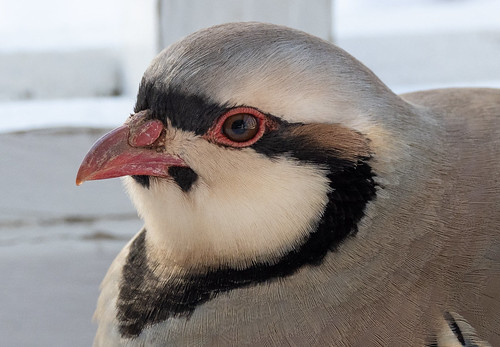
Chukar

Every year I celebrate March 2 as Chickadee Day, because it’s the anniversary of the day I saw and identified my first Black-capped Chickadee, Number One on my life list. This year I was hungry to see a Spruce Grouse, so I got up while it was still dark to drive up to Two Harbors and then up Highway 2 and Highway 1 toward Ely. Before I even had my coffee, I had to let my dog Pip outside. She's little, weighing just 8 pounds, and there are plenty of predators in the neighborhood, so I take her out on the leash after dark. This time, she instantly ran to a dark spot in the snow and started sniffing a deep red bloody spot and one little tuft of cottontail fur on the ground by the feeder, at the corner of an area of the backyard that Russ keeps shoveled for Pip to get around easily. By the light of our porchlight, I could also see a few pieces of the rabbit on the snowbank just above. I went in and got a flashlight to confirm what I was seeing.  
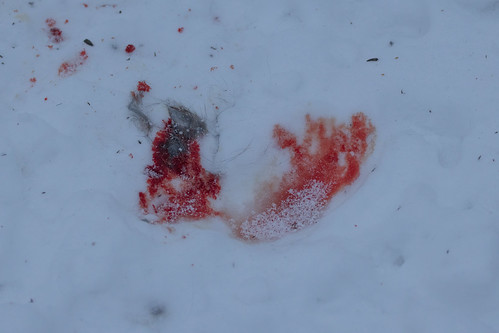
Where a Great Horned Owl killed a cottontail rabbit.

I’m pretty certain the perpetrator was one of the neighborhood Great Horned Owls because there were no tracks going up the snowbank, so the predator had to have flown there. A Great Horned Owl is the most likely nocturnal predator that could fly any distance at all with an adult rabbit carcass. 

Great Horned Owls often bite off and swallow a rabbit's head, and if scared off or not very hungry, they leave the rest. In this case, the head was missing, but so was almost all the rest of the body, so I’m presuming this was one hungry owl or, even more likely, a mated male who ate the head and lugged off much of the rest to give its mate on the nest. By now the female may be brooding, in which case dad was bringing food for both her and their chicks. I love owls and I’m glad someone got a good meal even as I devoutly wish it hadn’t been one of my bunnies. 

Anyway, I got dressed and waited for it to get light enough outside to take photos of the gruesome crime scene. But even before sunrise, two of my crows showed up. I didn’t begrudge them the calories, but I ran out to take pictures before they could carry away what was left, while it was still too dark for good photography. My crows are skittish whenever anything is out of the ordinary, like this sudden bonanza of rabbit guts on the snow, so I photographed them from indoors through the window glass. My photos ended up pretty poor, but oh, well. 
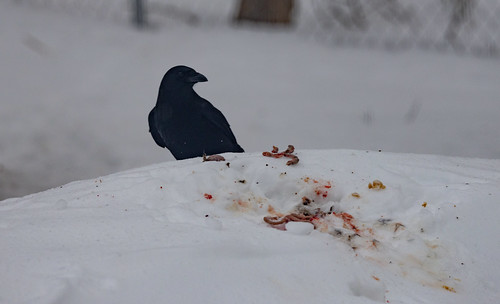
American Crow deciding what chunk of rabbit guts to carry off.

Chickadees were singing away. That happens to be one of the loveliest bits of serendipity about my starting birding on March 2—when I haven’t been traveling, I don’t think I’ve ever missed hearing chickadees singing on March 2.  
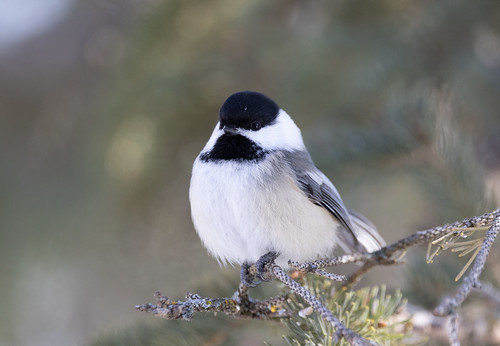
Black-capped Chickadee waiting for mealworms

While I was packing up my camera gear, I spotted a male Pileated Woodpecker at the suet feeder, and after watching him through binoculars for at least a minute, he finally posed exactly right for me to see the band on his right leg—yep, it was my dear BB. 

Banded Pileated Woodpecker

BB, at least one unbanded male, and at least one female Pileated had been coming multiple times every day through quite a bit of the winter. In the last couple of weeks I haven't seen any of them around most days, but this was the third day in a row that BB showed up, which was a joy. A minute or two later, when I was putting on my coat, BB flew away in a weird, zig-zagging flight, pursued by someone I couldn’t get a clear look at. They completely moved out of sight, and I don’t know how that encounter ended up. In the past I’ve photographed a very determined Sharp-shinned Hawk repeatedly chasing a female Pileated and seen Merlins harassing raptors larger than Pileateds. We’ve had both sharpies and Merlins this year, so either is a possibility, along with such real menaces to Pileateds as Northern Goshawks, so I’ll be uneasy until I see BB again. 
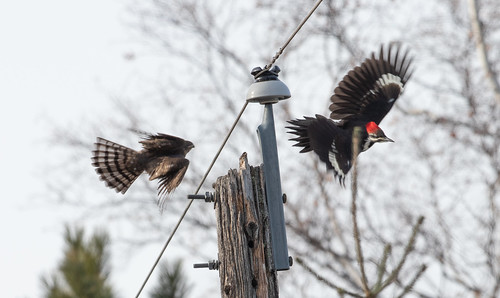
Exit, pursued by a Sharp-shinned Hawk

On balance, Chickadee Day was starting out pretty rough, but a lovely drive to see Spruce Grouse would certainly brighten things up, right? 
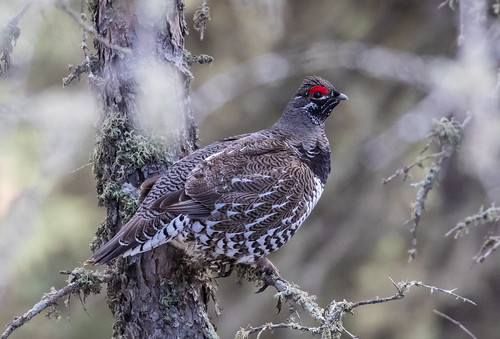
Spruce Grouse

People have been seeing them on Highway 1 just north of the Spruce Road, so that’s where I headed. Going through the eerie, burnt area by the Sand River made me sad—the Greenwood Fire last year destroyed so much habitat!—but the grouse have been seen here a few times this winter so I kept careful watch. The only two times a car came up behind me, I had plenty of room on the shoulder to pull over before they were inconvenienced, so I drove nice and slow, scrutinizing the road ahead and the trees along the road, but no luck. Two small flocks of redpolls flew up from the road ahead of me, but I’d seen them way better already that very morning in my own backyard, and the only other birds I saw up there, ravens, had also made an appearance on Peabody Street. 

Driving home as I revisited Highway 61, I saw a few Bald Eagles—the only species I saw on that entire long drive that I hadn’t already seen at home. I didn’t have time to stop in Two Harbors or any of my favorite spots—I was already late getting to my daughter’s house for babysitting. My Chickadee Day adventure was a total bust.

A small flock of Cedar Waxwings was in Katie’s backyard, but now that I had something to photograph, I’d left my camera at home. The one big bright spot over there was Walter. He's not quite at the talking stage yet, though he often points to the feeder and says "chee!" when he spots a chickadee. On Chickadee Day when I asked him what a chickadee says, he said, "dee dee dee." A boy after his grandma's heart.

Grandma showing Walter a chickadee

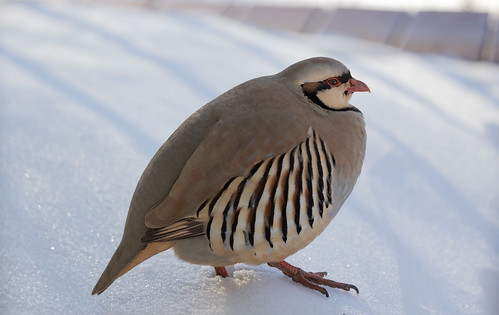
The moment I got home a little after 4, while I was still taking my coat off, I got a text message from a dear friend of mine, Sarah Glesner, who was right that moment looking at a Chukar at her parents’ place a half mile away. 

Chukars are Old World grouse—the national bird of both Iraq and Pakistan. They are beautiful birds belonging to the same family as pheasants and grouse, and so have been introduced as game birds in many countries. In the United States, state departments of natural resources have introduced them many times over the years, including in Minnesota and Wisconsin, but Chukars have become established only locally here and there in the West. They’re easy to raise in captivity, so are often found in private aviaries. They’re also a popular quarry for canned hunts at game farms catering to unsportsmanlike shooters, and are also kept by retriever clubs for training and competitions. 

Last summer, a group of Chukars were hanging out in Sarah’s parents’ part of the neighborhood after apparently staging a great escape. I got photos of one of them on July 13.

Chukar

By then, the original flock had dwindled, and one by one, the remaining numbers shrunk. That area is closer to where the Great Horned Owls usually hang out than my yard is, and our neighborhood has plenty of foxes as well as being located right under Hawk Ridge. I hadn’t heard anything more about the Chukars by August, so I assumed the whole flock had died out, but Sarah said this one individual has been showing up at her parents’ feeder most afternoons all winter. 

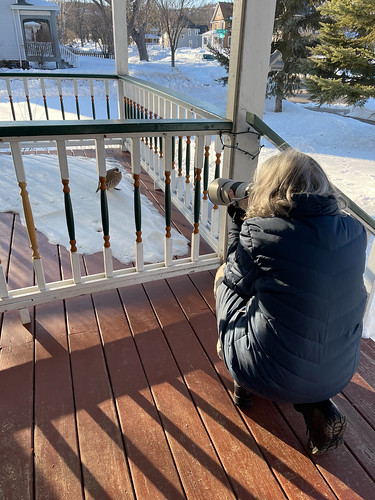
I was at their door a few minutes after getting her message. I thought I’d have to do a bit of work to find a good spot with an angle where I could take good pictures without scaring off the bird, but nope. It was walking up her front sidewalk to her porch as I arrived, while she was standing on the porch. It sauntered up the steps like it lived there, and stayed right there on the porch where Sarah and I both stood for ten full minutes before it jumped down and wandered to the back yard, apparently not minding us talking to each other as I clicked away. I took about 350 photos of which 270 turned out, as Sarah took a few of me.

Chukar

Chukar

Chukar

Laura photographing Chukar

This bird can fly—Sarah has seen it up on rooftops—but there’s no pretending any of my photos were taken in a wild setting.  That's okay—even if I prefer taking pictures of birds in my trees rather than in my feeders,  I am not into misleading people about birds or pretending I'm some rugged wildlife photographer when I'm really just a birdwatcher who takes a lot of pictures. And there's no pretending this little beauty belongs anywhere near Duluth. It may not be countable on any birding lists, but it’s as wild as an escapee from domestication can be, and it made a lovely and serendipitous end to what had been an otherwise mostly dispiriting Chickadee Day.

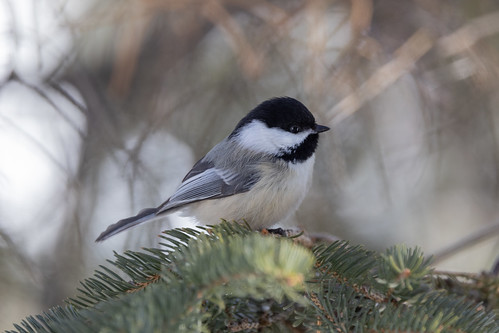
Chukar

Monday, February 21, 2022

Little Walter the Chickadee

Black-capped Chickadee waiting for mealworms

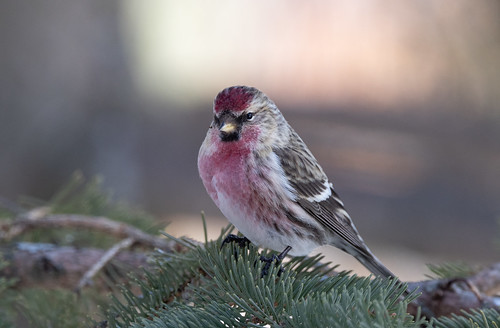
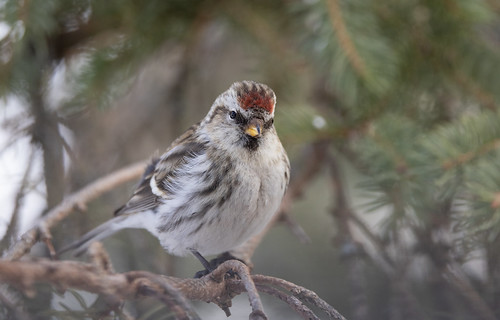
All the redpolls crowding into my feeders have been filling me with both joy and the impulse to take bazillions of photos. Their plumage is so variable that no matter how many individuals I photograph, I keep seeing more beautiful variations, and want pictures of every one of them.   

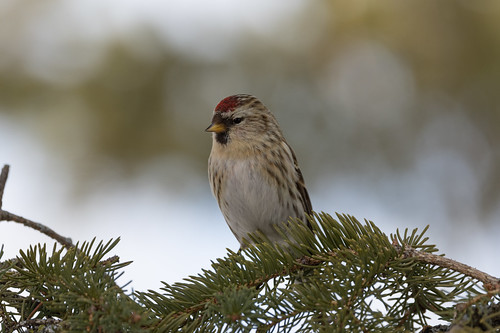
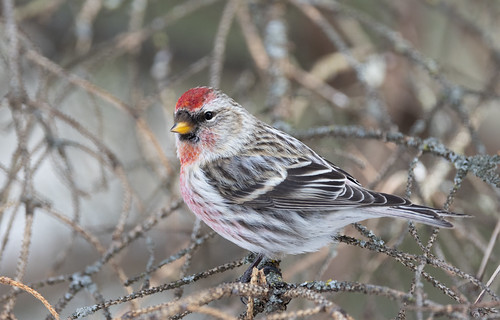
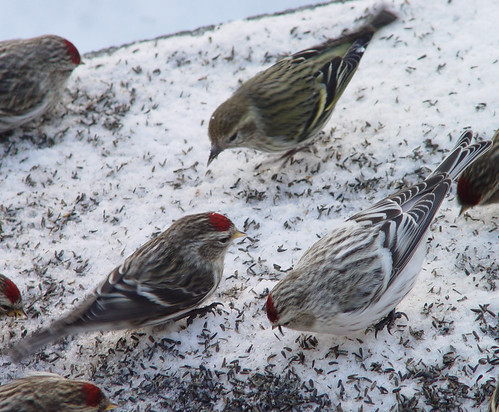
Common Redpoll

Common Redpoll

Common Redpoll

Common Redpoll

My home office turns out to be the perfect place for this. The redpolls come to the window feeder and, even better, spend a lot of time in the spruce tree near the window. All I have to do is lower the upper pane and click away for perfect, unobstructed shots, at least for a few seconds, and sometimes for a full minute or more. But suddenly and inevitably I hear the soft whirring of wings and insistent chattering and there goes my photo op. 

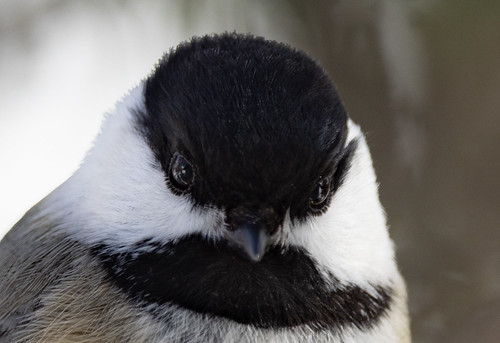
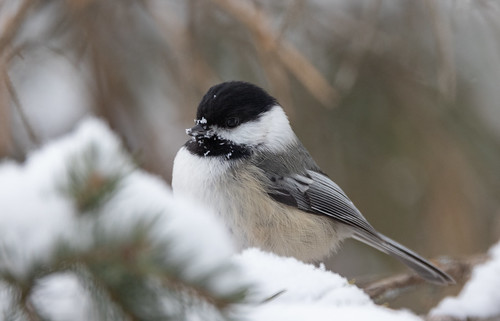
One particular chickadee—I’m pretty sure the male of the pair that nested in our cherry tree last summer—has flown in. He hovers directly in front of my camera for a moment and then alights on the window, blocking my view of the redpolls. Once he even landed on my camera. I’m of course using my 500mm lens, so can’t get a picture of him except when he darts into the tree to give me a long, hard stare. At that point I can’t help but aim my camera at him, which is counterproductive as far as he’s concerned—he wants food, not a photo op—so in he zooms again. (All the chickadee photos in this blog post are of him when he's doing this. Quite a few of my chickadees make eye contact and allow me to take close up photos, but these were all taken of him during my redpoll photo sessions.) 

Black-capped Chickadee waiting for mealworms

It's not like he doesn’t have plenty of food right there—that window feeder is invariably stocked with the large peanut halves he loves topped off with dried mealworms. I’ve watched him devour those when I’m sitting at my desk with the window closed. When the feeder is full, whether my window is open or closed, all the other chickadees are just as happy to get their snacks there, but not this one guy. When he sees me at the open window, visions of wriggly, warm-alive mealworms dance in his head, and he expects me to drop everything to root through my mealworm bucket just for him. 

Black-capped Chickadee

Of course I oblige him. If I’m entirely focused on taking redpoll pictures, giving him mealworms is the only way he’ll fly off long enough for me to take a few more before he returns. But there’s something else at play, too. When this little guy, so adorable, so confiding, looks right into my eyes, he can wrap me around his tiny claw the exact way my adorable, confiding, one-and-a-half-year-old grandson Walter wraps me around his little finger. I’m Walter’s primary childcare provider during the work week. He’s pretty good at entertaining himself right up until the moment I answer an email or take a phone call. That’s when he looks up at me with those adorable dark eyes filled with expectation, wraps his tiny hand around my little finger, and tugs. Of course I oblige him, though he doesn’t want mealworms—he wants Grandma’s full attention. 

We humans see chickadees through the eyes of a species that produces helpless young that remain dependent for years, so what our eyes recognize as cute or adorable often elicits both smiles and an impulse to nurture. Compared to adults, human babies are tiny with relatively large eyes, plump bodies, and oversized heads—features that help define cuteness to our eyes. Small wonder chickadees are so universally considered cute and endearing. Of course, a chickadee's oversized head didn’t evolve to appeal to us—their head size is evidence of learning capacity. Chickadees readily figure out how to manipulate things in their environment including, in this case, a little old lady in her home office, to get what they want. Even at their most annoying, their adorableness wins out, and so I can’t help but smile and indulge the winsome little creature at hand, whether it's Walter or one particular chickadee.

I don’t usually give my chickadees names, but this guy who knows just what buttons to push to bend me to his will turns out to have an obvious one. I’m calling him Little Walter.  

Black-capped Chickadee

Saturday, February 19, 2022

Redpolls!

Common Redpoll

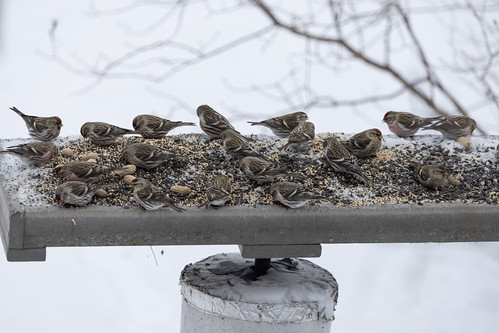
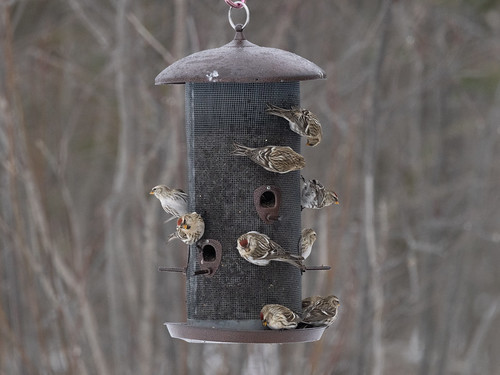
This is a banner year for redpolls. People all over Minnesota and Wisconsin are posting about them on Facebook, and my email box is full of stories about these charming winter visitors. Redpolls have everything going for them as far as their popularity with people goes. They’re little, both sexes have beautiful plumage, their chattery calls are pleasant, and they seem amazingly approachable and even friendly. They get along with one another well enough that a surprising number can crowd into a single platform feeder, though if you pay attention, you can’t help but notice that some are pretty darned assertive in defending their personal space when they’d prefer not to share.  

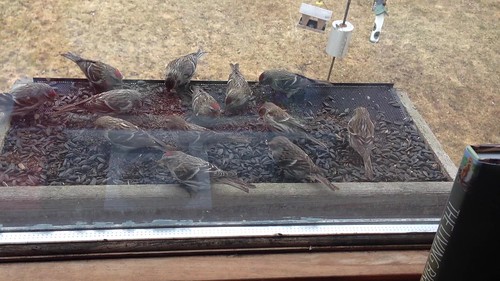
Common Redpolls at my window feeder

Redpolls, which are circumpolar, breed in coniferous forest and scrub of the far north, in North America through arctic Canada and most of Alaska. In Eurasia they breed from northern Scandinavia, northern Russia, and northern Siberia south to central Russia, southern Siberia, Outer Manchuria, Sakhalin and Kamchatka. For no good reason, the Lesser Redpoll of Europe also been introduced in New Zealand. On tundra and beyond the timberline, they’re found only in hollows and sheltered spots with shrubby vegetation. 

Seed production in many trees varies wildly, often alternating crazily from one year to the next. In response, redpolls stay mostly in the far north when food is plentiful there, and head south in vast numbers when it isn’t. Some winters they may appear as far south as South Carolina, Alabama, and southern California, while other years they barely travel as far south as the northernmost states. 

Hoary and Common Redpoll and Pine Siskin

As befits a bird that can winter so very far north, redpolls are shockingly hardy. Researchers could easily look at extreme temperatures in locations where they knew redpolls were visiting feeders to establish just how hardy they are, but for some reason, some scientists thought it necessary to conduct laboratory studies in which they watched various songbirds become hypothermic and then die as the temperature in a controlled chamber was lowered degree by degree. Common Redpolls survived down to -65º F and Hoary Redpolls down to an astonishing -88º F. I don’t know if that says more about the extreme warm-bloodedness of redpolls or the extreme cold-bloodedness of some researchers.

Redpolls have many strategies to survive such extreme temperatures. Their muscle mass increases as temperatures drop below zero, enhancing their ability to shiver, which warms their core tissues. Their plumage is 31 percent heavier in November than July to increase insulation, and peripheral vasoconstriction—that is, reducing blood flow at their extremities—also thickens their insulation while concentrating the warmth in their core. The fuel that redpolls burn to warm the body in the first place is very high energy—those tiny seeds—and they can eat over a longer time in a 24-hour day than most birds because they have more rod cells in their retinas, allowing them to feed at lower light levels. And they go to sleep not only on a full stomach, but with extra food to unconsciously snack on as they sleep—their esophagus has a great many diverticula, or pouches, that they also fill as evening falls. As they sleep, after they’ve digested their stomach contents, those pouches slowly empty into the stomach, stoking their metabolic furnace through the long winter night. 

Common Redpoll

Their feeding behaviors help conserve heat, too. We can’t help but notice redpolls milling about on the ground as well as in our feeders. In more natural settings, they feed on seeds clinging to trees, but don’t necessarily stay in those trees to eat. They’re much more protected from gusts of wind on the ground, allowing them to fluff their feathers to conserve their body heat. So both on their arctic breeding grounds and wherever they happen to be wintering, redpolls often shake seeds from catkins and then drop to the ground to eat them. 

With such a wide arctic range, different redpoll populations show differences in bill size and plumage. Most recent ornithological research has focused on their taxonomy. Currently, scientists recognize three different species in the world, the Common and Hoary appearing in North America, and both of those along with the Lesser Redpoll appearing in the Old World. Some scientists believe there are as many as six redpoll species, but based on DNA and other data, other scientists believe all of them should be lumped into a single species. Some birders would be just as happy not having to sort through each one seeking out a Hoary, but there will be a lot of birder angst if we lose that one from our life lists. 

Hoary Redpoll

This season, redpolls started passing through northern Minnesota in big numbers back in October. I spent a lot of time outside in November and early December watching the Rufous Hummingbird on Peabody Street and hearing redpolls, but not once did a redpoll come down to my feeders, and I only read a few accounts of them visiting other feeding stations. Why would they bother while so much natural food was available in the form of seeds still clinging to trees?  

But as the season progressed and they depleted more and more of their natural food sources, they showed up at more and more feeders, in bigger and bigger numbers. Redpolls are nomadic, moving about from here to there all season, their numbers usually peaking in late March or April. 

Now that they’re visiting feeders, I’m going through a lot of Nyjer seed. I put it in three small tube feeders, and pour some over the sunflower seed in the two platform feeders in my yard. My home office window feeder is the only one squirrels can get into, so I fill that one with Fiery Feast—a capsaicin-laced mixture of nuts and sunflower hearts—but with so many redpolls, I’ve also been sprinkling Nyjer seed in there. Redpolls really do concentrate on small seeds, but on Saturday I watched one pull a large peanut half from the feeder and dart into my spruce tree, where it took tiny bites as it tucked the peanut chunk into different crevices among the spruce needles. I guess I’ll have to live a lot longer than my paltry 70 years to understand even the most familiar birds. 

Common Redpoll

One of my listeners, Nicole Ottjes writes:

I have lived in Duluth for 6 years in the Piedmont area, and this winter for the first time I have a huge number of redpolls every day in my yard.  For the past few weeks I bet there have been 50-100 redpolls gorging on the shelled sunflower seeds in my tray feeder. To quote my neighbor, “There goes the bird food budget!” When I go out to hand-feed mealworms to my chickadees, the redpolls hang around too and land on my head and hand sometimes.  They haven't eaten a mealworm from my hand yet (maybe mealworms are not in their diet?), but they are pretty intense!    

Adult redpolls are primarily vegans, feasting in their natural habitat on very small seeds from birch, willow, alder, and some conifers. Their interest in insects is mostly limited to the nesting season, particularly as the best high-protein food for their growing chicks. When I mentioned that they aren’t much interested in insects in winter, Nicole quickly wrote back:

You were right - I put seeds in my hand instead of mealworms, and apparently that's all it takes. I wonder if they would have eaten from my hand if they hadn't seen the chickadees doing it already? Chickadees seem like great teachers.   

Nicole sent a great video of at least a dozen redpolls flitting about and crowding into her outstretched hand. 


Copyright 2022 by Nicole Ottjes

I’ve never fed redpolls by hand, but just watching her video was thrilling. I’ve been taking lots of photos of redpolls in my feeders and trees, and this weekend made a short sound recording of their pleasant little call notes, but Nicole’s splendid video tops them all. I'm so pleased that it was her chickadees that inspired her redpolls to come to her hand. 

Redpolls are thriving through all the frigid weather we’ve been having. But their habit of feeding on the ground, which works just fine year-round in their natural habitat and during the coldest period of winter in our backyard habitats, turns out to be dangerous for them when we start getting thaws as winter releases its hold. In nature, not all that many seeds collect under any single tree, but all the wasted seed and seed shells that pile up under our feeders through the winter slowly decay, fostering bacteria and mold growth. Periodic thawing hastens the process, especially as spring progresses. So those of us with bird feeders have a moral responsibility to dig out or rake out the spoiled seed whenever the weather and ground conditions allow. Composting is a perfect way to dispose of them as long as we keep the compost pile or bin screened to keep those little birds out. Like any restaurant owner, we people with bird restaurants have obligations to our diners, even if no health inspectors are checking up on us. 

Common Redpoll


Wednesday, February 16, 2022

Winter Bird Song, Part II

Great Reed-Warbler 

Mid-February chickadees, cardinals, and White-breasted Nuthatches are singing. These non-migratory species spend winter on or near the territories they’ll claim come spring, near the mates they’ll nest with come spring. Migratory birds wintering up here who will breed farther north don’t normally sing at all in winter. Some do begin during migration before they reach their destination, even while it’s still wintry. There is nothing more beautiful than juncos and Fox Sparrows singing away during an April blizzard. But neither species is singing right now. 

Winter Wrens and Hermit Thrushes, species with two of the most gorgeous songs on the planet, seldom jump the gun to thrill migration watchers. They wait until they’re on territory to sing.

Oddly enough, some birds that migrate long distances do sing their territorial songs in the dead of winter while they are hundreds or thousands of miles from where they’ll nest. Alert listener Don Watson called my attention to a February 2016 article in The Atlantic by Joshua Sokol, “The Birds That Spend All Winter Practicing Love Songs,” subtitled “Some species work on their beach body. Others work on their pipes.” 

The article, about European birds singing in sub-Saharan Africa in winter, focused on the work of Claire Spottiswoode. She’s been an avid birdwatcher since her childhood in South Africa, where she loved listening to Great Reed-Warblers, which sounded to her like “deep-throated jazz musicians.” These birds don’t breed in Africa, but in Europe, and as Spottiswoode became a researcher, she started wondering why they were singing at all so far from their breeding grounds. Singing is energy intensive and attracts predators, plus reed-warblers don’t associate with mates in winter and obviously aren’t defending a nesting territory. So why on earth are they such active singers in winter?

One of Spottiswoode’s former grad students, Marjorie Sorensen, conducted a study in Zambia testing the possibilities. She found that when playing recordings of their songs, Great Reed-Warblers neither reacted aggressively nor avoided the recordings, so the winter songs apparently had no territorial function. And the singing individuals had no higher testosterone levels than non-singers. Breeding reed-warblers have two song-types—quick ones to warn away intruders and longer ones communicating with potential mates. The winter songs were just as complex as the breeding songs but in a slower tempo. Sorensen explained that “They don’t really have breaks between their songs. They’re just singing, singing, singing.” The songs also seem to meander mid-verse, with the birds switching more rapidly from sound to sound. Females choosing a mate seem to prefer more complex notes, so males apparently use their low-stakes winter rehearsals to try a variety of tones and perfect the best ones. 

There will need to be more research on how these songs change from winter through migration and on the breeding grounds to test whether the purpose of winter singing really is to practice. But this new explanation is inspiring more ornithologists to study the issue. Examining the songs of 57 species that sing in winter, researchers noticed that these species tend to be ones with complex songs and/or drab plumage, making their songs very important in attracting mates. It’ll be fun watching how research teases out what exactly is going on. Here in America, the change in White-throated Sparrow songs from their traditional Old Sam Peabody, Peabody, Peabody to a slightly different version (which doesn’t appear to be as universal as scientists originally proclaimed a couple of years ago) apparently sprung up as males from different parts of the country were listening to one another’s songs on their wintering grounds. 

This is why I so love ornithology—one could study birds every day during a long lifetime and never even scratch the surface. The more we know about birds, the more we realize how much we don’t know. 


Tuesday, February 15, 2022

Winter Bird Song, Part I

Black-capped Chickadee

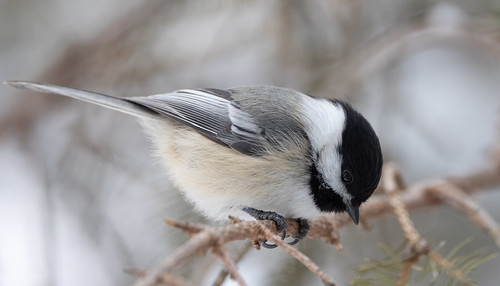
Every morning when I go out to add food to the feeders, I’m hearing a wonderfully welcome sound—my neighborhood chickadees are singing their lovely Hey, sweetie! song, a promise that come spring, these beloved little guys will be doing what needs to be done to ensure the production of new baby chickadees. That clear, whistled song is produced mostly by males, though females are known to sing, too. 

Researchers describe the song as a simple Fee bee, the first note higher than the second, and the second with a very short amplitude break in the middle, audible at close range, that makes it sound more like fee bee-bee. (You can hear it at this link.) My hearing is not very good, but I can hear that break almost all the time, even when the chickadees are pretty far away. 

Eastern Phoebe

The Eastern Phoebe’s raspy song is also described as fee bee, fee bee-bee, but it sounds entirely different (listen here), confusing a lot of people. So instead of using that to describe chickadee songs, I use a different mnemonic, Hey, sweetie!, which serves a double purpose, suggesting one of the purposes of the song, to attract a mate and keep that pair bond strong. 

Bird songs, including those of chickadees, usually do double duty, also announcing that the singer owns and is willing and able to defend a territory. The male chickadees who rank higher in the flock hierarchy sing more than lower-ranking birds do. The singing right now, in the dead of winter, helps solidify flock rankings and pair bonds without disrupting flocking behavior. Those of us who feed birds get to hear more songs than people living farther from feeders—the chickadees who visit high-quality feeding stations first thing in the morning sing more frequently than chickadees who have to work harder for their breakfast. 
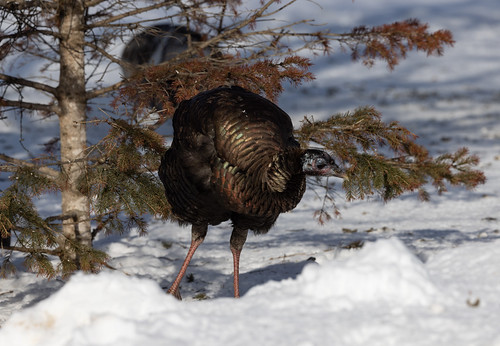
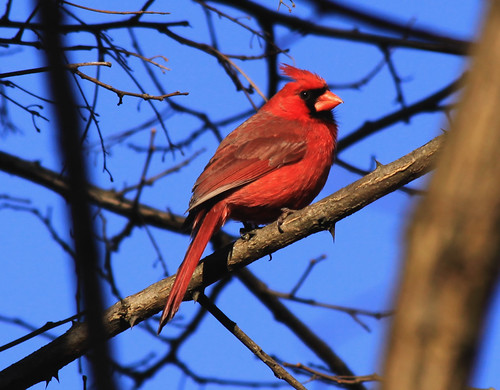
Northern Cardinal

Cardinals are singing now, too. At least some chickadees and cardinals were singing a bit back in December, but as days lengthen, giving them more hours to find food each day, they can spend more time on singing and other things. Male cardinals sing year-round, most frequently in the Midwest from late February through July. Female cardinals have a much shorter singing period, more closely coinciding with nesting. Even then, they sing about a fifth as often as males or less. 

Northern Cardinal

Female cardinals have pretty much the same repertoires as males but their songs can be longer with more syllable types. That greater complexity probably has to do with what they’re communicating to the male regarding her needs during incubation and feeding young. Song exchanges between incubating or brooding females and their mates appear to coordinate male feeding visits to the nest. Females also sing in territorial defense of their nest. Males “countersing” with neighboring males as well as with their mates. Before nesting, males and females match each other’s song types more than males countersinging with other males do. 

Northern Cardinal
Yes, it snows in southeastern Arizona! The bird's color is a bit distorted from the lighting, but you can see how his crest is longer and the black around his face covers a smaller area than the male cardinal pictured above.

Intriguingly, there are differences in the singing styles of the familiar cardinals in Canada and most of the United States and the cardinals in Mexico and parts of Arizona. Those of us who pay attention to cardinals may notice that the males in Southeastern Arizona have longer crests, are a slightly different shade of red, and have slightly less black on their faces than cardinals elsewhere in the US and Canada. Their songs are also slightly different. (You can hear both the common Northern Cardinal and the long-crested cardinal on the All About Birds cardinal page here.) Ornithologists are considering splitting cardinals into as many as six species, four of which are found exclusively in Mexico; more research into the vocalizations and genetics of the six types will determine whether any or all of them are truly separate or not. 

Hairy Woodpecker

Chickadee and cardinal songs are so musical that we can’t help but recognize them as true songs. Woodpeckers are drumming right now, which serves as their song, too. Like chickadees and cardinals, they won’t be starting to nest for several weeks, but drumming serves pretty much the same purposes as more musical songs. 

White-breasted Nuthatch

White-breasted Nuthatches are also singing, but people don’t necessarily notice the differences between their day-to-day cranky yank! notes and their longer song, given exclusively by males, for pretty much the same purposes as chickadee and cardinal songs. You can listen to their calls and songs here

White-breasted Nuthatch

Nuthatches stay in pairs through the winter, which is apparently more beneficial to the males than the females. Both benefit from a nearby extra pair of eyes searching out hawks, shrikes, and other dangers, but whenever a female comes upon a good food source, her mate chases her off to eat first. Fortunately, nuthatches eat like chickadees, carrying off a morsel to eat elsewhere, so she returns to a feeder as soon as he flies away. 

Dark-eyed Junco

Common Redpoll

Most of the other birds we’re hearing right now are making calls rather than songs. Juncos won't start making their trills until March and April. The handful of robins that overwinter up here will start singing around the time average day-night temperatures reach 37º F or so. Redpolls and other finches make plenty of twittering calls, but those don't count as songs. 

February is the shortest month if you’re simply looking at the number of days but by far the longest when we're hungry for spring. Fortunately, the sweetness and warmth of chickadee and cardinal songs touch our hearts as only the most exquisite valentine can do.  

Black-capped Chickadee

Sunday, February 6, 2022

Auggie's Bogwalk

Augie's Boardwalk

On January 29, when my friend Erik Bruhnke and I went to the bog, my loveliest moments of the day were at the Fringed Gentian Bog, named for an ethereally beautiful wildflower found in this part of the Sax-Zim Bog. The birding was nice and low-key, with chickadees everywhere and finches twittering all along as we walked along a lovely boardwalk called Auggie’s Bogwalk. 

Common Redpoll

It ended at a feeding station teeming with redpolls, Pine Grosbeaks, and a small display case filled with hand-carved owls and an invitation to take one home. 

Augie's Boardwalk

Auggie’s Bogwalk was built and named in memory of Augustus James Feth, a baby who died the day he was born, August 14, 2018. My grandson Walter was born exactly two years later, on August 14, 2020. Reading about Auggie called to mind Russ’s and my fears during our daughter’s long and arduous labor, and then our intense joy when her healthy baby was born. Standing there, the cheerful twitterings of redpolls and Pine Grosbeaks filling the air, I was filled with gratitude for all I’ve been given; sorrow for Auggie, his parents, and family; and deeply-felt gratitude to Auggie’s great-grandfather, Bob Briski, who had carved each of those owls one by one, creating a warm and loving tribute to Auggie with these treasures, so freely given to hundreds of strangers, springing from his own grief and loss.

In this sacred place, Bob Briski’s lovely tribute to a baby who never had a chance to see birds touched my heart and soul. Knowing how much my own baby grandson loves looking at birds, I felt even more acutely the tragic loss of his great-grandson. Walter’s favorite birds are chickadees, so I was happy that Auggie’s place was so filled with these delightful baby-pleasers. And Walter has seen lots of eastern cottontails during his own short life and makes adorable bunny sniffing sounds whenever he sees a bunny or a picture of one. Fittingly, Auggie’s Bogwalk happens to be the best place in the entire Sax-Zim Bog to see snowshoe hares. Erik and I didn’t see one on this trip, but I love imagining them hopping about on and under the boardwalk, brightening Auggie’s spirit. 

I treasure the owl carving I took home. I’m keeping it in a place of honor on my desk, reminding me to hold my own grandbaby tighter as I think of the unparalleled generosity of a man who found a way to bring joy and light to others from his own unimaginable loss.

Owl carved by Bob Briski in memory of his baby great-grandson

Saturday, February 5, 2022

It's All Good

Bohemian Waxwing

I spent January 29 birding with my good friend Erik Bruhnke. I always plan out a birding adventure by thinking of birds I hope to see. I’ve been hearing lots about Bohemian Waxwings and love seeing them, so I set them as my main goal of the day.   

Erik and I made plans to start out at 5:30 so at first light we’d be at the Sand River, way north of Two Harbors, where people have been seeing Spruce Grouse. Then we’d work our way up to Ely where Bohemian Waxwings hang out in the town’s many fruit trees, and then on across to the Sax-Zim Bog. Waxwings would be possible there, too, but our best chance would be Ely.   

This wasn’t strictly a birding day for Erik—he had to check out restaurants and restroom facilities ahead of a birding tour he’d be leading a few days later, so we couldn’t dawdle the way I do when I’m birding alone. That was fine with me. As Erik always says, “It’s all good.”    

Our plans went awry before we even started—due to unforeseen circumstances, we left much later than we’d planned. It was still darkish but the sun would rise well before we got to the Spruce Grouse spot, lowering our chances of seeing any. So we decided to reverse our plans, starting out at the Bog. No big deal—as Erik says, it’s all good.   

Snowy Owl

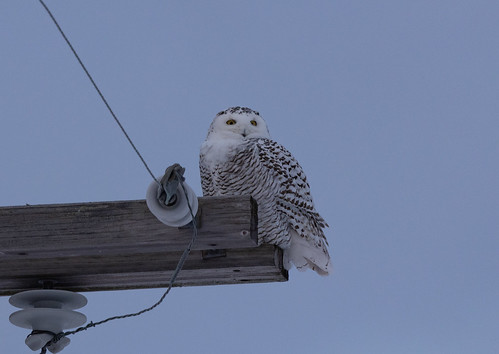
And it was good! Our first cool bird of the day was a Snowy Owl on a power pole on Highway 7. Then we worked our way to the Fringed Gentian Bog, a good place to see feeder birds and the best spot to see a snowshoe hare—one has been hanging out around the boardwalk there. I’ve yet to photograph one of those in winter, so I was particularly excited about that prospect. There were a lot of redpolls there, a few Pine Grosbeaks, and the usual chickadees and nuthatches, but we missed the snowshoe hare—an excellent reason for me to return soon. 

Common Redpoll

Erik called out a magpie in time for me to just barely catch it as it flew out of sight beyond the trees. No photos, but even a split second with a magpie is wondrous. As Erik says, it’s all good.   

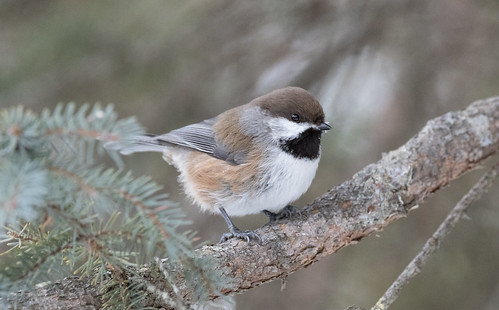
Next we headed to the feeders on Admiral Road. That used to be the best spot in the bog to see Boreal Chickadees, but they’re not showing up there this year. Erik and I didn’t get to the Welcome Center where Boreal Chickadees have been easy this year, but I got some nice photos a couple of weeks ago, and I’ll head to the Welcome Center again next time I’m at the bog. 

Boreal Chickadee

We did see four Canada Jays which is always exciting.

Canada Jay   

Next we headed to the feeders on McDavitt Road, where 60 Evening Grosbeaks were a sight for sore eyes. I’ve seen them there before this year, but I can never get enough of them. We also had a small flock at Mary Lou’s feeders in the northwest corner of the bog’s birding map. That’s also where we had a delightful flock of Wild Turkeys, including a few of the pale, “smoke,” plumage variant. These were my first turkeys of 2022. As Erik says, it’s all good.   

Wild Turkey

Wild Turkey

In recent weeks, lots of people have been seeing Great Gray Owls here and there, but Erik and I didn’t spot any. I still need to see that one for the year, but 2022 still has a long way to go. As we headed out of the bog, we got an even better look at our first Snowy Owl of the day. As Erik says, it’s all good.  

We got to Ely later than we’d wanted, and later than the Bohemian Waxwings come each day to a good stand of fruit trees. Erik had to check out a couple of restaurants, and then we drove around town, looking for and scrutinizing every fruit tree we could find, but no waxwings.  

We made one stop, on Spruce Road, on our way down to Two Harbors, and kept searching for owls, waxwings, and anything else we might see, but it was getting late. Oh, well. My goals for each day aren’t like a child’s list of Christmas wishes from Santa Claus. I was too excited about the three new birds for my year list—a Hoary Redpoll at the Fringed Gentian Bog and both Wild Turkeys and House Sparrows at Mary Lou’s feeders—to feel any disappointment at all.  

Oddly enough, the next morning, while I was working at my desk, something made me go to the window right when a large flock of Bohemian Waxwings was sitting in the maple tree in my front yard. I got two very backlit photos from the window and then rushed outside, but the birds were already taking off. I’m sure I’ll get plenty more photos of them in the coming weeks—they were milling about here and there in Duluth on February 5. The sun behind the Bohemian Waxwings in my pictures gives some of them a soft halo-like aura around hazy, ghostlike bodies. Somehow I couldn’t resist posting one on my website. It won't win any photo contests but, like Erik says, it’s all good.   

Horribly backlit Bohemian Waxwings