Thursday, August 9, 2007
From Winging It
Rick Wright, the editor of Winging It, the newsletter of the American Birding Association, sent a comment for my previous post about anthropocentrism, with a link that Blogger doesn't make into a hotlink or post the entire URL to, so here it is--Winging It" "The Bilingual Birder." As I expected from an essay by Rick Wright, it's insightful and a good read!
Anthropocentrism
 I don't read nearly as many blogs as I should--there are really a lot of great voices out there, and I'm finding blogs as good a source as any for finding out a lot of important news in the birding world. But yesterday I found my way to one of my favorite of all blogs, Mike McDowell's Birding and Digiscoping Blog. Mike is an amazing digiscoper--check out the gorgeous shorebird photos he posted this week!
Anyway, Mike recently wrote about Chipping Sparrows, and was taken to task by an anonymous commenter who accused him of committing the unpardonable sin of anthropomorphism -- attributing a human quality ("sweet") to a bird, which the anonymous commenter said was unscientific. I read the original post, and in addition to the usual lovely photos, the text sounded pretty clear-sighted to me:
Now of course what sounds to our ears like sweet little call notes may actually be Chippy obscenities, or parental nagging, or all kinds of things we don't understand. Mike's post was actually quite objective, pointing out that although Chipping Sparrows do, indeed, seem sweet to our sensibilities, this behavior he was observing at his feeders was decided not sweet. Being scientific means keeping our minds open to all the possibilities, and Mike's post indicated that he was doing just that. And it's important to remember that Mike wasn't writing for a scientific journal, wherein our word choices are necessarily careful and clearly backed up by specific observations. But being scientific in our thinking means keeping out minds open to ALL the possibilities, even ones that don't appeal to our native human desire to think we're the most important species in the universe, unique among the entire animal kingdom. I posted the following comment to Mike's blog:
Wow, do I ever have the Chipping Sparrows in my backyard right now – the most I've observed in four years at our house. A few weeks ago the chattering of begging juveniles was nearly constant throughout the day. Fortunately, I haven't observed any of the adult sparrows bringing food to young cowbirds as I have in past years. Though I'll keep putting birdseed out for the chippies, they almost invariably fight over it - fluttering, grappling and ascending together in violent but remarkable bursts of energy and sound. Oh, it's probably not really the food per se but the fact they're in such close proximity to one another. Still, it's astonishing that such an otherwise sweet little bird is capable of such harsh behavior!
Anthropocentrism is the name I use for the scientific error of putting humans in the center of the universe and thinking we are unique on the planet and in the universe in having intelligence, compassion, and other "human" traits. We share a huge amount of our genetic code and biochemistry with other animals. Pretending we're unique simply because we parade about in clothes and squander natural resources more voraciously and unnecessarily than any other animals is grossly unscientific.Thinking about this today, I also must acknowledge the fact that many people think we're superior in every possible way to animals because a very small percentage of us read and enjoy Shakespeare, many of us enjoy movies and plays, and a disturbingly large percentage of us follow news of Paris Hilton. No bird could create a Beethoven symphony, but then again, neither could any human except one. I think it's time to start calling people on unfair and unscientific accusations of anthropomorphism.
Wednesday, August 8, 2007
My home run kings

So Barry Bonds broke Hank Aaron's long-standing home run record last night. I'm going to keep the asterisk next to Bonds's 756--that number is not as impressive as Aaron's 755, and is only meaningful in an era when one thing we hate way more than cheating is losing.
I grew up in a different time--when Americans ridiculed the Communist Bloc Olympics teams for obviously using steroids. Americans whined about how unfair it was that our clean-cut American boys and girls, all amateurs in the true spirit of the Olympics, were competing against souped-up Communists paid by the state to perform. This was the era parodied by the Zucker Brothers in a Top Secret! scene wherein muscular men in drag posed as Communist bloc Olympic women athletes. I still get a laugh from older listeners when I talk about an incident when I had to feed a baby Saw-whet Owl some exceptionally large mice. I say they were huge--they looked more like rats than mice, like "the Russian shot-put team of mice."
Kids today wouldn't get it. The asterisk next to Bonds's 756 will remain there for those of us who remember when as a society we almost uniformly disapproved of those who cheated in sports by using steroids, associating such cheating with totalitarian regimes who used athletics to "prove" the superiority of their system.
I find it endlessly fascinating that even as more and more we resemble the totalitarian Russia of the 50s--in our red tape and bureaucracy with regard to health care, in our government spying on our citizens, in our citizenry's apathy and sense of helplessness about making a difference--we've also become like them in the use of steroids in sports.
I'm keeping the asterisk next to Bonds's name, and will never forget that Hank Aaron was the one who scored the most home runs during the time that America really was a Democracy.
But truth to tell, my personal Home Run King will always be Ernie Banks. Why? My feelings about the Chicago Cubs were summed up in this essay, written right after the Cubs lost to the Marlins in 2003.
Harry Potter Movie: No owls were harmed...
The wonderful and attentive Katty Geltmeyer, who has helped me a LOT with my Owls of Harry Potter pages, sent this review of Harry Potter: Order of the Phoenix (Movie 5) by the American Humane Society.
Speaking of my Owls of Harry Potter pages, an interesting California-based magazine called Raspberry World reprinted my whole page in their current issue. That was a cool honor! Tragically, they give the online site as birderblog, so no one will be able to find me.
Speaking of my Owls of Harry Potter pages, an interesting California-based magazine called Raspberry World reprinted my whole page in their current issue. That was a cool honor! Tragically, they give the online site as birderblog, so no one will be able to find me.
Tuesday, August 7, 2007
My hero!
As horrible as the I-35W collapse has been, it is disasters like this that separate the wheat from the chaff--that show the mettle of a man or woman. This story in today's New York Times had me crying.

Read the whole wonderful story. I love subscribing to the online New York Times.

Among the dozens of wrenching accounts to come out of the collapse of the Interstate 35W bridge in Minneapolis, the actions of 20-year-old Jeremy Hernandez were a bright spot: Trapped in a tipping school bus with 50 children, he kicked open the back door and began helping them one by one to safety.
Within a day, news outlets across the country were repeating the story of the school bus, along with a sad footnote — that Mr. Hernandez had recently been forced to drop out of an automotive repair program because he could not afford the $15,000 tuition.
That has changed. On Saturday, Mr. Hernandez learned that Dunwoody College of Technology had offered him a full scholarship toward a degree in applied science. He has also received offers of help from dozens of strangers across the country, said Molly Schwartz, communications director for Pillsbury United Communities, which employed him as a gym coordinator for one of its summer programs.
...
Mr. Hernandez was not available to comment on the offer; Ms. Schwartz said he left town for northern Minnesota late on Friday, overwhelmed by the attention and concerned that his co-workers were being overlooked. He spent the weekend fishing. When President Bush’s staff contacted him to request a photo opportunity, “He was just, like, ‘Nope,’ ” she said.
Read the whole wonderful story. I love subscribing to the online New York Times.
Monday, August 6, 2007
The Simpson's Movie: Beaks UP!

Oh my gosh! The Simpsons Movie was wonderful! And it had two hilarious scenes with birds--one noting that birds tend to crash into glass and one that was a homage to Disney movies--or at least a parody of them. I'm a Simpsons fan to begin with, but I think anyone with a sense of humor would enjoy it, even if we don't like the idea of swallows crashing into windows.
Word to the wise--stay for the credits. (But you ALWAYS stay for the credits, right?)
Sunday, August 5, 2007
Day in the Twin Cities


Thursday I went down to the Twin Cities to spend some time with my Journey North buddy Jane. We'd made these plans over a week ago, and I decided to go through with it even after the horrible collapse of the I-35W bridge. Traffic wasn't nearly as bad as I'd expected, though it took almost 4 hours to get to Jane's--I usually go over the bridge, so had to take an alternate route.
Jane and I needed some down time, so she and I decided to just do what we felt like, so we went out to lunch and then to Garrison Keillor's book store, Common Good Books, in St. Paul. What a lovely little place--just like my fantasy perfect bookstore! Well, except for one little thing--my fantasy bookstore would carry my books. I checked out the nature section and then Jane asked at the desk but they hadn't heard of me. Oh, well--it wasn't that disappointing, and then we headed to the movies to see Hairspray--there wasn't a single bird in the film, but it was a joyous riot. I just love Christopher Walken when he gets into dancin' mode.
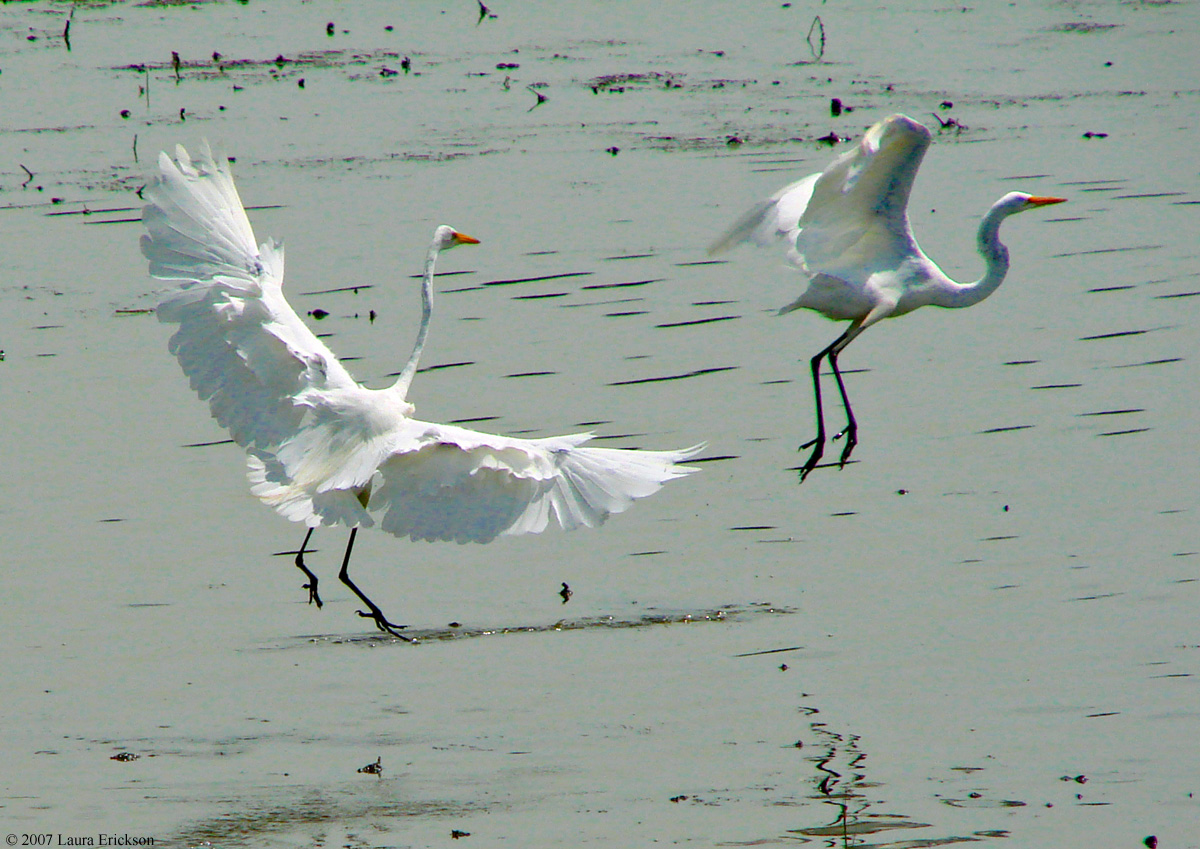
Then yesterday I met up with my friend Julie Brophy. She and I are going to be working on a project next year trying to attract nighthawks to nest on rooftops by providing nest pads, and we were making some plans for the project over lunch. Then we headed to Purgatory Creek to see what we could see. Neither of us had been there before, and we had no clue where the blind was (must be a pretty effective one!) so we missed the Red-necked Phalaropes that had been hanging out there. We did see several species of shorebirds including one Buff-breasted Sandpiper, and lots of egrets. A family with a couple of little kids came by and Julie helped them see some of the birds. But despite the nice variety of birds and the fun of seeing children enjoying them, the low water levels filled with dying, struggling fish made me sad.
I drove home feeling low, listening to news of deaths in Iraq, deaths in the Mississippi, crumbling infrastructure and droughts and hot temperatures, and wondering what we can do to turn things around. Where's Franklin Roosevelt when we need him? Just think--while he was president, we defeated BOTH the Japanese and the Nazis in less than four years while ending the Great Depression and keeping our country as united in purpose as it's ever been since the Revolution. I think the secret of Roosevelt's success was his reminder that the only thing we have to fear is fear itself. It's rather the opposite approach to our current color-coded fear-mongering, keeping everyone on high alert about Iraq even as we make arrangements to provide weapons to Saudi Arabia, the very country that supplied almost all the hijackers on 9/11. I find it all very confusing and demoralizing, but as I said, pessimism and fear are not the way to pull ourselves out of this morass. It's important to pay attention to the loveliness in our midst so we stay anchored to the best of our world. I don't think it's a coincidence that Franklin Delano Roosevelt, who so believed in and affirmed human dignity and and value of each human being, was also an avid birder--he knew what was worth protecting and saving, and why.
We need to be more proactive--about our aging infrastructure, the quality of our air and water, and disappearing natural habitats. The egret was the bird the National Audubon Society has long used as its emblem, since Audubon got its start in the band of people working hard to stop the slaughter of birds for their beautiful plumes. But the egret serves equally well as an emblem for clean air and water, and protecting wetlands and other habitats. I saw an egret flying overhead during television coverage of the I-35W bridge, threading its way through the scene as if knowing that the fates of every creature on earth are inextricably stitched to our survival. Collapsing buildings and bridges, exploding pipes, bombs and automatic weapons and land mines--all of these bode ill for birds as well as us humans. Roosevelt would have understood.

Saturday, August 4, 2007
More "bird-scaring" plastic owls

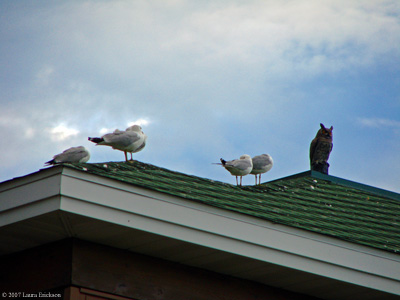
Earlier this week I posted a photo from The Daily Mail: "Fake 'bird-scaring' owl becomes home for family of swallows." To reinforce the lesson the plastic owls aren't particularly scary to birds, Richard Hollis, a birder from Iowa, sent the above photo of pigeons ignoring a plastic owl. And on the Fourth of July, I took this photo of Ring-billed Gulls ignoring this plastic owl in Duluth.
Oh, my gosh! Jack's Backyard
I was interviewed this morning on WEEU's "Jack's Backyard" program. It airs in Reading, PA. But what a humbling experience! Jack Holcomb had actually read 101 Ways to Help Birds, and apparently genuinely loves it for its breadth and scope as well as the depth of information--he actually read the Table of Contents on air! He said this belongs on the shelf next to his birding "bible," Roger Tory Peterson's field guide. I was genuinely honored.
I've been having a rough summer with more problems than I quite know how to deal with. This was such a refreshing and unexpected accolade that my head is still spinning.
I've been having a rough summer with more problems than I quite know how to deal with. This was such a refreshing and unexpected accolade that my head is still spinning.
Wednesday, August 1, 2007
New York Times: In Praise of Tap Water
Yesterday's New York Times has a great editorial about why it's a bad idea to buy bottled water. They cover most of the important points, too. Read the whole editorial here. Here's an exceprt:
Instead of consuming four billion gallons of water a year in individual-sized bottles, we need to start thinking about what all those bottles are doing to the planet’s health.
Here are the hard, dry facts: Yes, drinking water is a good thing, far better than buying soft drinks, or liquid candy, as nutritionists like to call it. And almost all municipal water in America is so good that nobody needs to import a single bottle from Italy or France or the Fiji Islands. Meanwhile, if you choose to get your recommended eight glasses a day from bottled water, you could spend up to $1,400 annually. The same amount of tap water would cost about 49 cents.
Next, there’s the environment. Water bottles, like other containers, are made from natural gas and petroleum. The Earth Policy Institute in Washington has estimated that it takes about 1.5 million barrels of oil to make the water bottles Americans use each year. That could fuel 100,000 cars a year instead. And, only about 23 percent of those bottles are recycled, in part because water bottles are often not included in local redemption plans that accept beer and soda cans. Add in the substantial amount of fuel used in transporting water, which is extremely heavy, and the impact on the environment is anything but refreshing.
Tap water may now be the equal of bottled water, but that could change. The more the wealthy opt out of drinking tap water, the less political support there will be for investing in maintaining America’s public water supply. That would be a serious loss. Access to cheap, clean water is basic to the nation’s health.
Subscribe to:
Posts
(
Atom
)