Laura Erickson's For the Birds

Friday, November 19, 2021

Pileated Poop Shot!!

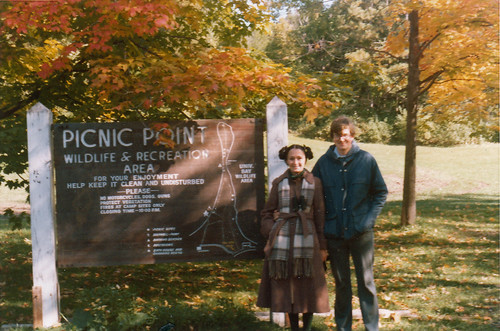
Laura and Russ at my favorite place

Back in the last millennium, when I was a junior high teacher, I used to take my students on bird walks. One morning when we were birding in my favorite Madison, Wisconsin, marsh, a Black Tern flying over pooped, making a direct hit on my hair and face. As is typical for a bird with a watery diet, the splat was a messy one.   

I was in my 20s and very self-conscious—had I been with an adult group, I probably would have been mortified. But I was in full teacher mode, trying hard to model being a mature, nature-loving adult, so even as I was wiping the mess up and cleaning the yucky drips off my eyelashes, I was explaining the difference between the mammalian and avian digestive and excretory systems— how the white parts of the poop were the bird’s urine while the dark parts were fecal matter. And on the spur of the moment, as if this would make the experience more fun and interesting than embarrassing, I told them that this made the Black Tern #1 on an important bird list I was starting up, my “Pooped-Upon List.”

I never committed this list to paper, but over the years, I’ve been pooped upon by some pretty cool birds—both species of waxwings, a Ruby-throated Hummingbird, a couple of warblers, and on one memorable occasion, a Pileated Woodpecker. I got pooped on all the time by birds I was rehabbing, but counting them would have been cheating. Oddly enough, I’ve so far never been pooped upon by either a gull or a pigeon. 

White Tern photo by Bruno Navez

Only once did I ever make an effort specifically to add a bird to my pooped-upon list, when my family went to Hawaii in 2000. One of my most yearned for lifers was the White Tern, and I decided that since my pooped-upon list started with a Black Tern, I should bring it full circle. So when I spotted a White Tern perched on a wire at Waikiki Beach, I parked myself strategically below and waited. Russ and the kids, never having been junior high teachers, found this mortifying and spent the next half hour getting ice cream and eating it as far from me as possible.  

When I started photographing birds, taking pictures one at a time, I’d end up with a lot of near-misses—a bird perfectly composed except for its eyes being closed in mid-blink, or its head all blurry because it turned just slightly as I snapped. That’s when I figured out what the “burst” function was all about—when a bird was holding still, I started taking at least 5 or 6 shots in rapid succession, having a much higher probability of at least one being good. That’s also how I took my pooped-upon list to the next level—and one requiring much less cleanup for me. I started getting photos of birds pooping. 

Over the years, I’ve gotten poop shots of Bald Eagle...

Bald Eagle

Atlantic Puffin... 

Another Atlantic Puffin poop shot!

Atlantic Puffin pooping!

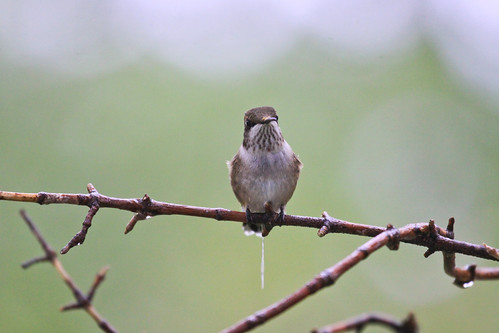
Ruby-throated Hummingbird...

Ruby-throated Hummingbird

Turkey Vulture...

Turkey Vulture pooping!

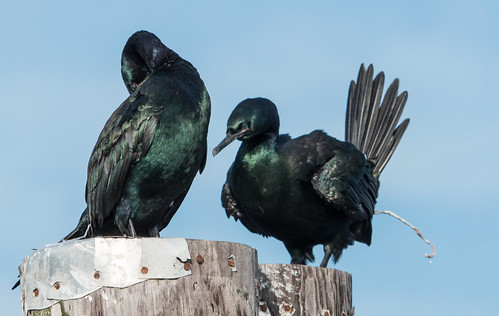
Brandt’s and Pelagic Cormorant...

Brandt's Cormorant pooping!

Proper cormorant etiquette

Bobolink...

Bobolink pooping!

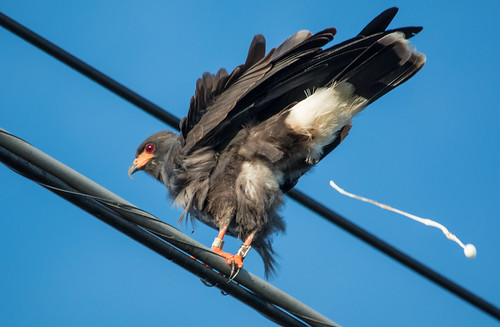
Snail Kite... 

Snail Kite pooping!

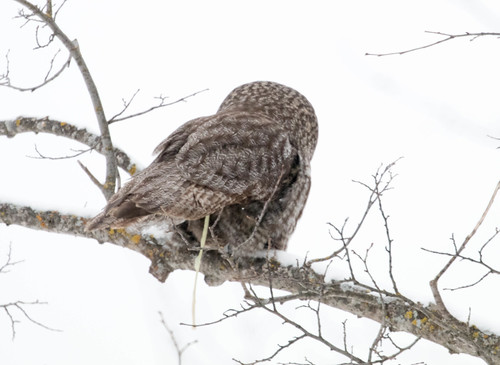
Great Gray and Northern Hawk Owl... 

Great Gray Owl pooping!

Northern Hawk Owl

Purple Gallinule... 

Purple Gallinule pooping

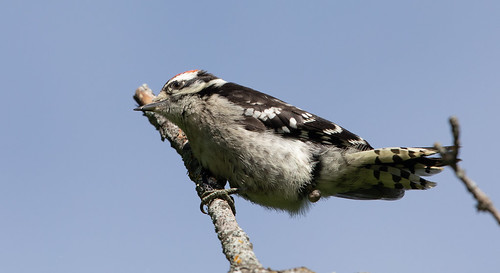
Downy Woodpecker... 

Young Downy Woodpecker poop shot!

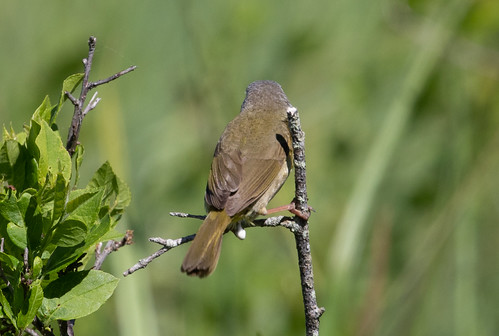
Common Yellowthroat, and more. 

Common Yellowthroat pooping!

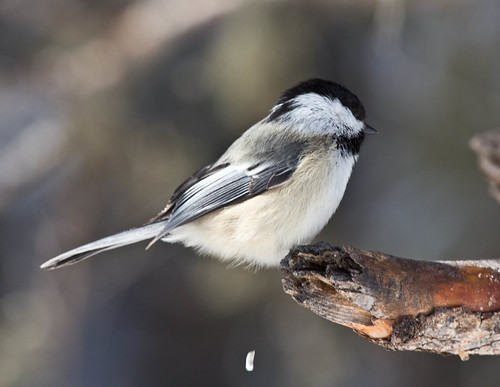
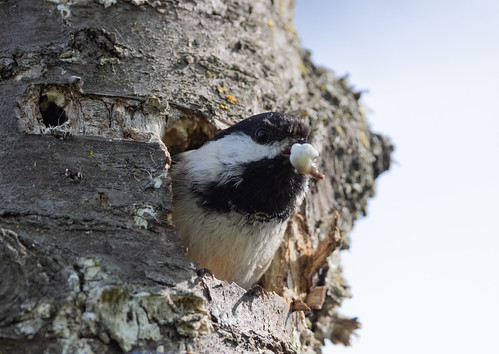
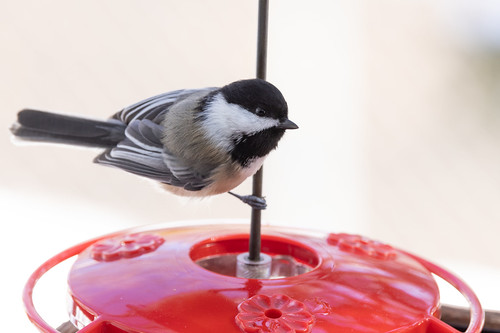
I take so very many photos of Black-capped Chickadees and Blue Jays that you’d think I’d have plenty of poop shots, but I’ve lucked into only a single one for each, unless you count the fecal sacs adult chickadees carry out of the nest cavity.   

Black-capped Chickadee pooping!

Blue Jay poop shot!

Black-capped Chickadees nesting in yard

Perhaps my favorite poop shot of all was of a Cerulean Warbler at the Magee Marsh in Ohio during their wonderful birding festival, “The Biggest Week in American Birding.” 

Cerulean Warbler Poop Shot! (Perhaps my finest moment as a photographer!)

My birding friend Curt Rawn was standing next to me, his hand in the right place at the wrong time or the wrong place at the right time, so while I was getting the photo, he was actually getting pooped upon, and let me take photos of that. 

Cerulean Warbler Poop! On Curt Rawn's hand!

Cerulean Warbler Poop! On Curt Rawn's hand!

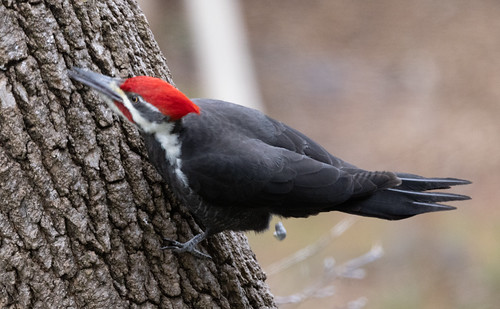
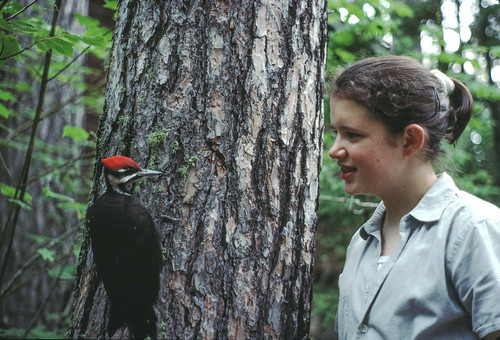
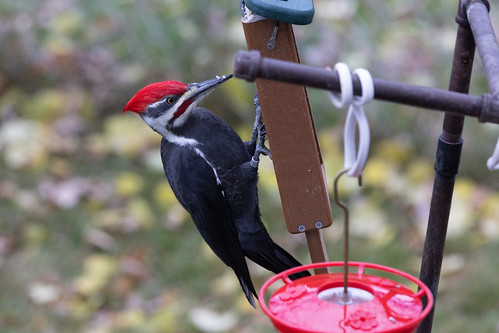
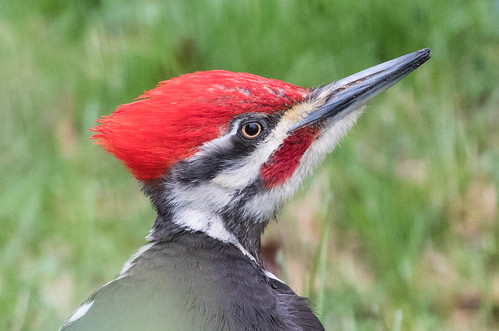
When I was pooped upon by a Pileated Woodpecker, I was standing right by the trunk examining some lichen on the bark when I felt the plop on my head. When I looked up, the bird gave a yell and flew off—I didn’t actually see it pooping. (I'm not sure I'd even known it was there until that moment.) And although I’ve taken thousands of Pileated photos, I’ve never caught one in the act until just this week. I had my home office window open to get photos of the Rufous Hummingbird and while it was gone, my favorite backyard Pileated flew in to a box elder with a perfect opening between trees for me to take some pictures. Suddenly, he lifted his tail away from the trunk and let go. And I have the photographic proof. 

Pileated Woodpecker
Here's how he was sitting...
Pileated Woodpecker
when suddenly he backed up and...

Pileated Woodpecker
voila!!!

My career has never been very lucrative—I earned more money teaching in Catholic schools in the 1970s than I have in most of the years since—but you can’t measure wealth in mere money. Donald Trump, Elon Musk, Bill Gates, Warren Buffett: I bet not one of them has ever gotten a photo of a Pileated Woodpecker pooping. And that makes me feeling pretty darned rich.  

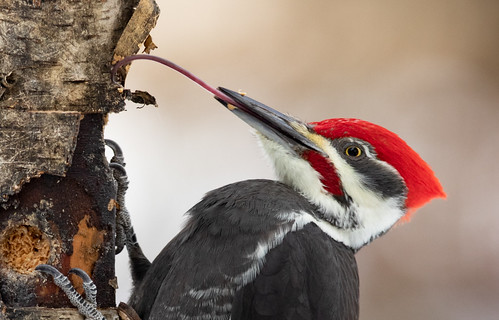
Pileated Woodpecker tongue!


Thursday, November 18, 2021

How I know that "my" hummer is a Rufous, and why it's important

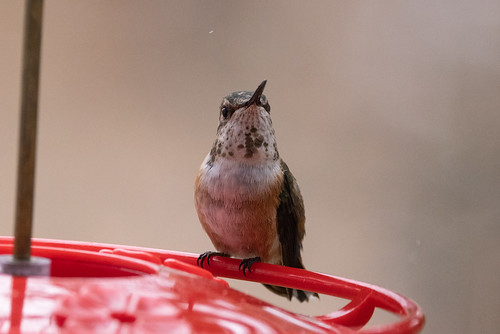
Rufous Hummingbird

Recognizing birds is an essential skill for a birder, and as the author of the American Birding Association’s Field Guide to the Birds of Minnesota, I’m supposed to be an actual authority on bird identification. 

But important as recognizing birds is, it’s never been my primary interest. When I was a teacher, recognizing my students was essential, too, but hardly the point. On the first day of school, back in the days when 1-hour film development was a new thing, I’d bring my Olympus camera, loaded with a new roll of film, take a picture of each child, get them developed after school, and take the photos home to construct an identification guide for each class. 

In the way that I needed to learn a whole new batch of birds when Russ and I first went to Arizona, I needed to know each student’s range to put them in the correct guide: the Field Guide to Mrs. Erickson’s 6th Grade Science Class had an entirely different set of students than the Field Guide to Mrs. Erickson’s 7th Grade Math Class.  

In the classroom, the official range map—my seating chart—was very helpful, but in the same way that individual birds can sometimes be found out of range, occasionally a couple of kids would swap seats to try to throw me off. I couldn’t focus on a lot of elements of plumage—whatever a child was wearing in the first photo was bound to be different the very next day. Through the first week, I’d add helpful “field marks”—especially vocalizations and behavior—to cement my memory of each child. But as with bird identification guides, my field guides to my students quickly became extraneous as we fell into a new year of math or science or reading or music. 

At this point, the birds I find in Duluth are usually ones I recognize as easily as I recognized my students a few weeks after school started. But now and then, even today, I need to focus on identification, cracking out field guides and even more specialized resources. 

The hummingbird coming to my feeder right now is a case in point. The vast majority of hummingbirds appearing anywhere in the eastern United States are Ruby-throats. In spring and summer, I hardly even glance at those I see anywhere around here unless I'm trying to photograph them. Having a lot of experience does mean that I can take in a lot of details efficiently, but still, if there were an outlier hummingbird during the time when so many Ruby-throats were about, I could very easily overlook it, in the same way that if a Carolina Chickadee ever worked its way to Duluth, chances are I'd never notice unless it was a singing male. 

I've seen one probable Rufous Hummingbird in northern Wisconsin on August 11, 2007. I only saw that one because the homeowner called me telling me there was a "weird" hummingbird with all the Ruby-throats at one of his window feeders. I didn't get confirming details to exclude the rarer possibility that it was an Allen's Hummingbird.
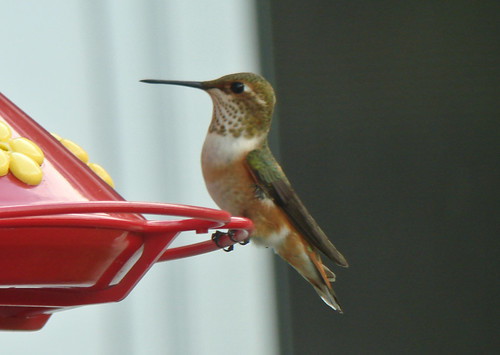
Selasphorus sp.-- probably a Rufous Hummingbird
The August 11, 2007 bird in northern Wisconsin. I'm guessing this is an immature male because of how evenly distributed the "spangles" on the throat are. 

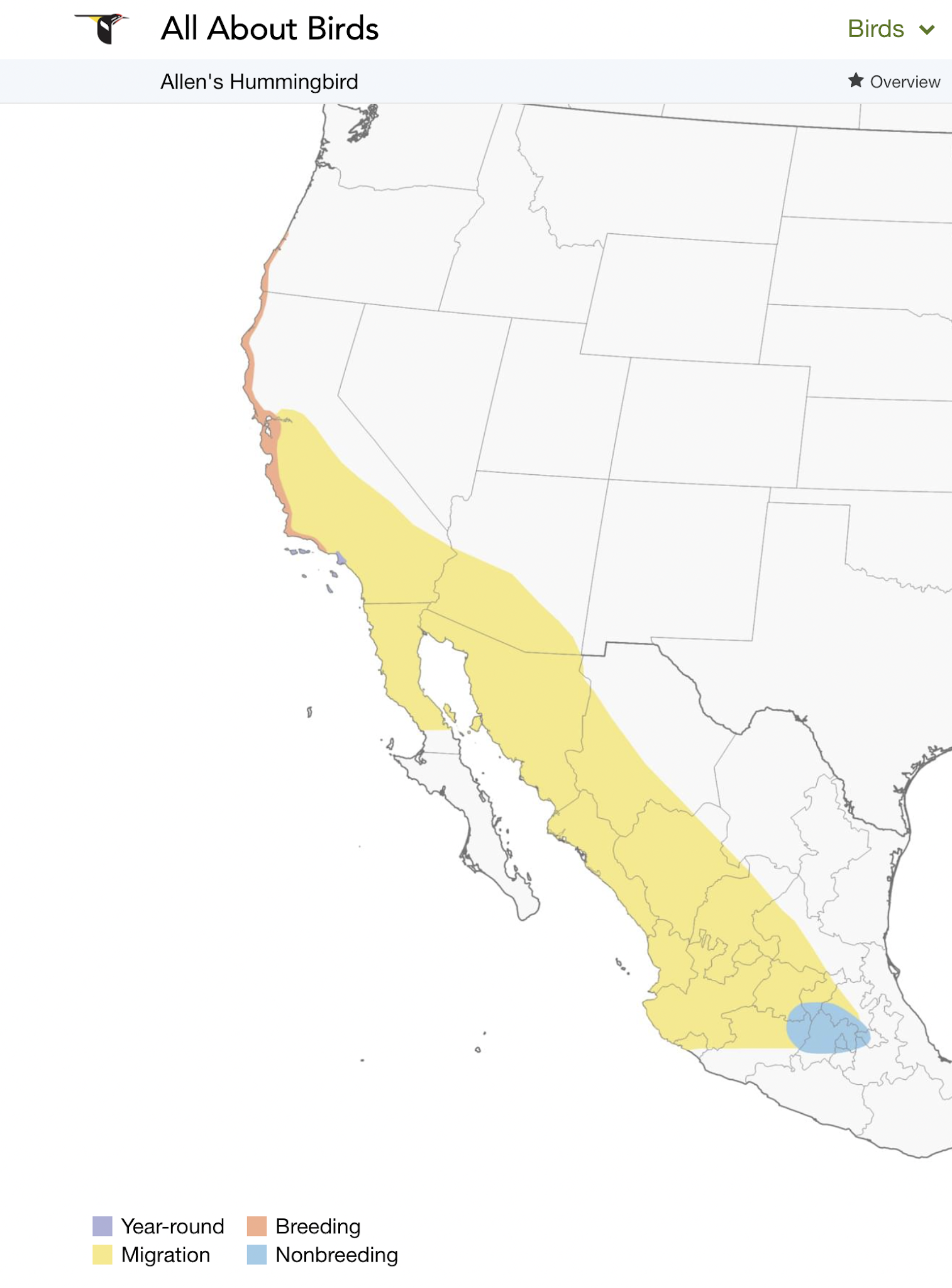
A handful of Allen's have appeared here and there in eastern states, but none have ever been identified in Minnesota—comparing their range map with that of the Rufous suggests why. 

Traditional range map of Allen's Hummingbird

Traditional range map of Rufous Hummingbird

The Land of 10,000 Lakes has had our share of outlier hummingbirds over the years—Calliope, Costa's, Rivoli's, Anna's, and Mexican Violetears, along with the one that has appeared most often, the Rufous Hummingbird.  

Rufous Hummingbird at feeder, November 2004
The hummingbird that appeared at my feeder from November 16 –December 3, 2004

It’s important to know for sure who the one showing up on Peabody Street right now is, because the likelihood of survival as November proceeds is much more probable if this is a Rufous Hummingbird than any other species. Why? Rufous Hummingbirds breed the farthest distance from the equator of any hummingbirds. In spring, the main population migrates north along the Pacific slope, they breed in the Pacific Northwest and Alaska, and then work their way south along the Rocky Mountains before they get to the American Southwest and finally to their wintering grounds in southwestern Mexico. 

Rufous Hummingbird
This Rufous Hummingbird is exactly where they belong in October, in Mexico.  I photographed him in 2006.

Outlier Rufous Hummingbirds sometimes appear in the eastern states, especially during fall and winter. Most avian outliers end up dying without producing young, but individual Rufous Hummingbirds wintering in the United States are increasing in number, meaning these outliers must be passing their genes on to new generations. Normal Rufous Hummingbirds may now be at a disadvantage as extreme hot temperatures and droughts grow ever more common and as tropical deforestation damages their winter habitat, giving the outliers an evolutionary advantage. 

It’s fairly intuitive that hummingbirds wintering in the Southeast can survive winters down there, but we’re also seeing individual Rufous Hummingbirds surviving entire winters in Ohio and Pennsylvania, even with subzero temperatures. Confirming the Peabody Street bird's identity helps us understand changes in Rufous Hummingbird migration patterns in recent decades, giving us a glimpse at the species' evolutionary biology in real time.  

Rufous Hummingbirds are tiny, averaging a bit lighter in weight than the heaviest Ruby-throated Hummingbirds, tipping the tiny scales at 2–5 grams compared to the Ruby-throat's 2–6 grams. But they're not all that much smaller than the tiniest bird that regularly winters up here, the Golden-crowned Kinglet. Indeed, the weights of the two species overlap a bit, Rufous Hummingbirds averaging that 2–5 grams compared to the kinglets’ 4–8 grams. 

Golden-crowned Kinglet

The very lightest Black-capped Chickadees weigh almost double what the heftiest Rufous Hummingbirds do—9 grams vs. 5 grams. Chickadees have been exploring the hummingbird feeder I set out on my office window tray feeder, and they look enormous compared to the tiny hummer. 

Black-capped Chickadee

Allen’s Hummingbird is almost identical to Rufous, but one would assume Allen’s isn’t nearly as hardy—it breeds strictly along a narrow coastal strip of the Pacific Slope in California and Oregon and as a whole avoids mountains except in the Southwest and Mexico, wintering in Central Mexico. I'd think that in the exceptionally unlikely event that an Allen’s did find its way to Minnesota in November, its prognosis would be dire, except for the fact that an Allen's turned up in New Glarus, Wisconsin, sticking around in one yard from 26 November through 26 December just last year. That bird's identity was confirmed by a bird bander. 

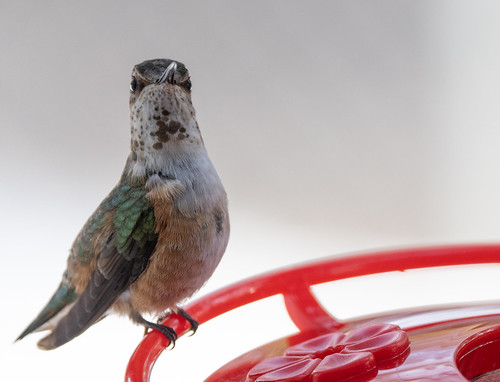
So how do we confirm that the bird in my yard is not an Allen’s? To tease this out, we first have to figure out how old and what sex it is. Its back is green without any of the rich rufous plumage of adult males of either species, except on the flanks. That excludes adult male of either species. It has quite a few dark feathers on the throat, especially concentrated in the center. Immature male hummingbirds often get these (though they often look more uniformly scattered, like that Selasphorus I photographed in Wisconsin), but older adult female Rufous and Allen’s do get throat markings, especially concentrated in the center. And those markings exclude young females. 

Rufous Hummingbird

To figure out any more, a bird bander would take measurements—impossible if the bird isn’t in hand—and get a close look at the bill and the tail feathers. 

Hummingbird banding with Nancy Newfield
Hummingbird bander Nancy Newfield examines the bill of a Rufous Hummingbird with a magnifier. Taken in Louisiana in August, 2002.

Baby hummingbirds start out with what’s called a “corrugated” bill, as if the outer layer is full sized and a wee bit baggy until, as the beak grows, those vertical wrinkles smooth out. This is fairly easy to see in hand, especially if you're using a jeweler's loupe or other magnifying aid, which most hummingbird banders do, but seeing those corrugations is way trickier in the field. I’ve taken a bazillion photos of the hummingbird at my feeder, some very high resolution, and I can't see a single corrugation—the bill looks smooth and perfect in every one of my photos. Unfortunately, I’ve been mainly shooting at a fairly high ISO, so the photos are grainier than ideal, but nevertheless, my photos do support a higher probability that this is an adult female than a young male. 
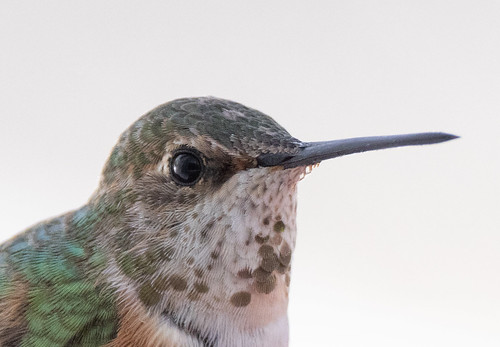
Rufous Hummingbird

Now the shape of the tail feathers becomes the critical issue. In a hummingbird bander's experienced hands these are very easy to see, but it’s way, way trickier to get photos that clearly show them. The best we’ve managed so far with this bird are screen shots extracted from two slow-motion videos I took remotely. The best photos I’ve got are not in good focus but do show the shape of the critical r2 and r5 feathers—that is, the feather next to the central tail feather and the outermost tail feather. There's a notch on r2 that is clear enough to exclude Allen’s, and r5, the outer tail feather, appears wider than it should be on an Allen’s.  


So with this much evidence supporting my bird being an adult female Rufous Hummingbird and no evidence supporting it being an Allen's Hummingbird, I'm satisfied. And now I'm hoping that she heads out. 

I was hoping she'd leave today. It's very windy outside, though coming from the WSW it's at least tail winds. But hummingbirds migrate by day, usually taking off in mid-morning, and I'm still seeing mine as of 2:20 pm, so I expect she'll still be here tomorrow. The last time I had a lingering hummingbird, in 2004, she lit out about 10 am on December 3.  I don't want this one to stick around that late in the season, but even if she does, her being a Rufous means she has a pretty good a chance of survival, helping her species adapt to a new winter range.  
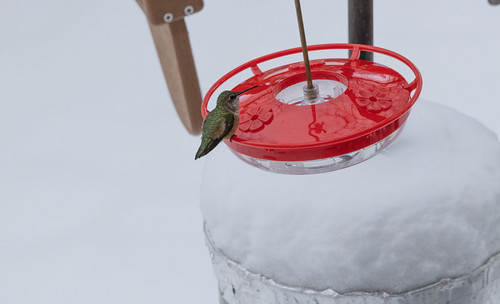
Rufous Hummingbird

Tuesday, November 16, 2021

Pileated Woodpecker: Bird of the Year

Pileated Woodpecker tongue!

Every year, the American Birding Association chooses a Bird of the Year. As they explain: 

We aren’t seeking the rarest, most endangered, or most sought-after species, nor do we seek overexposed “greeting card” birds. We aim to pick species that are charismatic and accessible enough to be spark birds, but that also remain favorites for those who have been into birding for years. On top of that, we want a conservation story to tell. And we strive to feature a variety of artists and a variety of visions and styles.

Their announcement last December, naming the Pileated Woodpecker the Bird of the Year for 2021, was especially wonderful for me, because the Pileated is one of my personal Top Ten Favorite Birds. Of course I had to purchase a t-shirt...

and also the gorgeous ABA Bird-of-the-Year poster autographed by the artist, Juan Travieso. 

And my dear friend Steve McInnis sent me the coolest can of beer from Dogfish Head, an independent craft brewery in Delaware near ABA headquarters that made a limited edition batch of beer in honor of ABA’s bird of the year. It’s whimsically called Binoculager. The original artwork of a pair of Pileated Woodpeckers on the can is astonishingly cool. 

Why am I so in love with Pileated Woodpeckers? Before I even set out on my first outing as a birder, on March 2, 1975, I was smitten with the Pileated illustrations in my field guides. I didn’t see one for over a year, but on the evening of June 5, 1976, Russ and I saw one at Hartwick Pines State Park in Michigan—it flew past close enough that I felt the wind from its wings on my face, and alighted close enough that Russ managed to get a photo with his macro lens. The bird is very tiny in the middle of the photo, but I was nevertheless thrilled.  

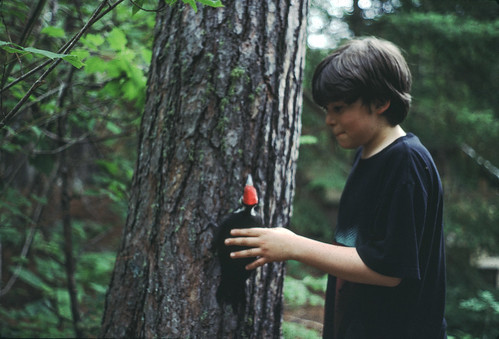
Before Russ and I moved to Duluth, it was a red-letter day whenever I managed to see one, and even up here they were few and far between for more than two decades. But in 1998, I got to rehab a recently fledged Pileated for three weeks—that was truly one of the most wonderful experiences I had as a rehabber. Gepetto liked to cling to my arm with his face next to mine. Very often he’d put his beak right next to my ear and insert his long, long tongue into all the folds of my ear. How could anyone not love a bird who did that?  

GepettoTomLaura.jpg

GepettoKatie.jpg

GepettoTom3.jpg

I got my first photos of a backyard Pileated in December 2004, and that one individual wasn’t all that regular in my backyard. 

Pileated Woodpecker

Now I see them most days, and have managed to get a lot of good photos and videos. Right now, one banded male has been showing up daily for a few weeks. He was almost certainly banded up at Hawk Ridge, but I’m trying to tease out the band numbers to confirm that. The USGS band is on his right leg, and it’s very tricky to see at all, much less to read the numbers—when woodpeckers perch on vertical structures, they hold those numbers literally close to the chest. But on November 3, I got a photo clearly showing the digits 115. 

Banded Pileated Woodpecker

Then this Saturday, the 13th, I got more photos of the band with the seam visible, showing that 115 (and possibly 1154) is at the start of the band number, which ends with 8.  

Banded Pileated Woodpecker

It snowed Saturday night, and on November 14, I got a nice clear photo of the band, but it was covered with snow!! Apparently their legs really are cold, and their feathers really do prevent much heat from escaping their warm bodies. 

Banded Pileated Woodpecker

On November 15, I got a photo that shows the digits 365. 

Banded Pileated Woodpecker

USGS bands have nine digits, so at this rate I should have the whole number within a few weeks, assuming this bird keeps coming. 

As much as I love birds, and as much as I have some special favorites, only a very few get my heart racing just to see them. Of the 11 species they’ve selected as Bird of the Year so far, four of them fit the bill—Evening Grosbeak and Common Nighthawk, "BOY"s from 2012 and 2013, are special favorites not only for lots of wonderful outdoor experiences but also because I spent a lot of time rehabbing individuals. I had one dear nighthawk named Fred for many years as a licensed education bird. Right now my heart stops every time one particular Rufous Hummingbird shows up at my feeder. That tiny dynamo and one that showed up in November 2004 stuck around for many days—it feels like a cosmic blessing that they chose my neighborhood to visit along their arduous migration. That means the 2014 Bird of the Year also is one of my very favorites. 

But the Pileated Woodpecker must be embedded even deeper in my heart, because I’m going to have a very hard time letting go of this year’s bird, and will keep my Bird of the Year poster and beer can displayed in their place of honor in my home office permanently. There’s still over a month before the 2022 Bird of the Year is announced, and a month and a half before the Pileated’s reign ends. But it will continue reigning in my heart as one of my dearest birds for the rest of my life. 

Pileated Woodpecker


Sunday, November 14, 2021

Hummingbird Update

Rufous Hummingbird 

The Rufous Hummingbird who showed up in my neighborhood before Halloween was still visiting at least three people’s feeding stations this weekend, including mine. I’ve kept one of the locations a secret, but I did tell a few birding acquaintances that she was coming to my feeder and one of the other backyards, and I provided the same info for a small text message group of trusted birders. 

Quite a few people showed up to see it the first couple of days after the word got out last week. I was mostly babysitting at my daughter’s house, but Russ was around and confirmed what I’d noticed in my own limited time here—everyone kept their distance and was extremely respectful of the bird’s needs. 

I try my hardest to be an ethical birder, and work especially hard to protect the birds I’m personally responsible for—the ones visiting my own property. This Rufous Hummingbird seems shyer than the one who visited me back in November and December of 2004, but I did get some excellent video by setting up my camera on a tripod on the front porch and staying inside during its visits. 


There’s a lot of foot traffic on my block and plenty of little children running about, but this is where she chooses to be right now. My 2004 bird encountered a lot more birders and didn’t appear to be visiting any other yards, but she stuck around day after day for 2 ½ weeks, surviving a blizzard and one night when the temperature plunged to single digits. Even when temperatures were as low as 20º F, I could watch her darting about in the upper branches of my big white spruces, fly-catching for tiny insects in and near the buds. She left at midmorning on a mild day—it was in the 20s—and seemed perfectly healthy after feeding heavily, so I know she had at least a chance of long-term survival. 

People have voiced a wish that someone would trap her and bring her to a greenhouse or transfer her south or something. During a fierce blizzard on December 2, 2004, I couldn't help but leave a window to my home office open for that little rufous, and sure enough, she flew right inside. But she was simply curious, not seeking warmth. She flew to the center of the room near the ceiling, hovered in a tight circle studying the room, and then darted right back outside into the snow and wind. I wondered if she was thinking, "Well, she's no Martha Stewart." Whatever her reasons, she clearly chose to be outside on her own terms rather than in a snug human habitation.

My real-life personal experiences with that Rufous Hummingbird informed how I dealt with this year’s visitor, along with lots of emails and phone conversations with actual hummingbird experts during that previous visit, and information gleaned ever since, from scientists such as Scott Weidensaul who are researching the increasing numbers of Rufous Hummingbirds wintering in the eastern United States. Cold as it’s been here, with nighttime temperatures in the 20s, one banded Rufous Hummingbird near State College, Pennsylvania, survived air temperature lows of -9º F and wind chills of -36º F in January 2014.

But someone has been publicly lambasting me for telling birders about this hummingbird, and texted to the birding group, “How about leaving this stressed hummingbird alone so that it might survive?” When I mentioned Weidensaul’s work, this person claimed to be familiar with it but mansplained that “Seven degrees of latitude is significant.” 

State College, Pennsylvania is at 40.7º N, and according to my GPS, my backyard is at 46.5º N. Of course that six degrees of latitude is significant. But the latitude of southern Alaska, where Rufous Hummingbirds breed, is 60º N. Unless our mansplainer subscribes to the “Beam me up, Scottie” theory of bird migration, he must realize that a hummingbird traveling from its breeding range in Alaska and the northern Rocky Mountains to anywhere south of here for the winter must cross 46.5º N at some point along the arduous journey. This year Peabody Street happened to be along this one's path. 

Rufous Hummingbird

She spends much more time away from my feeders than at them, and doesn't appear any more often at the two other feeding stations. This is still autumn, but even in the dead of winter, Scott Weidensaul’s work has established that hummingbirds spend a lot of time catching insect food in addition to nectar. Indeed, two nice birders named Brandon and Trey who were at my house today (Sunday) told me that they'd watched this hummingbird hawking for insects at the top of a snow-covered spruce tree next to my house—the temperature was 30 degrees.

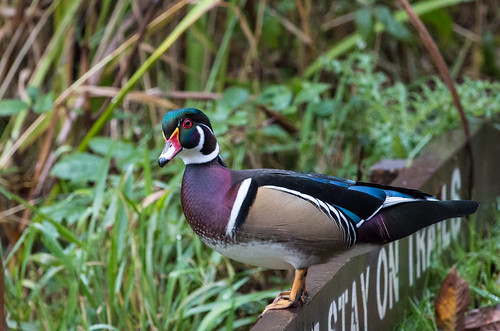
Wood Duck

My critic is an avid duck hunter, in both the photographic and the shooting sense, so it seems a bit inconsistent for him to be so concerned about stressing out one perfectly healthy hummingbird who seems to be doing well in my neighborhood and is hardly being held here against her will. She's in the middle of her migration, as are the ducks he aims for during Minnesota's waterfowl season. The most abundant duck in America, the Mallard, has a population less than half that of Rufous Hummingbirds—an estimated 9.4 million Mallards compared to 22 million Rufous Hummingbirds. Wood Ducks, numbering roughly 3.5 million, are barely a sixth as numerous as Rufous Hummingbirds. And two other ducks popular with hunters, Canvasbacks and Redheads, each number less than 1 million—significantly less than 5 percent of the Rufous Hummingbird population. I’m not saying these numbers measure the relative value of an individual bird’s life, nor am I implying that licensed duck hunting isn’t a legitimate sport—indeed, I purchase at least one Federal Duck Stamp every year. But people respectfully enjoying seeing and photographing a hummingbird in November are causing a lot less stress to her as an individual than people shooting at ducks are to those individuals, not even counting the individual ducks that are outright killed.

Rufous Hummingbird

I’m not used to having to defend my ethics and, in this case, I’ve been working especially hard to accommodate the needs of the hummingbird in both providing food and limiting birding pressure on her. But public criticism cuts deep, especially when it involves a bird I’m so emotionally invested in. 

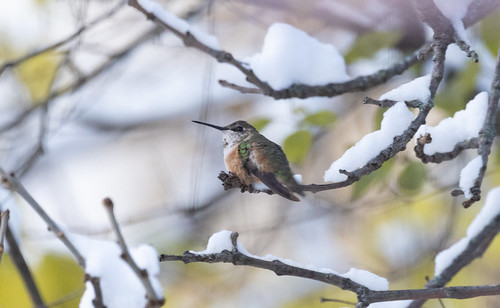
Most of the local birders have seen her now, so only a handful birders showed up on Saturday and so far on Sunday. I swapped out the 30-degree sugar water for very warm sugar water before dawn after Saturday night’s snowfall, and sure enough, she was back at my feeder at first light today. After drinking her fill, she perched for several seconds on a snow-covered branch before heading off once again. I got photos through the window of her at the feeder and on that branch. 

Rufous Hummingbird

I don’t know how long she’s going to remain on Peabody Street—her fate is in her capable wings, not my clumsy hands. She will certainly move on sooner or later, and as far as I’m concerned, the sooner the better. But as long as she keeps visiting my yard, I’ll keep the home fires burning and the sugar water fresh.

Rufous Hummingbird