Laura Erickson's For the Birds

Tuesday, May 17, 2016

Spring Migration Update

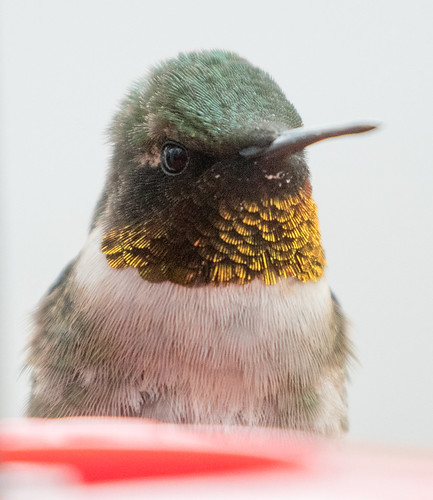
Ruby-throated Hummingbird

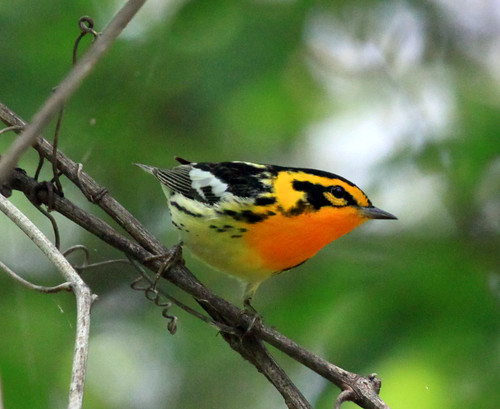
More and more birds are arriving in the north woods now. On Thursday the 12th I had my first hummingbird of the season along with a Least Flycatcher and Black-and-white Warblers in my own yard, and I’ve had a few warblers here and there. A few Yellow-rumps and several Pine Warblers were on territory on Big Pete Road in Port Wing on Monday the ninth.
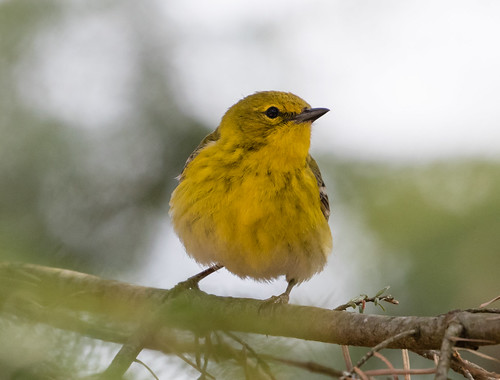
Pine Warbler

On Sunday the 15th at the Western Waterfront Trail,, I saw Baltimore Orioles, Black-and-white and Palm Warblers, another Least Flycatcher, and my first singing catbird of the season.
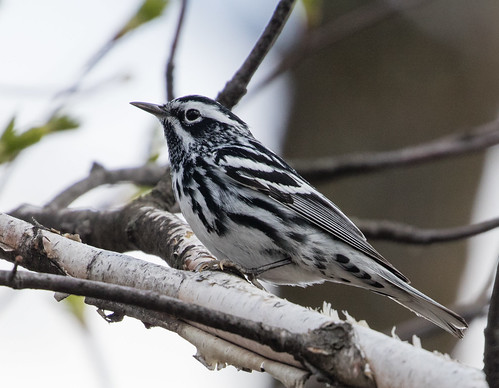
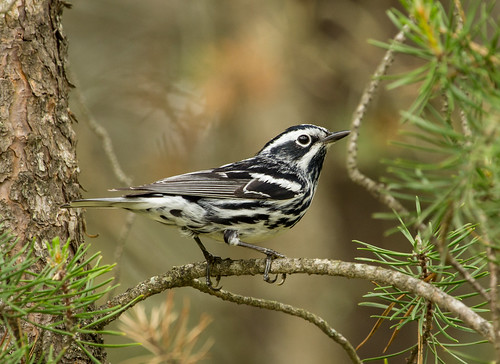
Black-and-white Warbler

And a real rarity flew over my head—a Little Blue Heron. I couldn’t track it down to photograph it, but Peder Svingen and Larry and Jan Kraemer noticed my eBird report and refound it that afternoon, and soon lots of birders managed to see it. It was still present on Monday the 16th.
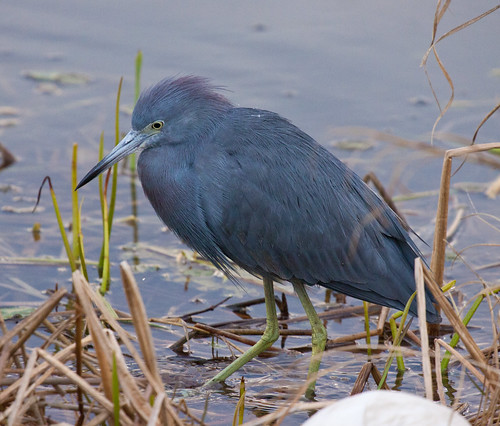
Little Blue Heron
This is not the actual Little Blue Heron seen in Duluth—I photographed this one in Florida.


My Thursday hummingbird didn’t stick around, and neither did the one I saw several times on Saturday. I’ve not had more than three White-throated Sparrows at one time, and not one Harris’s or White-crowned Sparrow yet. I never had as many as a dozen Fox Sparrows or Juncos in April—they managed to sneak through on their way north without many stopping here.
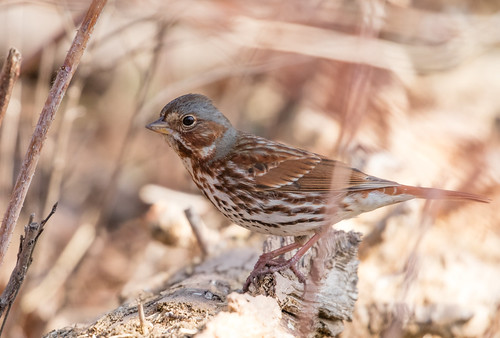
Fox Sparrow

Dark-eyed Junco

At least several Chipping Sparrows, two pairs of Song Sparrows, and two or three pairs of robins seem to be setting up territories near and in my yard.
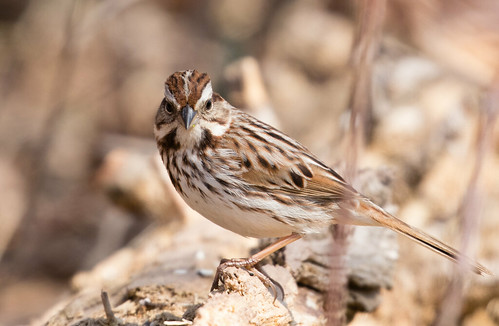
Song Sparrow

Chickadees, Red-breasted Nuthatches, and Hairy and Downy Woodpeckers are also nesting near my yard, and a pair of Pileated Woodpeckers is apparently nesting somewhere near here.
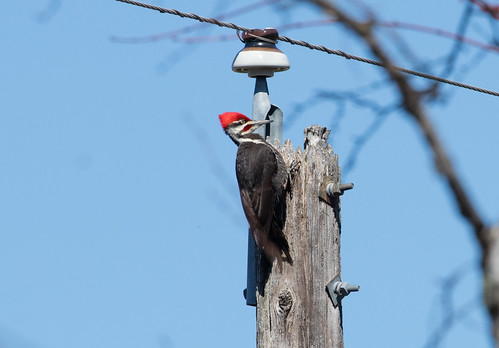
Pileated Woodpecker

A male Red-bellied Woodpecker with a slightly deformed bill has also been coming regularly.
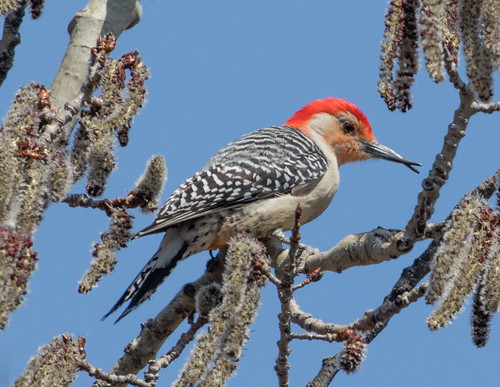
Red-bellied Woodpecker with deformed bill

Most days I’ve had at least one Ruby-crowned Kinglet or Brown Creeper, but other little migrants have been few and far between.
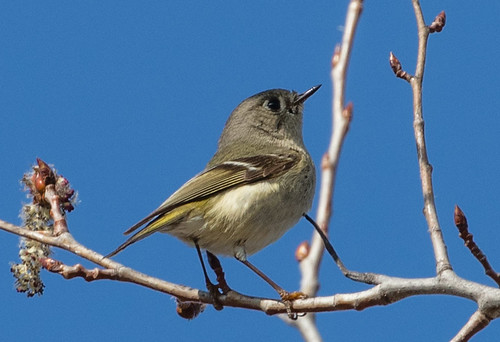
Ruby-crowned Kinglet

Brown Creeper

I’ve seen hawks and eagles flying over, and a Hermit Thrush a couple of weeks ago. But overall, there has been surprisingly and disappointingly little bird activity in my yard so far this season.

I’m sort of glad the weather has consistently stayed cool up here, delaying migration until we have more emerging insects. Birders usually like warblers arriving before we have any leaves, but I’m always very nervous when we get a flood of migrants before there’s a good supply of tiny hatching caterpillars on newly opening leaves to provide ample food for warblers and other migrating songbirds. This year it’s backward—thanks to that bizarre day when temperatures reached the 90s last week, trees are leafing out on the early side, so ironically the flood of birds this year may be arriving after a big chunk of their main food supply has come and gone.

As I’ve gone through "For the Birds" transcripts and recordings from years past, I appreciate more and more how phenology is regular and predictable, yet every year is unique. Paying attention to which birds appear when, in what numbers, is interesting the first spring. Somehow it’s even more interesting the following year, and year after year, even as spring proceeds pretty much normally, the fascinating differences keep us increasingly engaged. Writing down our daily sightings helps us keep track of each year, and keeps us eager and excited about the next year. Entering our daily sightings into the Cornell Lab of Ornithology’s online service, eBird.org adds an important element to our fun by making our personal sightings available to a world of ornithologists and birders. My Little Blue Heron was fun to see, but I felt way more joy seeing the photos and excited words of other birders who went looking for it after I reported it on eBird. After all, most gifts, like spring itself, bring us even more pleasure when they are shared.
Wednesday, May 11, 2016

Thirty Years Ago

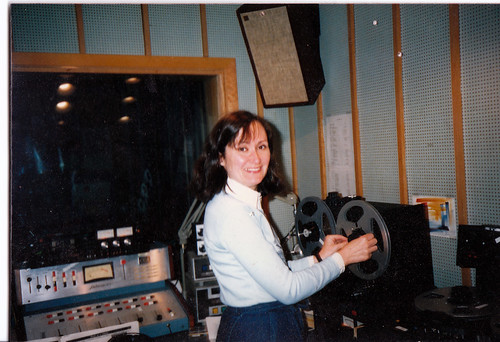
Laura producing For the Birds at KUMD in the '80s.
Laura at KUMD around 1987.
Thirty years ago, on May 12, 1986, at 7:35 am, my very first "For the Birds" program aired on KUMD. If anyone had told me just weeks before that I’d ever talk on the radio about anything, I’d have laughingly responded, “Inconceivable!”

And it really was inconceivable. We had a radio club in our high school, but only boys were allowed on air, and I was completely intimidated by the whole idea anyway. I saw myself as the elementary school teacher type, and that is what I became. 


But in 1981, after Russ got his Ph.D. and took a position as research scientist with the EPA up here, I settled in as a stay-at-home mom. We’d come here from Madison, Wisconsin, where as a volunteer I’d led field trips and taught free beginning birding classes for Madison Audubon. But Minnesota’s top birder lived in Duluth and made his living doing those things, so my poor offerings were both unwelcome and unnecessary. I floundered for a while, not sure where I fit in anymore. At that point, while my kids were babies, I had plenty to keep me busy with, anyway.

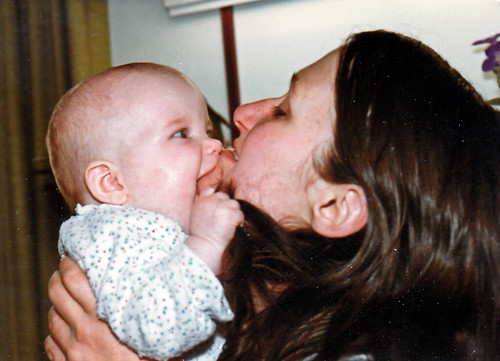
Mother and Child

I may not have seen myself as a radio producer, but I became a voracious radio listener, and one of my great joys was listening to JohnCiardi’s guest spots on National Public Radio talking about the etymology of words and expressions. He had a wonderful, gravelly voice unlike any professional radio broadcaster, and his enthusiasm and genuine passion for his subject was contagious. I associated his name with a poem that suddenly started rattling around in my brain, but all I could remember for sure was the last line. I didn’t know why I associated it with him, but one day in early 1986, I wrote to him in care of NPR asking if he knew the poem.

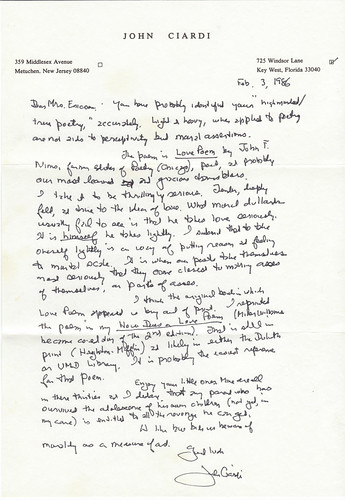
I received a delightful letter from him identifying “Love Poem” by John Frederick Nims. The reason I associated it with Mr. Ciardi was because it was in a book he’d put together titled How Does a Poem Mean, which we’d studied in a high school English class. I was thrilled!

My letter from John Ciardi


The letter is dated February 3, 1986. I somehow lost the envelope with the postmark, and so I cannot be exactly sure when it arrived, though it seems in my memory it was closer to Easter than it actually may have been. Then on March 31, the day after Easter, I heard on All Things Considered that John Ciardi had died on Easter Sunday. That devastating news was presented in standard radio-speak, smoothly delivered, as if there wasn’t a sudden cataclysmic void in the universe.

As I recall, there were interesting stories in the news that week, but they were all delivered in that same dispassionate, professional tone. It seemed to me that someone—anyone—had to quick get on the radio and share something they cared passionately about the way John Ciardi had shared his passionate love for words.

On the strength of that sudden spark, I came up with three scripts, the first about how spring weather influences bird migration, a second about orioles, and a third about grackles. But I had no clue how to proceed. My friend Karen Keenan called Bob DeArmond, a friend of hers at KUMD, and he said I should talk to Stephanie Hemphill. He set up a meeting for the first week of May. It was lucky Karen and Bob took this on, or I'd probably still be sitting here with those three radio scripts.

Now I had to come up with a name for the program. I was petrified that listeners would say I was just for the birds, so I beat them to the punch.

I was so nervous my legs felt weak by the time I  walked into KUMD, scripts and my Peterson Field Guide to Bird Songs vinyl records in tow. Stephanie recorded me on the spot. I cringed hearing my voice played back, but was fascinated watching her expertly mix the bird sounds with my voice onto a new tape. There were three programs, so she said they would run them every Monday, Wednesday, and Friday, and that was that.

Stephanie was in the sound studio with me for the first few weeks until I learned how to mix the programs myself. I was so nervous with her there, feeling like I was wasting her time and mortified every time I messed up a line and had to do it over, that I talked much faster and my voice was higher pitched than normal.

But it turns out people really did want to hear someone talk on the radio about something they were passionate about, so KUMD kept playing "For the Birds," and I kept producing it. And that was how a low-ambition stay-at-home mommy came to be on the radio, blathering about birds for lo these many decades, all because of John Ciardi. Inconceivable!

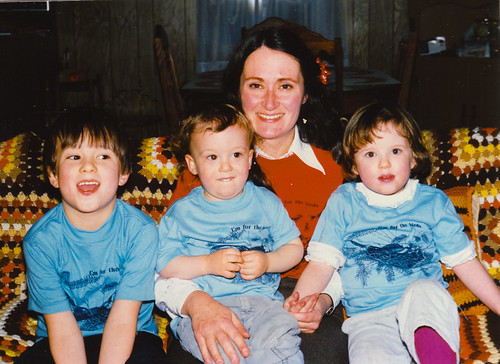
Joey, Tommy, and Katie modeling their "I'm for the Birds" t-shirts in 1988.
In 1988, KUMD gave out "For the Birds" coffee mugs as premiums. My friend Darlene Peterson
had created the design, using a photo of a Blue Jay on her nest taken by my friend
John Keenan. Joey, Tommy, Katie, and I are modeling them. 

Warbler Day

Today is the day I celebrate every year as Warbler Day. Up here in Duluth, warbler migration is just kicking in, but in other places I’ve lived—Chicago; Lansing, Michigan; Madison, Wisconsin; and Ithaca, New York—warbler migration usually is peaking right about now.

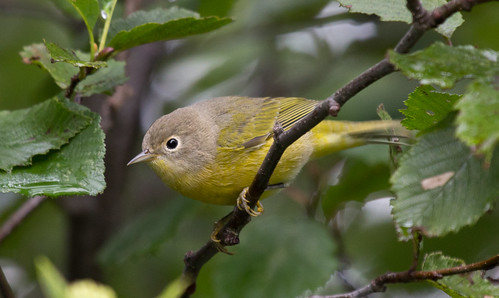
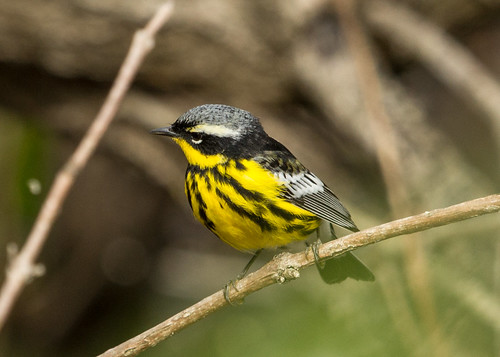
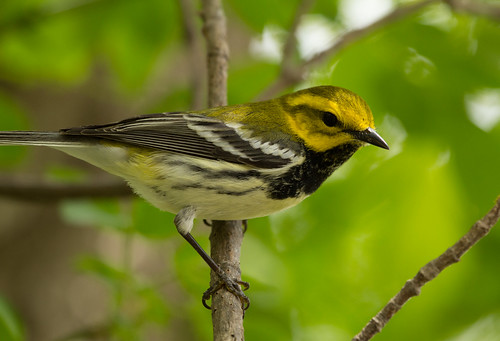
I selected May 11 as Warbler Day because that’s the day I identified my first warblers ever, in 1975. I lucked into the middle of a big migratory flock of them. Most warblers are territorial enough by spring migration to get agitated hearing others of their species singing, so a flock of, say, 7 individuals is likely to have 6 or 7 species rather than several of a single species. Sure enough, that one flock gave me a veritable rainbow of warblers: Black-and-white, Nashville, Magnolia, and Black-throated Green. 

Black-and-white Warbler

Nashville Warbler

Magnoila Warbler

Black-throated Green Warbler

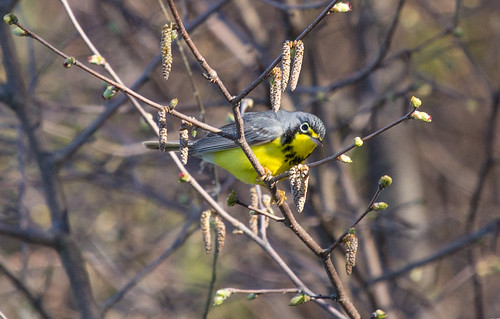
In retrospect, that flock also definitely had a Canada Warbler—I was trying desperately to see all the important field marks of each one, but going back and forth between the bird and my field guide was tricky because the birds were so actively flitting this way and that. I saw one that was brilliant yellow with shiny black streaking beneath, with a bluish gray back with no wing bars. I looked down in my book and found Canada Warbler, but when I looked up at the bird again, the one where it had been also had a brilliant yellow underside with shiny black streaking, but it now had large, thick white wing bars. It cooperated long enough for me to confirm it was a Magnolia, but the one I first saw there had to be a Canada Warbler even if I didn’t see it long enough to confirm it for my life list. 

Canada Warbler

Magnolia and Canada Warbler side by side

I’m sure there were several other species in the flock as well, but needed more time to study each one than the active little birds gave me.

Two days later I added another warbler to my lifelist—the Blackburnian. 

Blackburnian Warbler

Those were the only warblers I was able to identify that spring—I was just starting out, still new at getting birds into my binoculars and tracking them, and trying to fix all the critical features of each bird while I could hold it in view. I clearly remember how frustrating warblers were for me, but also the thrill when I kept one in view long enough to work through what it was. By the next spring, I was much better, and my warbler list grew to over 20 species.

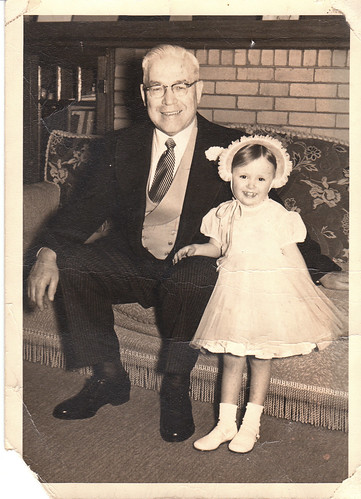
The warblers I saw in 1975 may be the first ones I ever identified, but they aren’t the first ones I ever saw, though I didn’t realize it at the time, because I happened to be a preschooler. It was probably May 1957 when I saw a flock of brilliantly colored, tiny birds in the maple tree out my upstairs bedroom window in Northlake, Illinois. My mother said they must be canaries, but they were ever so much more intensely colored, and so much more active, than the only canaries I’d ever seen—my Grandpa’s beloved pets.

My Grandpa had told me how canaries saved the lives of miners by warning them about poisonous gases—but those heroic little birds actually had to die to save them. So my preschool brain reasoned that these brilliant little birds outside my window must be the angels of canaries that had died saving miners’ lives. When I became a birder and realized those angel birds had been warblers, my childhood fancy made the warbler family even lovelier and more precious to me.

Grandpa and me


Warblers are challenging puzzles, beautiful spirits, and wonderfully characteristic of our north woods. Of course, the dark side of enjoying them on their breeding grounds is the ever present cloud of mosquitoes. Mosquitoes bite warblers as voraciously as they bite us humans, but in turn the warblers get quite a bit of protein by gobbling up mosquitoes, inadvertently consuming any human blood those mosquitoes may have sucked up.

It’s cool to look at warblers rushing through and wonder which might have a tiny speck of protein in their bodies that came from my own blood. It’s satisfying to realize that I am unwittingly supplying at least a trace of nourishment to these luscious little birds that so deeply nourish my soul.

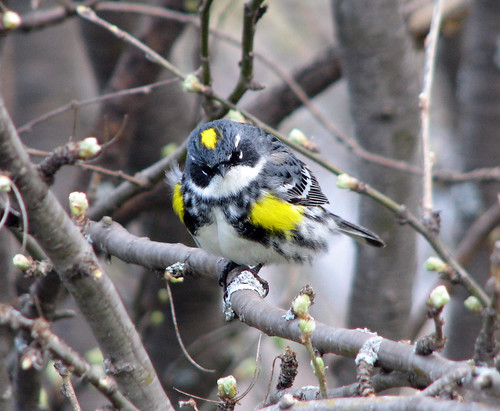
Yellow-rumped Warbler

Tuesday, May 10, 2016

Mornings in the Sharp-tailed Grouse observation blind

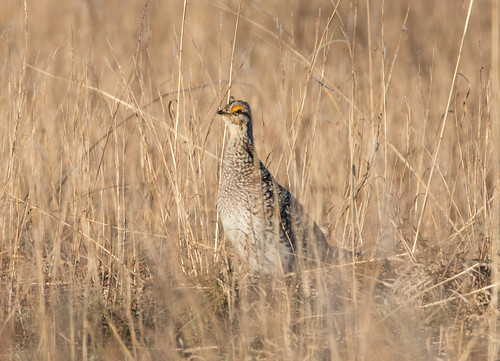
Sharp-tailed Grouse

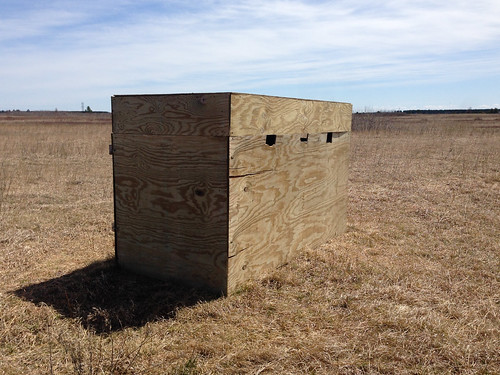
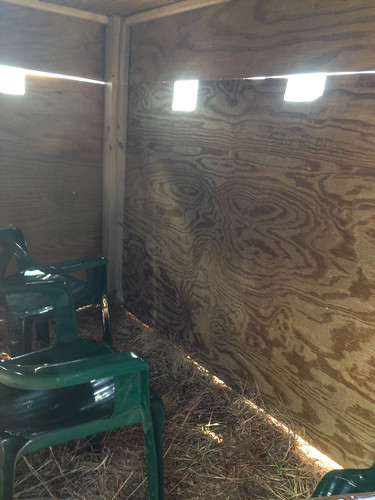
I spent two mornings last week in the Sharp-tailed Grouse observation blind in the Douglas County Wildlife Area—the blind operated by the Friends of the Bird Sanctuary

Sharp-tailed Grouse Observation Blind

Sharp-tailed Grouse Observation Blind

I arrived both days around 5:20 am—we're supposed to be there at least a half hour before dawn. I wished both times that I'd gotten there a few minutes earlier--it's always funnest to arrive before any birds are singing yet, so you can hear the exact order that they pipe in with, but some were already singing when I got there. On Friday when I pulled into the parking space, I could already hear grouse dancing quite a distance southeast of the normal lek, and I was afraid I wouldn't see any at all from the blind, but three flew in several minutes after I settled into the blind and stuck around until after 7 am. While I was in the blind both days, I left Pip curled up in her warm bed in the car. 

On Monday, I could count 7 or 8 males dancing. A female came in for romance three times. She may have been one individual, or two or three—grouse don't wear name tags so  it was impossible for a mere human to know for sure. On Friday, it was only the three males. 

Some males will keep hanging around for weeks. If a female loses her eggs or chicks early on, she’ll be ready to start again, and any obliging males will get another opportunity to plunge into the genetic pool and try to swim out a winner. But males intent on survival start conserving energy and being more secretive once most females are sitting on nests and ignoring the males for another season. Displaying is dangerous—concentrating so hard on other grouse makes it hard to notice any Red-tailed Hawks, Northern Harriers, or eagles overhead, or any prowling mammalian predators. Pip and I came upon a nice pile of wolf scat Friday on the path from Grouse Road to the blind.

Scat

On Monday I set up my directional microphone toward the display area as soon as there was enough light in the blind for me to see what I was doing. It was still twilight, but by then a Brown Thrasher and Vesper and Field Sparrows were singing away. The last time I made sound recordings in this blind was in 2005—11 years ago now. The background noise from traffic from Highway 53, over a half mile away, is a bit louder and more persistent now. Fortunately, there weren’t any wind sounds at all.

I didn’t get any good photos of the grouse displaying this time—their lek was a bit farther from the blind, and they were mostly hunkering down in a weedy patch affording them protection from predators. I took one video I like of a few displays. You can’t see the birds at all well, but do get to watch the triangular white patches of their behinds, erect and shaking as they dance about.

Sharp-tailed Grouse

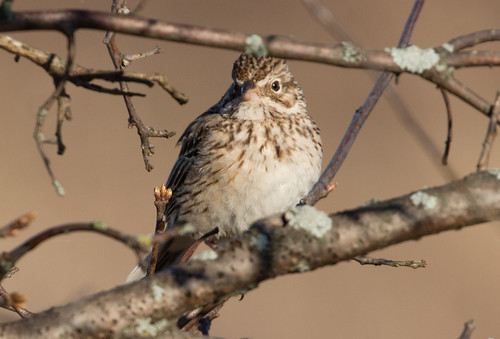
I did get lots of photos of Vesper Sparrows, mostly when I was scouting on Sunday afternoon and then when I was returning to my car after my mornings in the blind.

Vesper Sparrow

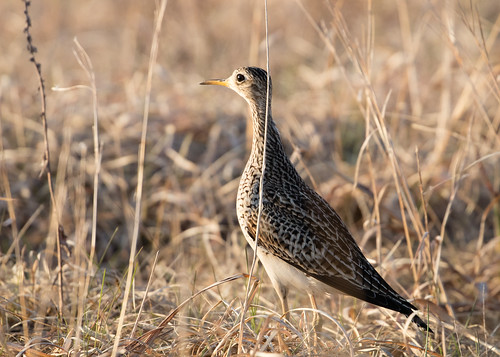
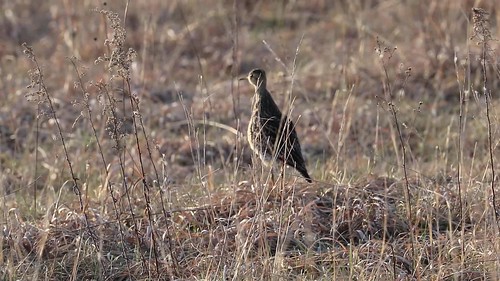
If the grouse were less conspicuous on Friday, more birds of other species had arrived. Two Upland Sandpipers alighted near the blind. I’m not sure where one was—it may actually have been on the roof of the blind, because its calls sounded very mechanical—but the other was nice and close, with a perfect view out of one of the windows, so I got several photos and video.

Upland Sandpiper

Upland Sandpiper

Friday morning was just too perfect to head home after the birds stopped displaying, so Pip and I walked and drove around a bit first. We watched the Upland Sandpipers doing their sky dance, and spent a bit of time with some Brown Thrashers, a Song Sparrow, and some Tree Swallows.

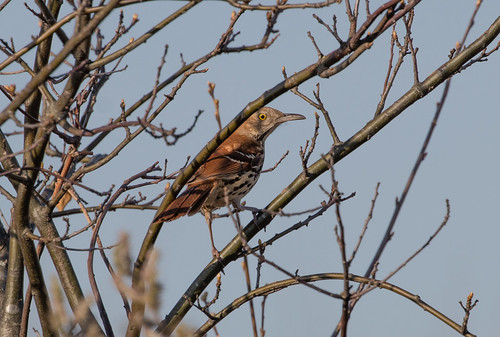
Brown Thrasher

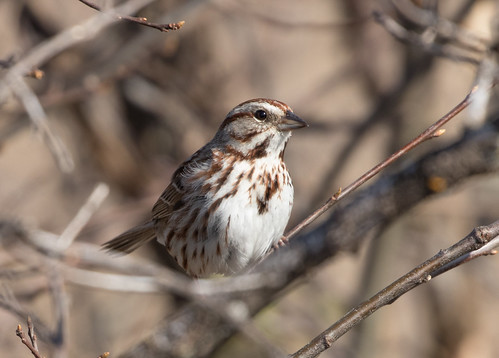
Song Sparrow

Tree Sparrow

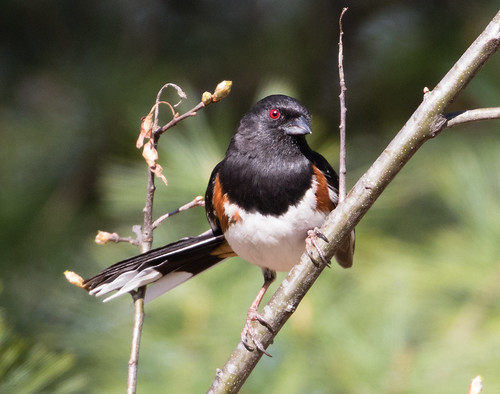
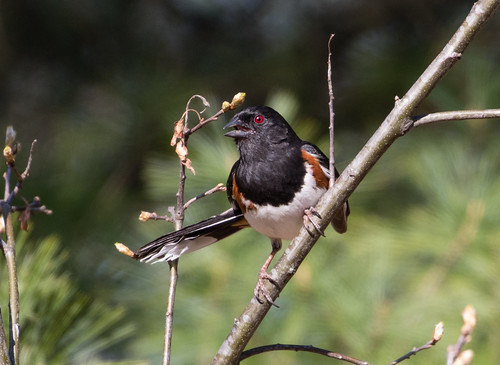
At one point while we were driving along, I could hear towhees singing on either side of the road. I stopped the car between them, and took photos of the one on my side of the road—that was the one in perfect light.

Eastern Towhee

Eastern Towhee


By then it was getting late, so Pip and I headed on, grateful to the Friends of the Bird Sanctuary that the Douglas County Wildlife Area is in such good hands.  

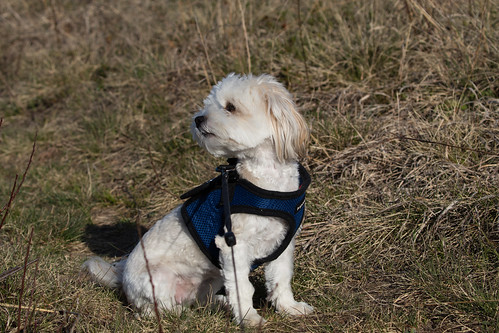
Pip the Birding Dog!

You can see lots of photos of Sharp-tailed Grouse, including them displaying, and hear my recordings, from my Sharp-tailed Grouse species page

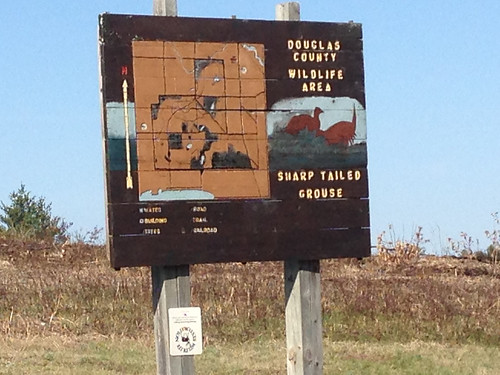
Douglas County Wildlife Area sign

Monday, May 9, 2016

The Lusty Month of May Here in Camelot (well, Peabody Street)

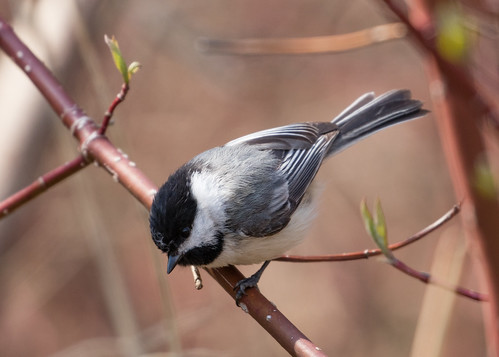
Black-capped Chickadee

Russ and I were walking along Peabody Street—our own personal Camelot—at lunchtime on May 4 when we came upon two chickadees in a singing tournament, one on either side of the road. The trees on that stretch of the block include several very old ones. One big old birch looked exactly rotten enough for a pair of chickadees to excavate a perfect nest cavity. 

I’m presuming that the bird on our side of the road was a male defending a nest in that tree—he may already have a mate incubating eggs, or there may have been a female flitting about nearby, ready to bat her nictitating membranes at whichever male won the singing contest. A female chickadee, like Guinevere, is very loyal to her Arthur, and will stick with him through thick and thin as long as he doesn’t mind her occasional dalliances with the neighborhood Lancelot. 

Chickadees don’t live and die by chivalry codes or fight wars, so the occasional extramarital fling doesn’t have any historical repercussions. What ornithologists coyly call “extra-pair paternity,” wherein some of a female’s young in a single brood of chicks have a different father than the others, doesn’t lead to any practical repercussions for any of the chicks or adults involved. So there aren’t any Mordred chickadees out there trying to wreak revenge on a whole kingdom. Hanky-panky is the order of the day in the lusty month of May.

Pileated Woodpecker
Our friendly neighborhood male Pileated Woodpecker
On that same walk, Russ and I heard our friendly neighborhood male Pileated Woodpecker drumming—he and the female show up a few times a day in my yard, but I’m still trying to figure out where they’re nesting. 

Chipping and White-throated Sparrows have been singing away—they’re just arriving, and haven’t started nesting yet. Crows are nesting in the yard behind mine, but I haven’t found precisely where the nest is yet. There are three pairs of robins on my end of the block again. One pair spends a lot of time in my front yard, and another around my neighbor’s back yard. The rainstorm on Friday produced at least a bit of a mud supply for them to start building nests, so they should get going any day.

Robins usually choose either a conifer or a structure on a building for their first nest. One pair successfully nested under an overhang on my neighbors’ shed last summer, and I saw a male checking out that spot last week, so I’m keeping my eyes on it.

Looks like somebody's about to fledge!
Baby robins under our neighbor's shed last summer.
I’m still watching for my first backyard hummingbird—I saw one briefly in the Douglas County Wildlife Management Area at the Sharp-tailed Grouse observation blind last week, so I set out my feeders the moment I got home. I also set out oranges—Baltimore Orioles often return the same day as the hummers. 

We haven’t had any of the weather systems that knock migrants down and hold them here in inappropriate habitat for days at a time so far this spring, so I’m mainly seeing the new arrivals that will be sticking around in my yard rather than a variety of sparrows and warblers, but I keep myself planted close to my window feeders just in case. Anything is possible in the lusty month of May. In short, there’s simply not a more congenial spot for happily everaftering than here on Peabody Street.

Tuesday, May 3, 2016

"Dad" the Great Blue Heron

"Dad" the Cornell Great Blue Heron

One year ago today, on May 3, 2015, I went birding in Sapsucker Woods in Ithaca, NY, hoping to reconnect with someone very dear to me. He’d never once sent me an email or text, and I didn’t know if he’d show up while I was there, but hope springs eternal. Cornell University has a lot of prominent, world-famous professors and researchers, but the guy I so yearned to see wasn’t among them. He was an unemployed yet self-sufficient, hard-working recluse—the quintessential outdoors guy, into fishing and woodworking and building, yet surprisingly tender and patient with young ones. He was a true blue, all-American Great Blue Heron.

Sapsucker Woods has almost certainly been home to Great Blue Herons since the ponds formed. My personal experience with them there began with the first time I ever visited the Cornell Lab, in April 2006. During the time I was living in Ithaca while I worked at the Lab, from January 2008 through April 2010, Great Blue Herons could be seen every time I took a walk around the pond. My first spring in Ithaca, I thought one heron seemed unusually calm and tolerant of my presence, but figured that was just Cornell karma.

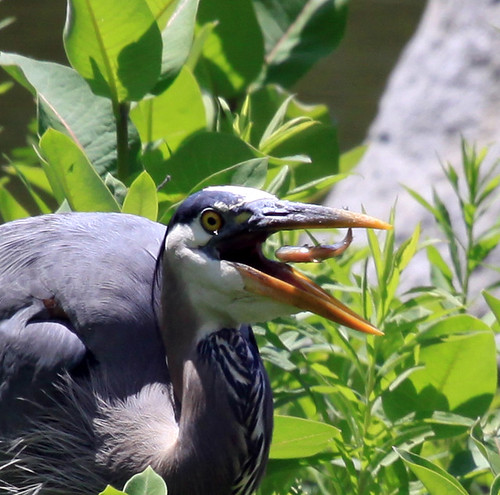
Great Blue Heron and fish

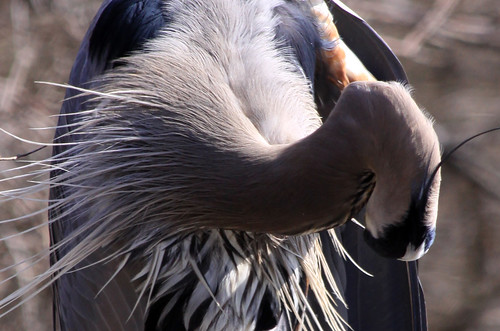
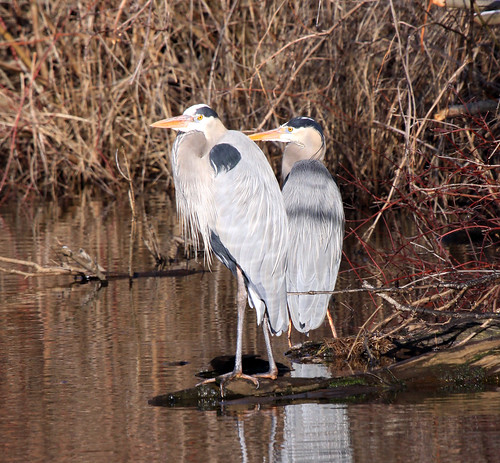
Great Blue Heron

Great Blue Heron

Great Blue Heron


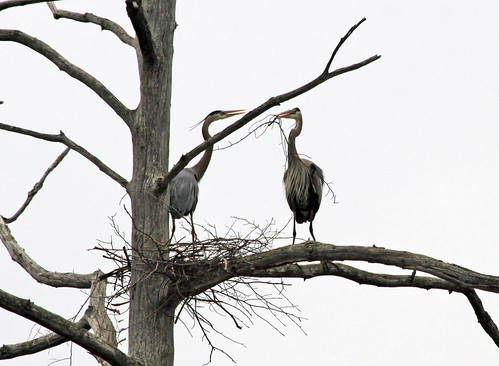
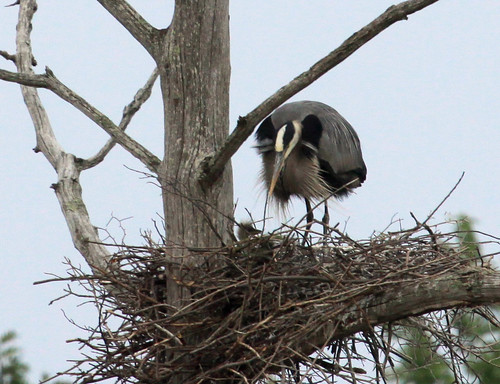
In 2009, I got my first DSLR camera, and that’s when I started taking hundreds, and then thousands, of heron photos. That was also the spring that a pair of Great Blue Herons constructed a nest in the pond. Every day I took photos of the growing family—they successfully raised 4 babies that year.

Great Blue Heron

Great Blue Heron and chick

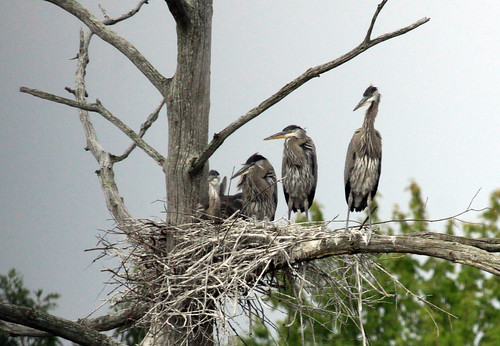
Great Blue Heron family

Great Blue Heron family

I was at the Lab during a major thunderstorm when the chicks were still little (but didn't bring my camera that day—it was raining). The female hunkered down on the nest. The male stood up at the edge of the nest, facing the full brunt of the storm with his wings slightly opened to umbrella his mate and young, and held fast, buffeted by powerful winds, pelted by rain and some hail, for the duration.

I left Cornell in April 2010, but not before a pair of herons arrived at the nest again.

Great Blue Heron

That was the spring Kevin McGowan noticed something unusual about the male at the nest: he was missing the hind toe on his right foot. I started scrutinizing my photos and, sure enough, the male who built the nest the previous year was missing his hind toe. And that unusually tame Great Blue Heron I’d taken so many photos of in 2009? He was the exact same individual bird! I started thinking of him as “Dad.”

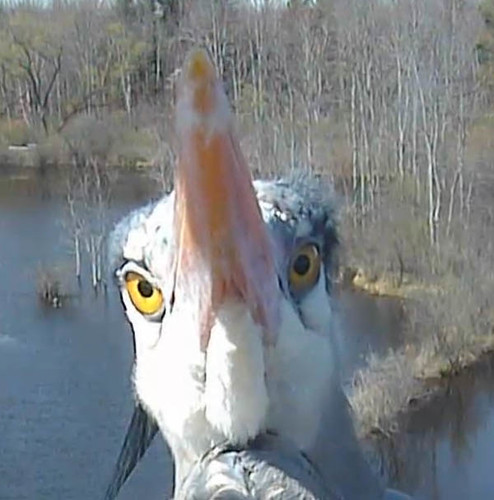
I was gone through the nesting season in 2010 and 2011, but people at the Lab watched Dad and his mate—there was no way of knowing whether she was the same one or not—successfully fledge four chicks both years. Then in the winter in 2012, long before any herons returned, Cornell put a couple of cameras in the nest—nest cams that would stream live on the internet so we could watch the birds raise their family up close and personal. I was asked to be a monitor in the chat room. And though I was 1200 miles away, this was one of the most thrilling experiences I’ve ever had watching individual birds.

Great Blue Heron

That year they produced five eggs, and despite a few attacks by a Great Horned Owl leading to one egg getting cracked, a late winter storm, and other tricky situations, all five hatched, and all five successfully fledged.

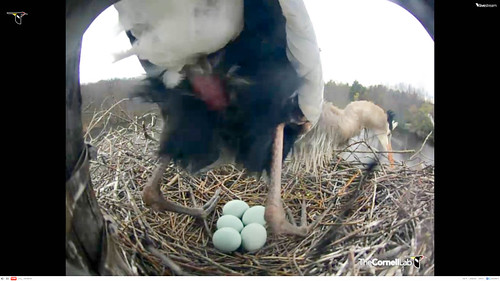
Great Blue Heron brood patch

Great Blue Heron after owl attack

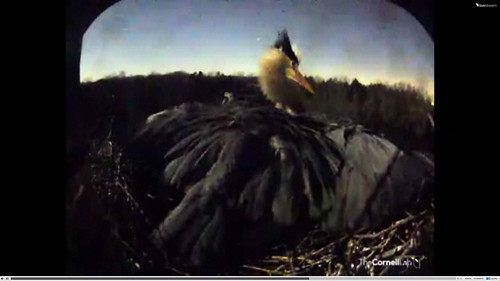
Nesting Great Blue Herons in snowstorm

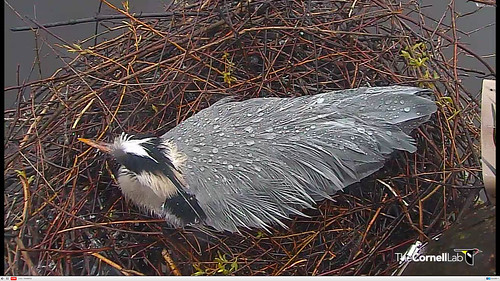
Great Blue Heron in rain

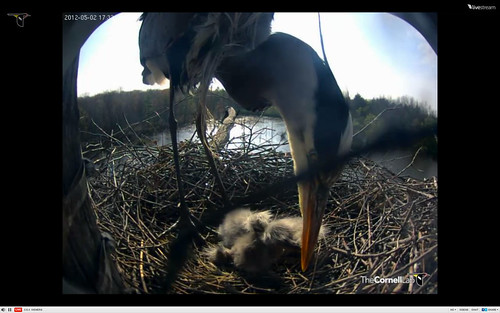
Great Blue Heron feeding chicks

In 2013, the female appeared to be a new one, but Dad, missing that right hind toe, was back and the pair again produced four eggs and raised the four chicks to fledging. The nest fell out of the tree in 2014 before egg-laying began.

Then last year late in the season, Dad got into a fight with another heron, and his foot got hurt—one front toe was badly broken. He hobbled about at first, but the toe seemed to be healing.

Banded Great Blue Herons in Texas have survived 23 and 24 years. I don’t know if Dad's being attacked and injured was evidence of advancing age—we have no idea how old he actually was. But this year, for the first year since at least 2009, Dad has not returned to Sapsucker Woods. We don't know for certain that he's dead, and unless his death had been witnessed or his body retrieved, we could never be sure about the date or time of his demise. Few wild birds get obituaries.

It’s hard to tell individual birds apart—that’s the whole reason scientists mark them with leg bands, wing tags, and electronic trackers—and it’s hard to place a value on an individual bird. Dad produced at least 21 fledgling herons over his lifetime, making a genetic mark on his species. He also inspired a lot of human beings, who will never forget how he stayed on that nest through a snow storm; how he tenderly nurtured his chicks, always making sure to deposit the food in the nest nearest to the littlest chick; how when he regurgitated a still-alive goldfish in the nest to the utter shock of the babies, he patiently showed them that even though it moved—something no regurgitated fish had ever done in their experience—it was still food; how he was a constant presence in Sapsucker Woods, not shying away from people but always certain of himself and his absolute right to a love, his nest and territory, and good food.

I learned to love Great Blue Herons more as I came to know this one individual better. The last few years, the moment there was even a slight break in wintry weather in February I started impatiently awaiting news  that Dad had reappeared, each year breathing a sign of relief as soon as someone reported seeing him. I treasure my memories of the time I spent with him last May 3, all the time I spent with him in person during my years at Cornell, and all the time I spent watching him via Cornell's nest cam, not in person but somehow even more intimately. Now there is a gaping hole in my universe—a dark and empty void that, like Rachel's children, cannot be restored.
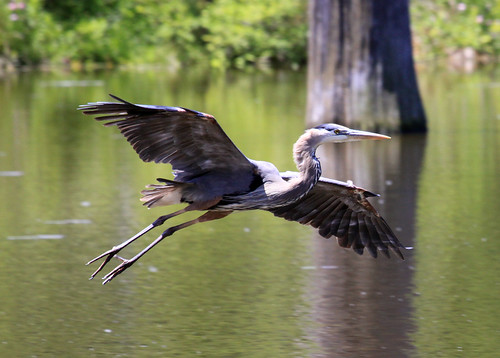
The world will go on without Dad, as it will one day go on without me. But I’m grateful that his and my paths intersected during our finite stays on this little planet. For the rest of my life, whenever I see any Great Blue Heron, I’ll think of one in particular, and smile.
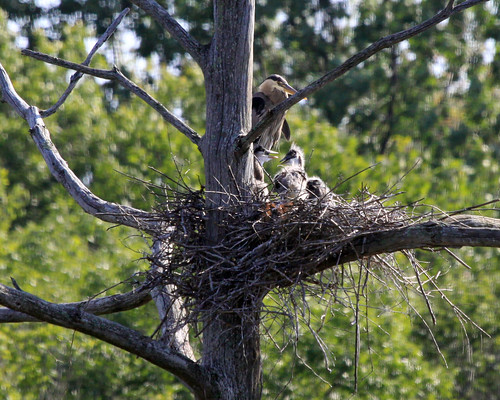
Great Blue Heron nest cam