Laura Erickson's For the Birds

Wednesday, March 13, 2019

A New Glass Tower in Duluth

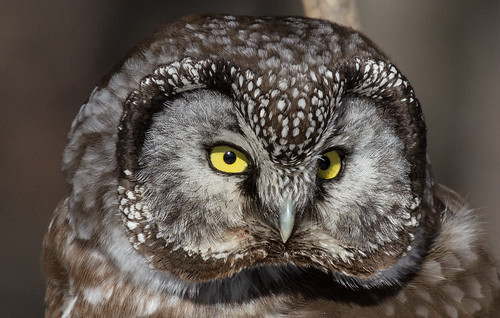
Boreal Owl
The Boreal Owl was one of the splendid birds that drew me to Duluth in the first place. Boreal Owls are frequently killed by windows when hunting in backyards. 
Last night, the Duluth Planning Commission heard public comments about the Environmental Assessment Worksheet that was completed regarding the glass tower that our biggest medical provider, Essentia, is planning to build downtown. A couple of people from Duluth's Dark Sky organization spoke about keeping the lights compatible with their mission, and I talked about the need for the glass to be fritted to protect birds by day and to have a very low light transmission to protect birds by night. What follows is the gist of what I said.

Notice that even the architects' conception of this project includes birds. 
When my husband Russ got his Ph.D. in 1980 and was fielding job offers, I lobbied very hard for him to take the one in Duluth, Minnesota, entirely because of Duluth’s amazing birds. A lot of other features have held us here for 38 years, not least our medical establishment. Russ and I have both had to deal with cancer and I had a heart attack, and so I can personally vouch for the excellent care we received, both during the immediate emergencies and the follow-up.

Now Essentia, the provider he and I have been using for decades, is going to be building a state-of-the-art facility, a glass tower that will stand far above the surrounding buildings. I’m hoping against hope that they will use glass that prevents birds from hitting the building both by day and by night. 

At least a billion birds a year are killed at windows in the United States, which is 5 to 10 percent of the total bird population of North America. As a city on a huge migration path, Duluth takes out more than our share. 

Many birds die outright in any collision with glass. We take hope when we find one still alive, and if it flies off, we enjoy a palpable sense of relief, but in truth, at least half of all birds that fly off after a collision die later, thanks to brain swelling and other injuries.

Vikings Poster

Etchings in what is called fritted glass help birds see it by day. That is what we desperately needed on the U.S. Bank Vikings Stadium, because the huge expanse of glass in that whole green area near the river makes the flood of birds feeding, resting, and moseying through the area in spring and fall vulnerable to collisions. I’ve personally found dead warblers in downtown Duluth that smacked into relatively low buildings, and people working at UMD, the airport, and Essentia as it is now have documented plenty of bird kills from collisions with glass at all those places. Fritted glass would have protected many of these birds.
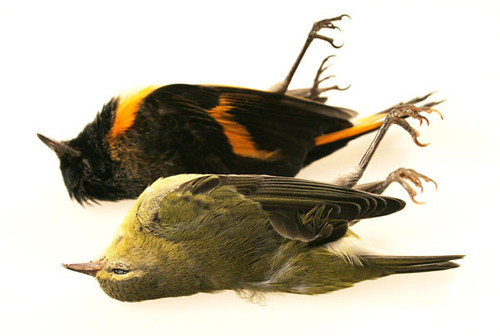
American Redstart and Tennessee Warbler
I found these dead warblers below a fairly small window in downtown Duluth at sunrise in fall 2005.

But birds collide with glass at nighttime, too, and fritted glass doesn’t help them. What lures them in to collide with communications towers and tall buildings are lights. 

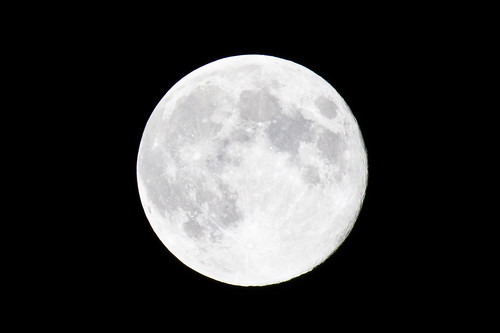
Most of our songbirds that pass through Duluth in spring and fall do their long-distance travel by night, when conditions are cooler and less windy, and when hawks aren’t about. As these songbirds take off after dark, they head straight for one bright light—which their instincts tell them is the moon—to know they have a clear path up above all obstructions. Once they reach altitude, they can use the stars, geomagnetism, and other guides to navigate, but if they get confused because of clouds or fog, they head straight for lights, which they instinctively know must be the moon or stars, which are impossible to collide with.

When I was rehabbing, I had to be careful at night during spring or fall if I entered a room with warblers—if I turned on a light, the little birds all instantly flew directly toward and into it. That gave me a pretty clear idea why so many birds are killed by colliding into windows and lights on high rises. These deaths are especially numerous when there are dense clouds, drizzle, or fog—weather conditions especially prevalent in Duluth during spring and fall migration. When birds lose sight of the moon and stars in these conditions, they go for the brightest light they can see.
Full Moon

Some glass has been developed to vastly reduce light transmission—this is now used in some coastal areas of Florida to keep baby sea turtles from heading the wrong direction when they hatch and must head toward the sparkling water. It would be great to use this low-transmission glass on the new tower. Having that darker glass fritted would protect birds 24-7.

Nature is such a part of our quality of life here in Duluth that many healthcare companies, from pharmaceuticals and insurance companies to Essentia itself, use nature in their advertising, as a palpable symbol of the quality-of-life issues their services and products help give us. Quality health care should not be incompatible with the survival of birds. Let’s hope Essentia selects glass for their new tower that will make this building state-of-the-art for healthcare and for the birds that help us to enjoy our healthy lives.
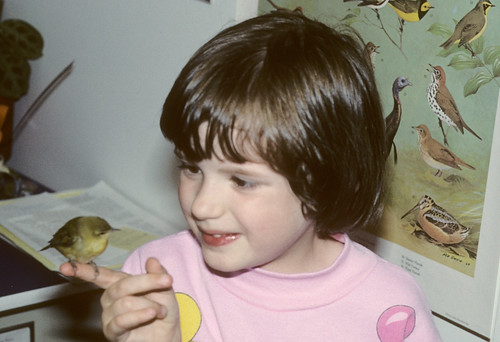
Katie and Orange-crowned Warbler

Sunday, March 10, 2019

Cathy Zimmerman's Bobwhite in Cornucopia, Wisconsin

Cathy Zimmerman's Bobbi the Bobwhite. Copyright 2019 by Cathy Zimmerman. All rights reserved.
On Saturday, I got a wonderful email from Cathy Zimmerman. She wrote: 
On October 8, 2018, two female Northern Bobwhites wandered around our home outside Cornucopia, Wisconsin. I posted a picture to the Chequamegon Bay Birders Facebook page, and was quickly informed that they were likely used for training dogs and had escaped. A little research revealed that their northernmost range is far southern Wisconsin.   
Almost three months later, one female became an almost daily presence at the house. Because of her captive rearing, she was fairly tame, and quickly came to identify me with food. The turkeys, red squirrels and blue jays were more aggressive getting to the sunflower seed and corn that I put out in the morning, so I started to keep an eye out for her and would give her some food of her own.   
I immediately grew very fond of her, and each morning that she had successfully survived this most bitter of winters, my spirit rose with joy. She would come to me so trustingly, and make the cutest little noises as she quickly ate. Of course I had to name her, and of course I named her Bobbi!   
The Lake Superior winds and heavier than average snowfall, and presence of coyotes and other predators caused me to worry about her survival. According to The Sibley Guide to Bird Life and Behavior, “Northern Bobwhites usually roost on the ground, often in a tight circle of 5-15 outward-facing birds. Roosting coveys may be essential for survival in this species, since lone bobwhites may not generate enough warmth to survive a cold night.” Well, my little lone Bobbi proved them wrong, and 300 miles north of her usual range, and I was quite proud of her!   
I knew even if she survived the winter, she would likely never meet another Northern Bobwhite, and even less likely a male to mate with. Yet I hoped that she would get to experience the relief of spring, when life wouldn’t be so difficult. I took many pictures of her, knowing that ultimately they would be pictures to remember her by.   
We had a routine, and when she didn’t appear on the morning of Tuesday March 5, I was worried. There had been other days I hadn’t seen her before work and I tried to be optimistic. At 5:45 PM I happened to look out the kitchen window and saw not a bobwhite, but a bobcat!   

Lurking bobcat. Copyright 2019 by Cathy Zimmerman. All rights reserved. 
I can only conclude that the bobcat ate my bobwhite, and I guess that’s not too bad a fate. And I will always have the sweet memories and photographs. It will almost be like looking through a family photo album—“ Here’s Bobbi with the Ruffed Grouse that decided to check things out.” “Here’s Bobbi with the rabbit who decided to help itself to her seeds.” “Here’s Bobbi with her most beautiful feathers that outdoes any supermodel’s costume.”   
Copyright 2019 by Cathy Zimmerman. All rights reserved.

Copyright 2019 by Cathy Zimmerman. All rights reserved.
Some will find this sort of bond with a bird silly, but I know you will understand. I would often go to work and try to tell people with excitement about the Northern Bobwhite that had adopted our home, and they would nod politely, some venturing to ask, “So that’s a bird?”   
Yes, she’s a bird, but also a friend, and I miss her. And she is why Northern Bobwhite is my Best Bird Ever.  

Thursday, March 7, 2019

Birds in the News

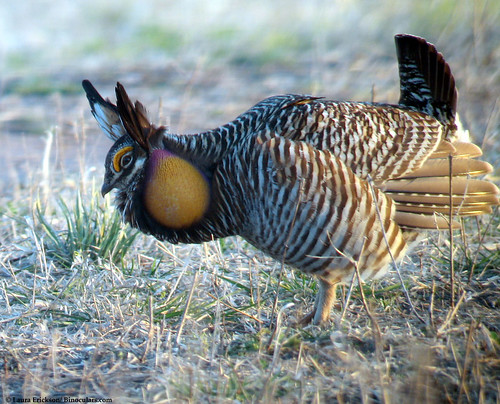
Greater Prairie-Chicken

My treasured friend Mick Fiocchi sent me a link to a story this week from the Wisconsin DNR, from their Snapshot Wisconsin newsletter, regarding 15 trail cams they set out, three each on five Greater Prairie-Chicken leks in central Wisconsin. Direct monitoring for prairie chickens involves a lot of human hours, because at each spot, the person must arrive while it’s still dark and remain until the displaying birds depart, often not until mid-morning. Arriving late or leaving early risks frightening the birds off their display grounds, disrupting them at their most vulnerable period of the year.

The cams picked up prairie chickens at all five sites, while humans detected the birds only at three sites. At the sites where they did detect them, the human observers saw more prairie chickens than the cams picked up, so human observers are still important, but the cameras provided photos not just during the morning displays but also in the evening, interestingly, taking more photos per hour during the evening than morning displays. Those Snapshot Wisconsin cameras also collected over 3,000 non-prairie chicken images including badger, coyote, deer, other birds, and more.   
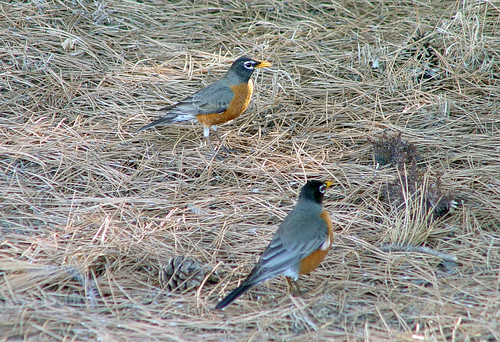
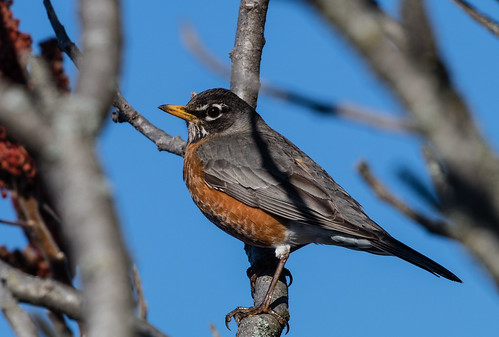
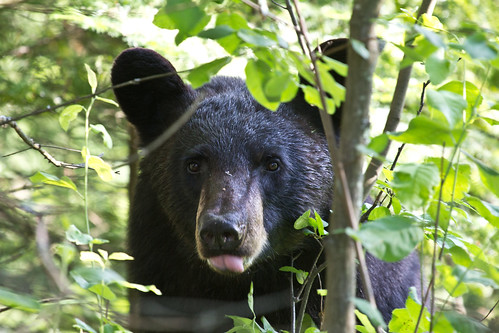
Rather brazen black bear at my mother-in-law's

An article dated February 26 in the national Sierra Club magazine titled “Does a Bear Think in the Woods” focuses on studies of bear behavior and intelligence, centering primarily on Ben Kilham, who has studied bears in New Hampshire since 1996. His work is utterly fascinating, and author Brandon Keim mentions in passing about research into intelligence and communication in other species, including birds, noting that “ravens can plan for the future and demonstrate a degree of self-control comparable to great apes'” and “Japanese great tits, songbirds related to chickadees, use syntax—a linguistic property long thought unique to human language.” He also mentions that magpies can recognize themselves in a mirror. 

Keim writes, “This research highlights an intriguing possibility: Could it be that much of North America is populated by hundreds of thousands of exceptionally intelligent nonhuman beings?” I’ve been harping on “this intriguing possibility” since the earliest days of producing “For the Birds,” but 33 years later, it is still apparently more intriguing and cutting edge than clear and obvious for anyone to speculate out loud about animals being intelligent creatures capable of genuine communication. 

During Turner Classic Movies’ “31 Days of Oscars,” I watched the movie Close Encounters of the Third Kind. I still find it hilarious that we can accept the idea that people could somehow forge communication with aliens based on musical tones—how could we be sure the aliens were ascribing the same meaning to  each tone that we did, when here in Minnesota, right this very moment, we can hear pure tones clearly meant as communication yet we still don’t have a clue know how to communicate with chickadees? Wouldn’t you think the scientists who think about finding and communicating with other forms of life “out there” would start by learning how to communicate with other forms of life right here on earth? 

One day, the anthropocentric people who dismiss animal communication and intelligence as being of an entirely different order than human communication and intelligence will be dismissed the way people who once believed the earth is flat and at the center of the universe are now dismissed.

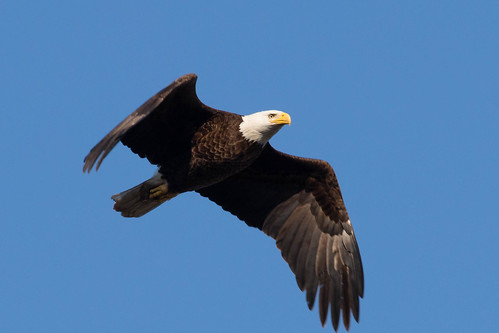
Bald Eagle

Our final "Birds in the News" story took place on February 23, in the world of college baseball, when Jacksonville State University was playing against Jacksonville University. You can see a short video with charming color commentary online. In the top of the eighth inning, an Osprey flew over John Sessions Stadium carrying a fish. When a Bald Eagle divebombed it, the Osprey dropped the fish into the outfield. The eagle circled lower, apparently trying to retrieve the fish, but before it could reach it, one of the Jacksonville University players ran out, grabbed the fish, and carried it off, giving his team a double win. They beat Jacksonville State 5-2 and the Bald Eagle 1-0.

Wednesday, March 6, 2019

Abnormal Plumage, Part II: Leucistic Birds

Leucistic Black-capped Chickadee; photo Copyright 2019 by Gayle Friday
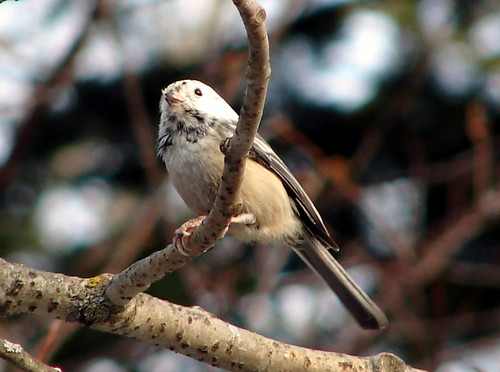
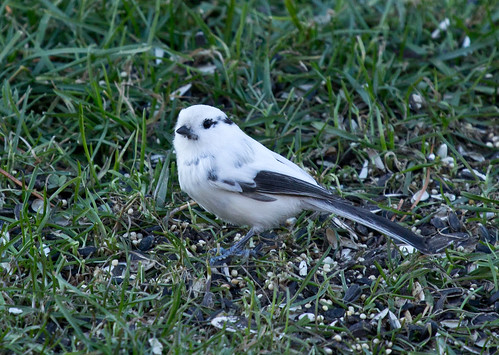
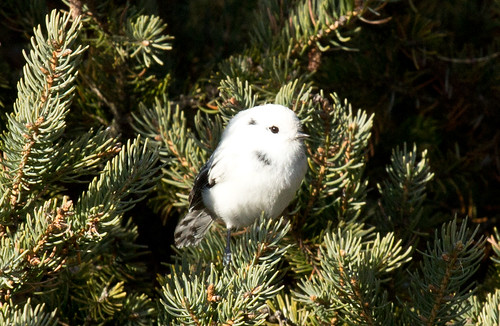
On February 26, I received an email from Gayle Friday, who lives in Lakewood Township. She sent me three photos of a very odd Black-capped Chickadee. This bird was extremely pale in all the body areas where it would have any melanin—the cap was a light brownish-gray rather than black, the back lighter gray, the wings and tale extremely light gray, and the sides a very soft yellowish buff. I thought about the possibility that it could be a leucistic Boreal Chickadee, but the bright white on the cheeks is too extensive, and too precisely matching that of a black-cap.

Leucistic Black-capped Chickadee; photo Copyright 2019 by Gayle Friday
Gayle wrote back with more details: 
He first appeared  on Feb 4 and what caught my eye was the white flash. He seems a bit larger than some of my other chickadees and they seem annoyed with him. His cap is lighter , kind of chestnut colored. He seems to like both suet and feeder but picks feeder over the suet. He is still coming daily. I live in Lakewood on 10 acres of mostly spruce pine aspen with some hardwoods. He is still visiting daily.  
Leucistic Black-capped Chickadee; photo Copyright 2019 by Gayle Friday
Any bird with lighter than normal plumage or unusual white areas on the body is called leucistic. This chickadee is the first one I’ve ever seen that was in what might be called dilute plumage—the definition of the word leucistic as I learned it in ornithology classes in the 1970s. I’ve seen several other leucistic chickadees over the years, but they were what I’d prefer to call partial albinos—parts of their bodies were normally colored while other parts were pure white.

"Leucistic" Black-capped Chickadee
I took this photo in Brimson, MN, some time in 2006.

"Leucistic" Black-capped Chickadee
I photographed this one in Esko, MN, on November 8, 2012.

The word albino is now used in ornithology only to refer to a bird that is genetically incapable of producing any pigments, so it would have pink eyes and pink or dull tan legs and beak. And now the term “partial albino” is also out of favor, but in my opinion it’s rather useful to have two different terms to distinguish between patchy white birds and overall pale birds.

As rare as leucistic birds are, and as exceptionally rare as this particular leucistic bird is, I don’t feel the inner urgency to see it as I would if it were a Brambling or Fieldfare. Birding is rather an acquisitive endeavor, and what we mostly list are new species.

Matt Mendenhall, BirdWatching magazine’s editor, wrote about the gynandromorph cardinal in Erie, Pennsylvania, under the headline, "Half-male, half-female cardinal is cool, but it's not drawing a crowd." Because gynandromorphism is a plumage condition even rarer than leucism, he wondered why a bird that had been so prominent in the media has been so ignored by birders, at least as far as going to Erie to see it. He writes:
I checked the Pennsylvania and Ohio birding listervs and did not find a single notice from members about this bird. No one posted directions to the yard, or additional photos, or tips for when to go.   
If the Caldwells were hosting a Calliope Hummingbird, Black-headed Grosbeak, or some other vagrant from thousands of miles away, you can bet they would be enjoying the company of many, many strangers toting thousands of dollars worth of optics. They would all, with good reason, be trying to add the wayward bird to their life lists — and a large percentage would be shooting photo after photo of the visitor.  
But no birder would travel to Erie or anywhere else to add Cardinalis cardinalis to their life list. Nor do I know anyone who keeps a list of gynandromorphs they’ve seen.   
I actually do keep a list of the gynandromorphs I’ve seen, or I would except that I’ve only ever seen the one back in 1986. I’ll be trying to head to Gayle’s sometime this week to photograph her bird, to add images of it to my small collection leucistic chickadee photos. I hope her little bird makes it through this long, hard winter and many, many days to come.

"Leucistic" Black-capped Chickadee

Tuesday, March 5, 2019

Abnormal Plumage, Part I: Bilateral Gynandromorphs

Bilateral Gynandromorph in the Bell Museum collection, between a normal male and female.  
A long time ago in a galaxy far, far away—well, my own backyard in 1986—I spied an oddity among the scores of Evening Grosbeaks at my feeder. I almost rubbed my binoculars in disbelief when I realized I was looking at a bilateral gynandromorph—a bird that was half male and half female. The left side appeared to be in perfect female plumage, the right almost perfectly male, though the tail was pale and the forehead wasn't quite as black as on other males. I studied it for five minutes, but then the flock flew off in a flurry of wings and I lost it. The male wing was probably longer than the female wing, but I didn’t notice how it flew in the bustle, and I never saw it again.  

I knew about bilateral gynandromorphism because there's a gynandromorph Evening Grosbeak at the Bell Museum in Minneapolis, and Bud Tordoff wrote about it in the journal of the Minnesota Ornithologists’ Union, The Loon, in the Spring 1983 issue of Volume 54. The only way it’s possible to recognize a gynandromorph bird is when it belongs to a species with a strong difference between male and female plumage. It’s rare to spot one, and they’re usually hard to keep track of or photograph before they disappear. 

But this winter a gynandromorph cardinal turned up in Shirley Caldwell’s backyard in Erie, Pennsylvania. The bird is amazingly cool-looking, so of course photos of it went viral, and stories about it appeared in the New York Times, Forbes, and more. 

Shirley Caldwell's photo of a bilateral gynandromorph Northern Cardinal. 
Most of the news stories focused on the unique elements of bird physiology and morphology that allow such a thing to happen. The secondary sex features of us humans are influenced much more heavily by hormones than by genetics; in birds, it’s the opposite. Plumage characteristics and wing-length on the female side are completely different from those on the male side, not because of the hormones produced by the bird, which after all flow in the bloodstream throughout the body, but because of how male and female cells respond differently to those hormones in birds. 

A 2010 study investigating three bilateral gynandromorph chickens, "Somatic sex identity is cell autonomous in the chicken," by D. Zhao & D. McBride, published in Nature, established that gynandropmorph birds are not the result of something affecting the chromosomes early in development, but rather, that these birds are genuine male:female chimeras—that is, single animals produced by the merger of two different fertilized ova. In birds, usually if two ova are fertilized at the same time, the result is fraternal twins developing in a double-yolked egg; they usually die before hatching. Chimeras are entirely different. 

Gynandromorph chicken from paper in Nature
It’s easier to do scientific research on chickens than on wild birds, which are protected by law and hard to track in the field. Most birds, including chickens, have only one functional ovary, on the left side. In the chicken study, of two gynandromorphs that appeared male on the left half, one had an ovary on that male side, but couldn’t produce eggs. The bird that appeared female on the left side had an ovary on the left side and a testis on the right. 

A gynandromorph cardinal was discovered in Illinois several years ago—in that individual, the “female” side was the right side. Intriguingly, although that bird was tracked for 40 days, it was never heard vocalizing at all, and it kept to itself away from other cardinals. This year’s Erie cardinal is female on the left side, so it may have a functional ovary. And this one seems to have paired with a male—the two are fairly inseparable, and vocalize back and forth as normal mated cardinals do.

Shirley Caldwell was interviewed for the Forbes article. She's been taking photos and making videos of this bird, and is documenting the behaviors and vocalizations. With luck, she’ll be able to track the birds into the nesting season and find out if the pair mates and produces eggs and ultimately viable young. Field studies are far trickier to do than studies of captive birds, but I’m hoping this star-crossed, or genetically-crossed, bird has a long and happy life.

Sunday, March 3, 2019

Laura's Best Bird EVER: House Sparrow Lullabies

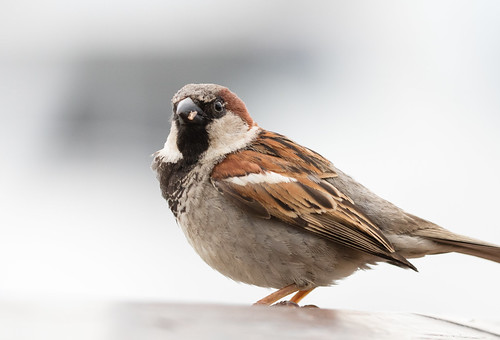
House Sparrow at Bar Harbor

The first birds I was ever aware of were little sparrows who gathered in bushes all around our two-flat apartment building in Chicago. I’d watch them hopping about in the weedy lawn when I was riding my tricycle on the sidewalk, and I could see and hear them from our living room or my bedroom. The cheeps came loud and clear when our windows were open, but even in winter, if I listened very hard, the comforting sound seeped through the closed windows into my hungry ears.

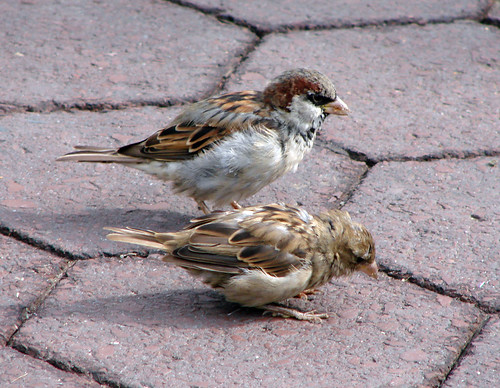
House Sparrows were the quintessential city birds—I noticed them at my Grandpa’s house and various picnic grounds in Chicago forest preserves as well as at home. And they were there when we moved to a blue-collar suburb, right there beneath my bedroom window yet again. I could hear them through the open windows of St. John Vianney Catholic Elementary School, and sometimes even when I was at Mass. When the first McDonalds restaurant opened in our town during the late 50s, it was my little sparrows who hopped up and looked at me with a very Oliver Twistian, “Please, Laura, I want some more” look, which I of course obliged with French fries.

Central Park Zoo House Sparrow

House Sparrow cheepings formed a warm and comforting, ever-present background in the soundtrack of my earliest memories. I grew up in a home of strife and violence, and when my parents were on the rampage, if I hid behind our juniper bushes or retreated to my bedroom, I could close my eyes and focus on my sparrows’ friendly chattering. I’d imagine that they were telling one another about their day’s adventures, giving warm encouragement and loving advice, or simply gathering around what passed for a happy kitchen table in their world, telling stories and jokes. I especially liked imagining that they included me as part of their circle of family and friends. This was long before the TV show The Waltons, but I’d settle into bed each night hungrily listening to their soft good-nights to one another, and maybe even to me. After I said my prayers, I’d always whisper good-night to my sparrows. I knew that not even God forgot about them.

House Sparrow

On my first day of school in first grade, an assistant pastor came to our class and asked if anyone could say their ABCs. I waved my hand in a most Hermione Granger sort of way, and he called on me. When I finished, he smiled warmly and handed me what we Catholic children called a “holy card.” It depicted the hand of God cradling a tiny baby bird—what I assumed must be a sparrow. Now I looked at that card when I said my prayers at bedtime, listening to the music of cheeping sparrows in the background. These tiny birds seemed to be carrying my prayers directly to heaven. 

(Not the same card. I can't find a photo of it anywhere.)
I knew my sparrows were properly called House Sparrows from as far back as I can remember. My parents and Grandpa must have been calling them “sparrows” from the start, and when my Grandpa gave me the “Little Golden Activity Book” Bird Stamps when I was five, a male was clearly pictured and labeled as a House Sparrow.

House Sparrow in Little Golden Activity Book: Bird Stamps

It wasn’t until I took ornithology in 1975 that I learned how damaging they’ve been to bluebirds and other cavity-nesting birds as an invasive species in North America. I can appreciate that and feel sad that this Pandora’s box was ever opened during the 1800s when sparrows were brought here by homesick Europeans, even as I can’t see a House Sparrow in any urban area or theme park without smiling at these Artful Dodgers who bring back some of my loveliest memories of childhood.

House Sparrow

Saturday, March 2, 2019

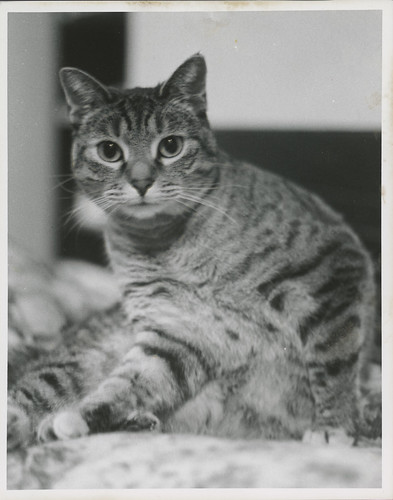
Kitty (circa 1997 — 2019)

Kitty
We got Kitty in the summer of 1998. When she was spayed, the vet said she'd already had kittens at least once, and was somewhere between one and three years old. My son Joey took this photo, and developed and printed it, in a high school photography class in 1999 or so. She was a good 'un. 

Do not go gentle into that good night,
Old age should burn and rave at close of day;
Rage, rage against the dying of the light.

Though wise men at their end know dark is right,
Because their words had forked no lightning they
Do not go gentle into that good night.

Good men, the last wave by, crying how bright
Their frail deeds might have danced in a green bay,
Rage, rage against the dying of the light.

Wild men who caught and sang the sun in flight,
And learn, too late, they grieved it on its way,
Do not go gentle into that good night.

Grave men, near death, who see with blinding sight
Blind eyes could blaze like meteors and be gay,
Rage, rage against the dying of the light.

And you, my father, there on the sad height,
Curse, bless, me now with your fierce tears, I pray.
Do not go gentle into that good night.
Rage, rage against the dying of the light.

—Dylan Thomas

From The Poems of Dylan Thomas, published by New Directions. Copyright © 1952, 1953 Dylan Thomas. Copyright © 1937, 1945, 1955, 1962, 1966, 1967 the Trustees for the Copyrights of Dylan Thomas. Copyright © 1938, 1939, 1943, 1946, 1971 New Directions Publishing Corp. Used with permission.

Chickadee Day!

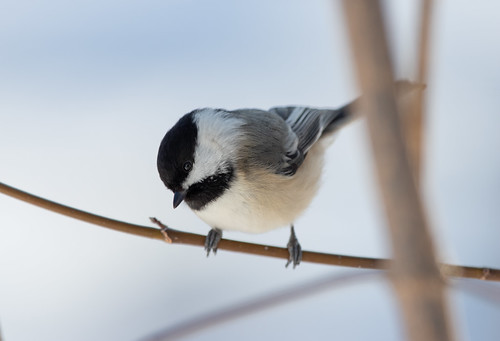
Black-capped Chickadee

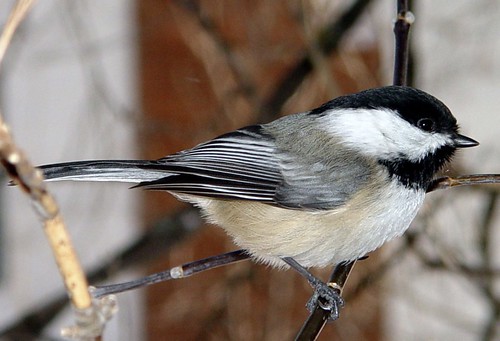
I’m writing this on March 2, 2019, 44 years to the day after I set out on my very first birding adventure and saw the #1 bird on my lifelist, a Black-capped Chickadee. I celebrate every March 2 as Chickadee Day. My Minimum Daily Requirement of birds always includes at least one chickadee, but somehow, seeing a chickadee on Chickadee Day seems even more urgent. 

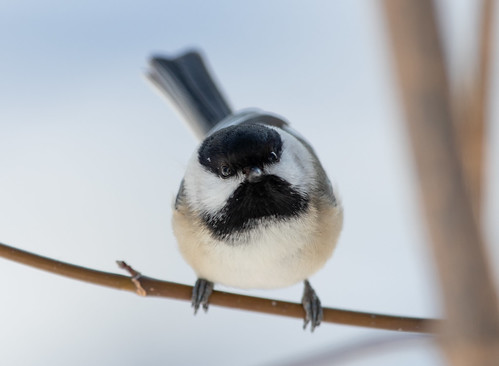
Black-capped Chickadee

So I started out the day at my home office window, where I whistled a chickadee song. Within seconds, in flew a chickadee, then two more, then another half dozen. I cranked open the window and held out a handful of live mealworms; one by one in they flew. A few are shyer than the rest, so after the brave ones flitted off with their first course of breakfast, I put the rest of the mealworms in a window feeder.

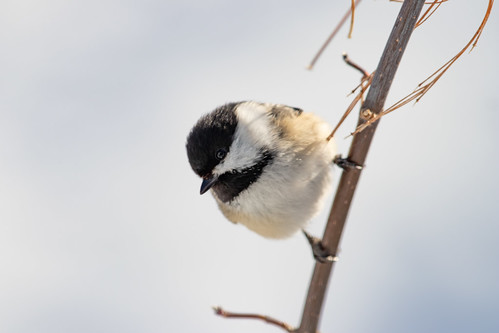
Black-capped Chickadee

This being Chickadee Day, before I closed the window, I took a bunch of photos, but only for a minute. My windows are the crank-open type, and I didn’t want to risk collisions—injuring or killing a chickadee on Chickadee Day would be even more unforgivable and ironic than on any other day.  In the 38 years we’ve lived in our house, we’ve not yet had a chickadee window collision that we’re aware of, and we’ve been pretty vigilant. Any window-kill is a tragedy, but because I get so much inspiration and joy from them, seeing a dead chickadee is even more gut wrenching for me than seeing any other innocent dead bird. 

Chickadees aren’t very colorful to human eyes—a realistic painting would require a palette of just black, white, gray, and buffy brown. To their own eyes, chickadees are much more colorful, but we mere humans can’t see in the ultraviolet range.

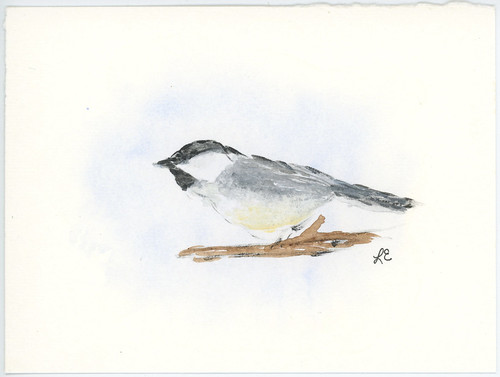
I gave a talk about chickadees at the TEDx-Bemidji event in October. During break, Maureen O'Brien led a chickadee-painting workshop. I went in to observe, and somehow found myself trying my own hand at it. Chickadees are so simply patterned that you’d think they’d be an easy subject, but the most important element of any bird photo or painting is the eye, and getting an almost perfectly black eye to stand out against the almost perfectly black cap is hard to do even for someone with experience. This was the first time in my adult life that I held a paintbrush. My effort was very primitive, but I'm hanging onto it anyway. 

Laura's first painting ever: Black-capped Chickadee 

I took my first chickadee photographs in 2002.

My first decent Black-capped Chickadee photo, from 2002

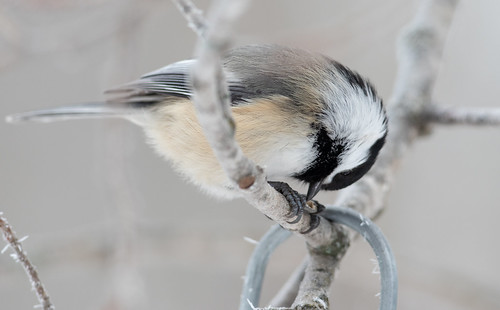
One of my earliest, a perfect profile, turned out well, but I keep taking more. I now have 12,931 Black-capped Chickadee photos and videos catalogued in Lightroom, and 665 in my online Flickr photostream, yet I’m still capturing new things. Just last month, I got a close-up of a chickadee eating a sunflower seed, showing exactly how they do it.

Black-capped Chickadee


Chickadees don’t crack open the shell and then pull out the heart. Rather, they peck a tiny hole in the shell, bite off and eat a tiny bit of the heart, and take another bite of the heart or another peck at the shell, little by little chipping away half the shell as little by little they eat the heart. If they get scared off, dropping the seed, they’ve still taken in some calories. I’ve seen this close up when I was rehabbing, but wasn’t taking pictures yet, so I was thrilled to finally get a photo of this.

Yes, 44 years after seeing my first chickadee, and paying an awful lot of attention to them throughout every one of those years, I’m still learning and observing new things and finding ever more reasons to hold them dear, and ever more reasons to provide nourishing, tasty food to my backyard chickadees and to try my hardest these interesting and endearing little beings.

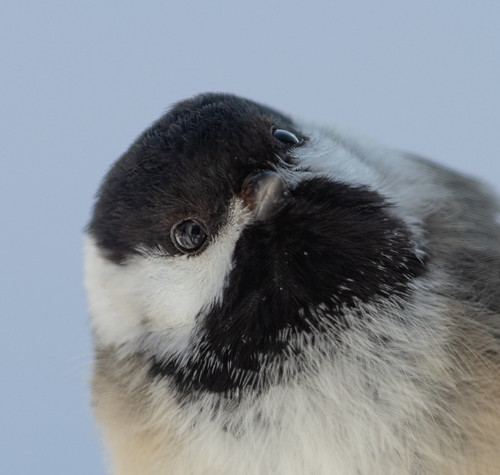
Black-capped Chickadee


Thursday, February 28, 2019

Laura's Best Bird Ever! Chicago Loop Snowy Owl

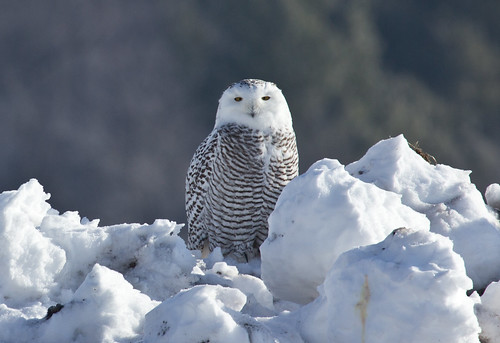
Snowy Owl

In 1975, my first year of birding, I spent every free moment watching birds outside or studying them inside. When Russ and I headed home to Chicago from Michigan State for Christmas break, my lifelist was over 100 and I was hungry for more, so Russ and I went birding three times in the week we were in that toddlin' town. But the very best bird of that trip—one of the best birds of the entire year—wasn’t seen on any birding jaunt—it wasn’t even seen through binoculars.

On December 18th, we went to the Loop for some last minute Christmas shopping. We finished up with time to spare, and so visited a couple of museums along Lake Shore Drive. Because this was not a birding trip, I’d of course left my heavy 7x50 binoculars at home. 

Suddenly, as we walked along on the bustling sidewalk, what to my wondering eyes should appear but an enormous, mostly white bird flying toward us just a few feet over the mass of pedestrians, staying directly above the sidewalk. Its thick, rounded wings flapped slowly. Its huge yellow eyes, facing forward within its huge round white face made it unmistakably an owl. This was the first owl I’d ever seen, and it wasn’t just any owl. This was a Snowy Owl!

I spotted it when it was perhaps a hundred feet away still, but even though it seemed to be flying at a leisurely pace, it was moving in fast. My heart raced, oxygenated blood rushing to overloaded brain circuits as I tried to process and memorize every detail. When it was a mere 10 feet away or even closer, its eyes suddenly looked straight into mine; it held eye contact until it started passing over my head. I’d stopped dead in my tracks, too dumbfounded to even gasp, and Russ didn’t notice at first—he made it back to me, now facing the opposite direction to watch the bird retreat. Russ arrived barely in time to get a quick glimpse.

That encounter was a significant step in my growing competence as a birder—this was the first lifer I’d ever seen without binoculars, and I could appreciate that as it flew in, it was too close for my binoculars to focus on anyway. I was knowledgeable enough to realize that Snowy Owls do appear here and there along the Lake Michigan waterfront in winter and are often active in daytime, so spotting it wasn’t exceptional in any larger ornithological context than as an addition to my life list. But what an addition!

Birding is ever so much more than ornithology and lists, and this bird was ever so much more than a generic Snowy Owl. Something magic happens when our eyes meet anyone else’s—a spark of recognition of individuality, a momentary but real connection between two beings who are simply in the same place at the same time, but then unexpectedly and inexplicably join together in a single shared moment. This was certainly no Vulcan mind-meld, nor even what could be called a meeting of minds. Just a momentary connection, as sudden and electric as a synapse, lasting less than a second and ending the instant the owl broke eye contact. I kept following his retreating form with longing, tracking him as he grew smaller and smaller in the distance, moving on toward the rest of his life.

Wednesday, February 27, 2019

Last Robin of Winter vs First Robin of Spring

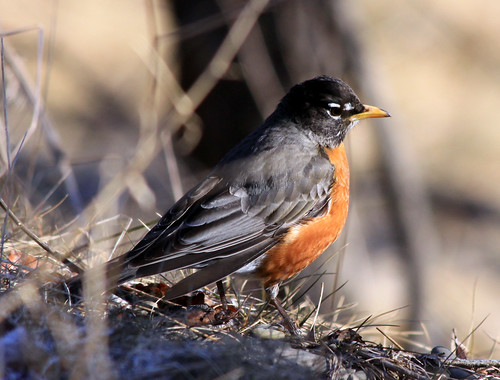
American Robin closeup

Back in the 1990s, a woman named Elizabeth Howard got a brilliant idea for an unprecedented educational service, developing a website that would be available for free to students and teachers, teaching about animal migration--she called it Journey North. One of the birds she was gung-ho to include was the American Robin because so many people associate robins with spring. She called me several times and came up to Duluth once to pick my brain about it, and hired me to write a lot of content about robins. 


Unfortunately for straightforward storylines, robins  don’t move between two separate ranges for summer and winter. They can be found year-round in coastal Alaska and British Columbia as well as at least a bit of all the northernmost states extending into Canada. I’ve personally seen robins on the Grand Marais Christmas Count as well as on a lot of Duluth Christmas Counts. “The first robin of spring” is hardly a ridiculous concept, but it is a complicated one that requires nuance to explain.

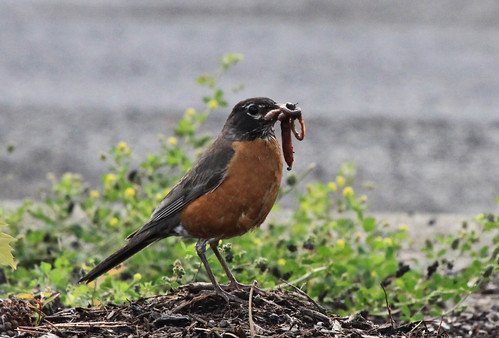
Robins are one of many species that switch their diet and lifestyle as well as their range between summer and winter. We think of robins as eating earthworms, which they certainly do, in addition to a whole host of insects, during their nesting season.

American Robin adult gathering food for chicks

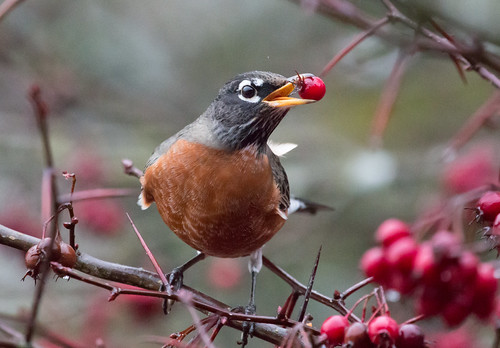
They eat worms and bugs during migration and winter, too, as they find them. But overall, they feed much more on fruits from fall to early spring each year.

American Robin eating fruit

Their behavior shows a dramatic change when they arrive where they'll nest, and both male and female grow extremely territorial. After they're done raising young for the season, they'll grow extremely gregarious until the next year.

So we could think of winter robins as flocking frugivores and breeding robins as territorial worm-eating insectivores. To simplify that, the first robin of spring would be performing its most territorial act—singing—and running on lawns eating worms.

But there isn’t a simple on-off switch between the two seasons. It’s more of a dimmer switch that takes many days or weeks to move all the way from off to on. Through winter, robin sex organs are excess baggage—like most birds, their testes and ovaries shrink after the breeding season, swelling up again in response to increasing day length and weather conditions. During the time those sex organs are expanding in early spring, the birds start producing sex hormones, at very low levels at first, and peaking as they establish their territory and start nesting behaviors.

When I’ve gone down to Nebraska in March to watch Sandhill Cranes, I’ve seen huge robin flocks pigging out on old crabapples and running in brown grasses along the edges of marshes looking for worms.

American Robins

And I’ve occasionally heard individual robins singing while still associating in flocks. They usually sing more quietly than on territory, and quickly get chased by other robins that are starting to feel their oats enough to be stressed hearing their song. I’ve frequently seen squabbling between males in these late winter flocks that I hardly ever see in January or early February. Little by little, the flocks break up even as they follow roughly the 37-degree isotherm northward.

That 37-degree isotherm is another complexity. That’s roughly the average day-night temperature at which earthworms start emerging. But warm underground springs here and there can make worms available when the average air temperature is quite a bit colder, and in areas that didn’t get much snowfall despite frigid temperatures, soils may not thaw enough for earthworms to emerge for many days after that temperature threshold is reached. So again, the rule is a general one.

During a good spell of mild weather in late March or April, my own backyard male robin will arrive and start singing away—HE’S my first robin of spring. A week or so later, one wonderful morning, I’ll spot a female with him. They’ll squabble with any robins who come near my yard, especially defending my backyard birdbaths as their personal property, yet for weeks after they’re both back being fully territorial, I’ll be seeing flocks of robins still passing through and still acting like winter robins. Every step of the way, the hormonal levels of those migrating robins will be rising, and some will be squabbling with one another and some males will start singing and other males will give chase. Using robins to define the start of spring is like watching the snow melt in March and declaring winter is over—late snow storms and late winter robin flocks are two reasons there's an April Fools Day.

American Robin in my bird bath

So how do you distinguish between the “first robin of spring” and the “last robin of winter”? We simple-minded humans have trouble comprehending complexities. Fortunately, robins have an easy time wrapping their bird brains around this kind of complexity. They'll have no trouble knowing exactly what to do as our long-awaited spring finally unfolds.

American Robin