Laura Erickson's For the Birds

Friday, February 17, 2023

Earning Trust in the Age of Climate Change

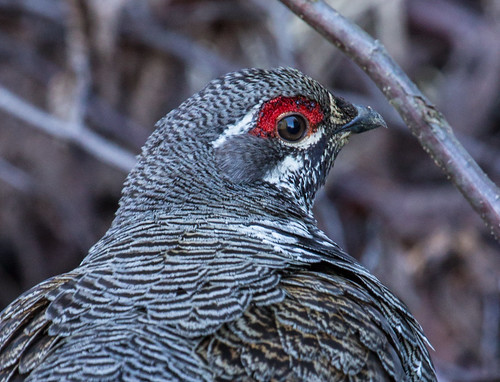
Ruffed Grouse
Ruffed Grouse often bury themselves in deep snow for the night. Yeah, it's cold, but on frigid nights the temperature under thick snow is higher than the air temperature and there is zero wind down there. 

My son-in-law, still adjusting to life in northern Minnesota, plays on an outdoor curling team. His game has been cancelled three weeks in a row, two weeks ago because it was double-digits below zero, the following week because it was so warm the ice was melting, and this week because it was raining. At this very moment, as I write this, temperatures are back below zero but are expected to rise into the 20s today. 

This weather is of course not “normal,” but when it comes right down to it, no winter is normal anywhere—there are always days, and sometimes entire seasons, that are significantly above or below the average for temperature and precipitation. I know one TV weather forecaster who was still insisting, last time I talked to him a few years ago, that climate change is a hoax, citing every recent cold weather event as “proof.” It must be getting harder and harder for him to make that case—in the century and a quarter from 1895-2021, the daily average minimum temperatures during winter (Dec-Feb) have increased 4.9 degrees in southern Minnesota, 6 degrees in central Minnesota, and an astonishing 7.3 degrees here in northern Minnesota.   

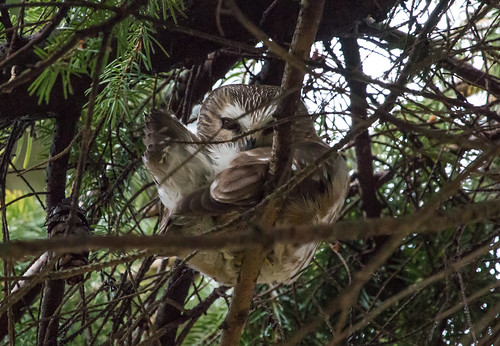
That does not mean winters are growing milder. Even though we’ve not had enough cold for Lake Superior to freeze this year, the wild swings are extremely hard on wildlife and humans both. A January snowstorm took out several of my daughter’s trees, ice dams have been a huge problem for a lot of Duluth houses, and rock-hard ice on top of deep snow makes vole hunting difficult for owls, plunging under the snow for shelter hard for grouse, and walking hard for deer.   
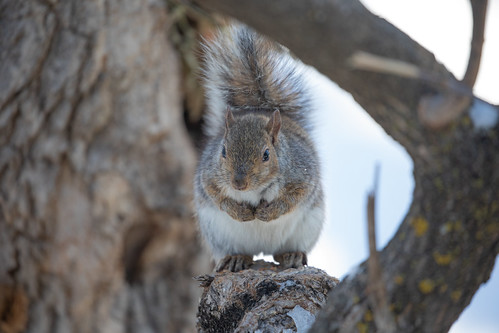
Gray Squirrel

Yesterday when a backyard squirrel, all plumped up with its tail snugly wrapped over its back, looked trustingly at Walter and me through my dining room window, I cranked the window open and Walter tossed it some peanuts. He was delighted that the squirrel instantly ran up and grabbed one to carry to a nearby branch where Walter could watch it eating. As soon as it finished the peanut, it ran back below the window and grabbed another.   

Walter is 2 ½ now, and understands that squirrels, bunnies, and backyard birds all live outdoors. They can’t come in the house to warm up, but they don’t need to—their fur or feathers keep them warm as long as they have enough food. I love that he’s developing empathy, taking joy in making sure our squirrels have that food. Compassion begins with self and family, but then circles out to include friends and neighbors, including backyard wildlife. Cultivating empathy and compassion for these inner circles helps ensure that little by little it will flow further outward.   
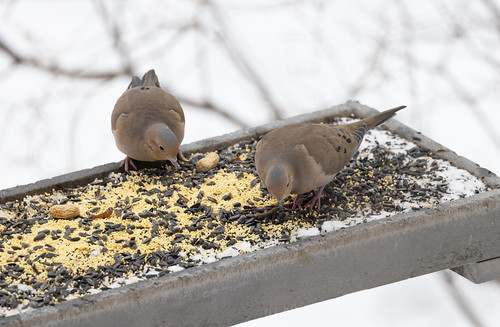
Mourning Doves

Walter and I also watched the two Mourning Doves who have been visiting my yard fairly regularly, especially on the coldest mornings. They are obviously counting on my feeder, but the fact that they don’t come every day is evidence that they have at least one other refuge somewhere near here. They’ll almost definitely get through the season in fine fettle, but I still get anxious on the coldest nights knowing how vulnerable their fleshy feet are to frostbite. I haven’t told Walter that—just reassured him that they have lots of bird seed in that feeder.  

Kelli Alseth's dove

Kelli Alseth, in Proctor, has been seeing one lone Mourning Dove every single day since early January, and every day she makes sure the bird has sunflower chips and white millet in safe, fairly secluded spots near her house. Kelli notes that the little dove has a few favorite places for eating and for roosting, including some in full sun and some sheltered from the wind. 

Kelli's dove knows where it'll be warmest depending on sunlight and wind. 

We know that Kelli’s dove relies on her yard because it shows up every single day at dawn and dusk—the two most critical times for wintering birds to fill up on food. Her conscientiousness toward that one little soul tells me a lot about what kind of trustworthy and compassionate human being she is—the kind I so want my little Walter to become.  

Meanwhile, Russ and I are doing everything we can to make Walter’s future as safe as possible even as climate change continues apace. Last fall we bought a heat pump, and we’re going to be installing solar panels as soon as the snow is gone this year. Being in our 70s, we won’t recoup the financial investment in our lifetime, but profits and dividends aren't always measured in dollars, and by any measure, burning less carbon is a Good Thing. No individual can make much of a difference in a global problem that is so big and so deep and so tall, but doing what we can makes me feel at least a little worthy of my grandchild’s love and trust. 

VIP at my book signing

Wednesday, February 15, 2023

Birding Basics: Binoculars

Laura's new binoculars! 

Binoculars are essential equipment for birding, but a lot of people get frustrated trying to get birds in their binocular view before the birds fly. When I went out on my first birding jaunt, on March 2, 1975, I was using brand-new Bushnell 7x50 binoculars. They weren’t expensive even for back then, but with their huge field of view and extreme brightness, I never, even from the start, had trouble finding birds in them.   

Those binoculars were a gift, and although they were extremely heavy, they were my passport to the whole new world of birds. A year later when I took my second ornithology class, I was asked to assist as a leader on some field trips, entitling me to use the university’s top-of-the-line Leitz 10x40 binoculars. They magnified birds 10 times rather than 7, and were smaller and lighter, the objective lens 40 mm instead of 50 mm. They were a noticeable improvement because of their superior manufacturing, but I had no trouble handing them back after each outing, happy to return to my own beloved pair.  

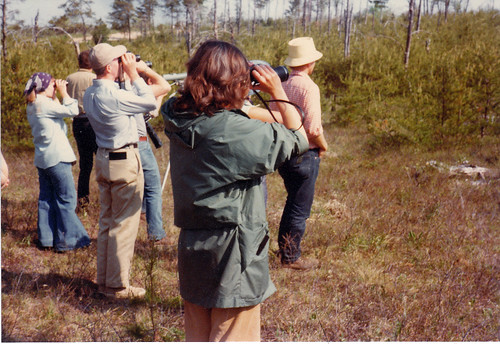
Me looking at my lifer Kirtland's Warbler
Looking at my first Kirtland's Warbler through my trusty Bushnell 7x50s.

Tragically, a few years later the cheap plastic neck strap snapped and my binoculars hit a rock, knocking them out of alignment. At this point I was ready for something lighter, but I made the mistake of going too far, getting Minolta 8x25 pocket binoculars. No one told me that the tiny objective lenses of pocket binoculars don’t let in enough light in early morning and late afternoon or in forested habitat, and are especially worthless for twilight or night birding, nor that the combination of higher power and narrower field of view would make it harder to find birds, though I used them so often that I quickly adapted to that. I do wish I’d known the longstanding rule that the diameter of the objective lens in mm should be at least 5 times the magnification power—that is, 7x35, 8x40, or 10x50.   

Optics have improved enormously since the 1970s, but that 5-times rule still is very important for inexpensive binoculars that lack the sophisticated coatings of pricier models. Even in top-of-the-line models, the second number should never be less than 4-times the first.  
For beginners, I strongly suggest a magnification of 7x or 8x. For any given model, that provides a much brighter view, less binocular-shake, lower weight, and a bigger field of view than 10x. It’s very important to use our binoculars a lot, pulling them up while keeping our eyes directed toward the bird. Practicing on stationary objects at first helps us discern whether the view through our specific pair of binoculars will land directly on, slightly above, or slightly below where our eyes were looking—this practice pays off when a good bird flies seconds after we spot it with our eyes.  If you wear glasses, make sure the binocular eyecups are all the way down, putting your eyeglass lenses close to the binocular optical lenses. Those eyecups are designed to hold the optical lenses a precise distance from your eyeballs, but eyeglasses hold the binoculars about the right distance without the cups. 

One very important rule for buying binoculars is to get the best model you can comfortably afford. Coatings and lens materials have improved enormously since I started out, and binoculars at every price point are better than they were half a century ago, but remember that for optics, the relationship between cost and quality is not linear. The jump in quality between $50 and $250 binocs is huge compared to the difference in cost. The jump in quality between $250 and $3,000 binoculars is huge, too, but not nearly as significant as the jump in cost. Top-of-the-line Zeisses or Swarovskis are definitely better than just about anything, but the biggest differences are hardly noticeable except for people who use their binoculars for long hours every day. For most of us, the difference between $250 binoculars and $3,000 binoculars could pay for a wonderful trip to see a lot of birds.   
Chandler Robbins in Guatemala
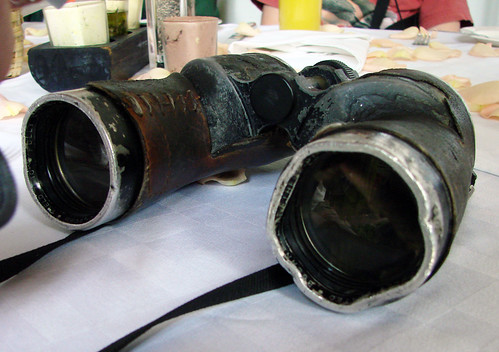
I took this photo of Chandler Robbins, my birding hero, in Guatemala in 2007. Back in the 1970s or early 80s, one of his friends made a protective leather cover for his binoculars, the same brand and from about the same era as my original Bushnells, and he stuck with them lo those many years, spending his money not on upgrading his optics but on important conservation projects to protect the birds he loved. When people gave him "better" binoculars, he usually gave them away to deserving birders in the tropics.

My focus has always been more on birds than on equipment, and I have no idea what products are out there anymore, so I asked one of my dearest friends, who is objective and knowledgeable about the current optics market, about his current recommendations. His top four favorites, all 8x42, as of February 2023 are: 

Vortex Diamondback 

Kowa SV II 

Opticron Natura BGA 

Kowa BD II XD 

When you’re in the market for binoculars, the very best way to test different models is at birding festivals. Representatives from manufacturers and retail companies encourage people to test their wares, often from an outside booth where you can look at real birds in natural conditions. If you know what your budget is, try to discipline yourself to test only models at or below your max. 

Once you have the binoculars you'll be using for a while, the most important thing is to stop thinking about optics and just use them. After all, the whole point of birding binoculars is to focus on birds.

These binoculars have seen a LOT of birds!
I took this photo of Chandler Robbins's binoculars, which he was still very satisfied with, at lunchtime when we were in Guatemala in 2007. 


Monday, February 13, 2023

Superb Owl Sunday 2023

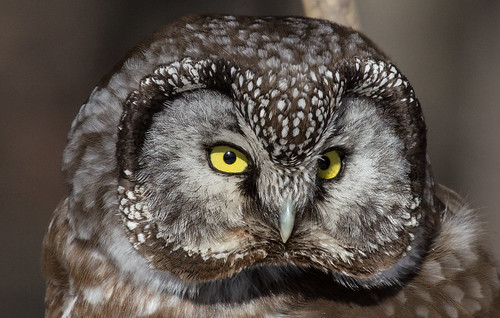
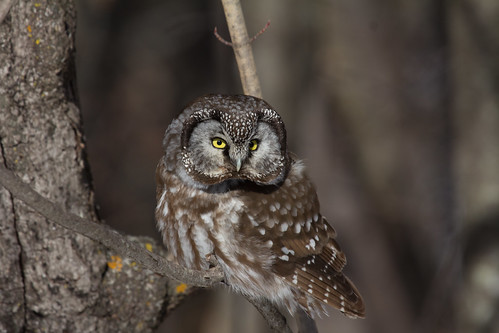
Boreal Owl

Russ and I don’t get to go birding together very often, but we do make a point of getting out one particular Sunday in February whenever we can—Superb Owl Sunday, which I made into a personal annual tradition back in the 1980s. Some years I haven’t been able to go birding, and many times Russ’s schedule hasn’t allowed us to celebrate together, but the very best owl photo I ever took, of the most cooperative Boreal Owl in the most perfect light ever, was on Superb Owl Sunday 2013. That was during my Big Year, and it happened on the only day that whole year that Russ and I could get out together.  

Boreal Owl

This year hasn’t been great for finding owls at the Sax-Zim Bog—I suppose I could blame it on something trendy like supply chain issues, but some winters owls do just fine further north and don't show up here. People up at the Bog have seen a Great Gray Owl every now and then this year, but the birds are apparently finding enough food at night that they don’t need to sit out in the open by day. Great Gray Owls don’t mind people too much as long as we don’t approach uncomfortably close, but ravens and crows can be very rude when they spot a Great Gray, so the big owls prefer to hide out by day if they’re not too hungry. On my two trips to the Bog so far this year, I haven’t lucked into a Great Gray.  

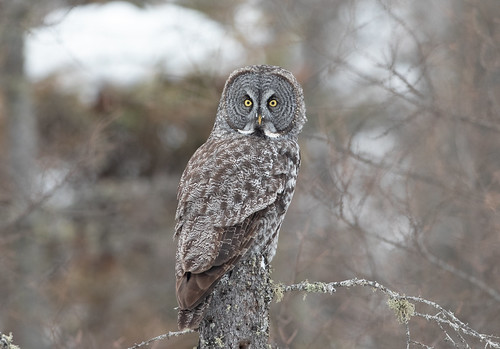
Great Gray Owl
I took this photo on Superb Owl Sunday 2019.

I did get fairly nice if somewhat distant looks at a Barred Owl at the bog this year on New Year’s Day. 

Barred Owl

Then on January 31, a Great Horned Owl turned up in my own yard in early afternoon, sitting in a very exposed limb in a big deciduous tree for several minutes. The bird seemed to be actively hunting, noticeably checking out the neighborhood squirrels and my little dog Pip, so I instantly brought her (the dog, not the owl) indoors. Great Horned Owls start nesting in January and February up here, so I’m assuming this was a male searching for food for his mate and, if they’ve already hatched, his tiny nestlings. No way could a Great Horned Owl carry off an 8-pound dog, but he could easily kill her and then eat her in place or carry off chunks for his family. I think the local pair is nesting somewhere near Lester Park. 

Great Horned Owl

On February 9, I noticed crows harassing a different Great Horned Owl behind my daughter’s backyard—that owl was roosting and trying to evade the notice of any local crows. It was too tucked against the trunk for Walter to pick it out, and the crows drove it off before my son-in-law Michael made it to the window. Any glimpse of an owl should be plenty good enough for me, but I was still disappointed that Michael didn’t get to see it. 

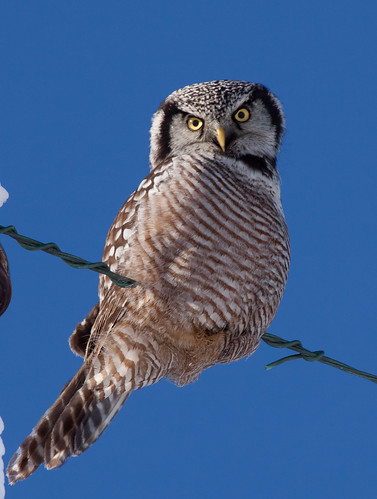
That was it for owl sightings in 2023, so I was filled with eager anticipation on Superb Owl Sunday. Russ and I headed to the Bog, and sure enough, one of our very first birds of the day was a Northern Hawk Owl. It was extremely far away—almost beyond what Pete Dunne calls the distance of conjecture—so wasn’t at all satisfying from a photographic standpoint, but in birding as in baseball, a win is a win, defined on Superb Owl Sunday as seeing any owl. 

Very distant Northern Hawk Owl
That teeny tiny speck at the top of the tree right in the center is a Northern Hawk Owl. Really!

Even better, owls are not the only birds, and we saw plenty of birds up close and personal, especially one of my all-time favorites, Evening Grosbeaks, which were visiting all the feeders. 

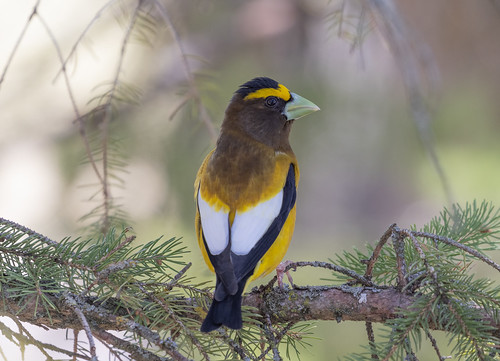
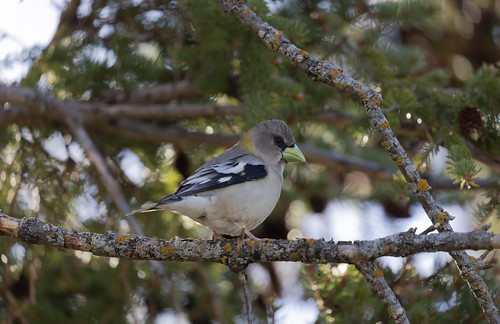
Evening Grosbeak

Evening Grosbeak

Evening Grosbeak

Their pleasant chatter formed so much of the soundtrack of my life for the lovely decade when my children were little, back when Evening Grosbeaks were abundant here, that hearing them is balm for my soul. I’ve made long stereo recordings from my house (all listed on my Evening Grosbeak page), but couldn’t help but hold my phone up for a 2-minute recording behind the Visitor Center.

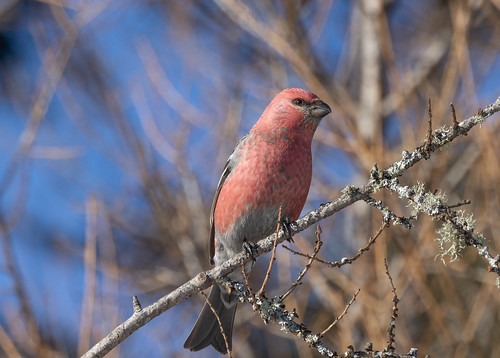
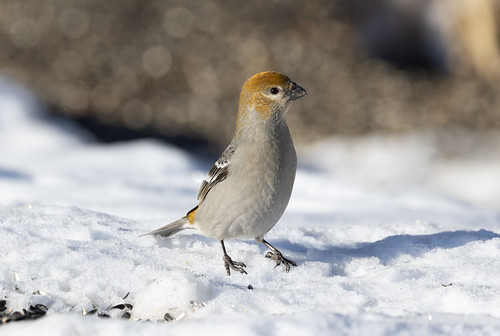
Evening Grosbeaks way outnumbered Pine Grosbeaks, but both species gave me lovely photo ops. 

Pine Grosbeak

Pine Grosbeak

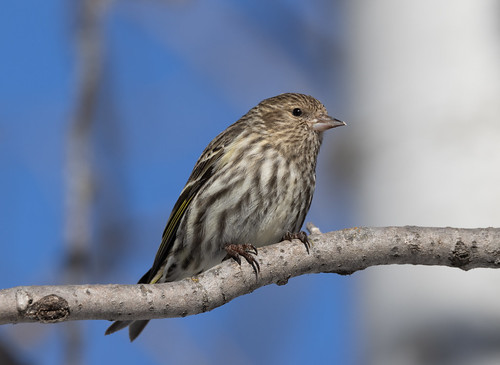
One lone Pine Siskin hanging out near a feeder by the Welcome Center outhouse was very cooperative.  

Pine Siskin

Canada Jays in several places were just as cooperative.  

Canada Jay

Canada Jay

We came home happy and satisfied with our beautiful day of birding.

But Superb Owl Sunday wasn’t over yet. My dear banded Pileated Woodpecker BB showed up soon after we got home, and SheB (the female who may or may not be BB's mate) came soon afterward. And then, what to my wondering eyes should appear but a little Brown Creeper hitching up my box elder. I was right in the middle of downloading photos from my camera’s card, but even if the camera had been ready for shooting, the little bird was focused on eating, not accommodating my photographic needs. I didn’t care—like I said, a win is a win.

Northern Hawk Owl
This photo was taken in January 2011--not on Superb Owl Sunday, but a Superb Owl nonetheless. 


Friday, February 10, 2023

A Few Conifer Specialists

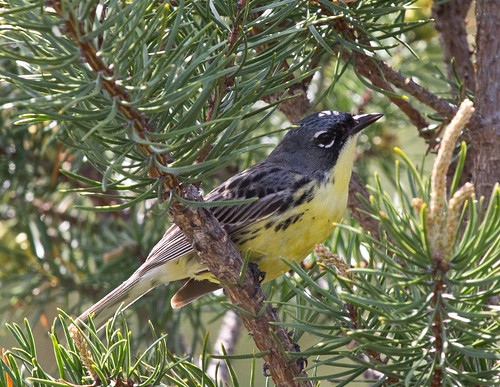
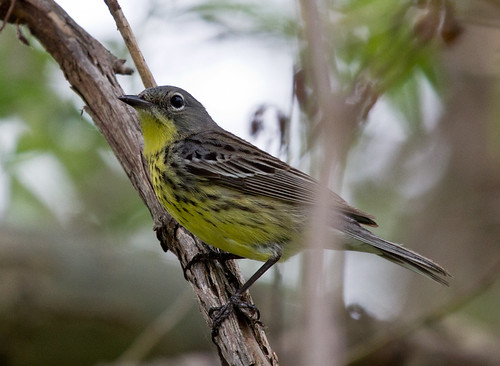
Kirtland's Warbler

The relationships between birds and plants are wonderfully complicated. Just about every bird I’ve ever seen in my yard has spent at least a little time in my conifer trees.  But a few birds are so specialized that they require conifers —sometimes even a single species of conifer—during an essential part of their annual cycle.   

For example, Kirtland’s Warblers are extremely tied to jack pines. On their wintering grounds in the Bahamas, during migration, and even on their breeding territories they find plenty of insect food from a variety of plants, but they nest exclusively on the ground beneath the sheltering bottom branches of jack pine trees. Males aren’t too fussy, but females are—one won’t even consider nesting until she finds a jack pine between about 5 and 15 years old and roughly 5–15 feet high. Too young and a tree won’t provide enough shelter for the nest; too old, and the bottom branches have fallen off, again leaving the nest too exposed. 

Kirtland's Warbler habitat
Ideal Kirtland's Warbler habitat near Grayling, Michigan

Jack pine cones open only when subjected to extreme heat—historically from natural wild fires. Now, with so many humans encroaching on their small natural range in northern Michigan, Kirtland’s Warblers depend on extensive management to ensure there are always stands of acceptable jack pines for them. 

Female Kirtland's Warbler at Magee Marsh
This fussy female Kirtland's Warbler was photographed at the Black Swamp Bird Observatory's Magee Marsh in Ohio during migration. No jack pines available, but she's not nesting yet anyway. 

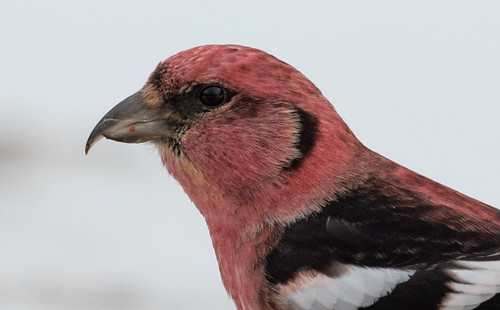
Crossbills nest in conifers, but it’s their feeding habits that make them such extreme conifer specialists. They get their name from the way the lower bill crosses under the upper, either toward the left or toward the right—an adaptation that allows them to insert the bill between cone scales and then twist the lower mandible towards the side to which it crosses, enabling the bird to extract the seed at the bottom of the scale with its tongue. 

White-winged Crossbill

Whichever way a bird’s lower bill crosses determines the side of its face that must be close to the cone. Intriguingly, just about exactly half of all Red Crossbills are left faced and half right faced, but about 75 percent of all White-winged Crossbills are right faced. That difference reflects their cone choices. 

White-winged Crossbill

White-winged Crossbills specialize on spruce and tamarack cones, which tend to be smaller and less sturdily attached to the branches than pine cones. White-winged Crossbills feed on cones still adhering to the trees, but if a section of cone is too hard to access for, say a right-faced bird, it can simply snip off the whole cone and rotate it in its foot, to get out all the seeds. White-winged Crossbills also feed on cones that have fallen to the ground, again easily rotating the cones to extract the seeds. In this species, the lower bill crosses to the right in three times as many individuals as the other way around—about the same percentage we’d expect assuming the way a bill crosses is due to a simple dominant or recessive gene. 

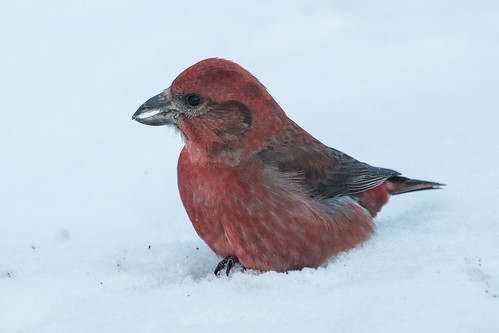
Red Crossbill
Yeah, Red Crossbills usually feed in pine trees. This one is picking up grit to help it digest those pine seeds and give it some minerals the seeds lack.

In contrast, Red Crossbills specialize on pine cones, which usually remain firmly affixed to the tree even as the seeds are pulled out, so Red Crossbill individuals miss a lot of seeds under scales that happen to be too close to the branch to access, depending on which way their bill crosses. Crossbills hang out in flocks, and for them to maximize the number of seeds for the entire flock, it makes sense that the bill crossing is 50/50, though scientists have not figured out how this is controlled genetically. 

Red Crossbill

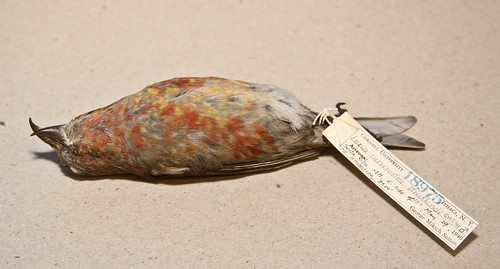
When I worked at the Cornell Lab of Ornithology, I checked out the specimens in their collection. In Red Crossbills, it’s supposed to be 50-50, and sure enough, 22 of 41 Red Crossbills crossed one way, 19 the other. But in White-winged Crossbills, a much higher percentage of birds have lower bills crossing to the right than to the left—in the Cornell birds it was 32 of 46 birds, or 70 percent. This kind of ornithological trivia is a little too specialized to ever make it into the TV game Jeopardy!, but I think it’s fascinating.

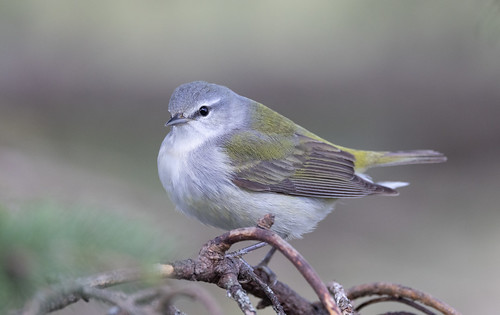
Tennessee Warbler

Cape May Warbler

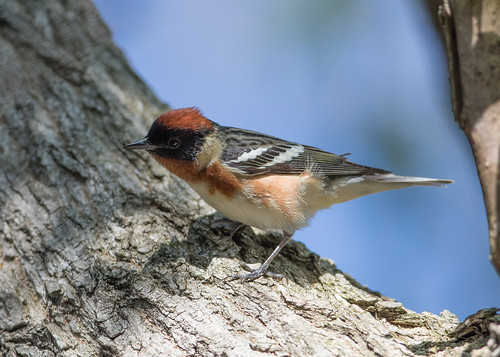
Bay-breasted Warbler

Some birds depend on conifers for food even though they don’t eat seeds at all. Tennessee, Cape May, and Bay-breasted Warblers feed voraciously on an insect that feeds on spruce and fir needles in northern forests: spruce budworm. 

photo by Jerald E. Dewey, USDA Forest Service, http://www.forestryimages.org/browse/detail.cfm?imgnum=2252020

This moth larva, considered a serious pest by foresters, is so important for these birds when feeding young that their populations fluctuate with spruce budworm population cycles. Evening Grosbeaks also depend heavily on spruce budworms for feeding their nestlings.  

 Evening Grosbeak

The more I learn about the fascinating connections between birds and plants, the richer my world becomes. 

Evening Grosbeak

Wednesday, February 8, 2023

100 Plants to Feed the Birds: Conifers

Great Gray Owl

When I started putting together my book, 100 Plants to Feed the Birds, the title was written in stone—Storey Publishing intended it to be third in a series that already included 100 Plants to Feed the Bees and 100 Plants to Feed the Monarchs, but it never occurred to me to limit myself to plants that produce seeds, nuts, fruits, nectar, or other vegetal matter that birds eat directly. Most of the birds who do feed on those items also eat a lot of insects that plants support, and birds also use plants for nesting, roosting, and hiding out in; for nest-building fibers; and more.

I knew I’d start with trees, which are the critical component in various ways for birds associated with every forested habitat and even for many grassland species. I broke trees down into two categories—conifers and broadleaf trees. Some people call those two categories “evergreens” and “deciduous trees,” but some conifers, such as the tamaracks in my neck of the woods, turn colors in autumn and then lose their needles until spring. Up here, broadleaf trees are pretty much all deciduous, losing their leaves in winter, but live oaks keep their leaves year-round, the old leaves staying green until new leaves replace them each spring.

Black-capped Chickadee in Northern White-Cedar

Conifers are woody plants that produce their seeds in cones; they may grow as shrubs as well as trees. Some of our most familiar backyard birds, from chickadees and nuthatches to many finches, are experts at pulling seeds out of cones. Few birds eat conifer needles—breaking down cell walls to extract the nourishment within involves a more specialized digestive system than most birds have, but a few species, such as Spruce Grouse, do eat needles, especially in winter and early spring, until insects and other more easily digestible foods become available again. 

Spruce Grouse
Adult male Spruce Grouse
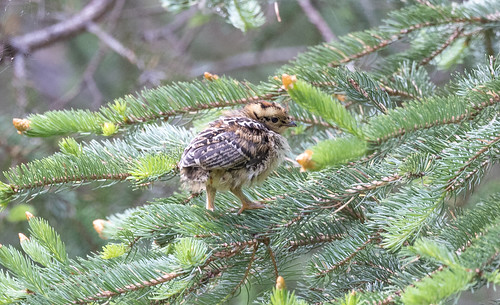
Spruce Grouse chick
Spruce Grouse chick in a spruce

Many conifers ooze droplets of sap from the tips of needles, buds, and branches, attracting insects; birds may feed on either or both the fluid and the insects. Native conifers also harbor a wealth of insects within the foliage and cones, providing even more food for native birds. The diversity of warblers in northern forests is due to the diversity of trees—most warblers specialize on gleaning for insects or flycatching from particular areas within specific kinds of trees, and several warblers are especially drawn to conifers.

Magnolia Warbler

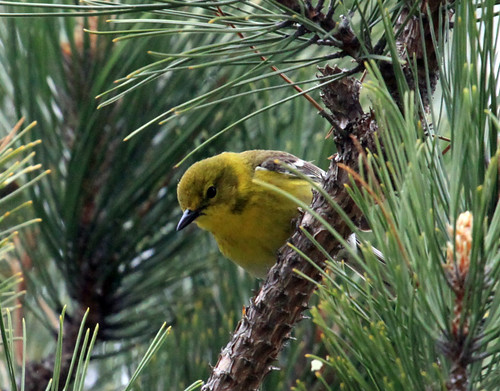
Pine Warbler

Conifers have enormous value far beyond providing food, because their dense branches provide shelter for many birds. Many of the owls I’ve photographed were roosting within a conifer, and cardinals, juncos, and a great many other birds spend their winter nights within the sheltering branches of conifers.

Northern Saw-whet Owl

Barred Owl roosting

Boreal Owl

When planting to help birds, I recommend not just native American species but species and cultivars that are locally native. Those are the ones that grow best in local conditions, minimizing the need for watering and fertilizers, and the ones most resistant to local insect damage while supporting the local insect species our birds depend on. Starting in the 1600s, when homesick Europeans brought to America many of the European plants they missed, right up through today, when gardeners still plant many non-natives, exotic plants made inroads and started taking over huge swaths of what would otherwise be natural habitat. Some exotic plants don’t compete excessively with native plants, but some have become extremely invasive, out-competing native plants. And bringing in those plants from faraway places also unintentionally brought in many harmful pests, from emerald ash borer and other harmful insects to chestnut blight and Dutch elm disease.

Exotic plants don’t support many of the insects that native plants do, but some aren’t huge ecological problems. As important as it is to plant locally native vegetation as we create backyard habitat, we can safely ignore some exotic plants that are already established. For example, here in northern Minnesota, Norway spruces are an exotic that were planted in many urban environments. I don't recommend starting new Norway spruces in our yards, but they haven’t become naturalized in wilder settings so we don't need to chop them down.

Great Horned Owl being mobbed by crows
Great Horned Owl trying to hide from local crows in a Norway spruce

But oddly, even some locally native conifers cause serious problems. In scrub habitat such as what Black-capped Vireos and Golden-cheeked Warblers require, fire suppression has led to junipers taking over, crowding out the many other essential plants these birds also require. Providing quality habitat in these areas may require burning or otherwise getting rid of some of the junipers to ensure a more well-rounded habitat. 

Black-capped Vireo gathering nest materials

So understanding local issues goes way beyond simple lists of good and bad plants. The more we understand about our local areas, the more inviting we can make our yard for the wildlife that belongs in our neighborhoods.

Kirtland's Warbler