Laura Erickson's For the Birds

Saturday, December 8, 2007

Conserve Water!


Bill Hilton Jr. had a great photo essay on his Hilton Pond website this week, about water conservation. I wrote a lot about water conservation in 101 Ways to Help Birds--I posted the section about water conservation on my blog here.
Friday, December 7, 2007

Eagley day


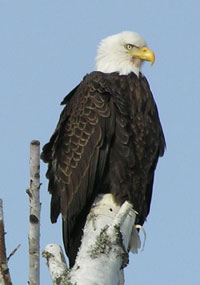
I had to drive to Spooner, Wisconsin, this morning to tape some Northland Adventures segments. Driving up, I saw a couple of Bald Eagles. Then I took another route home, stopping in Port Wing along the way, and got my eagle tally up to 8. Then en route from there, added another 2 for a total of 10. In every case there was a gorgeous adult sitting in a tree or circling in the blue sky, and a mangled deer carcass on the roadside nearby.

I don't think I've ever seen a prettier sunset. I was driving home and there was black ice and/or snowpack for most of the length of "Lucky" Highway 13, making it just plain seem like a bad thought to pull over. But my eyes feasted on it!

Amazon finally got in more copies of my book, and they're already running out again! That's a happy thought, but I hope not too many people are giving it as Christmas gifts. It's a very good book--don't get me wrong! But Christmas morning is the time for opening happy presents. I had nightmares about all the people who were going to open my first book for Christmas. They'd come downstairs filled with eager anticipation, hoping for the latest Paul Simon CD or some other happy and wonderful and beautiful thing, rip off the wrapping paper and find...my book. My nightmares were filled with sad, disappointed faces, and For the Birds was my HAPPY book! 101 Ways to Help Birds is more a New Year's resolution kind of thing than a Christmas morning one. But it does have a lot of timely information--every time I hear a news story about water shortages or the energy situation, I think, "Hey- Most of that was in my book!"

Tuesday, December 4, 2007

Dave Benson's new book!

We got a lot more snow today, but I had an errand out near the airport, and since I was out that way anyway, I stopped at Wild Birds Unlimited to get more sunflower seeds. And what should be sitting right there on the counter but Dave Benson's excellent new book, Owls of the North: A Naturalist's Handbook, published by Sparky Stensaas's Stone Ridge Press, in the new Bird Nerd Natural History series. It's a small book filled with wonderful photos and a wealth of information about all the owls we'd find in Minnesota or anywhere else in the upper Midwest or northeastern states and provinces.

Dave Benson is a wonderful naturalist who's been studying and talking about owls for almost as long as I have. A couple of the points he makes are a little different from my own understanding--I learned in Gary Duke's avian physiology class that owls do in fact have plenty of cone cells in their eyes--not as many (relative to rod cells) as many diurnal birds do, but plenty enough to allow fairly decent color discrimination. (In the human eye, we have about 120 million rods and only about 6 million cones.) According to this 1987 paper in The Condor, a Great Horned Owl's photoreceptors are 7 - 8% cones, and the authors suggest that although color vision isn't acute, it may "broaden the spectral window through which visual information may be gained; this might be particularly useful during the occasional daylight hunting forays of this species."

Also, banders are discovering that Saw-whet Owl feathers have wonderful patterns when they look at them with a black light. If the feathers have "color" in ultraviolet wavelengths, these owls almost definitely are able to discern it, which may allow them to recognize sex and even discriminate among individual Saw-whets.

Dave discounts one possible function of owl feather tufts helping owls to appear a bit more catlike, but that happens to be a theory I think makes a lot of sense. The times I've seen Great Horned Owls on the ground, feeding on rabbits, they DO have a very fierce, catlike appearance that must seem rather fearsome to an approaching fox--it might just give the owl an extra few seconds to finish swallowing and take off without being eaten. Of course, as Dave notes, looking like a small mammal could be dangerous for any bird, but even large predators seldom mess with cats without taking at least some self-protective measures, so during the vulnerable moments when an owl is on the ground grabbing and eating its prey, there might well be some benefit to holding those tufts like a cat's ears. Indeed, when a cat rears to attack, it pulls its ears back in almost the exact same way as my education screech owl Archimedes pulls his feather tufts back whenever I have to grab him to put his jesses on. As Dave notes where he discusses the defense posture, owls also hiss when they're approached, another catlike behavior, and Dave notes that some other Great Horned Owl vocalizations have made him think an owl was a cat.

Dave quotes a researcher who found that one tame Long-eared Owl taloned anyone who touched its tufts. My own Archimedes doesn't seem to react one way or another when I touch his feather tufts--he seems to like any part of his head stroked. I've read many sources suggesting that the feather tufts have a sensory function, and my own feeling is that this is almost certainly true, but is only one of several possible functions for those tufts. Like Dave says, though, nobody knows for sure.

Dave covers a lot of owl basics and presents a lot of solid information about each species, and even where his opinion about an issue is different from mine, there is plenty of food for thought, so the book is well worth $16.95. It's available in bookstores and online.

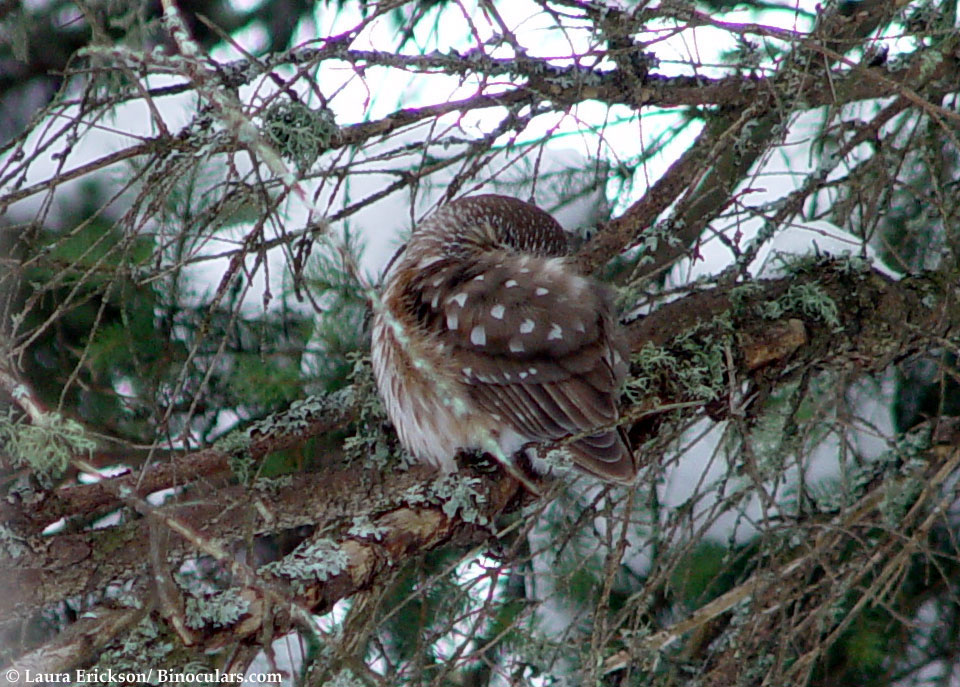
The photo on page 65, which Sparky took of a roosting Saw-whet Owl, is apparently of the exact same bird I photographed in Two Harbors a couple of years ago, resting on the exact same branch. It was a hotline bird, so dozens of birders saw it. Sparky is taller than me so his angle is slightly different, but it was really cool to see this particular bird in this wonderful book, which would fit perfectly in a Christmas stocking.

Monday, December 3, 2007

"Sublimely silly"


Uh oh. Amazon is all out of all three of my books! It was so cool to have a little plug for 101 Ways to Help Birds on Newsweek's blog, but it apparently led to a run on the few copies Amazon tries to keep in stock, and brought my book all the way up the charts to #97,871 in book sales. At this moment it's also #22 in "Endangered Species Books," and is not in the top hundred bird books. Oh, well. I wouldn't know how to deal with having a best seller, or even a not-too-bad seller, though it does mystify me why more people aren't interested in it, since it really does cover a huge spectrum of issues facing birds. Virtually every newspaper has been carrying stories about the declining numbers of birds with the release of Audubon's 2007 Watch List, but my book isn't on any of the writers' radar screens even though it covers every issue I've read about in those articles.

But Cafe Press still is carrying a CD I put together several years ago, "For the Boids," which is filled with radio programs I produced for various April Fools' Days and other unfathomable reasons. You can pay $15 for the CD, which sports a photo of me taken when I was four on the cover--the Beanie Baby Blue Jays were Photoshopped in. Or you can listen to most of the programs for free (I've never been much of a capitalist, have I?) on my webpage (scroll down to "From the Archives"). My all time favorite is "Where the Boids Are," in which two college students drive up the shore to Grand Marais for spring break to be where the boids are.

Birding in Sri Lanka


Now this is a cool blog, from a place I have absolutely no experience at. Amilo Salgado leads birding tours to Sri Lanka, and fills his blog with wonderful photos (like that Brown Hawk Owl above) of rare birds, snakes, and other cool subjects, along with stories that make me feel like I'm there right along with his clients and himself in this wonderfully exotic place. No way would I ever play Scrabble with him, but my daughter would relish a chance to compete with him on that score! Me, I'd just like to go birding with him.

A different Newsweek article

A few weeks ago, a Newsweek reporter called me about a bird-feeding article she was putting together. I forgot all about it, but here it is. Pretty brief, and didn't get into a lot of stuff we talked about, but it's reasonably accurate.

Sunday, December 2, 2007

Bell Museum, please reconsider!

Oh, my. Birdchick posted on her blog that the Bell Museum of Natural History is going to be moving to a new building--a literally new one. They showed off the plans for the new construction at the MOU Paper Session yesterday. But they developed a design that has a huge window--a potential bird disaster. I don't know if this is part of their plan to get new specimens for the museum (I'm being facetious here, but Bob Zink MUST realize that windows are one of the main sources of bird specimens) or they're trying to save money on construction costs (glass is cheaper than many building materials). I sure hope they reconsider. Read the details at Birdchick's blog. If they do keep these plans despite the obvious irony of a natural history facility killing potentially thousands of birds, I hope they develop effective screening. Several facilities did just this as shown on my safe windows page.

Varied Thrush!

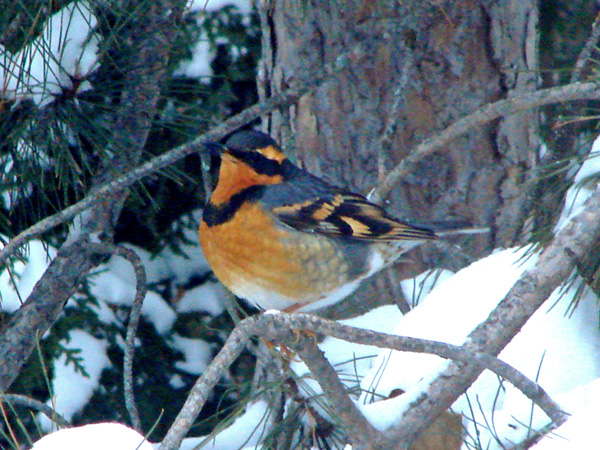
My good friend Alison Clarke looked out her window Wednesday morning to see a gorgeous male Varied Thrush! I was getting ready for my flight so couldn't run over to see it, but the cooperative bird has been sticking around in her neighborhood, visiting her feeder throughout the days ever since. So this morning I went over to watch the bird in luxury. I sat there eating delicious, fresh-baked cranberry bread and drinking coffee while feasting my eyes. The bird came several times while I was there.

The new snow is deep, it was murky and dark, and I photographed him from inside, through a plastic-covered (winterized) window, so my photos aren't nearly as good as the bird is beautiful. If I get a sunny day this week, I'll go back and photograph him from outside. If you're in Duluth, you can follow the hotline directions to find it.

As with most species, you can read about the Varied Thrush and hear its sounds at the Cornell Lab of Ornithology's All About Birds website, at the Varied Thrush entry.

"We are the people we have been waiting for"

Thomas Friedman has a wonderful, hopeful column today about global warming, or as he and others are starting to call it, "global weirding." As he notes:
And sweet-sounding “global warming” doesn’t really capture what’s likely to happen. I prefer the term “global weirding,” coined by Hunter Lovins, co-founder of the Rocky Mountain Institute, because the rise in average global temperature is going to lead to all sorts of crazy things — from hotter heat spells and droughts in some places, to colder cold spells and more violent storms, more intense flooding, forest fires and species loss in other places.
He writes about meeting with MIT students:
I got together with three engineering undergrads who helped launch the Vehicle Design Summit — a global, open-source, collaborative effort, managed by M.I.T. students, that has 25 college teams around the world, including in India and China, working together to build a plug-in electric hybrid within three years. Each team contributes a different set of parts or designs. I thought writing for my college newspaper was cool. These kids are building a hyper-efficient car, which, they hope, “will demonstrate a 95 percent reduction in embodied energy, materials and toxicity from cradle to cradle to grave” and provide “200 m.p.g. energy equivalency or better.” The Linux of cars!

They’re not waiting for G.M. Their goal, they explain on their Web site — vds.mit.edu — is “to identify the key characteristics of events like the race to the moon and then transpose this energy, passion, focus and urgency” on catalyzing a global team to build a clean car. I just love their tag line. It’s what gives me hope:

“We are the people we have been waiting for.”

Read the whole article.

Saturday, December 1, 2007

Great NY Times article

Here's an indepth article about the controversy surrounding the Jim Stevenson case. Kill the Cat that Kills the Bird?