Laura Erickson's For the Birds

Saturday, October 29, 2022

Birds in Art: The 2022 Exhibit

Every one of the 118 works in this year’s “Birds in Art” exhibit at the Leigh Yawkey Woodson Art Museum in Wausau, Wisconsin, deserves in-depth coverage, but that would take a whole book, and there already is one—this year's exhibit catalogue. I have to cover at least a few, though I'm leaving out others just as splendid.


Swiss-born Lucrezia Bieler produces exquisite papercuts using a single sheet of black paper cut with small, sharp scissors and mounted on white matboard. Her “Woodcock” depicts a female on the nest as a central image surrounded by a circular frame of 18 adult birds and two almost-hidden tiny chicks. The museum also enlarged that piece to display over an entryway. At the artist's original scale or much huger, the art was gorgeous.

Sunday, October 23, 2022

Birds in Art: a Little History

Every fall, I try to make a trip to Wausau, Wisconsin, to visit the "Birds in Art" exhibit at the Leigh Yawkey Woodson Art Museum. This extraordinary, juried exhibit was inaugurated in 1976, the year the museum opened, and has continued every year since. When I can't make it to the exhibit, I at least purchase that year's catalog. 


I discovered Birds in Art in the mid-90s, and since then have also acquired every catalog going back to 1989.  

Birds have been on the planet longer than humans, an inescapable part of our environment from earliest times. 

Grandma showing Walter a chickadee

My two-year-old grandson notices birds on our walks even when I don’t point them out, and without binoculars or me helping, Walter can accurately distinguish and name owls, chickadees, Blue Jays, crows, ducks, and woodpeckers. Small wonder that modern English words for wild birds such as hawk, owl, raven, swallow, and sparrow; for domesticated birds such as cock and fowl; and the word bird itself were all in use before the 12th Century. Birds feature in the Bible and the Quran, and in the tales, songs, literature, and artwork of essentially every human culture.  

The earliest known cave art includes drawings of birds. An owl depiction on the walls of the Chauvet cave in southern France is believed to be 30,000 years old. Many books and articles call it a Snowy Owl and use that as evidence that during glaciation, snowies were common, or at least noticeable, in France. Before I’d seen photos of that drawing, I reported that misinformation myself. But the cave drawing clearly depicts the owl having feather tufts, making it a much more likely tiny European Scops-Owl, medium-sized Long-eared Owl, or very large Eurasian Eagle-Owl—the three owl species with tufts that would be seen in France then or now.  

Long-eared Owl
This Long-eared Owl is the only owl I've ever photographed in Europe, not in France but in Austria. 

When I started birding, the first bird art I became aware of included what I saw in my field guides and basic bird books, and old standards—Audubon, Peterson, and Arthur Singer—doing beautiful work showing beautiful birds at their best. When I take photos, that’s what I aspire to—capturing each bird doing what it does as beautifully as I can. My favorite photos, like most of the bird art I display in my home, are straightforward depictions as true to the bird’s life in nature as possible.  

Much of the bird art I saw displayed at gift and art shops in the ‘70s were fairly expensive prints in a narrow genre: beautiful portrayals of waterfowl, often a string of ducks or geese flying into a marsh in autumn. They either included a clear representation of a hunter and dog lying in wait or implied their presence. Along with these were beautiful prints of a retriever or spaniel holding a dead duck.   

American duck hunters have been specifically associated with bird art since 1934, when President Roosevelt signed into law the Federal Migratory Bird Hunting Stamp Act, requiring every hunter to purchase a Federal Duck Stamp to legally hunt waterfowl. The first Duck Stamp was illustrated by famous cartoonist and conservationist Jay “Ding” Darling. In 1949, the first contest to select that year’s Duck Stamp artwork was held. Now that contest has evolved into a major event, and the superb artwork is part of the reason Duck Stamps are collectors’ items. Many hunters purchase more than one because they must keep a signed one on their person while hunting but want a pristine one for their collection. The Duck Stamp Act ensured that 98 cents of every dollar spent on a Duck Stamp goes directly to protecting habitat in the National Wildlife Refuge system, so a great many of us birders and other people who care about wildlife purchase a Duck Stamp every year regardless of their collectability.   

Bird art is more than depictions of game birds and other species in nature—it spans the gamut of how we human beings visually interpret those birds in our world. In tomorrow's blog post, you can read about how the Woodson Art Museum’s annual "Birds in Art" exhibit beautifully celebrates the traditional, straightforward depictions of birds in natural settings doing natural things while also widening the concept of birds in art in always wonderful and surprising ways.

Sunday, October 16, 2022

Bird Friendly Coffee: The Price of a Clean Conscience

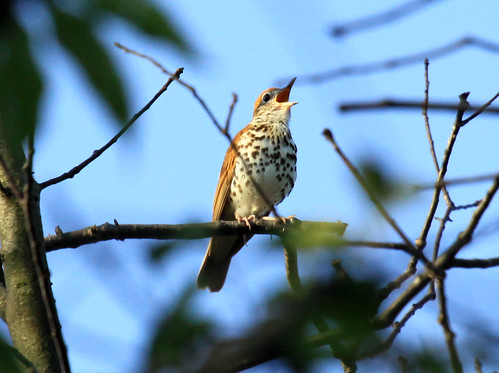
Wood Thrush

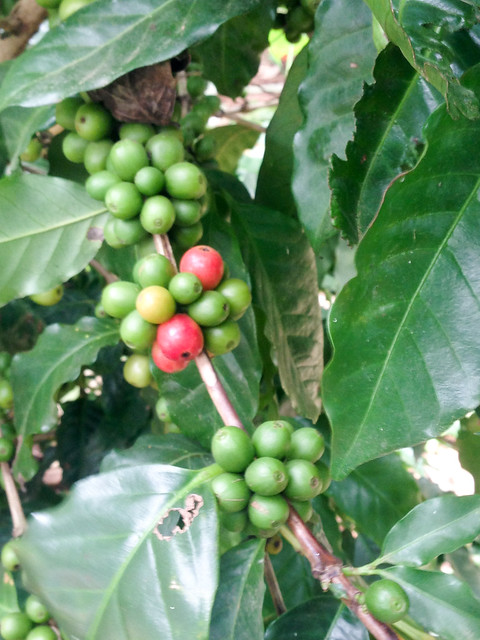
My morning coffee routine wouldn’t feel satisfying if I wasn’t certain that my coffee had been grown in a sustainable way that was healthy for birds, for the people growing and harvesting it, and for me drinking it. Coffee is grown in the tropics, mostly as row crops where rain forest once stood. How could I savor my morning cup knowing that warblers, orioles, and tanagers had lost critical winter habitat to a coffee plantation, or that the human beings who had picked each bean were not getting a living wage for their work?   

That’s what coffee certification is all about. It’s not too hard to find coffee that’s been certified fair trade, addressing some of my concerns, but I need more. When coffee is also certified as shade-grown, it was usually grown under an overstory of natural tropical trees, fostering at least some natural habitat for tropical birds and neotropical migrants.   

Unfortunately, as I once saw in Costa Rica, coffee can be called shade-grown even when it’s not grown under a natural overstory—the seemingly endless rows of coffee trees in one shade grown coffee plantation I saw were grown under plastic awnings.   

Rainforest Alliance certification ensures that the coffee is both fair trade and shade grown in a sustainable way, protecting birds and humans both. 

When I need gas on a road trip, I always look for a Holiday station because one of their coffee choices is always Rainforest Alliance certified. Even if I don’t need a cup right then, I like supporting Holiday’s commitment to protecting the world we all share.   

Rainforest Alliance coffee is not certified organic. Many wonderful coffee growers, who deserve to be rewarded, are reclaiming land that had been deforested for agriculture or lumber, and it takes years before land previously exposed to synthetic pesticides and fertilizers can meet the requirements for organic certification.   

Coffee growers who are already meeting organic standards also deserve support. That’s why for the coffee I make at home, I buy beans that were certified by the Smithsonian's National Zoo and Conservation Biology Institute as “Bird Friendly,” meeting fair trade, shade-grown, and organic standards. To clinch it, Smithsonian scientists verify that it’s grown in quality habitat with excellent bird diversity. 

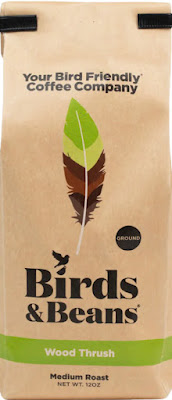
I keep checking food retailers and coffee shops in Duluth but so far haven’t found any local sources of Bird Friendly coffee, so I buy it online via Birds & Beans. I like medium roast, so I buy their "Wood Thrush" blend. I used to buy it by subscription, but I'm not a good judge of how much and how often to order, so now I just buy it as needed. 


The American Birding Association sells what they call "Song Bird Coffee," which is also certified by the Smithsonian as Bird Friendly.    

Even the best coffee and its packaging exact a toll on the earth, and the energy consumed in transporting coffee beans and roasting them, and my own grinding the beans and heating the water, all contribute to climate change. My longtime hero, the late Chandler Robbins, once told me that he can't bear to drink more than one cup a day for this very reason, inspiring me to do the same.  

Chandler Robbins in Guatemala

Bird Friendly coffee is more expensive than uncertified coffee, but how much is a clean conscience worth?


Joy in the Morning

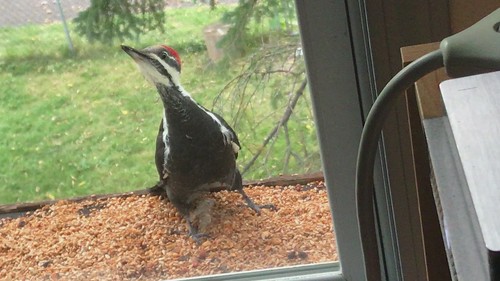
Pileated Woodpecker at my window feeder 

I’m a morning person, usually waking without an alarm clock. Except close to the summer solstice, I’m usually up before first light.   

I always need both time and coffee before I can handle noise or bright light in the morning. Scientists call the transition between sleeping and alert states sleep inertia, the time it takes to become fully functional. It can last up to four hours for some people. My own sleep inertia doesn’t last anywhere near the maximum, but it does last a good 45 minutes most days. When I need to be somewhere early and must set an alarm, I always set it 45 minutes earlier than what I’d need to get ready.    

I keep the lights low while I make my coffee, and I need quiet. Once or twice a week in the afternoon, I grind a few days’ worth of coffee beans into a small, airtight container. In the early morning quiet, after pouring just shy of two cups of water into the electric kettle, set at 205º, I press a moistened  paper filter into my ceramic pour-over funnel, set that into my good old Cornell Lab coffee cup, measure two rounded scoops of coffee into the filter, and take my dog Pip out while the water heats. In spring when birds are singing, this is when I set out my sound recorder to capture the dawn chorus. My kettle holds the temperature, so it doesn’t matter if Pip or I are a little poky.   

I pour the hot water over the coffee grounds slowly, in counterclockwise circles. It’s debatable whether the direction really matters, even with the spiraling grooves in the funnel, but the routine matters to me. I love watching hot water transform into coffee, savoring the aroma as the coffee grounds swell and darken when the water first touches them, and then seem to slowly exhale as the last of the water seeps through.     

I carry my cup to my desk, still keeping the lights too low to accomplish much of anything. If it’s starting to get light outside, I roll my chair to the window and gaze at the yard. Last year when a Rufous Hummingbird visited me from early November through December 4, this quiet routine made it easy for me to notice what time she first arrived each day. Being addicted to coffee probably indicates a flaw in my character, but making and drinking it is, for me, a soul-satisfying way to begin my day.   

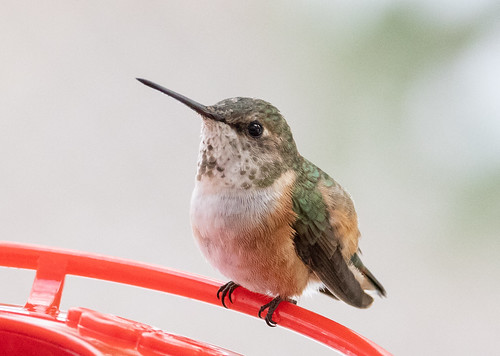
Rufous Hummingbird

This Saturday morning, it was already light outside when I carried my coffee to my office, so I filled the window feeder and sat there, savoring coffee and birds as I thought about how extraordinarily lucky I am. I often feel a suffusion of well-being and contentedness during my sleep inertia state, and Saturday it was heightened watching birds coming and going. No matter what the season, I can count on chickadees, who always have the power to make me smile. 

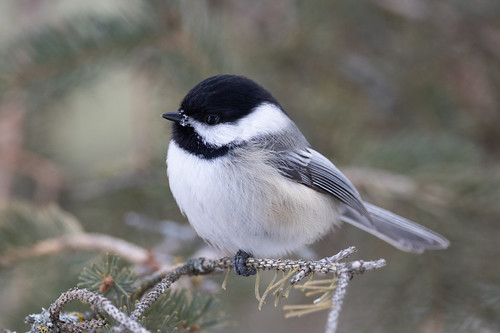
Black-capped Chickadee

So do Blue Jays, and two of them are sticking around this fall quite reliably. These two didn’t stay last winter but are old friends, both flying in for peanuts as soon as I whistle in the backyard. I don’t whistle when I fill my office window feeder, but if they’re nearby and notice, they fly in for the spicy peanuts in the Fiery Feast blend I use. When I’m right there at the window, their eyes meet mine occasionally, a friendly acknowledgment. At least, I like to imagine that we’re friends. I’d guess the relationship is more transactional in their minds, but it seems condescending and arrogant to presume to know a Blue Jay’s thought processes. Whatever they think of me, I’m happy that my presence at least doesn’t scare them away.  

Blue Jay

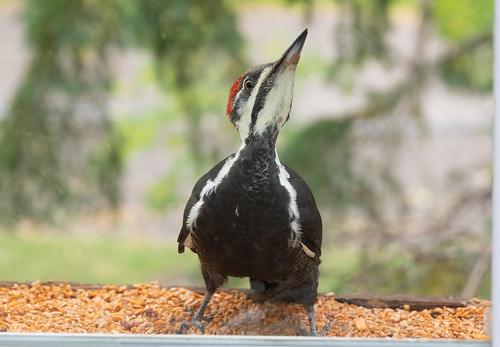
The jays disappeared  when a much larger bird flew to the feeder—a female Pileated Woodpecker, barely two feet from me. Like the jays, her eyes met mine. She pointed her bill to the sky and bobbed her head from side to side a few times, and then started feeding. Whenever she looked at me again, she repeated that bobbing movement. Looking at the underside of her head, my sleepy brain pieced together how woodpecker eye placement gives them  a wide, clear view of what’s below as well as above.  

Pileated Woodpecker at my window feeder

I’d never seen Pileateds do that head bobbing so closely until two weeks ago, when this same bird was at this same feeder while I was drinking coffee from this same cup. I’d made a video of it to show my grandson Walter. “Woodpecker” is one of his words, and we had a delightful time mimicking her, looking up and bobbing our own heads from side to side.  

Pileated Woodpecker at my window feeder

On Saturday morning, my suffusion of gratitude during sleep inertia swelled to high intensity. I’d made a list last year of my all-time favorite birds. Black-capped Chickadees hold the Number One spot, and Blue Jays and Pileated Woodpeckers are tied in second place. Imagine all three of my favorite birds in the universe visiting my  feeder when I’m inches away! The Pileated doesn’t always come to this feeder, but she and BB, the banded male I’m so fond of, have both been visiting my suet feeders every day.   

I savored the last dregs of coffee and rolled my chair away from the window, ready to start the day. Even as I gathered laundry and started the washing machine, worked on an article about my Alaska trip, put the wet clothes in the dryer, and went back to writing, a glow of happiness clung to me. If I’m not the luckiest person in the world, I’m certainly in a tie for first place.  

Pileated Woodpecker at my window feeder

Friday, October 14, 2022

Numbers!

I love numbers. Back in the olden days when I was an occasional counter at Hawk Ridge, any time little children asked what I was doing, I mustered my best Jerry Nelson voice to say, “They call me the Count. I am called the Count because I love to count birds.”  

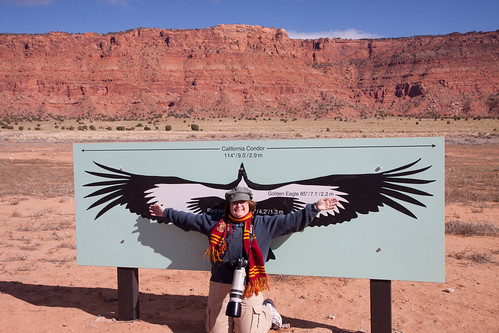
I’ve always played with numbers and made a big thing about special numbers. Way back in fifth grade, on the day I turned 10, I worked out that I would turn 60 on 11/11/11. That seemed cosmic because the sum of the digits of that birthday equaled the sum of the digits of that age. That’s why I had to do something cosmically special on 11/11/11, so Russ and I went to the Grand Canyon for me to see California Condors for the first time.   

California Condor

Numbers and silly statistics are part of the appeal of baseball for me. My favorite baseball player, Anthony Rizzo, got hit by a pitch for the 200th time on October 1, making him one of only four players in baseball history who got hit by a pitch at least 200 times and also had more than 200 home runs.  

My favorite baseball player with my favorite bird

Two-hundred hit-by-pitches made a nice round number, but there were two other round numbers I was looking for this month: 100 wins for the Yankees this season—they missed that by 1—and 60,000 for the Blue Jays, which is where my round numbers for October diverge from baseball. Some of the Blue Jays we see in Duluth may have spent a bit of time in Toronto at one time or another, but none are baseball players. I’m talking about the Blue Jays migrating over Duluth. Last year they broke their all-time high with 59,601 counted at Hawk Ridge Bird Observatory. The counters broke that record on October 5, and the very next day they broke 60,000. And as of the end of Thursday, October 13, the Blue Jay count at Hawk Ridge for 2022 is 60,485.  

Blue Jay

There may have been fall seasons, even since 2000, when more than 60,000 Blue Jays passed over the Ridge; it’s only been since 2007 that counters made a serious effort to count every bird flying over, not just every raptor. So breaking the record isn’t that significant, but somehow the number 60,000 seems really cool.  

The Finch Research Network publishes an annual Winter Finch Forecast, predicting where irregular or irruptive winter songbird species will appear each year based on analyzing, over the continent, cone production for various conifers; seed production for various deciduous trees; and berry production for fruit-bearing trees and shrubs. For example, this year the forecast for the upper Midwest predicts higher than usual numbers of Pine and Evening Grosbeaks. 

The forecast includes three irruptive songbirds that aren't finches, all of which they predict will be seen in good numbers in the upper Midwest this winter. I’m already seeing plenty of Red-breasted Nuthatches; Bohemian Waxwings usually appear later in fall or early winter. And the Finch Research Network writes this about Blue Jays:

This will be a good to strong flight year. Beechnut and hazelnut crops are poor. The acorn crop is generally poor but with pockets of good crops scattered from Manitoba eastward through southern Canada and northeastern states southward to Pennsylvania.  

Blue Jays at feeder 

After all the jays I was seeing in September, I’m now down to just a couple, which appear to be birds that have been on Peabody Street a lot in recent years—they fly in the moment I whistle and set out a small handful of peanuts. But it's too early to know if they’ll settle in here for winter or not. Blue Jays depend on natural food far, far more than feeders. Even during the peak of migration when my feeders are covered with them, bazillions more are in the neighborhood consuming seeds, berries, and insects. Even hungry migratory individuals spend a lot more time away from my feeders than in them, based on the fact that in 2020 and 2021, when I spent long hours keeping track of them, the outliers I could pick out by plumage abnormalities such as unusual paleness appeared only a few times over a full day, and when they did come to the feeders, remained for only a few minutes before heading back into the trees. Feeders provide variety in Blue Jay diets, but are never their primary food source.  

Blue Jays are hardly fair-weather friends—unlike the Toronto Blue Jays, who disappeared for the year this October 8, some feathered Blue Jays will be seen throughout their range this entire winter.  A handful of Blue Jays stuck around Peabody Street all last winter, though “my” Blue Jays—the ones who respond specifically to my whistle, disappeared, returning right about the time the 2022 baseball season was gearing up. 

All the baseball teams named for birds, as well as my beloved Cubs, are out of the running this season. But at least for the next three days, even as I keep whistling for my Blue Jays, I’ll be watching my favorite Cub, Anthony Rizzo, and the team the Cubs traded him to. Then at some point this month or next, I’ll forget all about baseball for the duration. But even in the dead of winter, a few Blue Jays will be here squawking and staring at me with their jaunty little crests, making certain I never forget them. 

Blue Jay


Friday, October 7, 2022

Saw-whet Owls

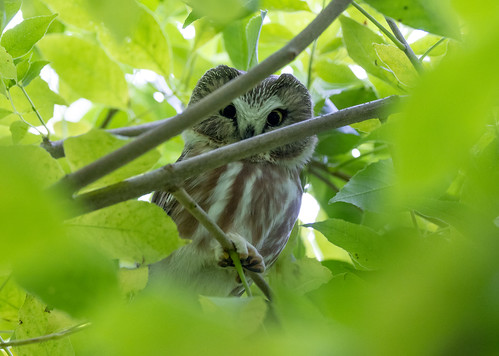
Northern Saw-whet Owl 

On Tuesday morning, I was late leaving to babysit my grandson. My little dog Pip was not ready to come inside, so I rushed out to get her, no time to spare, when a barrage of curse words hit my ears—at least a dozen chickadees and both kinds of nuthatches were swearing away in the back of my yard. I didn’t have time to search out what had set them off, but this being the first week of October, I had a pretty good idea.  

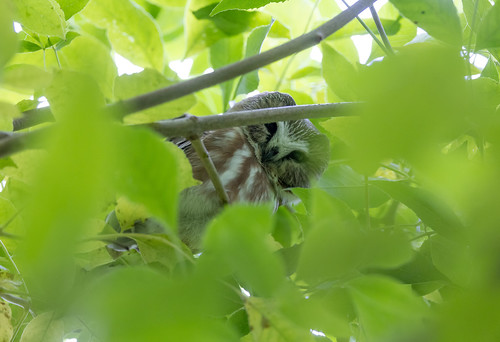
At mid-morning, I arrived home to even more swearing. And just as I expected, hidden in the tall, dense vegetation behind my yard perched an adorable little Northern Saw-whet Owl, beleaguered by the cloud of even littler birds yelling at him from every direction. The owl was apparently more concerned about me and my camera—I could tell because he didn’t look at the chickadees at all, just me, so after I took a few photos, I went back in the house. 

Northern Saw-whet Owl

When I spotted my neighbor Jeanne, I brought her over so she could see it too, and as long as I was there anyway, I grabbed a few more photos. I also put out a text alert to some birding friends in case any of them wanted to see it. When my husband came home for lunch, I of course brought him to the owl, and this time I got a short cellphone recording of a few nuthatches and a Ruby-crowned Kinglet swearing at it, but again, we quickly left the little bird in peace.   

Northern Saw-whet Owl

About 2:15 or so, one of my friends who’d received my text message came, so I showed her where the owl had been, but no little birds were cussing, a grackle was now moving about in that branch, and the saw-whet was nowhere to be found. Well, actually it was still very close. A few hours later, a couple of neighbors strolled past with their dog after I’d mentioned that the owl had been there. They scrutinized all the trees as they walked down the path. Even without any chickadees to alert them, they got a great look at the little guy, now at eye level rather than overhead, just a short distance beyond where I’d seen it. They got phone photos and videos, which they showed me the next day.  

What made the little guy move? Had it become exasperated with the scolding chickadees? I had been working at my computer by the window for over two hours but hadn’t noticed people about, so I don’t think a person scared it off. The grackle may have sent it packing. Grackles and saw-whets both weigh from 2 ½ to 5 ounces, but even a single grackle on the smaller end of the weight spectrum, with its sturdy, pointed bill, would make a more dangerous adversary than the half-dozen or dozen chickadees that balance a saw-whet weight-wise.  

Saw-whets migrate through Duluth in huge numbers, though most pass through without people noticing them. Every autumn, banders at Hawk Ridge capture from 600–1,500 owls, the vast majority of them saw-whets, mostly in October. Just about every block in Duluth probably hosts at least one or two saw-whets for at least a day or two every October, but the tiny predators do their darnedest to keep from being noticed.   

How can you luck into seeing one? I’ve been birding so long that I’ve trained myself, without even realizing it, to key in on bird sounds even when I’m busy with other things. It takes a kind of mindfulness to notice angry-sounding birds, especially chickadees, which vocalize a lot whether an owl is there or not. Paying attention to their everyday sounds helps us hear the difference when chickadees start making angry dee-dee-dee calls—the more dee notes, the higher the threat level. Paying attention to those notes has led my eyes to both saw-whet and Boreal Owls.  

Black-capped Chickadee saying naughty words to a Boreal Owl
I photographed this Boreal Owl in the Sax-ZIm Bog in February 2020. Notice the chickadee scolding it. Chickadees and other birds virtually never perch below a predator. They're much safer scolding from above.

Crows, jays, or robins making angry calls indicates that a larger owl or other predator may be nearby. Here in Duluth over the years, what is called a murder of crows has led me to Barred, Great Horned, Great Gray, and Long-eared Owls right in my own backyard.  

Barred Owl

Great Horned Owl being mobbed by crows
This Great Horned Owl is fairly hidden next to the trunk. Remembering that smart birds stay above the level of an owl may help you find it.

Superstitious people have long associated owls with death. My favorite explanation comes from the 1894 Zoological Recreations by W.J. Broderip: "[Owls’] retired habits, the desolate places that are their favorite haunts, their hollow hootings, fearful shriekings, serpent-like hissings, and coffin-maker snappings, have helped to give them a bad eminence."   

I’ve seen a lot of owls in my life and not one was associated with any human’s death—owls don’t have time for such nonsense. They usually manage to go about their daily, and nightly, lives no one the wiser. When we luck into finding one in our own backyard, that’s reason for joy and delight. Well, unless we happen to be a mouse or a chickadee.  

Northern Saw-whet Owl holding dead mouse
I photographed this little saw-whet while leading a bird walk at the Western Waterfront Trail in spring 2016. The predator is holding a white-footed mouse, but we can see only its feet beneath the owl.

Saturday, October 1, 2022

October!

Blue Jay

I’m starting to write this barely a half hour after sunrise on October 1, 2022, with a bazillion Blue Jays filling my trees yelling their heads off. I live below Hawk Ridge, where last year’s Blue Jay count was a record-breaking 59,601. In 2020, when I was home everyday, we had a great Blue Jay migration, too, with the count at 50,646. That's when I got photos of my big tray feeder overflowing with jays.  

At least 19 Blue Jays plus one on the squirrel baffle

This year I haven’t been able to set out that big feeder because of bears and rats in the neighborhood. I’ve even had to stop filling a small tray feeder in the backyard thanks to the rats, so the only feeder the jays can visit is the small tray feeder in my second-story home office window. The most jays I've seen in that one was 11, and the most I could capture in a photo today was 7.

Blue Jays at my window feeder

Losing my big feeder reduces the number of jays I can see in any given moment but doesn’t seem to have affected how many are on this corner of Peabody Street, based on how many I'm hearing. Blue Jay numbers peak in mid-September, so it’s possible they won’t reach last year’s record high at Hawk Ridge, but as of 5 pm today the count is up to 58,810. Considering that 852 of them were counted today, there's a good chance they'll break last year's record in the coming days.   

Sharp-shinned Hawk watching the Blue Jays in my feeder
Sharp-shinned Hawk eyeing my Blue Jays in 2020

Here below Hawk Ridge, some of those jays are clearly in jeopardy. I’ve found clumps of Blue Jay feathers in my yard twice this week, and I freak out every time I hear the distinctive Blue Jay danger yell, but it’s the jays themselves dealing with this ever-present danger, not me, and they seem to shrug it off with equanimity except during actual or threatened attacks, and then for a little while afterwards. After yelling their heads off complaining, they go back to their usual jolly ways.  

Blue Jay

Blue Jays are exactly the right size to make a satisfying meal for a Merlin or Sharp-shinned Hawk, with enough calories to hold the predator for a full day. A Blue Jay weighs more than four times as much as a White-throated Sparrow, more than seven times more than a Yellow-rumped Warbler, and almost eight times more than a chickadee. I hate witnessing predation firsthand, especially on my favorite birds, but raptors have to eat, too. I’ve watched Blue Jays pull robin nestlings out of the nest, and even the sweetest chickadees rip apart innocent caterpillars—it’s a bird-eat-someone world out there. 

Young Black-capped Chickadee devouring a caterpillar

Predation is hard on both ends of the talons. On Thursday, I looked out my window exactly at the moment a Merlin knocked a Ruffed Grouse out of the air. I’ve seen a Ruffed Grouse on my corner only once before in the 41 years I’ve lived here. This one, mortally injured, struggled on the ground, but the Merlin couldn’t pick it up—even the heaviest female Merlins weigh less than half what a grouse weighs, and bazillions of screaming jays and a murder of crows were clearly not going to let the Merlin eat it right there in the open, so it flew off, still hungry. The grouse died a few minutes later and I retrieved the carcass, too sad to take any photos. I gave it to Clinton Dexter-Nienhaus, who has a salvage permit and will have it prepared for display at the Sax-Zim Bog.  

BB, the banded Pileated Woodpecker, at my feeder
BB at my feeder October 1

Knowing that any day can be the last for any wild bird makes my encounters with special individuals even more precious. Last fall, a banded male Pileated Woodpecker who I nicknamed “BB” for Banded Boy started showing up. I photographed him whenever I could. I could usually capture just two or three numbers on the band, but little by little I managed to tease out the entire string of nine digits: #115423658.
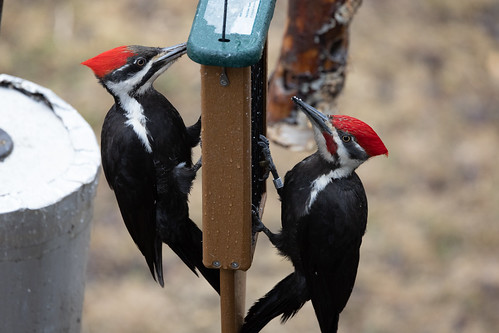
   Pileated Woodpecker

BB came just about daily all fall and winter through late April. On April 23, I even got a photo of him and a female in my feeder at the same time—I'm pretty sure she was his mate and that they nested somewhere in the neighborhood, but not near my corner. Soon after that, he stopped coming entirely, and I didn’t see him, or indeed any Pileateds, in my yard through the summer.   

BB the banded male Pileated Woodpecker
A scruffy-looking BB on September 2

In September, I started seeing BB once or twice a week, at first looking very scruffy after apparently raising young. Now he’s coming daily again. He comes to the suet feeder but also to our very old box elders, the power poles behind the yard, and a stump I often sit on near our raspberry patch. This morning he showed up at the suet feeder and then a female—unbanded so I have no way of knowing if she’s his mate—came to my window feeder right as I started writing this very sentence. She stayed in the feeder for at least four minutes as I got photos and video of her with my old cell phone. 

Pileated Woodpecker and Black-capped Chickadee at my window feeder

Pileated Woodpecker at my window feeder

A couple of chickadees alighted on the feeder while she was in it, but the Blue Jays kept their distance until she’d flown off.  A little while later, after I had my good camera, she or another female Pileated returned to that window feeder, and then a second female chased her off. A female appeared at that feeder at least 7 times through 4:30 pm, and BB made a second appearance in the suet feeder, as did at least one of the females.  

Pileated Woodpecker at my window feeder

My yard hasn’t had many rarities lately—the poor Ruffed Grouse is the only one I’ve noticed—but considering that chickadees, Blue Jays, and Pileated Woodpeckers are my top three favorite birds of all time, I’d say October is shaping up to be a splendid month. 

Pileated Woodpecker at my window feeder

Addendum: As of 1 pm on Sunday, October 2, the Hawk Ridge Blue Jay total for the season is 59,027, just 574 from the all-time record. We may break it today!