Laura Erickson's For the Birds

Monday, July 13, 2020

Ravens: Even Smarter Than We Thought!

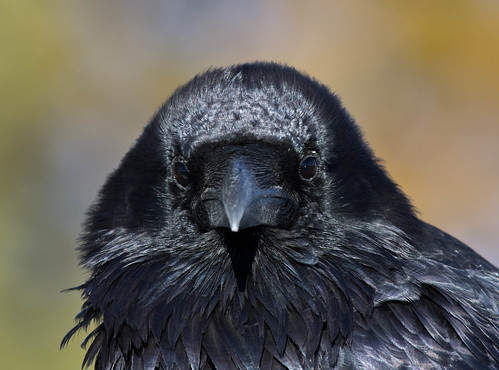
Common Raven

One of my friends, Kathie Brown from Maine, alerted me to a fascinating episode of Animal Planet’s “North Woods Law,” which this season is focused on New Hampshire’s fish and game conservation officers.  

The episode Kathie watched included a segment in which a landowner reported several dead Painted Turtles on his property. Kathie writes: 

The Conservation Officer and a State Wildlife Biologist went out to investigate. They initially found 24 dead turtles belly up on a dirt road near some wetlands. After checking everything out they noticed the turtles were all females coming up to the sand to lay their eggs. Each turtle was flipped on its back, and each one had a hole in front of one or both of its hind legs. The eggs and the guts were gone.  
 
Kathie notes:  

The Biologist considered all possibilities including contamination, poison, human vandalism, predation by raccoons and otters, etc. If you watch the episode it is so fascinating to see them trying to solve the mystery. The landowner called them in because they were on his property and he was rightfully very alarmed.
 
I was reading Kathie’s summary of the episode on Facebook, and gasped out loud when I read what they discovered. She wrote:  

Then they saw and heard a Raven. The Wildlife Biologist suspected that the Raven was flipping the turtles onto their backs and eating their insides and eggs. So, he put up a trail camera to document the behavior. He was able to get the ravens doing this on video. In the end the ravens killed 49 Painted Turtles. This was the first time this behavior was documented in NH.  
 
Kathie noted how disturbing this was to see on TV—it must have been even more disturbing for the poor landowner and investigators tracking down the killers. But as Kathie says, “It just goes to show how resourceful and intelligent Ravens and other Corvids are. I was fascinated by this discovery.”  
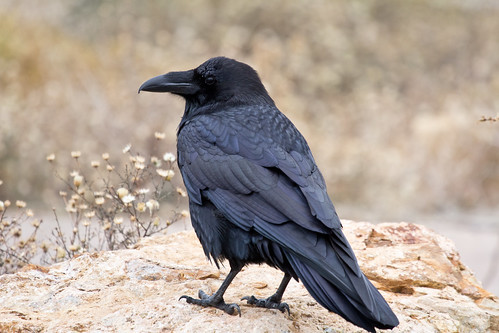
Common Raven

If ravens had credit cards and could figure out grocery stores, I’m sure they’d take advantage, especially when bacon’s on sale, but they’d still just as soon pick up their victuals in the dumpster out back. Russ and I got an enormous kick out of them when we were at the Grand Canyon in 2011—I got many of my best raven photos ever by simply walking around the parking lot, where they were sizing up every newly arrived car and truck, pulling food out of coolers, even if they’d been securely latched, if they weren’t also locked.  

Ravens have long known how to dig up turtle eggs and how to pull the innards out of road-killed turtles. Leave it to them to figure out how to convert living turtles into fresh turtle soup with eggs on the side. 
Intelligent problem-solving when it comes to food is obviously adaptive.  

But ravens also engage in more puzzling intelligent behaviors seemingly unconnected directly to survival, including play. And I’ll never understand why, long ago, the day after I lost my wristwatch on a walk in Port Wing, a raven flew over and dropped that watch at my feet.   

I love turtles too much to feel comfortable with mother turtles being turned on their backs and their eggs and innards eaten while the poor things are struggling, still alive through much of it. But turtles eat their own share of baby ducks, and I love and respect ravens too much to hold it against them, especially when my own species has such a bad track record in humane ways of producing our own meat and eggs. Henry Ward Beecher was 100 percent correct when he wrote, “If men had wings and bore black feathers, few of them would be clever enough to be crows.” And even fewer would be clever enough to be ravens.  

Jennifer Ackerman, in her splendid The Bird Way, quoted Swedish biologist Mathias Osvath saying, “We dig up dinosaurs to try to figure out what happened to them. Perhaps someday dinosaurs in the form of corvids will dig us up to figure out what happened to us.” And based on both how these ravens figured out turtles and how slow we humans have been to protect ourselves from COVID-19, perhaps that day will happen sooner than we think. 
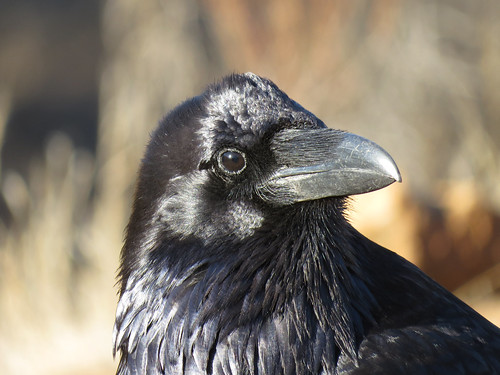
Common Raven

Friday, July 10, 2020

The Heart of the Matter


A couple of times in the 1980s, on my wedding anniversary, I talked about bird hearts. Today isn’t my anniversary or anything, but I came across this old transcript from 1988 and thought it was worth a second look.  

Hearts and birds somehow seem to go together.  Robinson Jeffers said to give your heart to Hawks.  Othello preferred to wear his heart on his sleeve for daws to peck at, jackdaws being a species of European crow.  Poe begged his raven to "Take thy beak from out my heart." Christina Rosetti was certainly having a better day when she said her heart was like a singing bird.  

Bird hearts are every bit as interesting as human hearts. The avian heart is one of the most powerful pumps in the world. As the ornithologist poet, Joel Peters, wrote to a hummingbird: 

Darting, hovering helicopter  
Fueling at a flower
Tell me how your engine-heart 
Generates such power! 
 
Like mammals, birds have a four-chambered heart which completely separates the circulation routes for arterial and venous blood.  But a mammal heart is puny and weak compared to a comparably-sized bird's heart.  A robin's heart beats 570 times every minute.  A sleeping chickadee's heart beats 522 times a minute, but during activity, ornithologists presume it beats more like 1000 beats a minute—chickadees don’t allow us to hook them up to little EKG machines while they’re going about their business. An active Blue-throated Hummingbird's heart races at 1,260--our own Ruby-throated Hummingbird, while resting in a dark chamber, has a rate of 614.  While incubating eggs, the heart rate jumps, especially on cool nights.  A House Wren's heart beats 455 times a minute at rest normally, but goes up to 701 while sitting on a nest.  

Not only do birds have rapid heartbeats--they also have powerful blood pressure.  The systolic pressure for a starling is 180 mm, and for a canary is as high as 220.  In comparison, a healthy person's systolic pressure should not exceed 150.  (Mine was 195 in the ER while I was having my last myocardial infarction.) A bird's high pressure pushes the blood through the body very quickly--it takes only about six seconds for blood to make a complete circuit through the body of an adult chicken.  

In selectively breeding domestic turkeys for rapid growth and heavy meat production, breeders unwittingly also selected strains that have high blood pressures and weak arteries.  As a result, some turkey flocks have suffered high mortalities from aortic rupture followed by internal hemorrhaging.  To prevent this, a tranquilizing drug is often added to feed mixtures to reduce nervous tension and lower blood pressure.  

High blood pressure pushes even a wild, natural bird's heart just about to the limits of mechanical safety.  Many banders have caught birds in their nets only to have them die of heart attacks in their hands.  One cardinal, who died after an exhausting territorial squabble, was examined carefully but no outer wounds were present.  A post-mortem revealed a 7 mm wound in the ventricle, probably caused by the great pressure built during the excitement.  Although post-mortems are not done often on birds, the deaths of a Field Sparrow with a ruptured aorta and a Bald Eagle with a ruptured right auricle were also apparently victims of excitement.  

Since I wrote that original transcript, the famous David Sibley, while banding a chickadee in 2012, placed a microphone on its back to record its beating heart. (Here's his blogpost about it.) When I played his recording, I looked at the spectrograph and could count the beats—118 over the 8-second recording, so I calculated out that that tiny heart was beating 885 beats per minute! Imagine that. Well, you don’t have to imagine—just listen to it


Wednesday, July 8, 2020

More about the Brown Thrasher


Back in the olden days, until I was was almost ten years old, Minnesota’s state bird was the goldfinch. But in 1949, someone got wind of the fact that the state legislature had never officially named it that. The goldfinch was also the state bird of Washington on the West Coast, New Jersey on the East, and Iowa in the middle, so the legislature named a committee to study the issue and come up with a state bird uniquely Minnesota’s. More than a decade later, they were still arguing the issue, but then the sudden widespread concern about pollution helped the Minnesota Ornithologists’ Union to persuade the decision makers to choose the Common Loon, a species dependent on water clarity and quality. I’m sure Minnesota’s being “the land of 10,000 lakes” helped, too.  

Most states don’t put that much energy into thinking about their state bird. For a while, the state bird of North Carolina was, appropriately, the Carolina Chickadee, but because that tiny bird is sometimes called the “tomtit,” state legislators bristled when anyone called their state the “Tomtit State.” In 1943, when you’d think they’d have had more pressing matters to deal with, they changed their state bird to the cardinal.  

Then there’s Georgia. No one was the least bit dissatisfied with the state bird they had in 1970, when state legislature jumped in anyway.  

Way back on April 6, 1935, a proclamation by Georgia Governor Eugene Talmadge named the Brown Thrasher the Georgia state bird.  But that was not official enough for the legislature, so on March 20, 1970, at the request of the Garden Clubs of Georgia, the state legislature named it the official state bird. The Joint Resolution of the Georgia General Assembly read:  

Whereas, the Attorney General of Georgia has ruled in an official opinion that Georgia does not have an official State Bird; and Whereas, hitherto, the General Assembly of Georgia has made no such selection; and Whereas, since countless Georgians have always considered the Brown Thrasher as the official Georgia State Bird it is only fitting and proper that the Brown thrasher be given the recognition it is due.
 
(That same Joint Resolution also named the bobwhite Georgia’s official state game bird.)

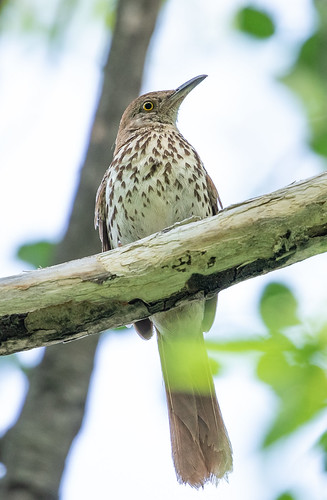
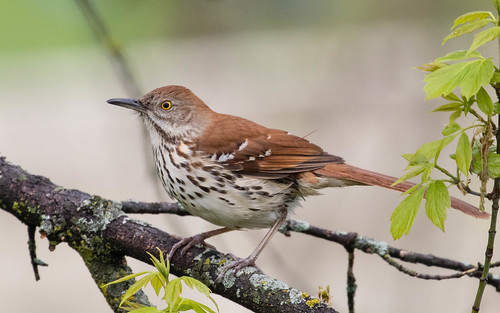
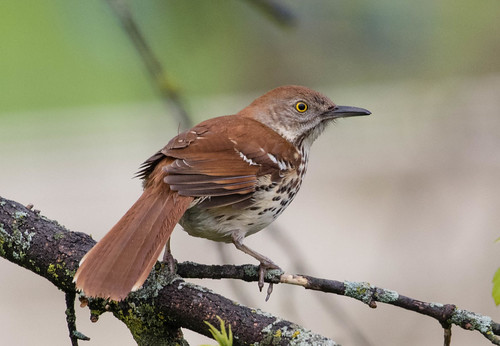
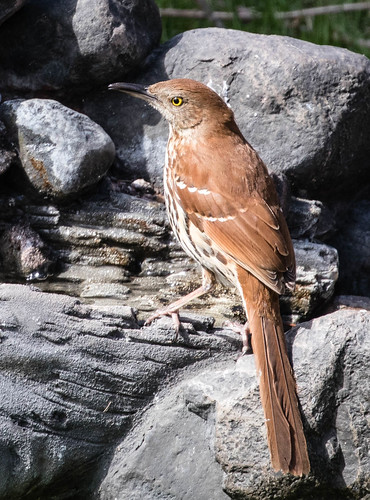
Brown Thrasher

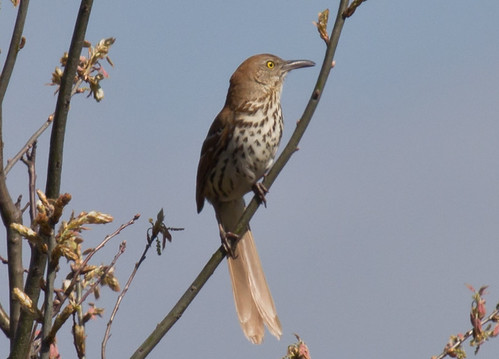
The thrasher is such a beautiful bird with such a splendid song that it deserves state bird status. But oddly enough, many people don’t know anything about it, probably because it’s rather reclusive. It sings as loudly as the cardinal, from the same tippy tops of trees. No bird that was truly shy would sing so loudly, right out there in the open, but somehow even from its conspicuous perch on a bare branch as high as it can get in a tall tree, it’s almost always backlit, its long, slender body and tail, in a vertical stance, looking like a branch more than a bird, making it tricky for people to figure out where the loud song is coming from. This is how thrashers often manage to hide in plain view.   

Cardinals sing their cheery song year-round; in spring, male Brown Thrashers quietly pick out a territory but then wait to sing until a female enters the scene. After a male has impressed one so that she selects him as her mate, he pretty much shuts up for the year as far as his loud, shout-it-from-the-treetops song, unless he needs to attract a new mate for a second nesting.  

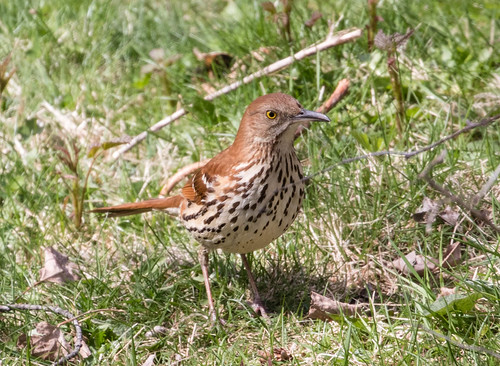
Brown Thrasher

When they’re not singing, thrashers literally come down to earth, spending a lot of time on the ground and in low shrubs, but are far more reclusive than cardinals—people usually only see thrashers when they’re paying attention. They’re normally here in the Northland only in the warm months, though individuals overwinter occasionally in both Minnesota and Wisconsin. (I saw one at my favorite stomping grounds in Madison, Wisconsin—Picnic Point—through the winters of both 1978-79 and 1979-80.) Brown Thrashers live in Georgia year-round, giving people who spend time outdoors lots of opportunities to notice them despite their secretive ways.  

Like the cardinal’s songs, Brown Thrasher songs are easy to identify, when you know what to listen for. Thrashers belong to the family Mimidae along with the Gray Catbird and Northern Mockingbird. All three have similar long, drawn-out songs, and all three incorporate some imitations of the sounds they hear, including cardinals and other birds, into their songs. Mockingbirds produce the most spot-on imitations, catbirds the fewest. The catbird song is long and disjoint, with occasional mews thrown in. The thrasher song is broken into words or short phrases, most repeated once. The steady string of paired sounds is easy to recognize, and has led to all kinds of mnemonics like, Hello! Hello! Who is this? Who is this? I should say! I should say! How’s that? How’s that? Mockingbirds repeat virtually all of their phrases, too, but we hear three, four, five, or more repetitions before the mocker goes on to the next phrase.  


Both mockingbirds and thrashers sing a lot of different phrases in a single song, but the thrasher produces far more different songs than mockingbirds do. After analyzing hours of recorded songs and their spectrographs, Donald Kroodsma made it into Ripley’s Believe It or Not! in 1981 for establishing that one Brown Thrasher had a repertoire of 2,400 distinct songs.  

It’s not just the size of its repertoire that makes it a favorite research subject. Researchers at Indiana University implanted tiny devices just beneath the two syringes of a Brown Thrasher, in its bronchial tubes.  (Syringes is the plural of syrinx, a bird’s song box. It has two, one on each bronchial tube.) They showed that the air flow and muscles controlling the voice are operated separately for the two voice boxes, the left side generally producing the lower-frequency sounds and the right side the higher ones. Both contribute about half of the fantastically coordinated production of a single song. The Brown Thrasher was the very first species this kind of research was done on.  

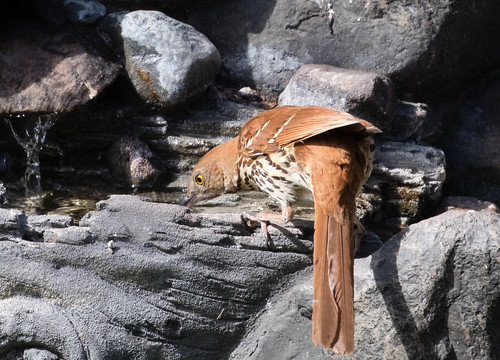
Brown Thrasher

My all-time favorite authority on bird vocalizations, Don Kroodsma, writes and talks about the Brown Thrasher a lot. His most recent book, Birdsong for the Curious Naturalist, which came out this year, is filled with useful information for how to listen to birdsong, with links and QR codes taking us to hours and hours of Don’s professional recordings—he includes three hours and fifteen minutes just of Brown Thrasher songs, and explains in such clear and simple terms how he calculates the size of a single thrasher’s repertoire that I plan to calculate my own backyard thrasher’s repertoire based on my own recordings the next rainy day when I am stuck indoors.  

I don’t envy Georgians for their state bird, but I’m sure glad at least one state chose it, and that this splendid bird spends time in my backyard, even if it’s mostly skulking around out of sight. My world would be a dimmer, duller place without it. 

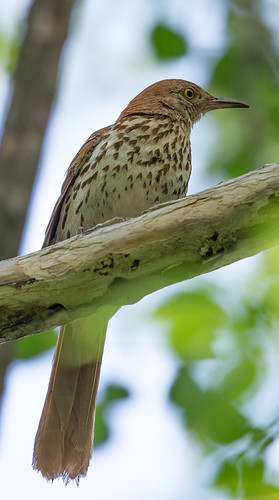
Brown Thrasher

Monday, July 6, 2020

Oneupmanship over a Snarky Boss: Laura's Best Bird EVER!

Brown Thrasher

On May 9, 1975, I saw two beautiful birds on the Michigan State campus, new for my lifelist, a pair of Brown Thrashers. The rich rusty color, long tail, bright yellow eyes, and streaking on the creamy underside were unique and memorable. I’d never imagined such a bird before, and now would never forget it.   

I didn’t write in my notes what called my attention to them, but I do know the male was not singing, at least not the full-throated song I learned the following year, or I’d have reported that in my notes. As I learned more about the species, I realized that of course he wasn’t singing—once a thrasher attracts a mate, he pretty much shuts up for the season. He may have been singing his soft whisper song, which males occasionally do near their mates, but I was hardly a savvy observer. There were too many sounds out there that I wasn’t paying attention to yet—so much muddled background noise and scenery bombarding my senses, and it took time for my eyes and ears to make sense of it all.  

Brown Thrasher

The next month, I took ornithology and another class at the Kellogg Biological Station in Kalamazoo, Michigan, and spent every other waking moment looking for birds. On Saturday, June 21, I noticed a Brown Thrasher hop into a shrub as I was driving out the exit of a Lansing nature center, and then on Monday, June 23, I saw a couple on an ornithology field trip. One walked along a fence row and then flew to a mulberry tree. When a robin chased it off, another thrasher flew to the tree and chased the robin off. Our instructor said they sing their song phrases in pairs, but we didn’t hear one. A couple of weeks later, one evening I saw three on the ground in an open area near dense shrubs on the Michigan State campus.  

Brown Thrasher

That was it for my encounters with Brown Thrashers that first year of birding. The next year I saw them much more often, adding them to my Ontario, Illinois, South Carolina, Georgia, and Wisconsin lists. As I grew more experienced, I got better and better at noticing them, skulking in and near dense shrubs or singing, sometimes wonderfully out in the open on a high bare branch.   

Brown Thrasher

That spring of 1976, I took my second ornithology class. For our field exam, the professor pointed to a bird in the open or in the general direction of a vocalization, and we’d have to identify it. The moment he pointed toward a singing Brown Thrasher, the bird flew to a more distant perch and kept singing. I’d already noticed him, so I wrote down the answer, but none of the other students had been on the bird when it was first pointed out, and it was hard to hear from the distant perch. The rule was if the bird flew before any of the students got on it, the prof tossed out the question, but he could see I got it in time. He tried to help the others by giving hints—“Listen! He’s singing everything twice: 'Get the seed! Get the seed! Drop it! Drop it! Cover it up! Cover it up! Water it! Water it!'” but no one else got it, even with his pretty clear hint. I was always pleased to get an A in a class, but I was never prouder than I was getting the only 100 percent on that field exam. So that Brown Thrasher became my Best Bird EVER! But the very next year, he was toppled from the position by a Brown Thrasher that I never even saw. 

We moved to Madison, Wisconsin, the month after that ornithology class ended. Our first year there, before I got my teaching job, I worked as a bank teller. I was an excellent teller in terms of being accurate with money and nice to customers, but my heart wasn't really in it. One April day in 1977, an executive of a big company got into my line while I was in the middle of a long, complicated transaction. As other tellers finished with their own customers, the head teller, a stern woman who did not approve of me, kept inviting him to go to someone else's open window, but he politely declined, saying he needed to talk to me. She gave me a questioning frown, but I had no idea what he wanted either, and assumed the same thing she did, that he was going to reprimand me for some egregious mistake I must have made.   

But no! When I finally finished with my long transaction, he stepped up with a simple deposit and a simpler question. He’d seen the coolest bird in his backyard that morning—a gorgeous rusty brown bird with a long tail and golden eyes. Before he was even finished describing it, I’d pulled out my trusty Golden Guide and opened it to the picture of the Brown Thrasher. 


He was utterly delighted. As he passed the vice president’s desk, he told him he should give me a raise for such high-quality customer service. The vice president beamed at me. The head teller pursed her lips and walked away.  

How could I not love Brown Thrashers even more after that? Birds enhance our lives in so many ways, bringing color and vivacity and song to even the most ordinary days. And once in a while, if we’re very lucky, a bird can even get us bonus points at work. Even though I never even saw it, that Brown Thrasher in that customer’s backyard way back in 1977 was my best bird EVER!

Brown Thrasher

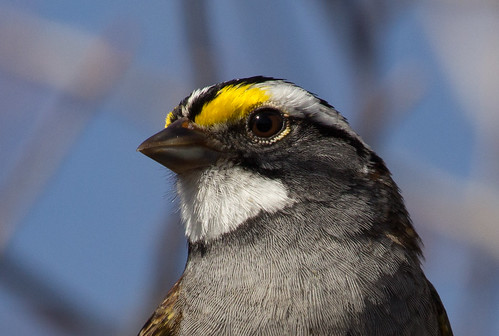
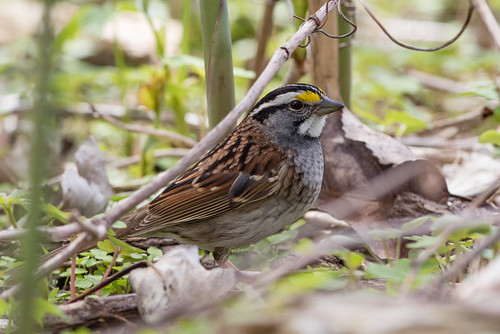
White-throated Sparrows: Singing a New Tune!

White-throated Sparrow

I pride myself on knowing a lot about birds. But as I learned long ago, what I know is always subject to change. Last week, the summary of a paper being published in the August 17, 2020 issue of Current Biology was previewed by several news sources, and suddenly my inbox was inundated with people sending me links to the story, about how White-throated Sparrows are singing a different song now, one that apparently started in western Canada and has spread far more quickly than it could by any means except that birds are apparently learning the new tune on their southern wintering grounds, where eastern birds mix with western ones. This turns a lot of what I thought I knew on its head.   

The White-throated Sparrow song I’ve loved for so long is described as following the rhythm Old Sam Peabody, Peabody, Peabody. People north of the border learn it the way E.B.White memorialized it in his lovely book, The Trumpet of the Swan, Oh, sweet Canada, Canada, Canada!  

By the time White wrote the book in 1970, neither mnemonic was exactly accurate: Instead of two steady notes to begin the song (the “Old Sam” or “Oh, sweet), birds had since the 1960s started singing three or four introductory notes. Some people adjusted the mnemonic to Poor old Sam Peabody, Peabody, Peabody, which is how the song sounded when I started birding in 1975. Whether you adjusted the mnemonic or not, it still clearly and accurately highlighted the series of triplet notes that are what have stood out for so very long for so many of us.   

In 2010, when the Birds of North America entry for the White-throated Sparrow was updated by Falls and Kopachena, the authors mentioned a personal communication from Scott Ramsay that “The triplets are replaced by doublets in central British Columbia.” That sounded like the kind of intriguing local dialect sort of thing limited to one location. Indeed, the very first sentence in the new Current Biology paper is:  

Hypotheses on regional song variation (“dialects”) assume that dialects remain stable within regions, are distinct between regions, and persist within populations over extensive periods.  

But the variation ending in doublets turned out to be spreading beyond British Columbia. The paper says:  

…doublet-ending songs emerged and replaced triplet-ending songs west of the Rocky Mountains sometime between 1960 and 2000 and appeared just east of the Rockies in the 2000s. From recordings collected over two decades across North America, we show that doublet-ending song has now spread at a continental scale.   

Scientists long understood that White-throated Sparrows learn their song from their father and neighboring White-throats before their first migration. White-throats in general return to the area where they hatched, so if learning the song locally were true, the songs in any given location would remain fairly stable from year to year and decade to decade, but White-throated Sparrows are breaking that fundamental rule about local dialects.   

In the way that radio, TV, and now social media foster the rapid spread of new songs, and soften the extremes of local dialects, White-throated Sparrows are picking up important elements of their song while mingling with White-throats from all over on their wintering grounds. The authors used geolocators to establish that the eastern and western populations mix in winter.   

Of course, when birds with the variant first appeared, they were mingling with plenty of birds singing the traditional song. So what drove so many birds to switch to the new version? Some recent research suggests that young male birds of several species are likely to pick out novel variants of a song over the way they learned it at home, rather like the way college students pick up cultural elements different from what they grew up with. When selecting a mate, female White-throated Sparrows may prefer the cutting-edge new song elements, hastening the faddish song’s spread.   

Researchers have been studying and recording White-throated Sparrows every year since the 1950s at Algonquin Provincial Park in Ontario. As the authors of the new study went through recordings collected over those years, they discovered that the very first bird singing the doublet song in the park was recorded in 2005; he was the only one out of 76 recorded males not singing the triplets. In 2007, 2009, and 2010, fewer than 5 percent of males were singing the new song, but more than 10 percent were singing it in 2012 and 2013. In 2014, it jumped to 21.8 percent of 101 males, and nearly half of the 92 males recorded in 2017 were singing it in Algonquin Park. Apparently the new song has completely taken over in Wisconsin and Minnesota.  

This is the year I started recording my backyard birds every non-rainy morning. We didn’t have a big sparrow migration, but I did get some White-throated Sparrow recordings. 
When I was listening to them back in April and early May, I was disappointed that I didn’t get any normal songs—the ones ending with the triplets. It never occurred to me that the birds had changed their tune—I figured I’d missed the main migration of males and was getting just female singers or something. Now in the coming weeks I’ll have to go through some of my recordings from earlier decades to see if I even have any good ones with the triplets. I was already deeply regretting not starting to record my backyard birds decades ago, and now I really wish I had. Oh, well. Live and learn.   

White-throated Sparrow


Saturday, July 4, 2020

YOU are invited!

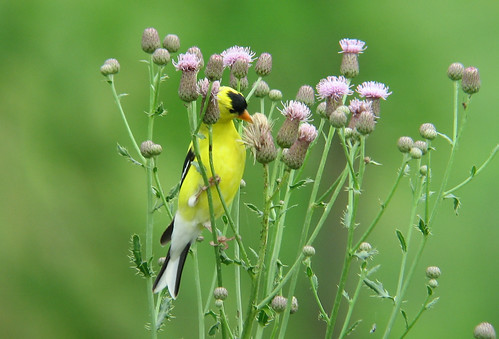
American Goldfinch

When: Saturday, August 1, 2020, 7:00 pm CDT
Where: Laura's Zoom Conference Room
My Patreon supporters (and people who contribute back-channel—email me if you want more information) will get an email invitation automatically.
Topic: Birds in Late Summer

Summer is the season when the very most birds are alive in the northern hemisphere, when baby birds are everywhere, before migrants leave. They may be abundant in July and August, but most birds have stopped singing, making it trickier to find them. What are your favorite backyard birds up to? (Email Laura before July 15 if you are coming and want her to include a particular bird in the program.) 

Thursday, July 2, 2020

What to Make of a Diminished Thing

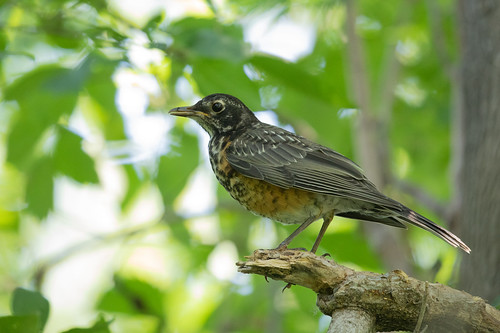
American Robin fledgling

Last December I had cataract surgery, first on my non-dominant right eye, and then two weeks later, on my left eye. During the fourteen days in between, I could directly compare how pristine colors were with the cataract-free eye by closing one eye and then the other. 

How my cataract distorts color

Cataracts add a brownish yellow cast to everything. Without that, the sky was ever so much more beautiful, and many of the rooms in our house suddenly looked newly painted. 

But we humans fairly quickly adjust to the everyday, and a month or two after getting the second eye done, being cataract free became an everyday condition. For a few days during spring migration, I noticed how brilliant migrant birds appeared, but even that quickly became the everyday norm. 

Rose-breasted Grosbeak
It's hard to believe we could ever take such a bird for granted, but after a while, we do.

After living on Peabody Street for 38 previous springs, I thought there was little left that would seem spectacular, and really, compared with many springs, this year’s was a rather late and lackluster migration. But my making sound recordings of my backyard birds almost every morning starting April 29, and really listening to those recordings through my headphones each day, suddenly made the commonplace more brilliant and gorgeous. 

My stereo microphone allowed me to hear the general direction the songs were coming from, and I started being able to distinguish some individuals. I could pick out my two familiar robins nesting on the east and west sides of my yard and discovered that one regularly sang a pretty phrase I’d never associated with robins before. When the chickadees started singing well before sunrise, it was easy to hear two different males going back and forth, and sometimes I could pick out a more distant third. I listened for my Song Sparrows to pipe in, and the flickers nesting in the tiny woodlot behind my house. Goldfinches twittered away every day.  

As May progressed, catbirds, thrashers, orioles, wrens, and Rose-breasted Grosbeaks joined the chorus. Usually I look for Ruby-throated Hummingbirds, but during May and early June, they often flew over my recorder, allowing me to pick out both their wing hums and their twittering notes. It was thrilling to pick out each brand new voice, but those voices were not just welcome as new year birds—this year, they sounded as wonderful as I remember when I was hearing each one for the very first time so many years ago.  

All of these are commonplace birds. My friends who aren’t as high risk as I and so not under as strict social distancing rules were seeing a lot more birds, and I was reading a lot of wonderful reports of rare birds just a few miles from my house. But I never felt envious that I couldn’t bird outside my own yard. Paying such close attention to these ordinary bird songs through my headphones gave me the same kind of joy as, back in December, my cataract-free vision had.  

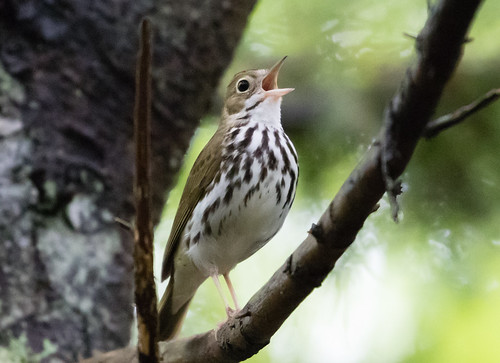
I haven’t heard a Red-eyed Vireo in a couple of weeks, but soon one will pick up the slack on and off for most of the day, even into September. If I lived near good woods, or could go back in time to my own backyard in the 80s, I’d be hearing Ovenbirds piping in on and off all day, too. And when they were everyday birds instead of a hotline species, Evening Grosbeak calls would fill in every quiet moment. It's sad to think about Ovenbirds and grosbeaks disappearing from Peabody Street even as it's still lovely to enjoy what I do have. As June has dissolved into July, I’m still recording lots of bird song. But where in May and most of June my recordings were so packed with different individual singers that barely a second went by without at least one bird going at it, now there can be minutes-long lulls between song. Yes, little by little, the annual cycle of bird song is coming to an end. By the end of the month, I’ll be filling in the gap by using my camera instead of my sound recorder. 

Disappointment could be the order of the day, but so soon after my cataract surgery experience, I’m suddenly seeing the annual cycle of bird song in a new light. Perhaps each bird must go through a long quiet time each year to reset its own everyday experience so that every spring, it’ll be experiencing gorgeous song with fresh ears all over again. 

Ovenbird

Framing it that way, I can read Robert Frost’s exquisite poem, The Oven Bird, with new ears:  

There is a singer everyone has heard,
Loud, a mid-summer and a mid-wood bird,
Who makes the solid tree trunks sound again.
He says that leaves are old and that for flowers
Mid-summer is to spring as one to ten.
He says the early petal-fall is past
When pear and cherry bloom went down in showers
On sunny days a moment overcast;
And comes that other fall we name the fall.
He says the highway dust is over all.
The bird would cease and be as other birds
But that he knows in singing not to sing.
The question that he frames in all but words
Is what to make of a diminished thing.

Yes, even in mid-summer, the season of greatest abundance, as more and more fruits ripen and more and more baby birds flit about, some elements of the season can indeed seem diminished. But that is exactly as it should be. The birds don’t all quit singing at once. They taper off gently so we can adjust, but we are already sensing with certainty that they will eventually quit.  

That autumnal hush may indeed seem a “diminished thing.” But unlike our aging bodies and minds, and treasured institutions we once had faith in that have grown tarnished, the diminishment of bird song as the season draws to a close won't be permanent. Bird song ebbs in summer so that come spring, we’ll once again hear it with fresh and hungry ears, drinking it in and enjoying it more fully, the way an everyday sky for a time seemed so amazingly fresh and brilliant to me, all because of that time of diminishment.  

Ring-billed Gull

Wednesday, July 1, 2020

Blast from the Past: Nighthawk Caeca

Fred the Common Nighthawk
In the early 1990s, after I'd been a wildlife rehabber for several years, I started working on my ill-fated Ph.D. program, under one of my heroes, Dr. Gary Duke, founder of the Raptor Center. One old For the Birds program explains why I was puzzled about nighthawks, and how that led to my going back to grad school. Here's the updated transcript:

When most people ask me about birds, they first apologize, believing I'll think their questions are stupid. But the stupidest question I ever came up with turned out to have a pretty interesting answer.  

The day I got my first injured nighthawk to take care of, I discovered that he produced two completely different kinds of droppings. Most of the time, they were like normal bird droppings: brown fecal matter with white uric acid excreted from the kidneys. But once a day, he produced a yucky, smelly brown liquid that looked like diarrhea, which didn't jibe with anything I'd seen in other birds. I thought he had some sort of intestinal illness or injury, but after I'd cared for several nighthawks, I came to realize that the two different droppings types are typical of the species. I was curious about it, but somehow the issue of droppings didn't seem like a fitting topic for investigation.
 
But the more I handled these handsome and gentle-spirited birds, the more I wanted to learn about them, and it slowly dawned on me that nobody else knew anything about their unique digestion either. Injured nighthawks that can't feed by catching insects on the wing are difficult for people to keep alive in captivity because they must be hand-fed, many times a day, so it was hard to find anyone who had observed what I saw. I wrote to one scientist who had raised nighthawks in captivity after learning that Poor-wills hibernate. Joe T. Marshall wanted to know if he could induce hibernation in nighthawks. When I asked him about their droppings, though, he said he never noticed, and suggested, accurately if a little oddly, that perhaps I noticed because I had children in diapers. 

Then I decided I was approaching the question from the wrong direction, and I started reading general ornithology textbook chapters about bird digestion. That's when I learned that "some" birds have structures called caeca. Just in case your memory of general biology is no better than mine, the caeca are a pair of intestinal offshoots branching out where the small intestine meets the large. In humans, the appendix occurs at the site of our caeca. Ostriches, chickens, Ruffed Grouse, and some other birds have very well-developed caeca. The descriptions of a chicken's caecal droppings matched exactly what I saw in my nighthawks.  

So what I first needed to confirm was whether nighthawks also have well-developed caeca, which seemed like the kind of basic question I could surely find an answer to somewhere. But none of my textbooks or reference works on birds, or specifically about nighthawks, had any itemization of whether they have caeca. Finally, I went to the UMD library and found a book by Beddard published in 1898, titled The Structure and Classification of Birds.   

It turns out that early ornithologists used the caeca as one of the primary pieces of evidence in establishing the taxonomic order of birds, much of which is still accepted today. This now-122-year-old book explained that the reason ornithologists originally concluded that owls aren't related to hawks and falcons is that owls have large caeca while other birds of prey have none at all. 
 
Although I had an intuitive sense of the relationship of owls to nighthawks because of their excellent nocturnal vision and soft, pencilled plumage, it turns out that internally these two groups are even more similar, sharing virtually identical digestive systems. Some ornithologists believe that owls were originally insect eaters that eventually adapted to taking bigger prey. So wondering about nighthawk droppings ended up leading me to the explanation of why nighthawks are illustrated near owls in field guides (though in 2020, based on DNA, they are no longer considered quite as closely related), as well as giving me some insight into the work ornithologists were doing a hundred years ago. 

After confirming that nighthawks do indeed have caeca, my next question became why? In Ruffed Grouse, the caeca grow huge in late fall and early winter, as the birds eat more and more aspen buds. Their smelly caecal droppings are the result of bacteria that produce an enzyme, cellulase, that breaks down the cellulose in woody tissue, allowing the grouse to get nutrition from their winter diet. As they switch to insects and softer foods in spring, the caeca atrophy.  

The diet of nighthawks is 100 percent insect, without a speck of cellulose to be found, but suddenly I realized that nighthawks do eat something equally indigestible, in the hard wing covers of beetles—chitin. I wondered if in fact the bacteria in nighthawk caeca produce chitinase to break that down. So I called one of the world authorities on bird digestion, Gary Duke at the University of Minnesota, and asked him. 

Gary hadn't thought about it at all, but got excited by my simply framing the question, and right there on the phone, he asked me to figure out the answer with him as his Ph.D. student. I was going to be his first Ph.D. student ever to do all my research without sacrificing a single bird—we'd work out ways of figuring it all out without hurting anyone. 

I had to work slowly, because my children were still little. We pretty much confirmed my guess, but also that nighthawk caeca also serve an osmoregulation function, but I wasn't close to finishing before Gary developed early Alzheimer's disease. I was heartbroken losing him, but not so very sad about my Ph.D. All I really wanted anyway was the answer to my stupid question about smelly nighthawk droppings. 

Fred the Common Nighthawk

Sunday, June 28, 2020

Blast from the Past: Eagle Poop!

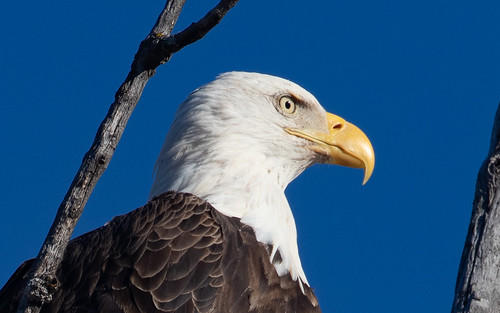
Bald Eagle

I’m still archiving transcripts from old "For the Birds" programs (I'm up to 2,900 programs with transcripts available through my webpage!), and last week I came upon one from April 14, 1997, that seemed worthy of a new look. I wrote:  

Last week I had to drive to Chicago, and half-way through Wisconsin, I spotted a Bald Eagle flying high overhead in the sunny blue sky. Eagles are one of the lovely elements of Wisconsin scenery, one of the reasons I enjoy life in the Northland. And early April is the time of year to see them. One of the best treats is to find two eagles in the blue spring sky. A mated pair does all kinds of lovely aerial courtship displays. But this particular eagle was all alone, and as I drove directly beneath it and lost sight of it, suddenly I heard a sound like a gunshot as an enormous splat of eagle poop hit my windshield. The car's speed combined with the eagle dropping's terminal velocity caused an awesome noise, and I was actually grateful that my windshield survived.   
 
Eagle poop is a messy, dark liquid, and this big job ended up right in the part of the windshield I actually need to look through. So I turned on my wipers and used a generous helping of washer fluid to clean it up as well as I could, but it mainly just smeared. I had to sit up very tall and erect and head for the next exit to really clean up the mess.   
 
I poured about a gallon of water and used my snow scraper on the mess, and at this close range I discovered that eagle poop is every bit as much an olfactory treat as it is a visual one. Eagles eat dead fish, and this time of year, fish are often well-decayed before the eagles sink their beaks in. Also, eagles specialize on other forms of carrion, like road-kills newly exposed by melting snowbanks. Their food smells bad enough going in, so imagine it coming out again! Fortunately, it was a breezy day and the job was quickly done.   
 
I thought that would be the end of my eagle poop adventure, but a few days later it rained. As soon as I started my windshield wipers, I discovered that the acidic dropping had eaten away the blade until it was nothing but tattered shreds. Birds in the hawk family have extremely strong digestive acids, capable of dissolving most bones and fur, and so small wonder the droppings had such a powerful effect on three-year-old rubber. But it was a powerful reminder to me of how lucky we are that we so seldom end up standing or driving in exactly the wrong place at the wrong time in eagle country. I had to rush to the nearest gas station to buy new wiper blades.  
 
My relatives in Chicago were extremely impressed by my eagle adventure. Being city people, they never get to see Bald Eagles at all, and think being pooped upon by an eagle is a rare and novel distinction. My sister, an alert listener to a good story, was shocked that I had actually cleaned up the mess, and asked if I wasn't going to get in serious trouble with the U.S. Fish and Wildlife Service. After all, isn't cleaning up eagle droppings a clear violation of the Endangered Feces Act?

Bald Eagle 

Friday, June 26, 2020

The Chipmunk Stalker

"Dad" the Cornell Great Blue Heron
"Dad," the male Great Blue Heron who nested in Sapsucker Woods every year from 2009-2014.
This is the last photo I took of him, in 2015.

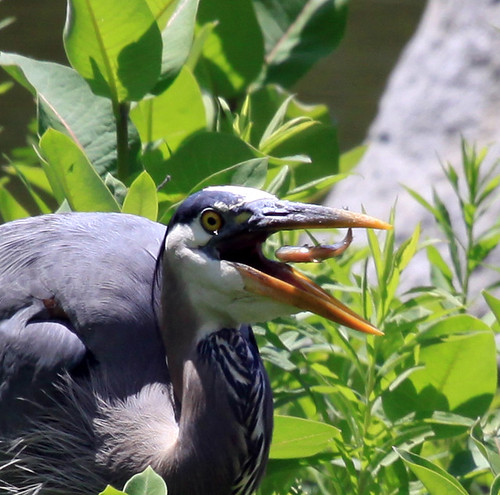
In 2009, during the time I worked at the Cornell Lab of Ornithology, a pair of Great Blue Herons built a nest in a long-dead white oak in Sapsucker Woods Pond, and successfully reared 4 chicks. That January, I’d bought my first DSLR camera, so I was spending all my breaks and lunches walking around the pond taking photos. I got hundreds of photos of one extremely cooperative heron as he preened, fished, and stood stock still as if posing for me. One of my favorite photos, though also one of the most tragic, shows an adorable little fish in its last moment of existence, mid-air between the heron’s huge mandibles.   

Great Blue Heron and fish

I started being able to verify that virtually all these photos were of the same individual, because he was missing a hind toe and a front claw. When I started photographing the nesting herons, I realized the male was the very heron I’d photographed so often. I grew inordinately fond of him.  

GRBHER_LauraErickson_edit

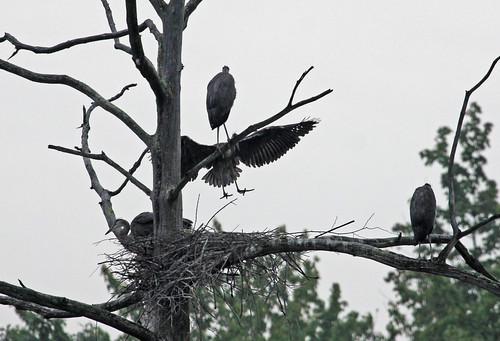
Watching the heron nest from even the best vantage points in the building or outside, we couldn’t see how many eggs were in it, if any, and had no clue when they hatched until we saw a tiny fuzzy chick head. A day or two later, we saw two at the same time, and then three. They all had to be standing tall at the same time for us to get a count, and it was over a week more before we saw all four. After they were big, we could easily count the four of them until they fledged. After that, we could still check up on them because the parents fed them only in the nest. It took a while for them to learn to find their own food, so one or two might fly up to the nest occasionally in the daytime, and all four gathered before nightfall to sleep up there. I started walking to the Lab from my apartment every evening, only able to sleep well after I’d made sure all “my” babies were accounted for. 

Great Blue Heron

Visitors and contributors to the Lab were enthralled with the photos of the Sapsucker Pond Great Blues, so I suggested they put a nest cam there before the next season—this was at the peak of popularity for the Decorah Eagle cam, and no one had ever set up a cam for a really close look at nesting herons before. The guy in charge of managing such things mansplained to me why that was utterly impossible, but of course in 2012 when the Lab did construct a nest cam, he got all the credit. So it goes.  

Great Blue Heron

Having that wonderful up-close and personal look at the parents and chicks gave me so much understanding and appreciation for how herons raise their young. Each parent spent a lot of time away from the nest fishing. When the chicks were first hatched, often the parent returning to the nest would brood them or just sit on a big branch, taking up to an hour to digest before regurgitating a pile of stomach contents into the nest. As the chicks got older and more capable of doing their own digesting, the parents regurgitated the food more quickly, and some of the fish even became identifiable. One time a large gold carp was still alive when the male vomited it up—whenever one of the baby herons touched it, it thrashed for a few seconds. Somehow my brain turned off my empathy switch regarding the poor fish because the moment it moved, the almost-full-sized baby herons were so shocked that they all lurched back and stared in amazement. It had clearly never, ever occurred to them that food could be alive.  

But virtually the only animals in the regurgitated pile of baby food that the parent herons brought back were fish. A quite dead vole did appear in the pile once, but the suspicious babies would not swallow it, and finally one of them tossed it out of the nest. 

Meanwhile, the Lab had also placed a nest cam on a Red-tailed Hawk nest on campus. I didn’t like watching that one—it was one thing to watch herons regurgitating fish, quite another to see what the hawks brought home, which included a lot of chipmunks and rabbits, occasionally still alive. I’m just too fond of little mammals to watch that.  

As one of the monitors in Cornell's Heron Cam Chat Room who also fielded a lot of questions sent to the Lab, I started hearing people claim that some Great Blue Herons specialize on chipmunks. I had misgivings the first time someone told me a heron was coming and taking the chipmunks at her feeder, but after hearing more than a dozen accounts, I had to accept these accounts as truthful oddities.  

Then this week, Heidi Holtan at KAXE forwarded me an email from Lynn Hanske in Baxter, Minnesota, who wrote:  

Thought you might be interested to see this video I took in my backyard of a Great Blue Heron last Friday.  This was the 4th chipmunk in about 25 minutes.  S/He has been back every day since and we’ve seen him catch and consume 12 so far!  Once he gets one, he walks it quickly down to the lake, shaking it the whole time, then dunks it in the lake and swallows it in one gulp.
 
 Lynn kindly gave me permission to post the video on my blog. Tragically, Blogger says it's too large of a video file, but I can at least provide a link to the .mov file

I got nervous when I watched the start, with the heron walking directly toward a chipmunk eating some breakfast, but the little guy noticed and hightailed it out of there in time. When the heron got that one or another, the worst of it was hidden behind some ferns. It’s interesting, so if you aren’t too enamored of chipmunks, check it out.  

Then Lynn sent another, longer video wherein the first chipmunk the heron grabbed managed to get away; the video kept going, and the heron did get that chipmunk or another. Who knew the lives of chipmunks were so fraught with danger?  (Here's the link to that .mov file.)

Point Reyes National Seashore

One of my friends, Christina, mentioned that the herons at Point Reyes in California seem to feed mostly on rodents, and since the years of the heron cam at Cornell, I’ve heard so many other accounts of herons taking various rodents that it no longer surprises me, even though Lynn’s videos disconcerted me. Much as I love Great Blue Herons, especially since growing so very enamored of that one individual at Cornell, chipmunks are the adorable little guys who live in my own backyard. Predation is an important part of nature, and I’m appreciative of whatever Great Blue Herons do to thrive, but sometimes my best strategy is simply to avert my eyes.  

Eastern Chipmunk

By the way, Lynn Hanske is also seeing a family of Wood Ducks visiting her feeders, including one odd little duckling. Apparently a Hooded Merganser lost her own nest and had no other place to lay an egg ready to pop out, so she deposited it in the Wood Duck nest. That one little Hooded Merganser duckling has no clue what to do at a feeder. Unlike Wood Ducks, who eat acorns and other terrestrial food items, mergansers eat fish and aquatic insects pretty much exclusively. We’re hoping the little guy is getting plenty enough food when the mother takes the ducklings to the lake, and stays out of the striking zone of a certain Great Blue Heron. Lynn will try to keep track of how the little one fares.