Laura Erickson's For the Birds

Monday, November 7, 2022

Phainopepla: A Bird As Unique As Its Name

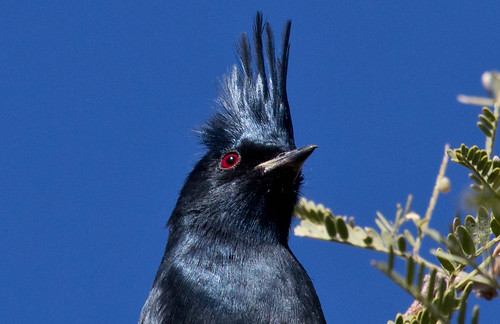
Phainopepla

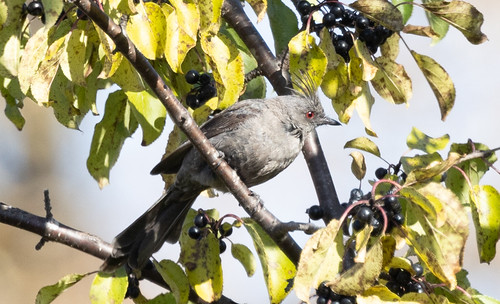
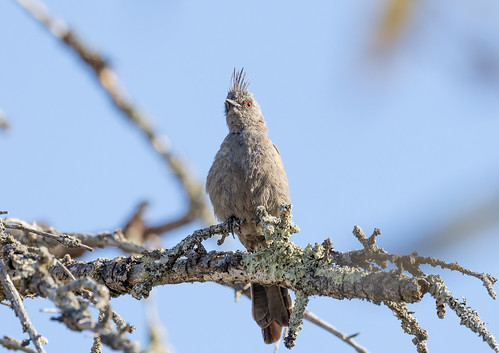
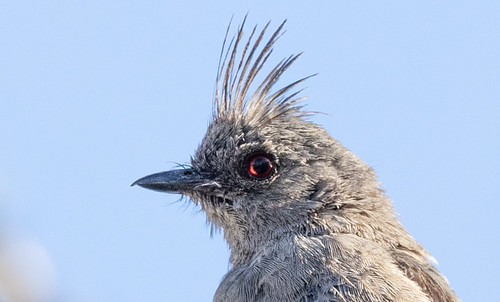
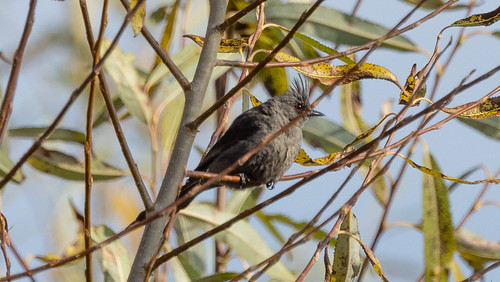
Ever since the Phainopepla turned up outside Duluth last week, I've been thinking of when I first discovered this lovely bird. In 1982, when our baby Joey was 6 months old, Russ had a meeting in Las Vegas and we made it into a family vacation. This was the very first time I’d ever been in the Southwest, and I saw Phainopeplas first at Sunset Park in Las Vegas, and then in several places in southeastern Arizona.   

Russ’s parents had gone to Arizona a year or two before we did that first time, and Russ’s dad was utterly taken with Phainopeplas. They often sit on conspicuous perches, and so are a characteristic desert bird that non-birders are likely to notice. But I think Russ’s dad especially liked their name. I remember him holding baby Joey and saying, “Did you see a Phain-o-PEP-la?”  It’s a fun word that even my 2-year-old grandson Walter likes to say.   

The unusual but cool-sounding word comes from the bird’s scientific name, Phainopepla nitens. In Greek, phainos means “shining,” and peplos means “robe.” In Latin, nitens also means “shining,” emphasizing that lovely quality of the adult male plumage.  

Phainopepla

The Phainopepla belongs to the silky-flycatcher family, which was once part of the waxwing family. Like waxwings, phainopeplas sally out to catch insects from conspicuous perches and then return where they started out or alight on another conspicuous perch.   
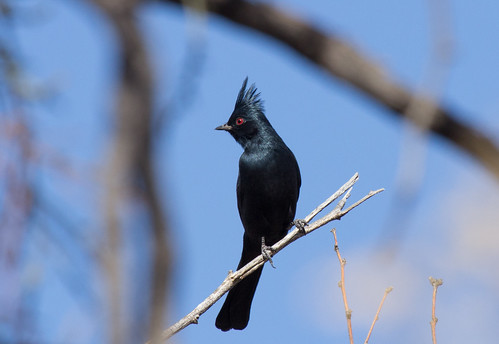
Phainopepla

Also like waxwings, Phainopeplas eat a lot of fruit. Phainopeplas are specialists on desert mistletoe, with a uniquely adapted stomach to extract as much nutrition from their berries as possible. The seeds and pulp hold almost all the nutrition, but the much less digestible skin makes those nutrients hard to access for animals that swallow berries whole. To get enough food value, Phainopeplas must eat a lot of mistletoe berries—as many as 1,100 in a single day. They devour enough to stuff their crop (a pouch in the esophagus) to capacity, and then retreat to a perch to quietly digest the feast.   

The Phainopepla’s muscular stomach chamber, or gizzard, is very tiny, processing one berry at a time by contracting to squeeze the seed and semi-liquid pulp directly into the small intestine as the berry’s sturdy outer skin remains in the gizzard. One by one, the berries run through the gizzard like this, the digestible pulp and seeds extracted and running through the intestines as the skins accumulate in the gizzard in a compact mass. When that mass builds to about 10 or 20 packed skins, the gizzard ejects it into the small intestine in a bolus separate from the pulp and seeds. As far as I can find, the Phainopepla is the only known bird able to shuck the outer coatings of berries like this. Between swallowing the berry and it coming out the other end takes only about 12 minutes, making the system as fast as it is efficient.   

Phainopeplas arrive on their breeding grounds in the United States between February and April. The birds in Arizona and California, the most well-studied populations, breed in two distinct habitats at two different times of the year. Between February and April, they breed in the Arizona's Sonoran Desert and California's Colorado Desert. In May, as summer heat intensifies and desert berry supplies dwindle, the birds appear in oak and sycamore canyons, where they breed through July.   

Nesting Phainopeplas behave quite differently in the two habitats. In the desert, mated pairs are extremely territorial, probably because desert mistletoe parasitizes the same trees over and over, producing a stable, long-lasting supply of berries close to where each pair nests. But in the oak and sycamore woodlands where they breed in summer, Phainopeplas nest in loose colonies of from 3–15 pairs, feeding on such fruits as redberry and elderberry, which grow away from their shaded nest sites. In this habitat, foraging Phainopeplas lose less from sharing the fruits than they benefit from more eyes searching out new fruiting plants and noticing and helping one another to mob nest predators.  

So far, researchers haven’t figured out whether the desert-nesting Phainopeplas in Arizona and California are the same individuals that nest in woodlands later the same years, or if these nesting styles represent two different breeding populations. Either way it's unique, befitting a bird with such a unique and fun-to-say name.

Phainopepla

Sunday, November 6, 2022

Phainopepla: Which Way Did She Go?

_G7A2104.jpg

On Saturday, October 29, word went out that a Phainopepla had turned up near the parking area of the McQuade Boat Landing just up the shore from Duluth. I was in the first crowd of people to see this first state record after Molly Misfeldt and Michael Sack reported it.   

The bird stuck around all weekend and all day Monday, and was still there on Tuesday, November 1. I didn’t need to babysit until mid-afternoon, so I went back a couple of times to get better photos and a sound recording, along with bragging rights about seeing this extraordinary bird in Minnesota in two calendar months. There were still birders watching it when I left, but it wasn’t seen again after that day. I felt bad for out-of-town birders who wanted to see it on Wednesday, but I was also relieved, hopeful that the bird left on its own power, not in the grips of a Sharp-shinned Hawk. I thought about the Saturday morning cartoons when I was a little girl, with a clueless sheriff trying to catch some speedy prankster like Wile E. Coyote and asking in a cartoonish voice, “Which way did he go?” There is at least some hope that the Phainopepla headed toward the Roadrunner's habitat in the Southwest, but we’ll never know for sure.   

_G7A1982.jpg

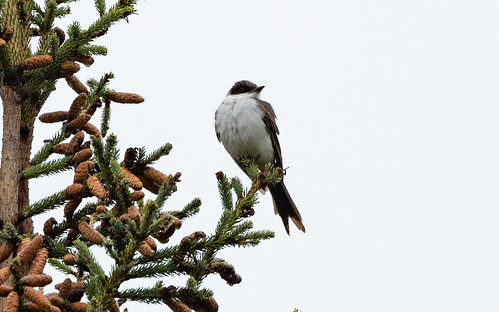
Scientists simply do not know what makes some individual birds wander well out of their normal range, but vagrancy happens fairly frequently in a few species. The Fork-tailed Flycatcher that turned up at Stony Point this spring was even further out of its range than the Phainopepla. Fork-tailed Flycatchers that wander into the United States tend to be from the South American population that migrates fairly long distances, while Phainopeplas migrate much shorter distances, yet that Fork-tail was Minnesota’s fourth state record, the second to be reported in St. Louis County, and they appear at least somewhere in the United States just about every year. Some ornithologists speculate that the migratory compass of vagrant Fork-tailed Flycatchers somehow got reversed. But there are only a handful of records ever of Phainopeplas anywhere out of the Southwest and California. How did one end up in Duluth?      

Fork-tailed Flycatcher

Jaegers and Sabine’s Gulls do not belong on Lake Superior, but every fall there are several sightings of Parasitic Jaegers, a handful of Pomarine Jaegers, once in a while a Long-tailed Jaeger, and usually one or two Sabine’s Gulls, seen right here in Duluth and Superior. The individuals are vagrants, but of species in which some individuals always wander. The Ivory Gull that showed up in Canal Park in Duluth in 2016 was the 12th state record; this past January Minnesota birders found the state’s 13th record.   

Ivory Gull

If no one understands what makes some individual wander, we have even less understanding of whether any of them ever get back to where they belong. Vagrants that linger a while may be in trouble—the Ivory Gull that appeared in Duluth on January 1, 2016, stuck around Canal Park for over three weeks but ended up dying on January 24; oddly enough, during the time that one was in Duluth, a different individual was found dead in Superior.  But lingering isn’t always fatal. One banded female Rufous Hummingbird wintered in northern Massachusetts at least six years in a row.   

Most exceptional vagrants appear out of the blue and disappear within days, or even hours or minutes. The Fork-tailed Flycatcher on Stoney Point September 17 this year was seen only a few times within a couple of hours before it disappeared for good. The only other Fork-tail ever seen in St. Louis County, in Duluth on September 6, 1991, was seen by only one person, Peder Svingen, and only for a few minutes. But the very next spring, one appeared in Grand Marais on May 3 and stuck around for 11 days. The only predictable thing about vagrant birds is their unpredictability.   

Phainopepla

I haven’t heard of any out-of-range Phainopeplas in the United States in the six days since the McQuade Harbor bird disappeared, and even if one turned up, we’d have no way of knowing for certain that it was “our” bird. Uncertainty and mystery are part of the magic of these sightings, and since our Phainopepla disappeared while the weather was still pleasant, there’s at least some hope that she’s been working her way back to familiar terrain in her natural range. Hope is the thing with feathers that perches in the soul, but my mind keeps going back to those Saturday morning cartoon sheriffs asking, “Which way did she go?”  

Phainopepla

Friday, November 4, 2022

The New Kid on the Block

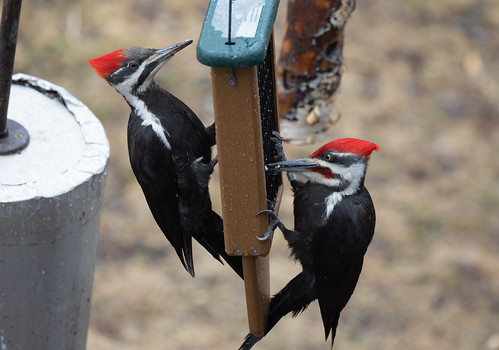
Two male Pileated Woodpeckers

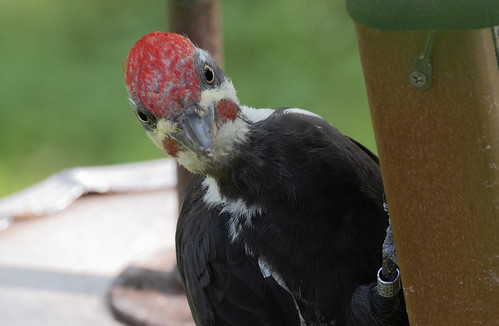
For the past year, I’ve been doing my best to keep track of one particular Pileated Woodpecker that I call BB, or Banded Boy. Frank Nicoletti banded him as an immature at Hawk Ridge last year.   

Banded Pileated Woodpecker

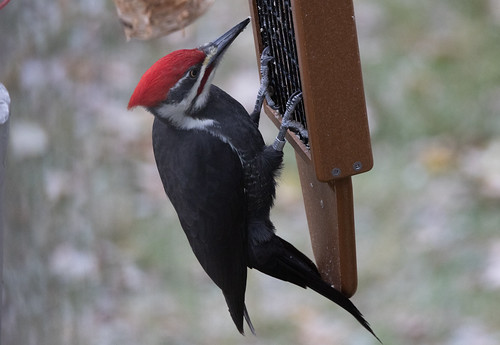
From the start, BB seemed like an old pro at using a bird feeder and is very laid back in my yard—last November he tolerated a whole lot of birders coming over to see a Rufous Hummingbird, and he doesn’t bolt from the feeder when my neighbor is mowing the lawn or when people and dogs walk by just past the fence, 15 or 20 feet away. And BB ignores me when I open a window and stick my long camera lens out. He kept coming frequently through this past April. Then he seemed to hook up with a female.  

Pileated Woodpecker

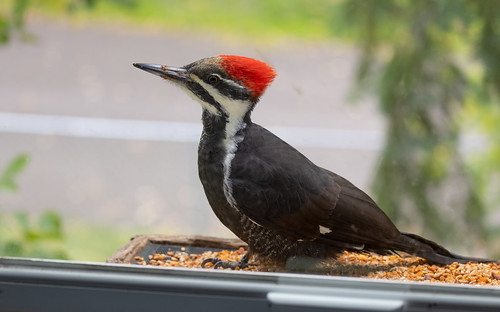
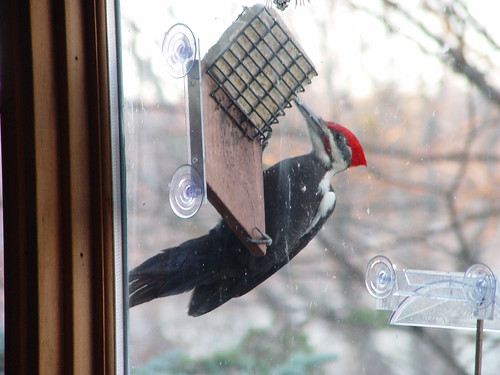
BB and his lady love stopped coming soon after I photographed them together, and I had very few Pileated sightings in my yard all summer. BB reappeared on September 3. Since then, I’ve also been seeing at least two female Pileateds, somewhat regularly. Oddly enough, they feed not only at the suet feeders but visited my window seed feeder for a couple of weeks.   

Pileated Woodpecker at my window feeder

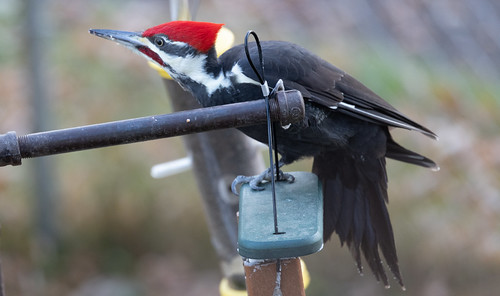
On Sunday, October 30, I was watching BB in the suet feeder when suddenly a second male Pileated appeared on the cross-pole supporting the suet feeder, his face just a couple feet from BB’s. BB ignored him for a minute or two, but when the new guy started pecking on a wire nearer the suet feeder, BB flew up at him, and then flew away.   

Two male Pileated Woodpeckers

That left the new kid on the block with the feeder all to himself. I always thought that suet feeders must be a little intuitive for woodpeckers, and it’s not like this new guy hadn’t watched BB on the feeder for at least a little while, but he simply could not figure it out. 

Male Pileated Woodpecker

Male Pileated Woodpecker

Male Pileated Woodpecker

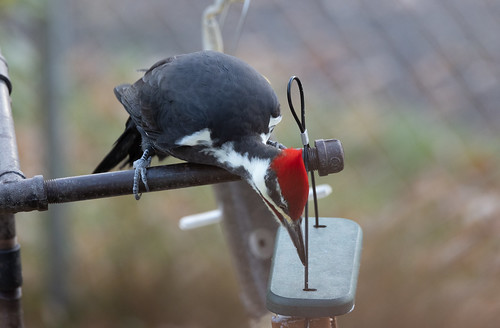
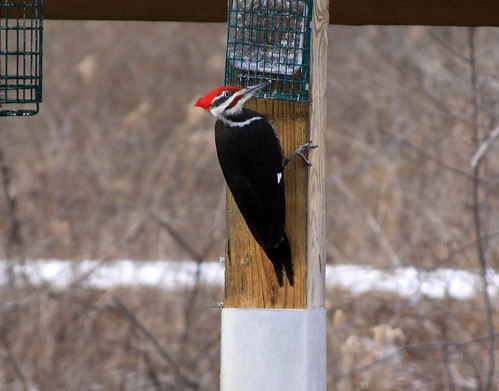
First he sat on the supporting pole and leaned down to take tiny bits of suet. That didn’t give him much food, so he jumped on top of the feeder but it was too slippery, so he grabbed on to the pole with one foot and straddled, sticking his tongue into the little holes holding the supporting wires, not getting much food at all. He did not sit vertically on the feeder the way woodpeckers normally do, and finally gave up and flew away.  

That was on Sunday. Since then, we haven’t seen him, but meanwhile BB has been coming several times a day, possibly making sure the new kid on the block isn’t trying to take over BB's favorite feeding station.  

It surprised me that the unbanded male didn’t know how to get food from a suet feeder, and made me curious about how Pileateds normally figure feeders out. Back in 2004, a male Pileated visited my small window suet feeder repeatedly for a few months. 

Pileated Woodpecker

But otherwise Pileateds just did not come to feeders in my yard or my mother-in-law’s in rural Port Wing, Wisconsin. I saw them at feeders here and there in Minnesota, Wisconsin, and Ithaca, New York when I worked at Cornell, 

Pileated Woodpecker

But I haven’t figured out whether those individuals had figured out feeders on their own, watched other Pileateds or other species of woodpeckers, or learned from their parents. I’ve had several different individuals coming to my feeder consistently for the past several years, so however each individual figured it out, it’s become pretty normal here. But as the new kid on the block shows, how you get food out of a suet feeder doesn’t appear to be intuitive, at least not to every Pileated. I’d love to ask BB how he figured it out. He’s pretty tolerant of me, but I suspect he will not give me a straight answer.

Pileated Woodpecker

Monday, October 31, 2022

What's the Name of That Song?

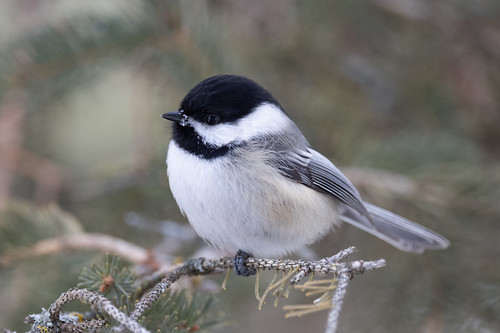
Black-capped Chickadee
The original Li'l Darlin'

At least two or three times every year, my high school jazz band played a song that I grew to love. It was probably listed in a program or two, but I never noticed what its name was. I last heard it the year I graduated, in 1969, but it’s been stuck in my head ever since as my most beloved and persistent earworm.

My son Tom was in Duluth East High School’s jazz band, but I never heard them play it and it didn’t occur to me to ask Tom if they ever played it in a practice, which was too bad—when I hummed it eight years after he graduated, he immediately recognized it, but he couldn’t remember the name. At least I finally had confirmation that my earworm was an actual song that my brain hadn’t made up whole cloth.  

That was ten years ago. And last week, like a lightning bolt out of a clear blue sky, Tom sent me an email with no subject line or text—just a link to a YouTube video. I clicked on it, and there it was—a full 57 years after I first heard the song and 53 years after I last heard it, Count Basie’s orchestra was playing “Li’l Darlin’,” written by Neal Hefti for Basie’s 1958 album, The Atomic Mr. Basie. Note for note, it sounded exactly as I remembered it. How thrilling to hear it again, and to know what it is!  


I asked Tom how on earth he’d found it, and he told me that now there are apps that specifically identify songs by humming the tune, and a search on Google can do the same thing when you click the microphone. I was impressed and touched that he remembered the song and how badly I wanted to find out what it was.

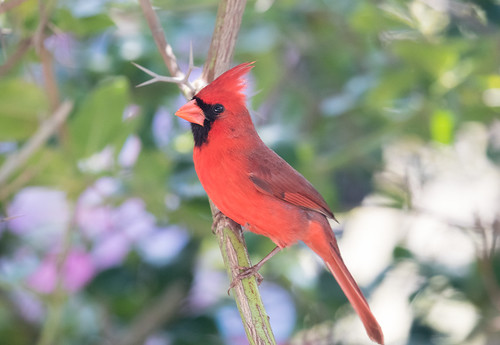
Northern Cardinal

An app called Spotify, which has been available since 2006, can identify any recorded song in their database, which has millions of recordings. But if a group does a cover of their own song, with the exact same voices, melody, and instrumentation, Spotify can't identify it unless that exact same version is also in the database.  

The algorithms in newer apps such as SoundHound or Google itself not only have a huge database of melodies but can recognize them in perhaps an almost infinite number of combinations of tempos, pitches, and tones, from whistling and humming to scat. Even so, some parts of a song may be more recognizable than others—my son didn’t get a response when he hummed the first two lines of “Li’l Darlin’.”  It was only in the next two lines that Google came up with the answer.  

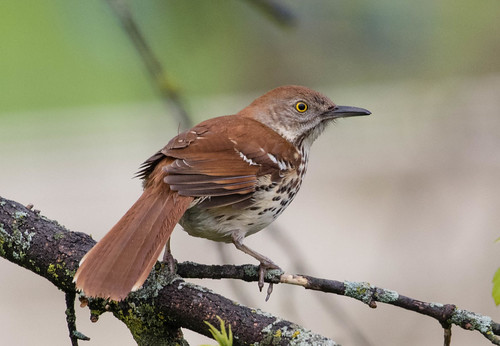
As with human dialects, bird songs can vary regionally, and individual birds may sing their own personal tunes. Some species are famous for how many different songs they sing—a single Brown Thrasher is known to have sung 2,400 distinct songs. 

Brown Thrasher

To confound bird song ID even more, thrashers, mockingbirds, and starlings very often mimic the songs and calls of other species. And at a given moment, several birds can be singing along with assorted insects, frogs, mammals, and human-generated sounds. If it was tricky for me in my 20s, with excellent hearing, to pinpoint each bird song within the entire surrounding soundtrack, it’s trickier for an app in a cellphone with only a single omnidirectional microphone.

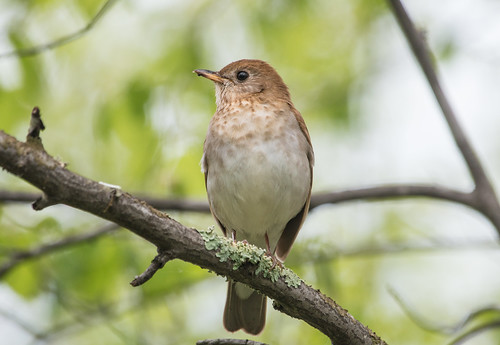
Veery

As someone who spent decades desperate to identify a single song, and who spent a lifetime studying bird songs, I appreciate not just how frustrating it is when we don’t recognize something, but how satisfying it is when we do figure it out. Unfortunately, describing bird songs with human words is very hard. If someone uses the word “spiraling” in their description of a northwoods bird, they are usually describing a Veery, and if they whistle a White-throated Sparrow or Black-capped Chickadee song, I can give them the answer just like that, but few bird songs are that easy. Now people often send me recordings made with their cell phone to identify, which would have been very easy before I lost my high frequency hearing, but background noise and the distance between the phone and the calling bird make even some low register songs difficult for me.  

Fortunately, the Cornell Lab of Ornithology has come up with a wonderful bird identification app called Merlin that anyone can use to figure out what birds they’re hearing. Merlin started out identifying birds by description, giving the most likely possibilities for the date and location when you answered a few questions. Then it rose to the next level, identifying bird photos, too, again when it knows the date and location. And now Merlin can also identify birds by sound. When you’re out walking and hear something interesting, you can turn on the app and it will identify, with surprising accuracy, all the birds singing and calling around you. If you’re trying to figure out a Blackburnian Warbler as a robin sings nearby, that doesn’t confound Merlin—it lists them both. Merlin is free, and you can integrate it with eBird so that your sightings will not only satisfy your own curiosity but contribute to the body of citizen science data Cornell is famous for. 

So now we can find out what the name of that song is whether it’s produced by a 50s-era big band or an elusive bird singing right that moment, thanks to the wonders of modern technology. From Count Basie to Merlin, how times do change. And, at least in this case, for the better.

Banded Merlin
Low-tech Merlin


Sunday, October 30, 2022

Rarity Begets Rarity

Eastern Screech-Owl

On May 17 this year, I saw a Field Sparrow in my yard. This is a common bird over much of the eastern United States and Canada, Duluth is within its breeding range, and I’ve seen quite a few in the state, but it doesn’t turn up here very often and this was a new bird for my yard list, so I sent out an alert in case any other local birders wanted to see it.   

Field Sparrow in Duluth!

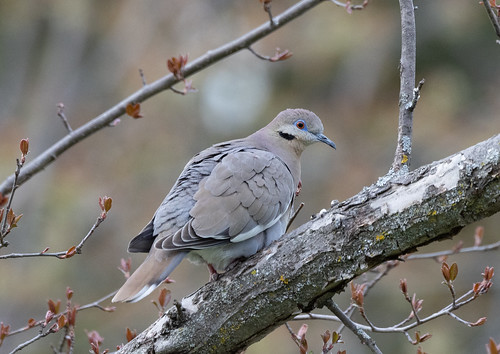
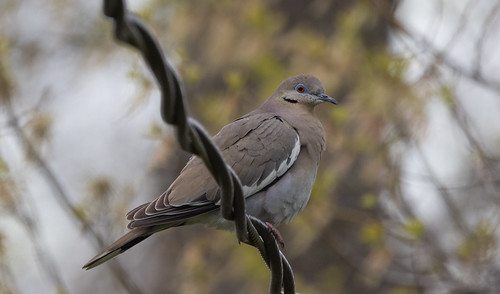
A few hours later, when I was babysitting my grandson Walter at his house 3 miles away, I received a text message from Bruce Munson about a much rarer bird that was right that minute in my yard—a White-winged Dove. 

White-winged Dove in Duluth!

Ironically, Bruce lives next door to my grandson, but at that moment he was sitting in my backyard looking at a bird I’d never seen anywhere in Minnesota before. Thanks to the alert, I got home in time to see it, a bird that would never have been noticed at all had not a bunch of birders been in my yard looking for my Field Sparrow.   

White-winged Dove in Duluth!

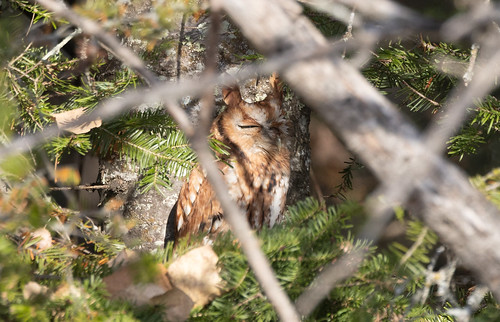
Something similar happened this weekend. On Saturday morning, Jim Lind found a gorgeous Eastern Screech-Owl roosting tight against the trunk of a spruce tree close to the main parking lot at the McQuade boat landing and got the word out. I missed Jim’s original text, but a little while later, Bruce Munson texted me to make sure I knew about it. I’ve only seen a screech owl in St. Louis County once before, way back in 2004, so I grabbed my binoculars and camera and set out.   

The last weekend in October happens to be when a lot of good birds turn up along the north shore of Lake Superior, and of course a screech owl is too good to miss. Lots of other rarities have turned up around McQuade over the years, more often on the far side of the smaller parking lot, so as long as they were there anyway, birders were checking that out, too. Sure enough, that’s where Molly Misfeldt and Michael Sack discovered a mega rarity—a Phainopepla! This silky flycatcher of Mexico and the American Southwest does very rarely appear way out of its range. The eBird map shows sightings on Nantucket Island and places near Toronto and Winnipeg, but these outliers are few and far between and never before has a Phainopepla appeared in Minnesota.   

Before I was even out of the driveway, hoping for the screech owl, I got a text message about the Phainopepla. When I arrived at McQuade, at least a hundred birders—some local and some from farther away, most here on day or weekend excursions up the shore—were crowded onto Scenic Highway 61. Their spotting scopes, binoculars, and cameras were all focused on one precise spot—a low branch of a dead spruce where the little wanderer was perched in a splash of sunlight.  

Phainopepla

After getting a bunch of distant photos, I went to the other parking lot to look for the screech owl and was surprised and delighted to discover that it was a red, or rufous, morph. The gray form is far more common in the upper Midwest. What a visual treat!

Ethical birders don't dare approach too close to roosting owls. We don't want to alarm them—if they open their eyes wide, they're likely to be noticed by chickadees whose alarm calls will alert other birds. I've seen both robins and Blue Jays draw blood when mobbing tiny owls. So I stayed in the parking lot, not getting any closer to take photos. Some people feel that an expensive camera with a long lens somehow justifies getting really close to a bird, but the way I see it, my expensive camera and long lens help me get decent pictures while staying at a respectful distance. 

Eastern Screech-Owl

After I'd taken several photos, I headed back to spend more time with the Phainopepla. I spent an hour and a quarter at McQuade in total, going back and forth between the two birds. The screech owl stayed put, but the Phainopepla left its perch several times to feed on buckthorn berries and once alighted in a willow where it preened for a bit, but it kept returning to the same spruce branch. 

Phainopepla

Phainopepla

Phainopepla

I helped some newcomers see the birds and explained to a few passersby on Scenic Highway 61 what all the commotion was about, but I was so focused on the birds that it didn't occur to me to take a photo of the crowd.  

I felt joyful heading home—the birds had been thrilling to see, I was reasonably happy with my photos as far as documenting the rarities went, and most of all, it was so rewarding to share these splendid birds with so many other birders, on the receiving end when people told me where they were to begin with, and then on the giving end as other people arrived.   

I take so much pleasure in seeing my favorite backyard birds over and over, and so much satisfaction in birding alone—walking or just sitting in lovely places and quietly communing with whatever birds' paths cross mine, not needing to talk to people at all. But even an introvert like me likes to spend some time with kindred spirits, and nothing beats mingling with a crowd of happy birders, every one of us sharing such a joyful experience. 

Eastern Screech-Owl

Saturday, October 29, 2022

Birds in Art: The 2022 Exhibit

Every one of the 118 works in this year’s “Birds in Art” exhibit at the Leigh Yawkey Woodson Art Museum in Wausau, Wisconsin, deserves in-depth coverage, but that would take a whole book, and there already is one—this year's exhibit catalogue. I have to cover at least a few, though I'm leaving out others just as splendid.


Swiss-born Lucrezia Bieler produces exquisite papercuts using a single sheet of black paper cut with small, sharp scissors and mounted on white matboard. Her “Woodcock” depicts a female on the nest as a central image surrounded by a circular frame of 18 adult birds and two almost-hidden tiny chicks. The museum also enlarged that piece to display over an entryway. At the artist's original scale or much huger, the art was gorgeous.

Sunday, October 23, 2022

Birds in Art: a Little History

Every fall, I try to make a trip to Wausau, Wisconsin, to visit the "Birds in Art" exhibit at the Leigh Yawkey Woodson Art Museum. This extraordinary, juried exhibit was inaugurated in 1976, the year the museum opened, and has continued every year since. When I can't make it to the exhibit, I at least purchase that year's catalog. 


I discovered Birds in Art in the mid-90s, and since then have also acquired every catalog going back to 1989.  

Birds have been on the planet longer than humans, an inescapable part of our environment from earliest times. 

Grandma showing Walter a chickadee

My two-year-old grandson notices birds on our walks even when I don’t point them out, and without binoculars or me helping, Walter can accurately distinguish and name owls, chickadees, Blue Jays, crows, ducks, and woodpeckers. Small wonder that modern English words for wild birds such as hawk, owl, raven, swallow, and sparrow; for domesticated birds such as cock and fowl; and the word bird itself were all in use before the 12th Century. Birds feature in the Bible and the Quran, and in the tales, songs, literature, and artwork of essentially every human culture.  

The earliest known cave art includes drawings of birds. An owl depiction on the walls of the Chauvet cave in southern France is believed to be 30,000 years old. Many books and articles call it a Snowy Owl and use that as evidence that during glaciation, snowies were common, or at least noticeable, in France. Before I’d seen photos of that drawing, I reported that misinformation myself. But the cave drawing clearly depicts the owl having feather tufts, making it a much more likely tiny European Scops-Owl, medium-sized Long-eared Owl, or very large Eurasian Eagle-Owl—the three owl species with tufts that would be seen in France then or now.  

Long-eared Owl
This Long-eared Owl is the only owl I've ever photographed in Europe, not in France but in Austria. 

When I started birding, the first bird art I became aware of included what I saw in my field guides and basic bird books, and old standards—Audubon, Peterson, and Arthur Singer—doing beautiful work showing beautiful birds at their best. When I take photos, that’s what I aspire to—capturing each bird doing what it does as beautifully as I can. My favorite photos, like most of the bird art I display in my home, are straightforward depictions as true to the bird’s life in nature as possible.  

Much of the bird art I saw displayed at gift and art shops in the ‘70s were fairly expensive prints in a narrow genre: beautiful portrayals of waterfowl, often a string of ducks or geese flying into a marsh in autumn. They either included a clear representation of a hunter and dog lying in wait or implied their presence. Along with these were beautiful prints of a retriever or spaniel holding a dead duck.   

American duck hunters have been specifically associated with bird art since 1934, when President Roosevelt signed into law the Federal Migratory Bird Hunting Stamp Act, requiring every hunter to purchase a Federal Duck Stamp to legally hunt waterfowl. The first Duck Stamp was illustrated by famous cartoonist and conservationist Jay “Ding” Darling. In 1949, the first contest to select that year’s Duck Stamp artwork was held. Now that contest has evolved into a major event, and the superb artwork is part of the reason Duck Stamps are collectors’ items. Many hunters purchase more than one because they must keep a signed one on their person while hunting but want a pristine one for their collection. The Duck Stamp Act ensured that 98 cents of every dollar spent on a Duck Stamp goes directly to protecting habitat in the National Wildlife Refuge system, so a great many of us birders and other people who care about wildlife purchase a Duck Stamp every year regardless of their collectability.   

Bird art is more than depictions of game birds and other species in nature—it spans the gamut of how we human beings visually interpret those birds in our world. In tomorrow's blog post, you can read about how the Woodson Art Museum’s annual "Birds in Art" exhibit beautifully celebrates the traditional, straightforward depictions of birds in natural settings doing natural things while also widening the concept of birds in art in always wonderful and surprising ways.

Sunday, October 16, 2022

Bird Friendly Coffee: The Price of a Clean Conscience

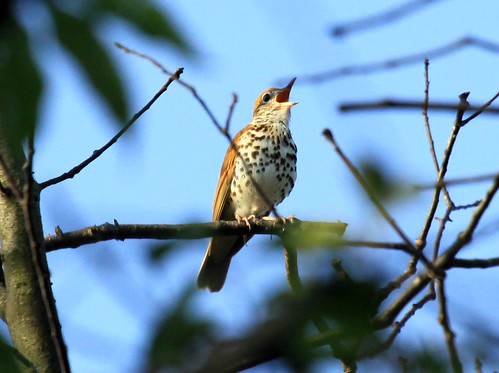
Wood Thrush

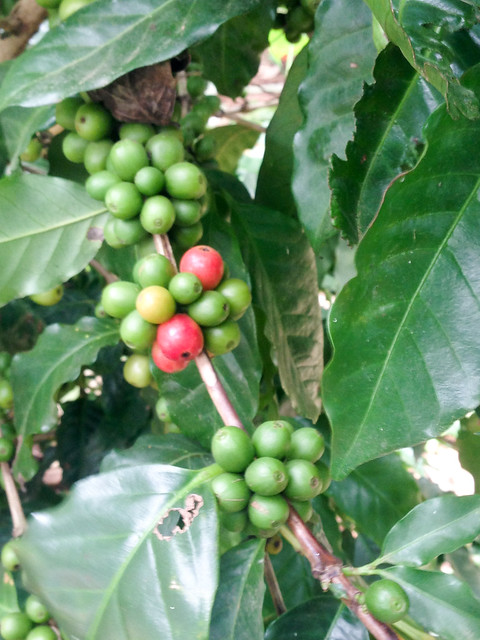
My morning coffee routine wouldn’t feel satisfying if I wasn’t certain that my coffee had been grown in a sustainable way that was healthy for birds, for the people growing and harvesting it, and for me drinking it. Coffee is grown in the tropics, mostly as row crops where rain forest once stood. How could I savor my morning cup knowing that warblers, orioles, and tanagers had lost critical winter habitat to a coffee plantation, or that the human beings who had picked each bean were not getting a living wage for their work?   

That’s what coffee certification is all about. It’s not too hard to find coffee that’s been certified fair trade, addressing some of my concerns, but I need more. When coffee is also certified as shade-grown, it was usually grown under an overstory of natural tropical trees, fostering at least some natural habitat for tropical birds and neotropical migrants.   

Unfortunately, as I once saw in Costa Rica, coffee can be called shade-grown even when it’s not grown under a natural overstory—the seemingly endless rows of coffee trees in one shade grown coffee plantation I saw were grown under plastic awnings.   

Rainforest Alliance certification ensures that the coffee is both fair trade and shade grown in a sustainable way, protecting birds and humans both. 

When I need gas on a road trip, I always look for a Holiday station because one of their coffee choices is always Rainforest Alliance certified. Even if I don’t need a cup right then, I like supporting Holiday’s commitment to protecting the world we all share.   

Rainforest Alliance coffee is not certified organic. Many wonderful coffee growers, who deserve to be rewarded, are reclaiming land that had been deforested for agriculture or lumber, and it takes years before land previously exposed to synthetic pesticides and fertilizers can meet the requirements for organic certification.   

Coffee growers who are already meeting organic standards also deserve support. That’s why for the coffee I make at home, I buy beans that were certified by the Smithsonian's National Zoo and Conservation Biology Institute as “Bird Friendly,” meeting fair trade, shade-grown, and organic standards. To clinch it, Smithsonian scientists verify that it’s grown in quality habitat with excellent bird diversity. 

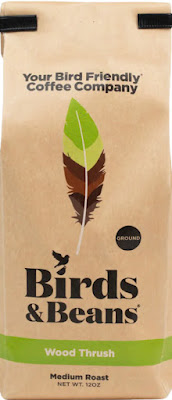
I keep checking food retailers and coffee shops in Duluth but so far haven’t found any local sources of Bird Friendly coffee, so I buy it online via Birds & Beans. I like medium roast, so I buy their "Wood Thrush" blend. I used to buy it by subscription, but I'm not a good judge of how much and how often to order, so now I just buy it as needed. 


The American Birding Association sells what they call "Song Bird Coffee," which is also certified by the Smithsonian as Bird Friendly.    

Even the best coffee and its packaging exact a toll on the earth, and the energy consumed in transporting coffee beans and roasting them, and my own grinding the beans and heating the water, all contribute to climate change. My longtime hero, the late Chandler Robbins, once told me that he can't bear to drink more than one cup a day for this very reason, inspiring me to do the same.  

Chandler Robbins in Guatemala

Bird Friendly coffee is more expensive than uncertified coffee, but how much is a clean conscience worth?