Laura Erickson's For the Birds

Sunday, April 19, 2020

They Shoot Swans, Don't They?

Here's the link that's also at the bottom of this blog post. Comment on the SECOND issue. https://www.regulations.gov/docket?D=FWS-HQ-MB-2019-0004

Trumpeter Swan

On August 8, 1979, when my sister-in-law and I were visiting Yellowstone National Park, I added a stunningly beautiful bird to my lifelist—an endangered species that, at the time, could be seen only in Yellowstone and in the Red Rock Lakes area in Montana—the Trumpeter Swan.

I was thrilled to finally see this wonderful bird, the subject of E.B. White’s charming children’s book, The Trumpet of the Swan. Historically, Trumpeter Swans bred in the United States from the West through Indiana, Illinois, Michigan, and Ohio, but they were wiped out by overhunting by the 1800s, and by the 1950s could be found only in that tiny area of Wyoming, Montana, and nearby Canada.

The first reintroduction programs in Minnesota, started in the late 1970s, were shaky, and during drought years in the 1980s and 1990s, many of the reintroduced birds succumbed to lead poisoning after ingesting old lead shot at the bottoms of lakes. Lead shot had been banned for waterfowl hunting in 1991 after a many-decades-long battle with the NRA and many hunters, despite how many waterfowl of all kinds died not from being shot but from picking up lead shot as grit. Even after it was banned, the lead shot already out there at the bottoms of lakes, rivers, and streams is still lurking today, ready to poison any creature who picks it up. When water levels are low, swans can reach the bottom in areas where shot has sat for decades.

Thanks to the Minnesota DNR’s Nongame Wildlife Program and the blood, sweat, and tears of many nonprofit wildlife rehabilitation centers, many of the poisoned swans recovered and the swan’s population has expanded. But now that it’s thriving, the current administration’s Fish and Wildlife Service announced rather quietly last Wednesday that they plan to open a hunting season on swans this year. I learned about this on Friday, and the deadline is today, Monday, April 20, for all comments.

According to data presented right in the hunting proposal, they were originally setting a target of 110,000 birds to allow a hunt of eastern swans, which also include the beautiful Tundra Swans that migrate through--the two species are almost impossible to distinguish in flight. Indeed, one of the problems both swans have had in the Midwest is from being killed by hunters, who at least claim to have trouble distinguishing them from Snow Geese despite the large black patch on Snow Goose wings. But the count of both swans from the 2019 Midwinter Waterfowl Survey in the Atlantic and Mississippi Flyways combined resulted in 92,819 birds, a full 15 percent below that target. So according to their own numbers, the eastern population of swans, including both Tundra and Trumpeters, is declining without a hunt. There is no "surplus population" when climate change, pollution and habitat degradation in the Chesapeake Bay where most Tundra Swans winter, and all kinds of other human-caused issues are right now hitting swans badly.

The number of waterfowl hunters in the United States has declined dramatically in recent decades. In 1970, duck hunters numbered about 2 million; in 2015, there were fewer than a million, and the ones who remain include a lot of non-conservationists. Now, rather than capitalize on getting non-hunting wildlife enthusiasts to work with hunters to help all wildlife thrive so the public can enjoy wildlife in a wider spectrum of uses, the US Fish and Wildlife Service has been pandering to the worst elements of non-conservationist hunters. They started a Mourning Dove season over much of the upper Midwest in the early 2000s. Speaking for Duluth Audubon, I pleaded with the Minnesota DNR to keep the season closed just along the hawk migration corridor along the north shore of Lake Superior during American Kestrel migration, because kestrels are often mistaken for doves, and pleaded with them to restrict this entirely new hunt to non-toxic shot, They refused to even consider either request.

Then in 2010, the Minnesota DNR targeted another beloved nongame species, quietly opening a hunting season on Sandhill Cranes. And now, when most of us are dealing with the surreal issues of life during a global pandemic, the U.S. Fish and Wildlife Service has just proposed opening a hunting season on swans! After spurning us twice before, I have absolutely no faith that the Minnesota DNR won't take immediately open a season on swans, too.

The Trumpeter Swan only exists in the Central, Mississippi, and Atlantic flyways thanks to being reintroduced, which was due to the hard work and funding of NONgame wildlife programs. This weekend, Carrol Henderson, past director of the Minnesota Nongame Wildlife Program, wrote:
Yesterday I was  by informed by Margaret Smith of The Trumpeter Swan Society that she had been notified by the US Fish and Wildlife Service that the pending Federal Register announcement for fall waterfowl hunting includes a new provision for general swan hunting seasons in the Central, Mississippi, and Atlantic flyways. Minnesota is in the Mississippi Flyway.  
The Federal Register posting occurred on March 19, but someone conveniently failed to notify people involved with Trumpeter Swan conservation until April 15, and the deadline for comments from the public is on Monday, April 20 at 10:59 PM!!!! [The website was down all weekend for scheduled maintenance, too.] While each state would need to individually approve such a season under the proposed guidelines, it opens the door to potentially creating a general swan season without adequate citizen input--as happened with the sandhill crane season in NW Minnesota. 
I'm begging all my listeners to PLEASE submit a comment by 10:59 pm Monday night (that's TONIGHT!) at the Federal Registry. After connecting to the link, look for the second item, “Migratory Bird Hunting: Proposed 2020-21 Framework for Migratory Bird Hunting Regulations,” and click on the box that says "Comment Now!" Please focus on why you oppose swan hunting specifically rather than attacking hunting or hunters in general. Many hunters—I hope and pray a majority—are still conservationists, and those deserve our appreciation. But we can't count on hunting groups to fight to protect nongame wildlife. So I'm begging you to comment on the Federal Registry today.

Trumpeter Swan

Here is the comment I submitted: 
I am strongly opposed to opening a swan season in the Central, Mississippi, and Atlantic flyways. By your own figures, the Eastern population is currently well below the 110,000 threshold originally set for opening a season, and the numbers appear to be declining--the most recent survey showed fewer than 93,000 swans. Tundra Swans are getting plenty of pressures from all kinds of issues in the Chesapeake Bay and on their tundra breeding grounds. The only reason we have Trumpeter Swans in this population at all is because of reintroductions funded by NONgame wildlife programs, and because so many Trumpeter Swans get poisoned by old lead shot still remaining in the bottoms of lakes and ponds--it was the NRA and hunters who fought so strenuously against banning lead shot for many decades after biologists and conservationists proved how damaging this shot is for waterfowl and all kinds of other birds--lead shot used over all those decades is still out there, and still poisoning swans. It has been the blood, sweat, and tears of wildlife rehabbers, without any funding or assistance from hunting groups, that helped keep the first reintroduced Trumpeter Swans alive and still helps swans poisoned by lead today.
The number of waterfowl hunters has declined by more than 50 percent since the 1970s. It is important to protect the interests of conservationist hunters, who have been funding waterfowl habitat via the Federal Duck Stamp for generations, but the U.S. Fish and Wildlife Service should also be focusing on protecting the interests of non-hunters. Many of us buy a Duck Stamp every year, too. We can and should be working together to protect all species, not alienating the growing numbers of wildlife photographers, birders, and families who love to get out to enjoy wildlife observation. In the Mississippi and Atlantic flyways, swans have been for generations NONgame wildlife. With swan numbers declining, there is no reason to open a season on them and many compelling reasons not to.
Trumpeter Swan

Friday, April 17, 2020

Laura's Best Bird EVER: The Brown Creeper Who Went to School

Brown Creeper

I fell truly madly deeply in love with Brown Creepers in 1977, when I was a teacher at St. James School in Madison, Wisconsin. It was much more than the species’ subdued loveliness and shy ways that made me fall in love.

One morning when I arrived at school, our janitor brought me a creeper that had collided with a window. The bird had a sprained wing, so it remained in my classroom for several days.

Brown Creeper in my classroom
This is the actual Brown Creeper! I unearthed this snapshot of it from 1978! 

I’ll never forget holding that tiny mite for the first time—its forward-facing eyes, an adaptation to give it binocular close-range vision as it looks into the tiny crevices in tree bark, looked directly into my own eyes. Many stunned birds seem unusually tame, but this one was alert—simply very calm. During the following days, as it grew stronger and started flying, it never once acted fearful. That word Winsor Merritt Tyler used to describe them, sentient, seemed true and apt.

We kept the window shades pulled at all times so it wouldn't crash into a window again. My students bought mealworms at a local pet shop, and we set up several fairly large tree limbs here and there in the classroom where it could perch and hitch its way up. But in this peculiar habitat, the little bird didn’t limit itself to those woody substrates—many times it alighted on a student’s or my ankle and hitched its way up a knee sock, trouser, or pantyhose-covered leg.

After several days, we could watch it easily fly from one limb, human or arboreal, to another without getting grounded, we knew it was time to release it. The next morning we took a class field trip, walking to a nearby wooded park with the bird in a shoebox. When we arrived at what seemed like a good spot in the midst of lots of large trees, I opened the box, half expecting that the moment it saw the trees, it would take off. But no—it studied its surroundings with interest, and allowed me to pick it up out of the box even though I held it loosely enough that it could have flown. I handed it to one of my students to release. She took it from me, held her arm out, and opened her fingers. The little bird looked all around, at the trees and at all of us gathered around it.

It must have remained on her open hand at least 30 seconds—possibly as long as a minute—before it finally flew to the base of the nearest tree just four or five feet away. We watched it hitch its way up, taking its time, opening its bill a few times to snap up microscopic insects.

Brown Creeper being released in a Madison park
Snapshot taken with my 50mm Olympus OM1 back in spring 1978.
When it climbed 20 or so feet up, it dropped to another tree not much further away.

Brown Creeper being released in a Madison park
It's amazing you can see the bird at all in this and the next snapshots. But it's there, and I'm glad I found these photos!

We watched it climb that tree, and another, and another.

Brown Creeper being released in a Madison park

It wasn’t in any hurry to get away from us, and we weren’t in any hurry to get away from it. But little by little it worked its way deeper into the woods, and finally we lost sight of it. I said, “Live long and prosper,” and we trudged back to school.

Not one of us cried, at least not too obviously. How could we not feel sad to say farewell to our pleasant little friend even as we were genuinely thrilled that we had saved its life and returned it to its natural home? I assigned the kids to look up the word ambivalent for homework. I bet they still remember what it means. That little Brown Creeper, the only one I’ve ever held in my hands or looked at face to face was my Best Bird EVER.

***

As I hunker down at home, it’s lovely for me to think about my lovely experiences with various birds and do more research into their lives. During the time we’re protecting one another by staying safely at home, I’ll be more than happy to produce more species profiles and Best Bird EVER entries. If you have an encounter with an exciting new bird or just want to learn more about your favorite species, send me an email. I’ll give priority to requests by children who are homeschooling, but in a way, we’re all homeschooling right now, aren’t we? Email your requests to chickadee@lauraerickson.com. Meanwhile, stay safe and well, dear listener.

Species Profile: The Brown Creeper

Brown Creeper

On April 8, I had a most welcome sighting in my backyard—a Brown Creeper, one of my most beloved birds for many reasons. Then on April 12, I got an email from KAXE listener Polly Edington of Grand Rapids, who wrote: 
Yesterday I saw this bird (first time recognizing it!) on our pine tree outside our kitchen window! And again this morn...looked it up in your bird book and marked it down! 
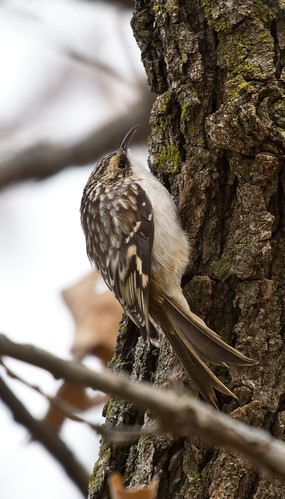
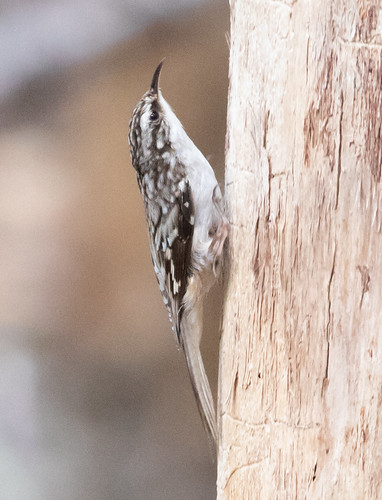
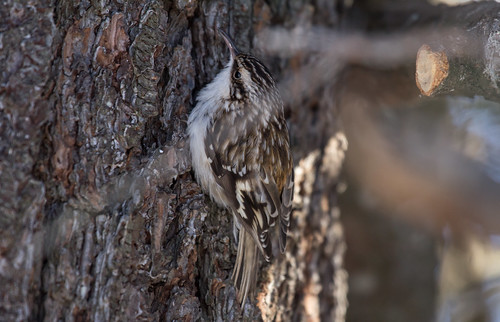
I love to hear from people that my ABA Field Guide to Birds of Minnesota is helpful, but even more, I love Brown Creepers. These tiny birds, the only members of the family Certhiidae in the Americas, are cryptically colored to match tree bark. They have a delicate but long bill, curved downward, and long, stiff, tail feathers that curve downward to brace them against vertical tree trunks. Their toes are slender but strong, the hind toe with a long, strong claw, an additional brace helping the bird hitch its way up tree trunks.

Brown Creeper

I saw my first Brown Creeper on December 16, 1975, at the Morton Arboretum outside Chicago. The next month, on January 30, 1976, I saw my first for my Michigan list at Baker Woodlot on the Michigan State University campus, and by February, according to my field notes, I was recognizing the tiny mites by sound. Their lovely high-pitched sound is beyond my hearing now unless I crank up my hearing aids to eleven and the creeper is very close. Losing the Brown Creeper calls and songs is one of the bitter tragedies of old age, but it’s well offset by the joy of still being alive and able to see these wonderful birds.

Brown Creepers live up to their name, creeping up tree trunks, often in an upward spiral, until they encounter too many branches, when they flutter down to a low spot on another trunk and creep up that one. If they continue up a limb, they gravitate to the underside.

Brown Creeper

Arthur Cleveland Bent put together a wonderful series of books about the life histories of North American birds, and gave Winsor Merritt Tyler the honor of writing the Brown Creeper entry. He opened it with this superb description:
The brown creeper, as he hitches along the bole of a tree, looks like a fragment of detached bark that is defying the law of gravitation by moving upward over the trunk, and as he flies off to another tree he resembles a little dry leaf blown about by the wind. As he climbs up the tree, he is feeding, picking up tiny bits of food that he finds half-hidden in the crevices of bark along his path. In his search, he does not work like the woodpeckers, those skilled mechanics whose work requires the use of carpenter’s tools, the drill and chisel. The creeper’s success depends on painstaking scrutiny, thoroughness, and almost, it seems, consciousness. Edmund Selous (1901), speaking of the European tree-creeper, a bird close to ours in habit, uses the exact word to show us the creeper at work. “His head,” he says, “which is as the sentient handle to a very delicate instrument, is moved with such science, such dentistry, that one feels and appreciates each turn of it.
Creepers seem as earnest and focused as they are sentient, and seem to be as introverted as songbirds could be. Occasionally during migration I spot two or more in the same swath of woodland, and they often hang around near chickadee winter flocks, but they hang out on the periphery of the flock, never in the thick of things, and often when the flock moves on, the creeper lingers. It’s only in their nesting woods that we’re likely to see two near each other, and even then, except when doing their charming courtship flights, they stay focused on their own work, like a couple who may be deeply in love but manage to ignore each other completely for hours at a time as they each work from home during a time of social distancing.

Brown Creeper

Even the most introverted among us fall in love, creepers included. I’ve only seen a courtship flight a handful of times in my life. Winsor Tyler describes it beautifully and accurately:
Once in a while we see a bird launch out from a tree and at top speed twine around it close to the bark, then dart away and twist around another tree, or weave in and out among the surrounding trees and branches. He has thrown off his staid creeper habits and has become for the time a care-free aerial sprite, giving himself up, it seems, to an orgy of speed, wild dashes, and twists and turns in the air. But after a round or two, back on the bark again, he resumes his conventional routine and becomes once more a brown creeper.
Bird observers in the early 1800s claimed the Brown Creeper nests in cavities, but in 1879, Thomas Brewer wrote that the normal nest, as with the European creeper, is built between a tree trunk and a flap of partially detached bark. Sure enough, the next spring, William Brewster used that tip to search trees near Lake Umbagog in Maine and discovered quite a number of nests.

On May 1, 1976, Russ and I went on a Michigan Audubon trip that included a nice long stop at Hartwick Pines State Park, where we saw a Brown Creeper nest. It was the loveliest thing—so exquisitely concealed on the truck of a huge white pine, the hammock-shaped nest woven of bits of bark, fuzzy material such as spider silk, and Usnea lichen wedged where a large piece of bark was jutting out. (Tragically, that was before either of us were taking bird photos.)

Creepers are so quiet and cautious that I’ve never seen a fledgling. Winsor Merritt Tyler wrote of one brood:
At 8 am, two were clinging, 30 feet from the ground, to the trunk of a living white pine tree which stood not far from the nest. One or two more were on another pine trunk. The little birds were extremely difficult to find by reason of their small size, their distance from the ground, their inconspicuous color and especially because each took a station in the dark shadow immediately below a horizontal limb. Here they remained motionless for many minutes. Later, two young birds, one following the other, moved upward by feeble hitches and perched or squatted close to the trunk in the right angle formed by the limb. In hitching over the bark, they moved almost straight upward and whenever I saw them as a silhouette against the sky, and could thus determine the point, they did not use their tail for support. The shortness of the young Creeper’s tails gave to their bodies a rounded, unbird-like outline and, with their short, stubby bills of wide gape and their squatting position on the upright bark they suggested tree-toads in no small degree. Like most young birds after they leave the nest, the fledgling Creepers were more noisy than they’d been the day before. They announced their whereabouts to their parents with a note not previously heard—a high sibilant call, “tssssi” or sometimes clearly divided into two syllables thus: “ts-tssi” The voice was very slightly tremulous and, although the pitch and delivery of the notes were decidedly Creeper-like, they suggested to Mr. Faxon and me a flock of Cedarbirds.
It’s during spring and fall that most of us get to enjoy creepers in our backyards. They’re usually so quiet that you have to pay attention to notice them in the first place. They aren’t all that concerned with our presence, but are tricky to photograph because they blend in so well with the bark. From mid-spring through late fall, I see them just about every time I go to either Twin Falls or Big Pete Road in Port Wing, Wisconsin. I love being able to count on them there, but there’s something special about the ones that I see in my own backyard even when I'm not hunkering down during a pandemic, so I relished the one I saw April 8. I'm thrilled that Polly discovered one of these wonderful birds, too.
Brown Creeper

Tuesday, April 14, 2020

How Wildlife Is Doing During the Shutdown

Common Raven

Now that people are hunkering down almost everywhere, wildlife is feeling the repercussions, mostly for the better, but in the case of some birds who have not just adapted to but capitalize on human presence, sometimes for the worse. Several national and state parks have been providing live cams showing birds and mammals thriving, visiting park sections that are usually too choked with people, and people have been posting photos of coyotes walking right down empty streets in major downtown areas.

The sky over Los Angeles is shockingly clear and beautiful. Even though a bustling economy is obviously a very important thing, I wonder how happy Californians will feel watching that beautiful clean air shift back to the city’s ever-present smog when life gets back to normal, or whether people will insist on a new, cleaner normal. The first time I visited Los Angeles, in 1994, I was shocked at the yucky yellowish brown haze, but my cab driver said it looked ever so much better than it had in the 60s and 70s, before the Clean Air Act was passed and California set stricter requirements for auto emissions than anywhere else in the country. They need such strict standards because of the combination of a huge population, warm climate, and California’s topography, which traps pollution west of the mountains. Even with those strict standards, during the time I spent in California on two visits during my Big Year in 2013 and my visit this past summer, I never saw the kind of clear skies that we take for granted in Minnesota. Some Californians who don’t travel much may be shocked seeing just how blue the sky really is, or at least is supposed to be. The shift for them must be even more dramatic than my own shock at how blue the sky was after I had my cataract surgery.

American Robin

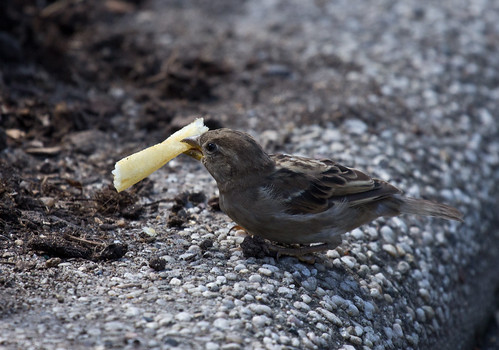
Some urban birds will do just fine—earthworms, insects, and fruit trees will provide all the basic fare robins need. But birds used to picking up dropped food by city dwellers, including gulls, pigeons, House Sparrows, and starlings, may have more trouble getting enough food. 

Central Park Zoo House Sparrow

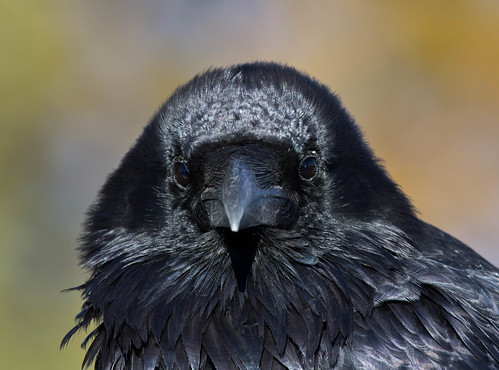
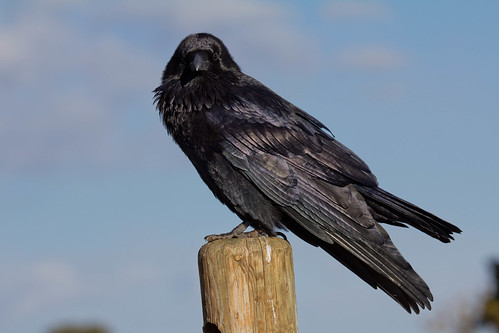
I wonder about the ravens Russ and I saw at the Grand Canyon back in 2011—we watched them open people’s coolers from their truck beds and raid dumpsters. Ravens are of course opportunistic omnivores, so they should be fine, but they’ll probably have to find some new sources of food to make up for the easy pickin’s they’re used to.

Common Raven
This raven was waiting on a post on the edge of the parking lot for a couple to walk away from their truck. The moment they were gone, the raven flew straight for the truck bed to check out lunch. 
Millions of birds and other wildlife are killed by cars every year—this year that number will go down, but it’s the kind of thing only insurance companies keep track of when people make a claim because of car damage or human injury, so we’ll never know how many songbirds, squirrels, porcupines, and other animals lived that would normally have been killed.


I’m trusting that companies with office space in big city high rises that had to shut down temporarily are keeping the office lights out, which may reduce the number of nocturnal migrants attracted by lighted windows to collide with buildings, too.

With reduced traffic, this could have been an ideal year for conducting Breeding Bird Surveys without so many cars roaring through, but of course the Breeding Bird Survey has been discontinued for 2020. This is of course very sad, but every year, several of the volunteers conducting these surveys are injured, and this year any counters injured would risk not just themselves but also first responders and hospital personnel. Also, many routes run through public lands that are currently closed. I’ve been very disturbed reading of some birders entering closed parks and refuges, feeling like somehow their own birding in that place overrides the health and safety of the employees who work there.

I know how disappointing this feels—the two decades when I did my Breeding Bird Survey were SO enjoyable and soul-enriching, filled with auditory and visual pleasures and the satisfaction of contributing to a most important database. This year’s data would have been exceptionally interesting without the noise factor of usual traffic, but that would also have compromised the value of the data in terms of showing year-to-year patterns, because this year is an outlier in so many ways.

Chandler Robbins, who started the Breeding Bird Survey in 1966, was born during the 1918 flu pandemic. I'm sure he’d have been onboard with protecting people by closing down the Survey this year. Important as a consistent Breeding Bird Survey is, during such a severe health crisis, it’s certainly not essential. I’m a little surprised at how vociferously a few birders are speaking out against closing it for the year and talking about doing their routes anyway. We should be coming together as a nation to deal with this crisis, taking serious responsibility for one another, making our sacrifices for the greater good with acceptance if not with joy.

Meanwhile, my favorite story of all regarding how animals are benefitting from us humans giving them some space for a bit comes all the way from Hong Kong, where a pair of Giant Pandas have been living together at the Ocean Park Zoo for 13 years with no sign that they were the least bit interested in mating. Now, with all the human gawkers gone, the pair have started going at it with gusto. Belonging to the same household, they don't need to worry about social distancing from each other, but apparently social distancing from others was more essential than zookeepers realized. When I read the story about them, it instantly called to my mind a song popular when I was in high school ("I Think We're Alone Now), and I couldn't help but smile. When I listen to the news too long and feel my blood pressure rising, I'll think of those two pandas, doing their part to ensure that the world of tomorrow is a joyful one. The very thought of baby pandas makes me very happy.

Laura and Russ and Panda
Russ and me at the National Zoo in D.C. in 2006--we can still stand close together like this, being in the same household. And that is a Giant Panda in the tree behind us. 


Sunday, April 12, 2020

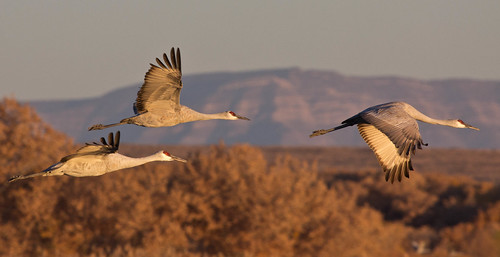
More than You Maybe Wanted to Know about Sandhill Cranes

Sandhill Crane

On April 9, I “attended” a webinar given by the Crane Research Coordinator at the International Crane Foundation, Anne Lacy, an authority on Sandhill Cranes. This was a thrilling experience for me because a long time ago in a galaxy far, far away, Anne was my own student, a charming and studious fourth grader who seemed serious and focused beyond her years. I don’t deserve any credit for Anne’s successful career—she was interested in birds and nature before she ever stepped into my classroom. I’m sure she made a stronger impression on me than I did on her, and so seeing her wonderful webinar was a most satisfying experience for me. 

I’m going to be highlighting some special birds during these dark times. Thanks to Anne’s webinar, I’ve decided to make the Sandhill Crane the first in this series.

In all the world, there are 15 species of cranes, found on every continent except Antarctica and South America. Some are rare and localized, others more widespread. Two species breed in North America: the endangered Whooping Crane and the much more abundant Sandhill Crane. Common Cranes, which breed in northern Europe and Asia, wander fairly regularly to North America, most often mingling with Sandhill Cranes during migration and winter.

One Demoiselle Crane, a species which belongs primarily in Asia and the Middle East and has a rigorous migration over the Himalayas, was documented in October 2001 in San Joaquin County, California. Another, or perhaps the same individual, was photographed in Alaska the following May. And one Hooded Crane, which belongs in Japan, Korea, and China, was reported and photographed mingling with Sandhill Cranes in April 2011 in Nebraska, that December in Tennessee, and in February 2012 in Indiana. Again, this may have been a single wayward individual.

I've seen almost all of the crane species in the world, alive but not in the wild, at the International Crane Foundation, whose co-founder, Ron Sauey, was a good friend of mine. He died tragically over 30 years ago now. I've seen only three species of cranes in the wild—our own Whooping and Sandhill Cranes, and the Gray Crowned-Crane in Uganda.

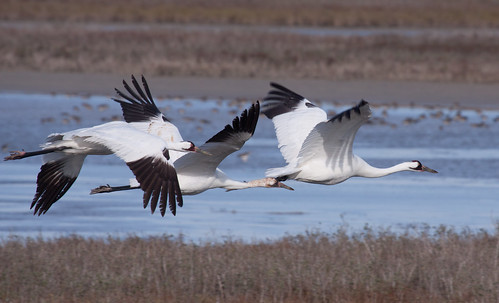
Whooping Crane

Sandhill Crane

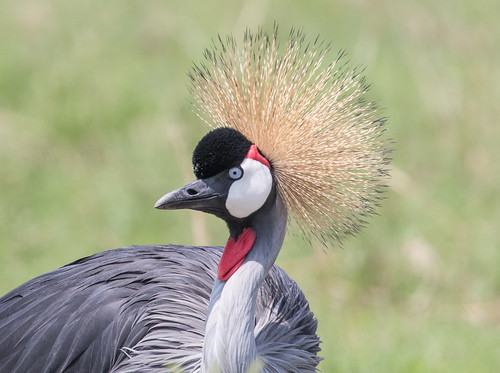
Gray Crowned-Crane

The word crane is from Middle English cran, akin to Old High German krano, and was first used before the 12th century. Cranes are featured in mythology and art of many cultures, so people almost certainly came up with words for these birds very early in human language development. The Sandhill Crane was named for the rolling hills of sand characteristic of parts of its range in the Middle West and Southeast, where the birds were first seen by early ornithologists. Linnaeus gave it the scientific name Grus canadensis in 1758; grus is Latin for crane. But DNA research published in 2010 established that the Sandhill Crane, the White-naped Crane of temperate East Asia, the Brolga of Australia, and the Sarus Crane of India and Southeast Asia belong to an entirely separate clade from other members of Grus. The American Ornithologists placed those four species in a brand-new genus, Antigone, in 2016. So now the Sandhill Crane is Antigone canadensis.

Intriguingly, one population of Sandhill Cranes breeds in northeastern Siberia, crossing back to North America to winter in the Southwest. Common Cranes also breed in that part of Siberia, and the two species occasionally hybridize even though they’re not closely related. Without access to, or indeed any interest in, 23AndMe or ancestry.com, cranes fall in love as they please. That scientifically judged “inappropriate” breeding may have been a factor in scientists choosing the Sandhill Crane’s new genus name—in Greek mythology, Antigone is the name of Oedipus’s daughter/half-sister.

Besides the population of Sandhill Cranes that crosses into Siberia to breed, there are some extraordinary, now regular and increasing, records of Sandhill Cranes spending the non-breeding season in China, South Korea, and Japan. It’s possible that the wayward Hooded Crane mentioned above started associating with Sandhills from this odd wandering group and followed them back to America.

Nonmigratory populations of Sandhills, each belonging to its own subspecies, live year-round in Cuba, Florida, and near the Gulf Coast in Mississippi. The Cuba and Mississippi populations are rare and endangered.

Sandhill Crane

Sandhill Cranes have been recorded flying as high as 13,000 feet as they migrate through the Rocky Mountains. Even over the very flat Platte River area in Nebraska, they can rise extremely high on thermal air currents during their migration. Demoiselle Cranes have been seen flying over Mount Everest, at about 28,000 feet above sea level. When I’ve been in Nebraska in March watching departing flocks circling on thermals, rising higher and higher until even through 10-power binoculars they look like the tiniest pepper specks in the sky and then disappear altogether, I’ve often wondered how high they were.

Sandhill Crane

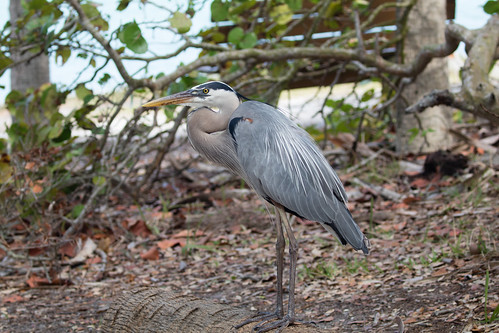
Sandhill Cranes are hefty birds, averaging about 4 feet from tip of beak to tip of tail, about the same length as Great Blue Herons.

Great Blue Heron

Sandhill Cranes have an average wingspan of 6 ½ feet; Great Blues of 6 feet. The crane’s wider wingspan is necessary to support its heavier body—depending on sex and subspecies, Sandhill Cranes weigh between almost 7 pounds and 14 pounds. In comparison, the heaviest Great Blue Herons weigh only about 5 pounds!

How the weight is distributed in a crane’s body compared to a heron’s explains the two species' different flying postures. Sandhill Cranes pick at a wide variety of slow-moving food items, including tubers, fruits, and seeds but also sluggish frogs, large insects, and other invertebrates. Their bill is substantial but needs nowhere near the structural heftiness that herons require to slam their bill into thick-bodied, stiff fish. And because crane food doesn’t move fast, they don’t need the kinds of thick neck muscles that give herons those lightning fast reflexes.

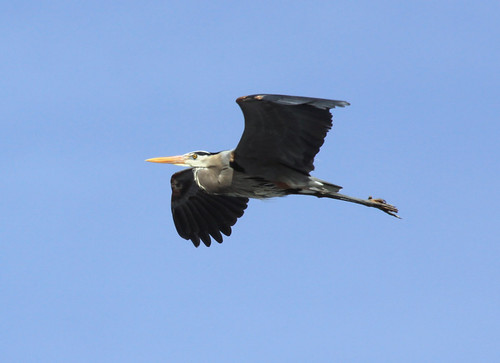
When a heron’s heavy neck and bill are outstretched, much of its weight is forward of its scrawny body. To stay aloft without stalling, herons must pull their head way in to put their center of gravity where it belongs for successful flight.

Great Blue Heron

Cranes have much heavier bodies, and their necks and bills are lighter both absolutely and relatively compared to herons, so they easily fly with their necks outstretched.

Sandhill Cranes

Both cranes and herons typically fly with their legs trailing behind them, but in March 1996, when I was visiting Nebraska when temperatures were well below zero, most of the flying cranes pulled their feet close to their bodies, something I’ve never seen before or since. (That was before I was photographing birds.)

Cranes and herons are different in another important way. Both have four toes—three in front and one behind. But the hind toe on herons is long and strong, allowing them to grasp branches and to nest in trees.
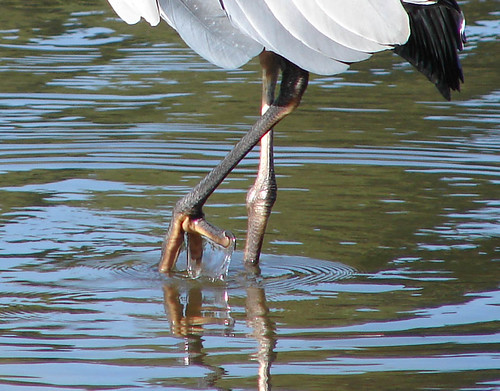
Great Blue Heron hind toe
Great Blue Heron's long hind toe.
"Dad" the Cornell Great Blue Heron
This unusual heron, famous for nesting in Sapsucker Woods at the Cornell Lab of Ornithology, was missing the hind toe on his right foot. It was apparently lost in an accident, but he managed just fine without it.
The hind toe on cranes is both small and elevated. Their footprint shows just the three front toes. Without a hind toe for support, they cannot grasp branches to sit in trees, and so they nest on the ground.

Sandhill Crane foot
I took this photo of a Sandhill Crane foot in the Rowe Audubon Sanctuary. Live cranes do not approve of showing off their feet like this. 
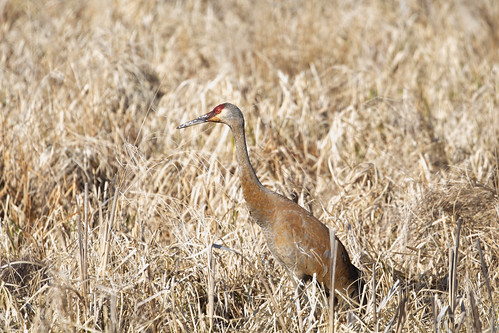
New body feathers for both Sandhill Cranes and Great Blue Herons are a lovely shade of gray, but many Sandhill Cranes look far more rusty brown than gray.

Sandhill Crane

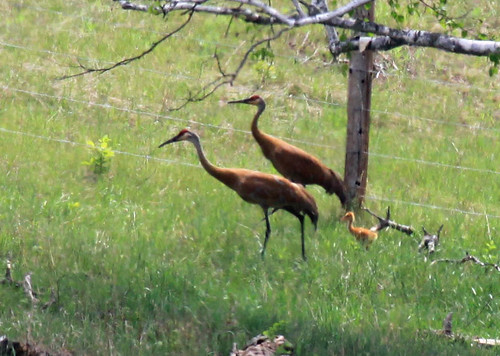
That’s because when they preen, they often smear mud into their feathers, staining them with iron oxide. Researchers have found that captive cranes also stain their feathers, and birds sometimes gather to preen where soils are especially iron-rich. The Common Crane is the only other species in the family that shares this interesting habit. Cranes with this staining are much harder to see both while on the nest and during the flightless period while they raise their chicks. Crane chicks bear rusty-colored down feathers when they hatch, giving them that cryptic coloring automatically.

20100526-SANCRA02.jpg

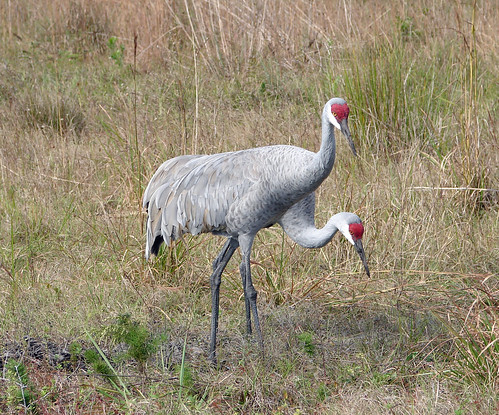
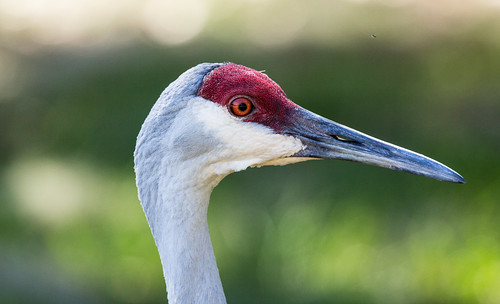
The bold red of the forehead and forward part of the crown is not a plumage color, but is simply bare, bumpy (papillose) skin. Blood rushing to the area intensifies the color during aggressive or sexual displays.

Sandhill Crane

Sandhill Cranes nesting in the northern extreme of their range belong to the subspecies called the “Lesser Sandhill Crane.” They average the smallest, which is opposite what Bergmann’s rule predicts—that the colder the climate, the larger a warm-blooded animal should be, which is true of ravens compared to crows and moose compared to deer. But the size differential in Sandhill Cranes is consistent with the diminutive Ross’s and Cackling Geese of the far north compared to Snow and Canada Geese. Migratory birds at the northern extremes of their ranges have a very short breeding season. Chicks of smaller species can reach full size more quickly, allowing them to migrate with their parents before frigid weather sets in for the year.

Sandhill Cranes underwent dramatic population declines throughout North America during much of the twentieth century, primarily due to habitat loss and development and over-hunting. Fortunately, this species is a generalist; after they were given protection by the Migratory Bird Treaty Act, and then after wetlands started getting more protection with the environmental laws passed in the 1970s, populations of the migratory subspecies started expanding.

Sandhill Cranes were given nongame protection in most states for decades, but now are hunted in at least 16 states. The Minnesota DNR’s nongame wildlife program used to use the Sandhill Crane as an enticement to solicit contributions. When the DNR made the crane a game species in 2010, after making another popular nongame bird, the Mourning Dove, a game species in 2004, they alienated a great many Minnesotans who had generously donated to support nongame wildlife for decades. Indeed, the Sandhill Crane remained the “poster child” for the Northwestern Region’s Nongame Wildlife Program webpage, a large photo of the crane conspicuously serving as the symbol of NONGAME wildlife for years after the DNR opened a hunting season on it in that very region of the state in 2010.

This screen capture was taken in November 2017, a full seven years after the crane was made a game species!!
The number of hunters has gone down steadily in recent decades, which makes it all the more disturbing that a bird like the Sandhill Crane, whose comeback is in large part due to management funded entirely by nongame interests, got appropriated as a game species as soon as its population grew robust, especially because its former rarity was in large part due to overhunting. I’m not an anti-hunter—my big brother was an avid hunter throughout his life—but I can’t wrap my head around the idea of shooting a crane, because it mates for life and most assuredly feels grief when its mate is killed. When I was in Nebraska one spring, I saw a Sandhill Crane with a badly injured wing skulking near our observation blind before disappearing into some thick vegetation. Another crane made several flyovers, calling over and over and clearly searching the water below. It took a couple of hours for it to finally give up. Taking one adult crane out of the population in autumn may essentially remove two for a year or more if the bereft survivor has trouble finding a replacement. Fortunately, so far there is no evidence that cranes are being over-hunted from a population standpoint.

Cranes and other waterfowl are extremely vulnerable to exposure to pesticides, oil and biotoxins, and ingesting lead, plastic, and other objects. But beside habitat loss, their biggest danger from humans is collisions with manmade structures, especially power lines and the guy wires supporting communications towers near crane habitat. Wires are straight-line structures with none of the natural cues birds use to detect and gauge their distance from natural obstructions, like tree branches, in their airspace.

The power lines running along the Platte River in Nebraska have long been known to kill Sandhill Cranes. The Rowe Sanctuary worked with the local power company to retrofit one set of power lines with devices to help the cranes notice the wires. These devices are extremely cheap, and both inexpensive and easy to install when power lines are first constructed; retrofitting is much more expensive, so you’d think power companies would install them as a matter of course whenever putting up new lines, but you would be wrong.

Bird flight diverter

The “bird flight diverters” being put up when I was at the Rowe Sanctuary are nothing more than simple little spirals of wire, but they add a three-dimensional element to those straight line wires, helping birds to notice and gauge their distance from the wires.

Wires with bird flight diverters

Another device, the “Firefly Bird Diverter” (which I don't have a photo of) is a more sophisticated model, consisting of a 3 1/2 by 6-inch heavy-duty plastic card with a special reflective coating that is highly visible to birds. The card hangs from a swivel attached by a clamp to the power line, rotating in winds as light as three to five miles per hour, alerting birds to the obstruction. The coating glows at night for up to ten hours, so it can help prevent nocturnal collisions as well. Sadly, even with either kind of diverter in place, there can be collisions, especially during foggy conditions.

I happened to be visiting the sanctuary in March 1996, which was an exceptionally cold month in Nebraska. Big ice floes on the Platte River made it difficult for the tens of thousands of Sandhill Cranes staging there to alight on the river in the evening. Many didn’t find their way down until well after dark, and even after birds did make it down to roost, floating ice kept coming along, flushing them throughout the night. I was there the morning seventeen cranes were picked up dead under power lines. Only one was found under a power line bearing bird flight diverters; all the rest were killed by unmarked wires.
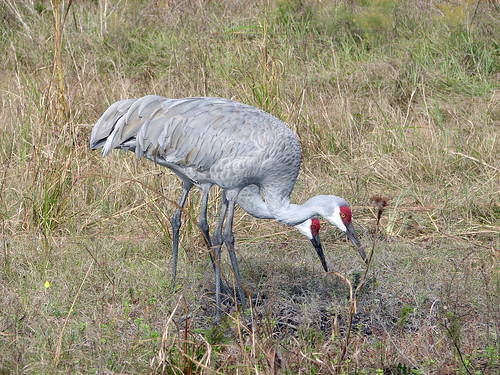
Sandhill Crane

The tens of thousands of cranes we see migrating through Nebraska virtually all belong to populations that breed in the western US and up along the west coast, some crossing to Siberia—those birds virtually never breed in Wisconsin or eastern Minnesota. "Our" cranes winter in the Southeast down to Florida, often stopping en route in Indiana. Some seem to be spending milder winters all the way up in southern Wisconsin now.

Cranes take a while to grow sexually mature. In the Mid-Continent Population, only 20 percent of 4-year-old cranes are likely to be paired, but 90 percent of 7-year-olds are paired. Regardless of age, cranes dance on and off year-round; dancing sometimes spreads throughout a whole flock as if they were in a flash mob or a Dr. Pepper commercial. Pairs form during the winter when huge numbers of cranes are mingling together, and once an attachment is formed, the birds stay together as they migrate north.

By spring, surging hormones set pairs' toes a 'tapping and wings a 'flapping more and more. The more a pair dances, the more they perfect their synchrony, which also helps them synchronize their bodies so the female will be ready to ovulate her two eggs right when the male is producing maximum amounts of sperm.

The exuberance of crane dances surges as they get closer and closer to their nesting area, and starts  culminating in sex. Inexperience may make their first nestings unsuccessful, and crane pairs occasionally "divorce" after losing eggs or chicks, but with age and experience, each pair's success grows.

Both parents develop a brood patch on each side of their sternum, ideal for incubating the normal clutch of two eggs, laid 2 days apart. Both parents divide incubation duties equally during daylight hours, but the female incubates by night as her larger mate guards her. Cranes grow increasingly attentive to their nest and chicks as they themselves mature.

It takes a full month for the eggs to hatch, normally a day apart. Within 8 hours or so of hatching, a "colt" can both walk and swim. If nothing disturbs the parents, they'll keep incubating the remaining egg and caring for the colt near the nest, but predators or human disturbance may make them flee before the second egg hatches.

The female hunkers on the ground to brood the chicks, which sometimes climb on her warm back between her wings and sometimes huddle under her wings. Brooding is fairly constant in cold conditions when the chicks are tiny, but by the time they're three weeks old, they receive very little brooding.

Although the family remains fairly close together, each parent usually stays with one chick. They begin eating when about a day old. The parents feed them bill-to-bill for 10 days or so, but after that the parents are more likely to set the food on the ground, sometimes breaking larger prey into more manageable pieces. The young are capable of getting their own food by the time they're about half grown, but even after that they occasionally beg for food, and sometimes the parents offer food without even being asked. Chicks take their first flights when about 7 weeks old, and are soon strong fliers. But the family remains together through fall migration and the entire winter. It's only around the parents' anniversary that they break away for some alone time. The following fall, when they again associate with other cranes, parents may or may not recognize their young from previous years.

Cranes figure in the art and mythology of many cultures. Their graceful lines and elegant plumage figure especially prominently in Japanese art. One of the especially appealing aspects of cranes, which looms large in how they are depicted culturally, is their lifelong fidelity to their mate. We humans have a tendency to embellish some avian qualities to force them into narrow, anthropocentric and anthropomorphic storylines, but after a pair has successfully raised a chick, their fidelity is not exaggerated.

And befitting their use as a symbol of longevity, cranes really are long-lived. One Siberian Crane, related to our Whooping Crane, lived in the National Zoo in Washington, D.C., for almost 62 years. In the wild, banded Sandhill Cranes have lived over 37 years.

It's not only artists and storytellers who love cranes. Their beauty suffuses the thoughts and writings of even the most objective scientists. Aldo Leopold wrote in his exquisite A Sand County Almanac:
Our appreciation for the crane grows with the slow unraveling of earthly history. His tribe, we now know, stems out of the remote Eocene. The other members of the fauna in which he originated are long since entombed within the hills. When we hear his call, we hear no mere bird. We hear the trumpet in the orchestra of evolution. He is the symbol of our untamable past, of that incredible sweep of millennia which underlies and conditions the daily affairs of birds and men.
Leopold’s essay about the crane, titled “Marshland Elegy,” is about how cranes were disappearing before his very eyes. He concludes:
To build a road is so much simpler than to think of what the country really needs. A roadless marsh is seemingly as worthless to the alphabetical conservationist as an undrained one was to the empire-builders. Solitude, was one natural resource still undowered of alphabets, is so far recognized as valuable only by ornithologists and cranes. Thus, does history, whether of marsh or marketplace, end in paradox. The ultimate value in these marshes is wildness, and the crane is wildness incarnate. But all conservation of wildness is self-defeating, for to cherish we must see and fondle, and when enough have seen and fondled, there is no wilderness left to cherish. Someday, perhaps in the very process of our benefactions, perhaps in the fullness of geological time, the last crane will trumpet his farewell and spiral skyward from the great marsh. High out of the clouds will fall the sound of hunting horns, the baying of the phantom pack, the tinkle of little bells, and then a silence never to be broken, unless perchance in some far pasture of the Milky Way.
Despite the many dangers looming for Sandhill Cranes, their numbers are far, far larger than when Leopold died in 1948, two decades before the Clean Air Act, Clean Water Act, and Endangered Species Act became the law of the land. I wonder if he ever imagined that his words would themselves become a trumpet call to people all over America, sounding a plea to slow down the so-called progress that had led to Los Angeles skies being choked with smog; the Cuyahoga River literally ablaze with toxic, volatile chemicals; Bald Eagles and Peregrine Falcons merely a memory over most of their former range; and a new wonder chemical, DDT, being sprayed over wetlands and residential streets?

Leopold couldn’t have predicted that his beloved Sandhill Cranes would now be thriving, but neither could he have predicted that the moment those landmark laws came into being, forces were already consolidating to eviscerate their enforcement. Most Sandhill Crane populations are doing well right now, in large part thanks to the historical way the US Fish and Wildlife Service enforced the Migratory Bird Treaty Act, penalizing companies that inadvertently kill birds during their operations. The current administration decided to no longer investigate or fine companies that kill cranes colliding with unmarked power lines or being poisoned at oil waste pits, taking away the only financial incentive companies have to avoid killing them. 

The cranes of course don't understand any of this. They'll keep on keeping on as long as they can, filling the hearts of those of us who know them with a joy that could never, ever be measured in money. It's a scurvy villain indeed who could sell off the well-being of these magnificent birds for a few dollars more.

Sandhill Cranes

What Kind of Mother Was I?

My husband and I have been going through old boxes of stuff, and came across this biography of me, written by one of the kids while in 5th or 6th grade.
Interesting Bird Lady 
My mother is a pretty interesting person. She knows a lot about birds and even has her own radio program about them. She thinks life is hopeful and wonderful. She has written two books about birds and is working on a third. She’s in the paper a lot, has been on the news a few times, and has even met Dave Barry once. The only problem is that we have nine birds living in our house, and I hate when I have to clean their cages or feed them all.  
My mother got interested in birds when she was very young. At the age of five, she memorized the whole bird section in the B encyclopedia. Her family didn’t have binoculars or a field guide, which kept her from learning how to birdwatch until she was much older. When she did learn how, she got addicted. She’s also addicted to playing Tetris and writing haikus. Her imitations of the Wicked Witch of the West, characters from Sesame Street, and lots of bird calls are impressive. She is very weird and interesting. 
Northern Flickers
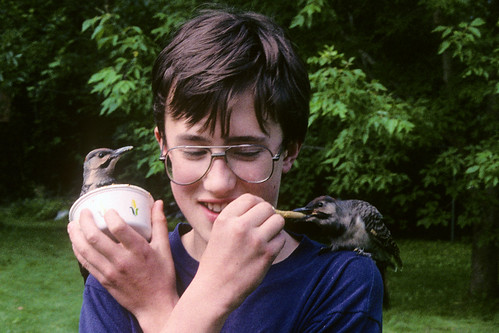
Joe feeding baby flickers
Katie and Pine Siskin
Katie with a baby Pine Siskin
Tom and Gepetto
Tom with a baby Pileated Woodpecker
Mario, Luigi, and Princess
All three of them with Mario, Luigi, and Princess, the baby raccoons. 

Friday, April 10, 2020

The Little Beth of the Bird World

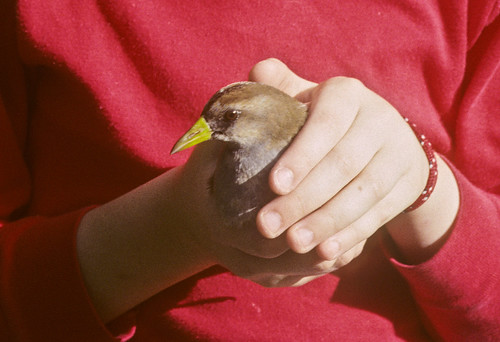
Katie and Sora

In the summer of 1993, I read Louisa May Alcott’s Little Women to my children, and we naturally wanted to know which bird was like which character. We knew right off that Jo was a Blue Jay: noisy, raucous, and perky, with a jolly sense of humor. People considered Jo a tomboy, though she was really just a child more interested in play and excitement than in the opposite sex, just like a young Blue Jay.  

Amy, bright and flighty and bossy, with rather a long nose, seemed exactly like a hummingbird. Meg, pretty and domestic, was a Rose-breasted Grosbeak. But how about shy, retiring Beth? A sparrow might seem the obvious choice, but although their plumage may be unobtrusively plain, sparrows sparkle with life and mischief. Every injured sparrow I’ve handled has resisted me with feisty spirit and even outrage—little unassuming Beth was far meeker than that. Nighthawks are meek and mild, but even they hiss violently when frightened. No, we couldn’t for the life of us figure out what kind of bird adequately represented Beth.

But soon after we finished reading the book, one Saturday, a shy little Beth was delivered right to our door, in the form of a Sora—an adult female who became lost on migration and ended up in a Duluth backyard.

Sora

Soras, who belong in cattail marshes or very wet meadows, have a quiet beauty much like Beth’s. They’re chunky, gray below and brown and black above with lovely white flecks. They have a little pointy stub of a tail which they cock and flick as they skulk in and out of cattails. Their musical call is charming, but like Beth, they prefer performing their music under cover where no one can see them.

Sora

This poor bird must have crash landed—she had two broken legs. Even before I attended to her injuries, within minutes of her arrival, she was taking mealworms and drips of water from my hands, and then quietly and patiently allowed me to splint her legs. When most wild, injured birds act gentle and calm, it’s a sure sign that they’re in shock and close to death, but every Sora I’ve handled has been amazingly trusting and tame no matter what its physical condition. Arthur Cleveland Bent wrote of Soras captured as adults and kept in captivity during the late 1800s and early 1900s, when it was still legal to make wild birds into pets. In all cases, the birds adapted to captive conditions within a few days. I felt an enormous responsibility for this Sora’s care because of the trusting way she looked at me through her bright, confiding eyes. 

Soras have long been hunted as game birds. But even Mr. Bent, an inveterate hunter of birds of all kinds, felt uneasy shooting them. He wrote:
When fattened on the succulent grains of the marshes, its flesh is excellent food. But, to my mind, it is too small, too tame, and too easily killed to afford really good sport, in which the bird should have a sporting chance for its life.
Bent wrote of individual hunters who shot as many as 195 Soras in a few hours. Eventually a bag limit was imposed, but to this day, Soras are legal game. They lay normal clutches of 10 to 12 eggs, and occasionally up to 18, so one would think there’d be an awful lot of them around, but so many of the wetlands they need have been drained or polluted that they’re far rarer than they should be. I saw and heard them far, far more often in the 1970s and 80s than I do now—it’s heartbreaking to go to my favorite marshes, where once I could hear a half-dozen or more as I stood in one spot, and now hear zero. The world could use more of these shy, gentle Beths.

Sora

Monday, April 6, 2020

Camera Fun

Rock Pigeon

Those of us who feel stuck at home right now should be spinning our situations as safe at home. People like me, who can comfortably get by without being scared about money, at least for the duration, are luckiest of all. I do all my writing, photo processing, and radio production at home. Little of that is for pay—most of the money I earn each year comes from my spring speaking gigs, which all were canceled this year, but my own income usually barely covers my travel, camera equipment, and computer costs. I clearly won’t be buying much of anything new this year or going anywhere anyway. I’m reasonably secure, and fully understand and appreciate how lucky that makes me. 

Of course, all that security comes from my husband’s income. He is safely working from home, but he’s not used to that and gets frustrated by all the distractions. My son Joe, who works for Disney, is temporarily working from his apartment in Orlando, but he'll be furloughed at the end of next week. Disney promises to keep the furloughed employees on healthcare and to give them their jobs back when this nightmare is over. Florida is notorious for providing the paltriest unemployment benefits in the nation, and negotiating their system has been a nightmare for Joe as he stays hunkered down. 

Many of the people leaving home to go to work right now are in a much greater nightmare. I think of all the people caring for highly infectious patients with insufficient and sub-par personal protection equipment, the people working in stores, making deliveries, providing police and fire protection, servicing utilities—so many essential people who are so much more vulnerable when the rest of us don’t follow simple social distancing rules.

So although I feel very guilty having the time and equipment to be playing with bird photography when so many people are out of jobs, and when so many of the people who are working are at such a heightened risk of infection, I also feel obligated to do what I can to help other people stuck at home. I’ve been very gratified hearing from radio and podcast listeners who are enjoying their own backyard birds, and from a few homeschooling parents and children with questions about the birds they’re seeing. Right now, we’re all in this together, each of us getting through as best we can. If we can be safe at home, we’re not only protecting ourselves but all the people without that luxury.
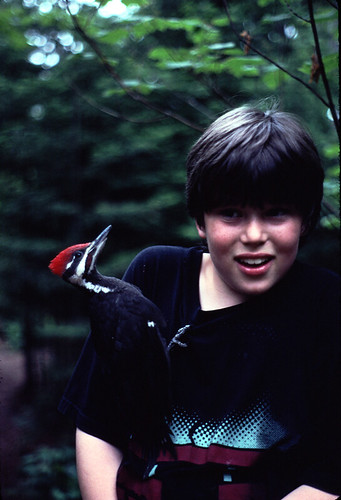
I got a new camera this year that just happened to arrive the day I had my heart attack. Russ brought me to the bog two weeks later for my first outing so I could see the Barn Owl that turned up, and I went on a couple of other birding jaunts before the virus put the kibosh on everything. But with all the junco activity in my yard this weekend, Sunday I decided I might as well learn a new trick, and I hooked up my camera to my computer via wifi. Now I can be writing at my desk treadmill, where I can’t see out the window, and notice on my monitor whenever a bird comes into camera range to click away.

It took me the whole day to figure it out. The default setting sent the photos via the wifi to my computer, hanging up the whole system for well over an hour for just a few shots at a pigeon, and of those, only one turned out. Once I worked it out so the photos stay in the camera, it took me a while to figure out how to focus remotely. And when I was finally starting to get the hang of that, something scared off the birds and they didn’t return for almost an hour. So at the end of the day, I ended up with just one passable pigeon and one passable junco photo, but if I keep playing with it, by the time hummingbirds come back in May, I’ll be able to get flight shots when the birds aren’t seeing me at all. That’s my plan, anyway. I’ll share my progress on my blog.

Let me know how your backyard birding is going. Meanwhile, stay safe and well, dear reader.

Dark-eyed Junco

Junco Migration Kicks In!

Dark-eyed Junco

This winter was the worst for birds in my yard since we moved to Duluth in 1981, and it was even more disappointing for me because of my heart attack on January 3—I couldn't help but wish that I could see birds while stuck at home much of the time. Things didn’t pick up much until last Thursday, April 2, when voila! A dozen juncos materialized out of nowhere.

Dark-eyed Junco

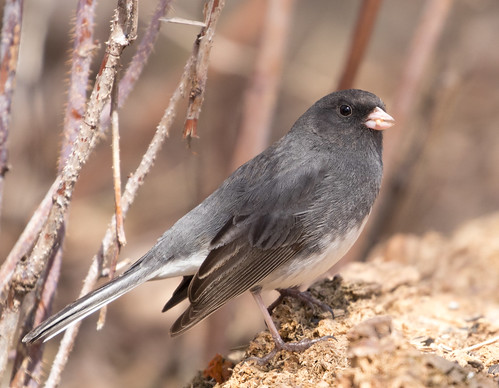
I saw my very first junco on March 21, 1975, in Russ’s parents’ backyard in Chicago when I was a brand-new birder. Something about their beautiful slate-gray plumage with the perfect white tummy and those white tail streamers, so wonderfully distinctive as they fly away, filled my heart with gladness. 

Russ’s mom was shocked that I’d never seen them before—they were of course quite common in spring and fall, so you’d think I’d have at least once noticed one flying off and wondered what it could be, but most of us are blind to most of the things in our everyday lives that we aren’t intentionally conscious of. It’s really the only way we can cope—to notice everything is to be like a baby at a shopping mall, looking every which way with amazement, unable to make sense of any of it because there is simply too much. To survive, by the time we’re toddlers we filter out most of the sensations hitting our eyes and ears, and by the time we’re adults, we filter out all but the very most pertinent sights and sounds. 

Juncos had to have crossed my field of view many times when I was young, but never once crossed my awareness until that March day. But as soon as I became aware of them, they really were everywhere, and the more I looked for them, the more there were. Now, I notice juncos in my everyday life the way other people notice their favorite song when it airs on the radio, or the way a parent notices when their baby starts crying. I can’t help but always be aware when juncos are about.

Dark-eyed Junco

Juncos are among the most soulful of birds, grounded and placid, feeding on the surface of the soil in sedate, well-rooted calm. Males sing from trees, the better for their sweet trills to carry, but come back down to earth for all their other activities. They migrate under cloak of darkness, which is why one day there are none, and the next morning we awaken to bustling activity. Right now, when we’re seeing corona virus cases and deaths increasing at exponential rates, it’s lovely for me to see something wonderful doubling in numbers each day—on Friday, the day after I had 10 or 12, I had about two dozen, and Saturday about 40. Junco numbers will be peaking in a week or so as most of them settle in further north and later migrants start taking over.

To our undiscerning eyes, Juncos don’t seem to be social distancing—they gather in big flocks, each bird contentedly feeding just one or two feet from neighboring birds, but considering that 6 feet is little more than one human body length on average, while 6 inches is the average length of a junco, on their scale, they’re giving each other plenty of room.
We had a serious rat problem on Peabody Street last year, so I was doing a minimum of bird feeding, and only in feeders that weren’t accessible to rodents, but I haven’t seen any rats this winter, so on Thursday I started cautiously spreading white millet on the ground—no more than the juncos can eat during a single day. Duluth’s Wild Birds Unlimited is making free deliveries during the emergency, so I got more white millet on Saturday, along with suet cakes, sunflower, and dried mealworms.

Dark-eyed Junco

On Sunday, I got an email from KUMD listener Colleen, asking me what the best choices of healthy bird seed might be. The single best, especially for use in feeders that squirrels can’t get into, is black oil sunflower. Each seed has more nutrition, in the form of oils and calories, than striped sunflower, and the shell is thinner, requiring less work to open. It’s a favorite of all my seed-eating birds, from woodpeckers to finches. When I’m trying to reserve a feeder for cardinals or grosbeaks, that feeder can be filled with the thicker-shelled striped sunflower, easy for their huge beaks to crack open, but trickier for other species. I use white millet only during sparrow migration in spring and fall, and when there isn’t a rat problem, I mainly scatter it on the ground near shrubs or tangles so the birds can quickly retreat if a hawk flies over. Doves also appreciate white millet on the ground, but my squirrels pretty much ignore it.

Heartwarming and sustaining as backyard bird-feeding is during this crisis, the most important thing is to prevent this horrible virus from spreading. When the new seed was delivered on my porch Saturday, I opened and emptied the delivery box, then re-washed my hands and thoroughly wiped each bag with a disinfecting wipe before bringing it into the house. If you can’t get home delivery and deal with it like that, see if you can get curbside delivery at whatever store you buy it at, and be sure to sanitize the seed packages and your hands before bringing them into your house, garage, or shed. Stay safe and well, dear reader.

Dark-eyed Junco